6- McGraw-Hill/Irwin Copyright © 2009 by The McGraw-Hill Companies, Inc. All rights reserved.
Sales Knowledge: Customers, Products, Technologies Chapter 6
Chapter 6 6-
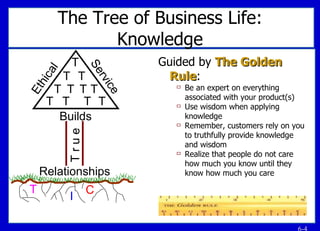
The Tree of Business Life: Knowledge Guided by  The Golden Rule : Be an expert on everything associated with your product(s) Use wisdom when applying knowledge Remember, customers rely on you to truthfully provide knowledge and wisdom Realize that people do not care how much you know until they know how much you care I T C Ethical Service Builds T r u e Relationships T T T T T T T T T T T
Sources of Sales Knowledge Sales training Experience
Knowledge Builds Relationships Knowledge increases a salesperson’s confidence Knowledge increases a buyer’s confidence in salesperson More knowledge leads to more sales and more relationships
Know Your Customers Find out all you can
Know Your Company General Company Information Company growth and accomplishment Policies and procedures Production facilities Service facilities
Know Your Product Product knowledge may include: Performance data Physical size and characteristics How the product operates Specific features, advantages, and benefits of the product How well the product is selling in the marketplace
Know Your Resellers Understand the channel of distribution Know as much about each channel member as possible Likes and dislikes of each channel member’s customers Product lines and the assortment each one carries When each member sees salespeople Distribution, promotion, and pricing policies What quantity of which product each channel member has purchased in the past
Advertising Aids Salespeople Main ingredients of a firm’s promotional effort Types of Advertising Differ National advertising Retail advertising Cooperative, or co-op, advertising Trade advertising Industrial advertising Direct-mail advertising Internet advertising
Why Spend Money on Advertising? Companies advertise because they hope to: Increase overall sales and sales of a specific product Give salespeople additional selling information for sales presentations Develop leads for salespeople through mail-ins and ad response Increase cooperation from channel members through co-op advertising and promotional campaigns Educate the customer about the company’s product
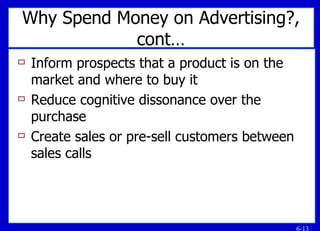
Why Spend Money on Advertising?, cont… Inform prospects that a product is on the market and where to buy it Reduce cognitive dissonance over the purchase Create sales or pre-sell customers between sales calls
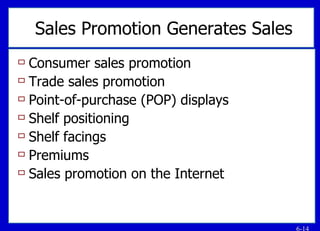
Sales Promotion Generates Sales Consumer sales promotion Trade sales promotion Point-of-purchase (POP) displays Shelf positioning Shelf facings Premiums Sales promotion on the Internet
What’s It Worth? Pricing Your Product Price refers to the value or worth of a product that attracts the buyer to exchange money or something of value for the product
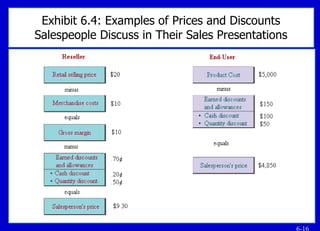
Exhibit 6.4: Examples of Prices and Discounts Salespeople Discuss in Their Sales Presentations
Know Your Competition, Industry, and Economy Understand competitors’ products, policies, and practices
Personal Computers and Selling The top 10 PC applications include: Customer/prospect profile Lead tracking Call reports Sales forecasts Sales data analysis Sales presentation Time/territory management Order entry Travel and expense reports Checking inventory/shipping status
Technology Etiquette Netiquette – etiquette on the internet Cell Phones Texting Instant Messaging Email Speakerphones and Conference Calls
Price Sheets Prices List Price—standard price Net Price—w/discounts Zone Price FOB Shipping Price FOB Destination
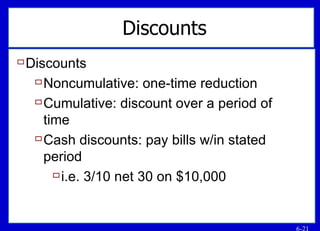
Discounts Discounts Noncumulative: one-time reduction Cumulative: discount over a period of time Cash discounts: pay bills w/in stated period  i.e. 3/10 net 30 on $10,000
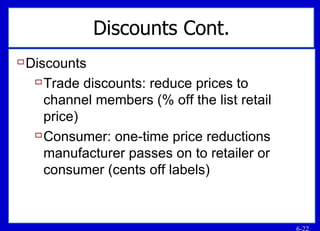
Discounts Cont. Discounts Trade discounts: reduce prices to channel members (% off the list retail price) Consumer: one-time price reductions manufacturer passes on to retailer or consumer (cents off labels)
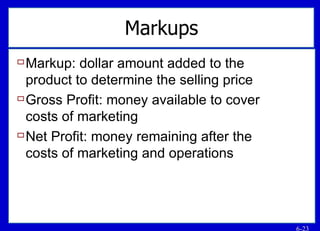
Markups Markup: dollar amount added to the product to determine the selling price Gross Profit: money available to cover costs of marketing Net Profit: money remaining after the costs of marketing and operations
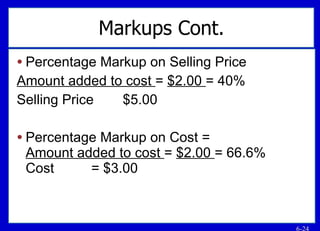
Markups Cont. Percentage Markup on Selling Price Amount added to cost  =  $2.00  = 40% Selling Price   $5.00 Percentage Markup on Cost = Amount added to cost  =  $2.00  = 66.6% Cost   = $3.00
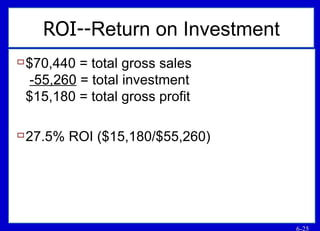
ROI-- Return on Investment $70,440 = total gross sales   -55,260  = total investment $15,180 = total gross profit 27.5% ROI ($15,180/$55,260)
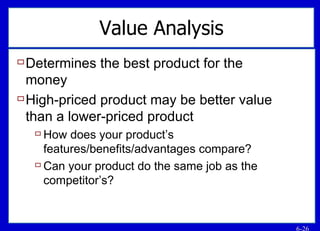
Value Analysis Determines the best product for the money High-priced product may be better value than a lower-priced product How does your product’s features/benefits/advantages compare? Can your product do the same job as the competitor’s?
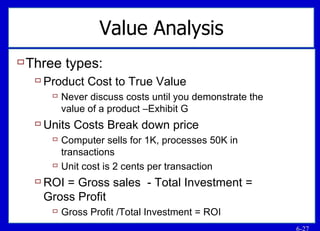
Value Analysis Three types: Product Cost to True Value Never discuss costs until you demonstrate the value of a product –Exhibit G Units Costs Break down price Computer sells for 1K, processes 50K in transactions Unit cost is 2 cents per transaction ROI = Gross sales  - Total Investment = Gross Profit Gross Profit /Total Investment = ROI
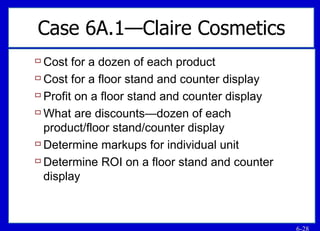
Case 6A.1—Claire Cosmetics Cost for a dozen of each product Cost for a floor stand and counter display Profit on a floor stand and counter display What are discounts—dozen of each product/floor stand/counter display Determine markups for individual unit Determine ROI on a floor stand and counter display
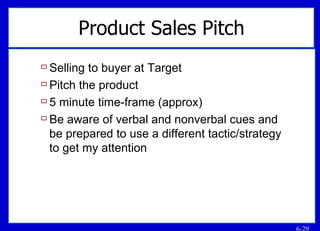
Product Sales Pitch Selling to buyer at Target Pitch the product 5 minute time-frame (approx) Be aware of verbal and nonverbal cues and be prepared to use a different tactic/strategy to get my attention
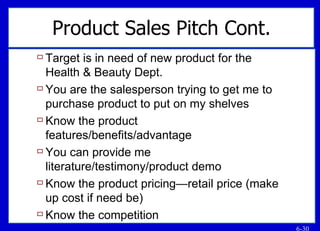
Product Sales Pitch Cont. Target is in need of new product for the Health & Beauty Dept. You are the salesperson trying to get me to purchase product to put on my shelves Know the product features/benefits/advantage You can provide me literature/testimony/product demo Know the product pricing—retail price (make up cost if need be) Know the competition
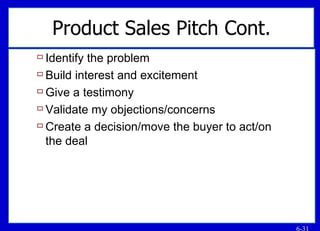
Product Sales Pitch Cont. Identify the problem Build interest and excitement Give a testimony Validate my objections/concerns Create a decision/move the buyer to act/on the deal

Chp 6 sales knowledge ppt

  • 1.
    6- McGraw-Hill/Irwin Copyright© 2009 by The McGraw-Hill Companies, Inc. All rights reserved.
  • 2.
    Sales Knowledge: Customers,Products, Technologies Chapter 6
  • 3.
  • 4.
    The Tree ofBusiness Life: Knowledge Guided by The Golden Rule : Be an expert on everything associated with your product(s) Use wisdom when applying knowledge Remember, customers rely on you to truthfully provide knowledge and wisdom Realize that people do not care how much you know until they know how much you care I T C Ethical Service Builds T r u e Relationships T T T T T T T T T T T
  • 5.
    Sources of SalesKnowledge Sales training Experience
  • 6.
    Knowledge Builds RelationshipsKnowledge increases a salesperson’s confidence Knowledge increases a buyer’s confidence in salesperson More knowledge leads to more sales and more relationships
  • 7.
    Know Your CustomersFind out all you can
  • 8.
    Know Your CompanyGeneral Company Information Company growth and accomplishment Policies and procedures Production facilities Service facilities
  • 9.
    Know Your ProductProduct knowledge may include: Performance data Physical size and characteristics How the product operates Specific features, advantages, and benefits of the product How well the product is selling in the marketplace
  • 10.
    Know Your ResellersUnderstand the channel of distribution Know as much about each channel member as possible Likes and dislikes of each channel member’s customers Product lines and the assortment each one carries When each member sees salespeople Distribution, promotion, and pricing policies What quantity of which product each channel member has purchased in the past
  • 11.
    Advertising Aids SalespeopleMain ingredients of a firm’s promotional effort Types of Advertising Differ National advertising Retail advertising Cooperative, or co-op, advertising Trade advertising Industrial advertising Direct-mail advertising Internet advertising
  • 12.
    Why Spend Moneyon Advertising? Companies advertise because they hope to: Increase overall sales and sales of a specific product Give salespeople additional selling information for sales presentations Develop leads for salespeople through mail-ins and ad response Increase cooperation from channel members through co-op advertising and promotional campaigns Educate the customer about the company’s product
  • 13.
    Why Spend Moneyon Advertising?, cont… Inform prospects that a product is on the market and where to buy it Reduce cognitive dissonance over the purchase Create sales or pre-sell customers between sales calls
  • 14.
    Sales Promotion GeneratesSales Consumer sales promotion Trade sales promotion Point-of-purchase (POP) displays Shelf positioning Shelf facings Premiums Sales promotion on the Internet
  • 15.
    What’s It Worth?Pricing Your Product Price refers to the value or worth of a product that attracts the buyer to exchange money or something of value for the product
  • 16.
    Exhibit 6.4: Examplesof Prices and Discounts Salespeople Discuss in Their Sales Presentations
  • 17.
    Know Your Competition,Industry, and Economy Understand competitors’ products, policies, and practices
  • 18.
    Personal Computers andSelling The top 10 PC applications include: Customer/prospect profile Lead tracking Call reports Sales forecasts Sales data analysis Sales presentation Time/territory management Order entry Travel and expense reports Checking inventory/shipping status
  • 19.
    Technology Etiquette Netiquette– etiquette on the internet Cell Phones Texting Instant Messaging Email Speakerphones and Conference Calls
  • 20.
    Price Sheets PricesList Price—standard price Net Price—w/discounts Zone Price FOB Shipping Price FOB Destination
  • 21.
    Discounts Discounts Noncumulative:one-time reduction Cumulative: discount over a period of time Cash discounts: pay bills w/in stated period i.e. 3/10 net 30 on $10,000
  • 22.
    Discounts Cont. DiscountsTrade discounts: reduce prices to channel members (% off the list retail price) Consumer: one-time price reductions manufacturer passes on to retailer or consumer (cents off labels)
  • 23.
    Markups Markup: dollaramount added to the product to determine the selling price Gross Profit: money available to cover costs of marketing Net Profit: money remaining after the costs of marketing and operations
  • 24.
    Markups Cont. PercentageMarkup on Selling Price Amount added to cost = $2.00 = 40% Selling Price $5.00 Percentage Markup on Cost = Amount added to cost = $2.00 = 66.6% Cost = $3.00
  • 25.
    ROI-- Return onInvestment $70,440 = total gross sales -55,260 = total investment $15,180 = total gross profit 27.5% ROI ($15,180/$55,260)
  • 26.
    Value Analysis Determinesthe best product for the money High-priced product may be better value than a lower-priced product How does your product’s features/benefits/advantages compare? Can your product do the same job as the competitor’s?
  • 27.
    Value Analysis Threetypes: Product Cost to True Value Never discuss costs until you demonstrate the value of a product –Exhibit G Units Costs Break down price Computer sells for 1K, processes 50K in transactions Unit cost is 2 cents per transaction ROI = Gross sales - Total Investment = Gross Profit Gross Profit /Total Investment = ROI
  • 28.
    Case 6A.1—Claire CosmeticsCost for a dozen of each product Cost for a floor stand and counter display Profit on a floor stand and counter display What are discounts—dozen of each product/floor stand/counter display Determine markups for individual unit Determine ROI on a floor stand and counter display
  • 29.
    Product Sales PitchSelling to buyer at Target Pitch the product 5 minute time-frame (approx) Be aware of verbal and nonverbal cues and be prepared to use a different tactic/strategy to get my attention
  • 30.
    Product Sales PitchCont. Target is in need of new product for the Health & Beauty Dept. You are the salesperson trying to get me to purchase product to put on my shelves Know the product features/benefits/advantage You can provide me literature/testimony/product demo Know the product pricing—retail price (make up cost if need be) Know the competition
  • 31.
    Product Sales PitchCont. Identify the problem Build interest and excitement Give a testimony Validate my objections/concerns Create a decision/move the buyer to act/on the deal