15 Strategies/Skills to Be a More
 Effective Salesperson/Lender
     (plus 6 Core Concepts)
            By Yuri Piltser
          February 7th, 2006
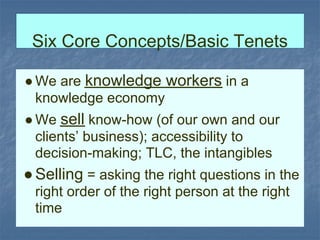
Six Core Concepts/Basic Tenets

â—Ź We are knowledge workers in a
  knowledge economy
â—Ź We sell know-how (of our own and our
  clients’ business); accessibility to
  decision-making; TLC, the intangibles
â—Ź Selling = asking the right questions in the
 right order of the right person at the right
 time
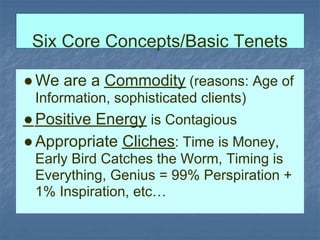
Six Core Concepts/Basic Tenets

â—Ź We are a Commodity (reasons: Age of
 Information, sophisticated clients)
â—Ź Positive Energy is Contagious
â—Ź Appropriate Cliches: Time is Money,
 Early Bird Catches the Worm, Timing is
 Everything, Genius = 99% Perspiration +
 1% Inspiration, etc…
Strategy #1 Watched Phone (almost)
Never Rings

 â—Ź Call your prospects/contacts; always keep in touch
   (timing is everything!)

 ● Call your clients’ CPA’s/attorneys; be in the “loop”

 â—Ź Call your clients/prospects without a specific reason

 ● “Dirty little” secret of most people: 90% of the time
   they love getting your calls! (key reasons: ego,
   pride, feeling that they matter); for the other 10%, a
   key question: “Is this a good time?”
#2 Always Ask for
         Business!

● Always think “New Business”; Be confident of our
  Delivery and Execution; accentuate the positive!
● “I’d like to prepare a Term Sheet for a Line of Credit
  for your company”
● “Can we take a look at that real estate transaction?”
● “If you need factoring – we have that product”
● “If you plan to lease office equipment – we can help
  with financing”
● Of another Bank: “Are you looking for another
  participant for this line of credit?” and so on…
#3 Always Ask a Killer
  Question (or two, three…)
● “Know anybody who may be looking for a bank?”
● “Are you happy with your bank?”
● Of a CPA: “Is your client happy with his bank?”
● “ Which companies in your industry, in your
  opinion, may be good prospects for us?”
● “In your banking situation, if there’s one thing you
  could change – what would it be?”
● Bottom Line: Find out their “Hot Buttons”/”Pain
  Points”; once you know them, you may then be
  able to address them
# 4 Go Ahead, Brag a Little      (not too much)!

â—Ź Discuss our credit-friendly and customer-friendly
  culture
â—Ź Our Big Fish/Small Pond environment
â—Ź Access to senior/executive management
â—Ź Quick, common sense underwriting process
â—Ź Our having been IDB Bank for over 40 years;
  Absence of constant upheavals/employee
  turnover
â—Ź Our being small which allows for a quicker
  decision-making
● Show Energy/Passion! (It’s contagious)
#5 Underpromise. Overperform.
 â—Ź Keep your word; try to promise only what you know you can
   deliver; Credibility/Integrity are at stake

 â—Ź Follow up and Follow through; Be persistent & assertive
   without being pushy & obnoxious

 ● Manage your prospect/client’s expectations

 ● Adhere to a “Sunset Rule” for phone messages

 ● Don’t keep them guessing – keep them involved and in the
   know

 ● Make them feel as if they’re your only Client/Prospect!
#6 Show Them Some “Love”
 ● Prospects want to be wanted and TLC’d
 â—Ź Bond with your prospects and listen to them; align your
   interests with their interest; be their friend
 â—Ź When you lose a deal, be gracious in defeat (and keep on
   following up)
 â—Ź Do something unusual (e.g. photos from a trip, clipping from a
   newspaper, etc.)
 â—Ź Bring them to 511 Fifth Ave. to introduce them to our executive
   management
 ● Main Idea: “Small is Beautiful”
#7 Be a “Student of the
Game”
â—Ź Know the macroeconomics of our industry;
  be ready to answer questions about the Fed,
  currency fluctuations, interest rates, etc.
● Know the competition – who they are, what
  they offer, how they approach the
  marketplace, who the major players are
● Know our products; become a “Maven”
● “Know their business, know your stuff.”
#8 Be Well Organized/Use Technology

 â—Ź A lot of energy/enthusiasm/time is wasted due
   to not being able to find a name, phone #, etc.
 â—Ź Keep your desk clean (at least try!); file often
 â—Ź Learn to use effectively the software we have (i.
   e. Outlook, Power Point, Excel spreadsheets):
   send e-mails straight from “Contacts”, create
   “smart” databases, import personal information,
   use the Web effectively (e.g. Youvegotcontacts.
   Com), etc.
#9 Get Personal!
● Know your key contacts’ birthdays, hobbies,
  likes/dislikes, kids’
  names/ages/activities/milestones
â—Ź Send cards, e-mails, news clippings,
  greetings, condolences
â—Ź Fact: prospects/clients love to get
  cards/gifts/premiums, etc.
● Basic message: “I’m thinking of you (and not
  only once a year at renewal time!)”
● “You’ve Got Contacts” on the Web is a good
  marketing product
#10 Develop/Nurture Contacts All the
Time

 â—Ź Build a database of all your contacts
 ● Divide them into categories (CPA’s, Lawyers, VIP’s,
   Bankers, etc.)
 â—Ź Keep adding names; always ask for business cards
 ● Attend shows/expos/dinners/events – be visible and
   make the Bank visible
 ● Your contacts will help you get new contacts (“two
   degrees of separation” theory)
 â—Ź Broadcast messages/flyers to many contacts at
   once (ex.: one CPA firm merges with another –
   send congrats to all your contacts at those firms)
#11 Learn to Delegate and
Prioritize
â—Ź Know who to turn to for anything internally (i.e.
  sending letters, opening an account, making a loan,
  trade services, investments, etc.)
â—Ź Set up schedules, tasks and deadlines (use Outlook)
● “Plan your work, work your plan” every morning
● Know the priorities: what’s important and what’s not
#12 Do More Breakfast Meetings

 â—Ź They jump-start the day
 â—Ź Less vulnerable to cancellations
 â—Ź Saves you and your customer/prospect time
 â—Ź Less expensive than lunches
 â—Ź (Lunches work, too!)
# 13 Learn, Develop and Hone Your
Negotiating Skills

 â—Ź Turn customer objections into customer objectives [e.g. lack of
   branches may be turned into a positive development (“stay with
   existing branch!”);]
 ● Anticipate objections and be prepared for them (e.g. “yes, we’re a
   foreign bank – just like HSBC”); always think of our “Value Proposition”
 â—Ź Work on asking the right questions in the right sequence at the right
   time
 â—Ź Use sharp/clever similes, metaphors, analogies (loan covenants are
   merely “road signs” to help us navigate the road or “we’re like airplanes
   – safety first”; “cheapest shirt/doctor” analogy for pricing objections; no
   PG’s are like a “mirage in the desert”, etc.)
 â—Ź Try to resolve most conflicts/objections without involving senior
   management
 â—Ź Read some good books on negotiating
#14 Become a Matchmaker
● “Find me a find, catch me a catch”
â—Ź Add value through your contacts and
 knowledge
â—Ź Think of ways to refer business to others (i.
  e. cross-sell opportunities, referrals to CPA’s)
  – become “relevant”
â—Ź Think of potential synergies between different
  entities in the same industry
â—Ź Know the financial and other players
  (mezzanine financing, equity investors,
#15 Strive to Become a Trusted Advisor

 ● Graduate from 1) “order taker” to 2)
   “relationship manager” to 3) “management
   consultant/potential matchmaker” and,
   finally, to 4) a “trusted advisor”
 â—Ź Earn their trust and become their Advocate
 â—Ź Provide solutions and Add Value
 â—Ź Work on creating a following
 â—Ź Be there for/with them when big events
   occur (sale, purchase, death, new
   generation, etc.)
…and Finally:


Enjoy the Trip!

15 sales techniques to improve the sales process

  • 1.
    15 Strategies/Skills toBe a More Effective Salesperson/Lender (plus 6 Core Concepts) By Yuri Piltser February 7th, 2006
  • 2.
    Six Core Concepts/BasicTenets ● We are knowledge workers in a knowledge economy ● We sell know-how (of our own and our clients’ business); accessibility to decision-making; TLC, the intangibles ● Selling = asking the right questions in the right order of the right person at the right time
  • 3.
    Six Core Concepts/BasicTenets ● We are a Commodity (reasons: Age of Information, sophisticated clients) ● Positive Energy is Contagious ● Appropriate Cliches: Time is Money, Early Bird Catches the Worm, Timing is Everything, Genius = 99% Perspiration + 1% Inspiration, etc…
  • 4.
    Strategy #1 WatchedPhone (almost) Never Rings ● Call your prospects/contacts; always keep in touch (timing is everything!) ● Call your clients’ CPA’s/attorneys; be in the “loop” ● Call your clients/prospects without a specific reason ● “Dirty little” secret of most people: 90% of the time they love getting your calls! (key reasons: ego, pride, feeling that they matter); for the other 10%, a key question: “Is this a good time?”
  • 5.
    #2 Always Askfor Business! ● Always think “New Business”; Be confident of our Delivery and Execution; accentuate the positive! ● “I’d like to prepare a Term Sheet for a Line of Credit for your company” ● “Can we take a look at that real estate transaction?” ● “If you need factoring – we have that product” ● “If you plan to lease office equipment – we can help with financing” ● Of another Bank: “Are you looking for another participant for this line of credit?” and so on…
  • 6.
    #3 Always Aska Killer Question (or two, three…) ● “Know anybody who may be looking for a bank?” ● “Are you happy with your bank?” ● Of a CPA: “Is your client happy with his bank?” ● “ Which companies in your industry, in your opinion, may be good prospects for us?” ● “In your banking situation, if there’s one thing you could change – what would it be?” ● Bottom Line: Find out their “Hot Buttons”/”Pain Points”; once you know them, you may then be able to address them
  • 7.
    # 4 GoAhead, Brag a Little (not too much)! ● Discuss our credit-friendly and customer-friendly culture ● Our Big Fish/Small Pond environment ● Access to senior/executive management ● Quick, common sense underwriting process ● Our having been IDB Bank for over 40 years; Absence of constant upheavals/employee turnover ● Our being small which allows for a quicker decision-making ● Show Energy/Passion! (It’s contagious)
  • 8.
    #5 Underpromise. Overperform. ● Keep your word; try to promise only what you know you can deliver; Credibility/Integrity are at stake ● Follow up and Follow through; Be persistent & assertive without being pushy & obnoxious ● Manage your prospect/client’s expectations ● Adhere to a “Sunset Rule” for phone messages ● Don’t keep them guessing – keep them involved and in the know ● Make them feel as if they’re your only Client/Prospect!
  • 9.
    #6 Show ThemSome “Love” ● Prospects want to be wanted and TLC’d ● Bond with your prospects and listen to them; align your interests with their interest; be their friend ● When you lose a deal, be gracious in defeat (and keep on following up) ● Do something unusual (e.g. photos from a trip, clipping from a newspaper, etc.) ● Bring them to 511 Fifth Ave. to introduce them to our executive management ● Main Idea: “Small is Beautiful”
  • 10.
    #7 Be a“Student of the Game” ● Know the macroeconomics of our industry; be ready to answer questions about the Fed, currency fluctuations, interest rates, etc. ● Know the competition – who they are, what they offer, how they approach the marketplace, who the major players are ● Know our products; become a “Maven” ● “Know their business, know your stuff.”
  • 11.
    #8 Be WellOrganized/Use Technology ● A lot of energy/enthusiasm/time is wasted due to not being able to find a name, phone #, etc. ● Keep your desk clean (at least try!); file often ● Learn to use effectively the software we have (i. e. Outlook, Power Point, Excel spreadsheets): send e-mails straight from “Contacts”, create “smart” databases, import personal information, use the Web effectively (e.g. Youvegotcontacts. Com), etc.
  • 12.
    #9 Get Personal! ●Know your key contacts’ birthdays, hobbies, likes/dislikes, kids’ names/ages/activities/milestones ● Send cards, e-mails, news clippings, greetings, condolences ● Fact: prospects/clients love to get cards/gifts/premiums, etc. ● Basic message: “I’m thinking of you (and not only once a year at renewal time!)” ● “You’ve Got Contacts” on the Web is a good marketing product
  • 13.
    #10 Develop/Nurture ContactsAll the Time ● Build a database of all your contacts ● Divide them into categories (CPA’s, Lawyers, VIP’s, Bankers, etc.) ● Keep adding names; always ask for business cards ● Attend shows/expos/dinners/events – be visible and make the Bank visible ● Your contacts will help you get new contacts (“two degrees of separation” theory) ● Broadcast messages/flyers to many contacts at once (ex.: one CPA firm merges with another – send congrats to all your contacts at those firms)
  • 14.
    #11 Learn toDelegate and Prioritize ● Know who to turn to for anything internally (i.e. sending letters, opening an account, making a loan, trade services, investments, etc.) ● Set up schedules, tasks and deadlines (use Outlook) ● “Plan your work, work your plan” every morning ● Know the priorities: what’s important and what’s not
  • 15.
    #12 Do MoreBreakfast Meetings â—Ź They jump-start the day â—Ź Less vulnerable to cancellations â—Ź Saves you and your customer/prospect time â—Ź Less expensive than lunches â—Ź (Lunches work, too!)
  • 16.
    # 13 Learn,Develop and Hone Your Negotiating Skills ● Turn customer objections into customer objectives [e.g. lack of branches may be turned into a positive development (“stay with existing branch!”);] ● Anticipate objections and be prepared for them (e.g. “yes, we’re a foreign bank – just like HSBC”); always think of our “Value Proposition” ● Work on asking the right questions in the right sequence at the right time ● Use sharp/clever similes, metaphors, analogies (loan covenants are merely “road signs” to help us navigate the road or “we’re like airplanes – safety first”; “cheapest shirt/doctor” analogy for pricing objections; no PG’s are like a “mirage in the desert”, etc.) ● Try to resolve most conflicts/objections without involving senior management ● Read some good books on negotiating
  • 17.
    #14 Become aMatchmaker ● “Find me a find, catch me a catch” ● Add value through your contacts and knowledge ● Think of ways to refer business to others (i. e. cross-sell opportunities, referrals to CPA’s) – become “relevant” ● Think of potential synergies between different entities in the same industry ● Know the financial and other players (mezzanine financing, equity investors,
  • 18.
    #15 Strive toBecome a Trusted Advisor ● Graduate from 1) “order taker” to 2) “relationship manager” to 3) “management consultant/potential matchmaker” and, finally, to 4) a “trusted advisor” ● Earn their trust and become their Advocate ● Provide solutions and Add Value ● Work on creating a following ● Be there for/with them when big events occur (sale, purchase, death, new generation, etc.)
  • 19.