Professional Basic Selling Skills Prepared by : Ahmed Sami المعلومات بالداخل موثوق بها لأنها مراجعه و معتمده من Certified from Pharmacists_coffee magazine
Upon completion of the course, participants will be able to : Understand the meaning of the sales call. Practice sales call planning. Identify buying motives. Practice sales call planning. Implement different approaches and presentation techniques. Transform features into benefits that satisfy partner’s needs. Sharpen questioning techniques. Handle customer’s responses and resistances. Develop various types of closes. Use visual aids. Utilize observation skills. Practice how to sell to a busy customer ( short call ).
Objectives To sharpen the  skills ,  abilities  &  behavior  in selling for participants in order to sell better & improve professionalism .
What is selling? Personal or Impersonal Based on WIN – WIN situation Personal : Face to Face communication. Impersonal : Involve no face to face communication. Act of persuading another person. Process of inducing & assisting. Selling a situation of persuasion
Need / Motive Need Creation or Uncover Need Satisfaction Motive Is what causes people to act
Features / Benefits Specifications of a product or service. Features: Benefits: Value to the customer. Customer always buy Benefits
Buying Motives To buy = To satisfy a need. We know 6 buying motives which are EQUAL IMPORTANCE. To find out buying motives, ASK QUESTIONS. Let customer buy for HIS reasons, not yours!
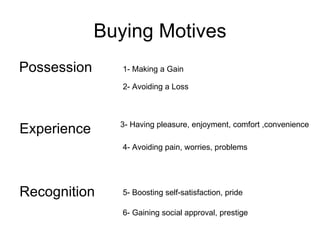
Buying Motives Possession Experience Recognition 1- Making a Gain 2- Avoiding a Loss 3- Having pleasure, enjoyment, comfort ,convenience 4- Avoiding pain, worries, problems 5- Boosting self-satisfaction, pride 6- Gaining social approval, prestige
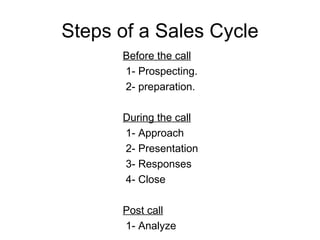
Steps of a Sales Cycle Before the call 1- Prospecting. 2- preparation. During the call 1- Approach 2- Presentation 3- Responses 4- Close Post call 1- Analyze
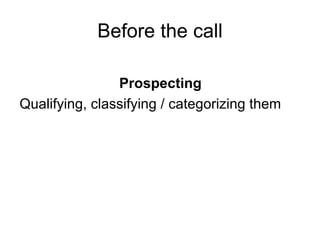
Before the call Prospecting Qualifying, classifying / categorizing them
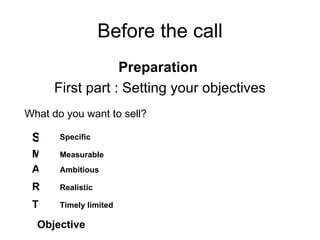
Before the call Preparation  First part : Setting your objectives What do you want to sell? S M A R T Objective Specific Ambitious Measurable Realistic Timely limited
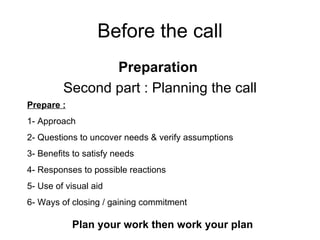
Before the call Preparation  Second part : Planning the call Prepare : 1- Approach 2- Questions to uncover needs & verify assumptions 3- Benefits to satisfy needs 4- Responses to possible reactions 5- Use of visual aid 6- Ways of closing / gaining commitment Plan your work then work your plan
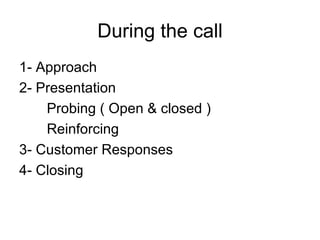
During the call 1- Approach 2- Presentation Probing ( Open & closed ) Reinforcing 3- Customer Responses 4- Closing
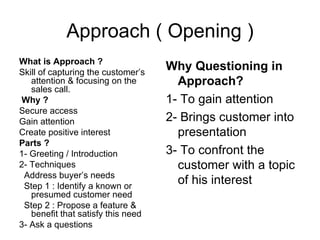
Approach ( Opening ) What is Approach ? Skill of capturing the customer’s attention & focusing on the sales call. Why ? Secure access Gain attention Create positive interest Parts ? 1- Greeting / Introduction 2- Techniques Address buyer’s needs Step 1 : Identify a known or presumed customer need Step 2 : Propose a feature & benefit that satisfy this need 3- Ask a questions Why Questioning in Approach? 1- To gain attention 2- Brings customer into presentation 3- To confront the customer with a topic of his interest
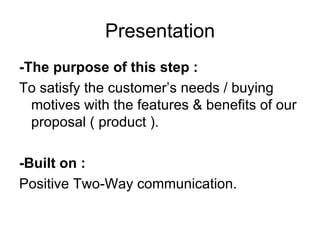
Presentation -The purpose of this step : To satisfy the customer’s needs / buying motives with the features & benefits of our proposal ( product ). -Built on : Positive Two-Way communication.
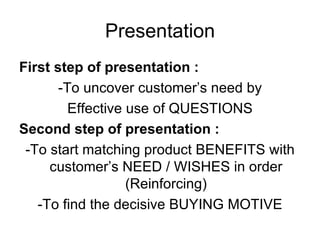
Presentation First step of presentation : -To uncover customer’s need by Effective use of QUESTIONS Second step of presentation : -To start matching product BENEFITS with customer’s NEED / WISHES in order (Reinforcing) -To find the decisive BUYING MOTIVE
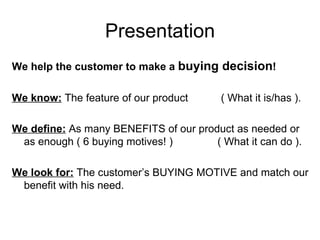
Presentation We help the customer to make a  buying decision ! We know:  The feature of our product  ( What it is/has ). We define:  As many BENEFITS of our product as needed or as enough ( 6 buying motives! )  ( What it can do ). We look for:  The customer’s BUYING MOTIVE and match our benefit with his need.
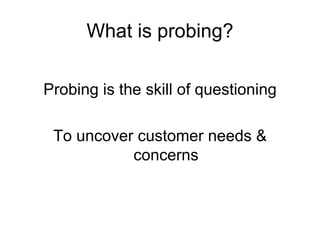
What is probing? Probing is the skill of questioning To uncover customer needs & concerns
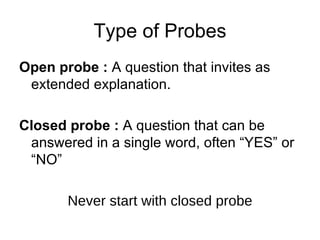
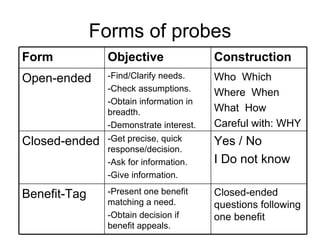
Type of Probes Open probe :  A question that invites as extended explanation. Closed probe :  A question that can be answered in a single word, often “YES” or “NO” Never start with closed probe
Forms of probes Closed-ended questions following one benefit -Present one benefit matching a need. -Obtain decision if benefit appeals. Benefit-Tag Yes / No I Do not know -Get precise, quick response/decision. -Ask for information. -Give information. Closed-ended Who  Which Where  When What  How Careful with: WHY -Find/Clarify needs. -Check assumptions. -Obtain information in breadth. -Demonstrate interest. Open-ended Construction Objective Form
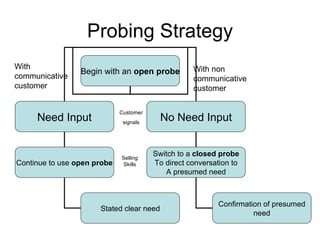
Probing Strategy With communicative customer Customer signals Selling Skills Begin with an  open probe Need Input No Need Input Continue to use  open probe Stated clear need Switch to a  closed probe To direct conversation to A presumed need Confirmation of presumed need With non communicative customer
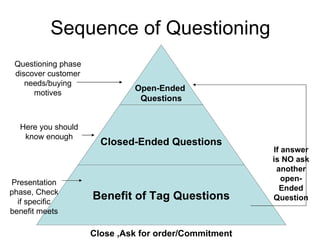
Sequence of Questioning Close ,Ask for order/Commitment If answer is NO ask another open-Ended Question Here you should know enough Questioning phase discover customer needs/buying motives Presentation phase, Check if specific benefit meets Open-Ended  Questions Closed-Ended Questions Benefit of Tag Questions
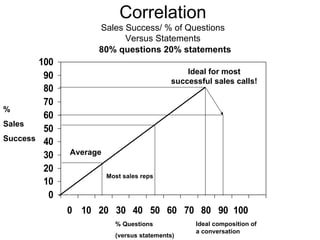
Correlation Sales Success/ % of Questions Versus Statements % Sales Success Average Most sales reps Ideal for most successful sales calls! % Questions (versus statements) Ideal composition of a conversation 80% questions 20% statements
Reinforcing Reinforcing is: The skill of  satisfying  customer needs with product  features & benefits . Reinforcing firmly establishes you as a  problem-solver  and shows the customer  why your product is needed .
Reinforcing What are the signals that tell you when to reinforce? A clear need stated by the customer in his own words. Confirmation by the customer of a presumed need that was first expressed by you in a closed probe.
Reinforcing Steps of Reinforcing : Step 1:  Paraphrase the customer need -Express direct agreement -Restate the customer need Step 2:  Propose a feature and benefit that satisfy this need.
Customer Responses 1- Positive customer responses. 2- Positive / Negative customer responses. 3- Negative responses.
Positive customer responses Prospects voice inflections and positive comments. Seller’s reaction: Praise and show approval for “Nice” comment / answer Examples: I’m very glad you mentioned this. I’m very pleased to hear that.
Positive customer responses B) Statements which show hesitation Using terms or starting statements like: -” I suppose that…” -” I probably should…” -” I hardly believe that…” -” May be…”  -” Perhaps..”  -” It seems...” These statements are not rejections of your proposal. They only express hesitation, doubts ,misgivings ,but are also signs to keep selling; the prospect wants to know more about your product/proposal. Perhaps move on to another benefit. Seller’s reaction: Isolates doubt by questioning, then eliminate it and change to another benefit / advantage.
Positive customer responses C) Prospect continues talking, but makes statements not appealing to you That means he is talking without dissatisfaction. If the prospect is still talking about the product, he has some interest in it. Statements that do not directly state a dislike or a disapproval of your proposal or product, should be considered positive. Seller’s reaction Let the prospect talk, then point out another benefit; might also be an opportunity to close.
Positive customer responses D) Non-verbal customer behavior If he is looking at your visual aid, sample, plan. Keep an eye on body language, whether it expresses rejection, inquisitiveness, approval. He will often signal interest through body language while being verbally skeptical. Or - He makes a verbal positive statement and signals disinterest through body language.
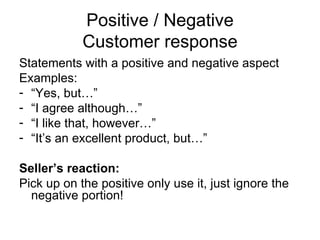
Positive / Negative Customer response Statements with a positive and negative aspect Examples: “ Yes, but…” “ I agree although…” “ I like that, however…” “ It’s an excellent product, but…” Seller’s reaction: Pick up on the positive only use it, just ignore the negative portion!
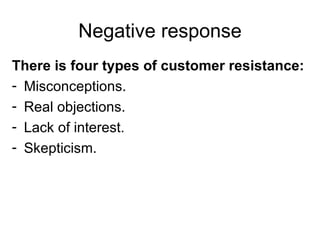
Negative response There is four types of customer resistance: Misconceptions. Real objections. Lack of interest. Skepticism.
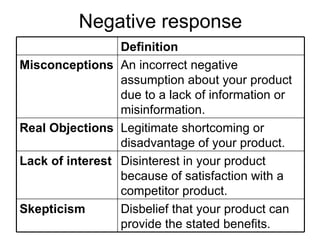
Negative response Disbelief that your product can provide the stated benefits. Skepticism Disinterest in your product because of satisfaction with a competitor product. Lack of interest Legitimate shortcoming or disadvantage of your product. Real Objections An incorrect negative assumption about your product due to a lack of information or misinformation. Misconceptions Definition
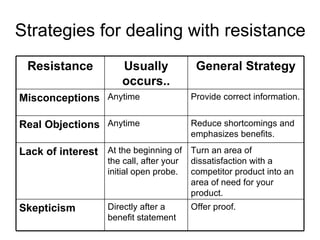
Strategies for dealing with resistance Offer proof. Directly after a benefit statement Skepticism Turn an area of dissatisfaction with a competitor product into an area of need for your product. At the beginning of the call, after your initial open probe. Lack of interest Reduce shortcomings and emphasizes benefits. Anytime Real Objections Provide correct information. Anytime Misconceptions General Strategy Usually occurs.. Resistance
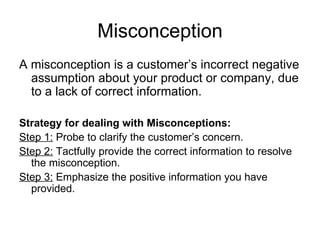
Misconception A misconception is a customer’s incorrect negative assumption about your product or company, due to a lack of correct information. Strategy for dealing with Misconceptions: Step 1:  Probe to clarify the customer’s concern. Step 2:  Tactfully provide the correct information to resolve the misconception. Step 3:  Emphasize the positive information you have provided.
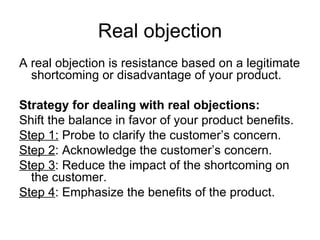
Real objection A real objection is resistance based on a legitimate shortcoming or disadvantage of your product. Strategy for dealing with real objections: Shift the balance in favor of your product benefits. Step 1:  Probe to clarify the customer’s concern. Step 2 : Acknowledge the customer’s concern. Step 3 : Reduce the impact of the shortcoming on the customer. Step 4 : Emphasize the benefits of the product.
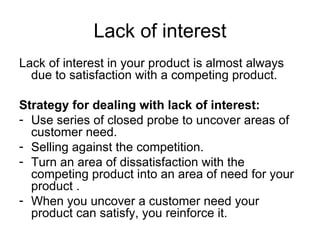
Lack of interest Lack of interest in your product is almost always due to satisfaction with a competing product. Strategy for dealing with lack of interest: Use series of closed probe to uncover areas of customer need. Selling against the competition. Turn an area of dissatisfaction with the competing product into an area of need for your product . When you uncover a customer need your product can satisfy, you reinforce it.
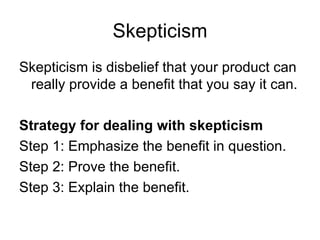
Skepticism Skepticism is disbelief that your product can really provide a benefit that you say it can. Strategy for dealing with skepticism Step 1: Emphasize the benefit in question. Step 2: Prove the benefit. Step 3: Explain the benefit.
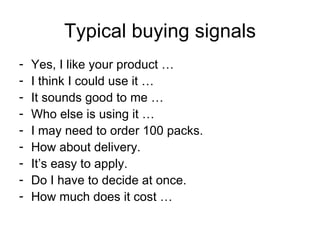
Typical buying signals Yes, I like your product … I think I could use it … It sounds good to me … Who else is using it … I may need to order 100 packs. How about delivery. It’s easy to apply. Do I have to decide at once. How much does it cost …
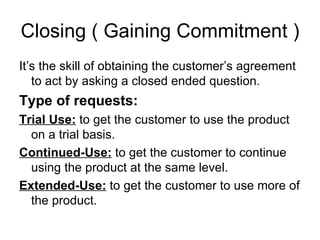
Closing ( Gaining Commitment ) It’s the skill of obtaining the customer’s agreement to act by asking a closed ended question. Type of requests: Trial Use:  to get the customer to use the product on a trial basis. Continued-Use:  to get the customer to continue using the product at the same level. Extended-Use:  to get the customer to use more of the product.
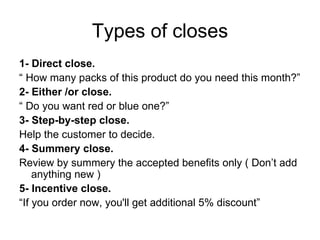
Types of closes 1- Direct close. “  How many packs of this product do you need this month?” 2- Either /or close. “  Do you want red or blue one?” 3- Step-by-step close. Help the customer to decide. 4- Summery close. Review by summery the accepted benefits only ( Don’t add anything new ) 5- Incentive close. “ If you order now, you'll get additional 5% discount”
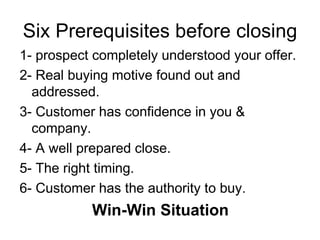
Six Prerequisites before closing 1- prospect completely understood your offer. 2- Real buying motive found out and addressed. 3- Customer has confidence in you & company. 4- A well prepared close. 5- The right timing. 6- Customer has the authority to buy. Win-Win Situation
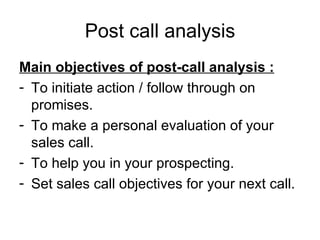
Post call analysis Main objectives of post-call analysis : To initiate action / follow through on promises. To make a personal evaluation of your sales call. To help you in your prospecting. Set sales call objectives for your next call.
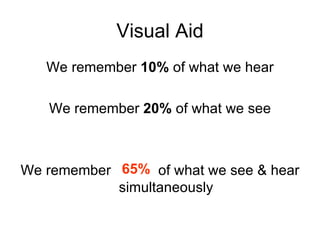
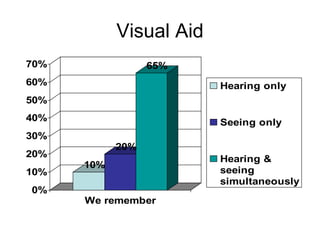
Visual Aid We remember  10%  of what we hear We remember  20%  of what we see We remember  of what we see & hear simultaneously 65%
Visual Aid
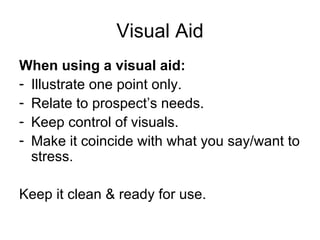
Visual Aid When using a visual aid: Illustrate one point only. Relate to prospect’s needs. Keep control of visuals. Make it coincide with what you say/want to stress. Keep it clean & ready for use.
The Short Call Purpose: To male maximum use of limited time with the customer. Constraints: A time-pressured customer will want information, not conversation.
The Short Call Strategy: 1- Present product features & benefits to meet known or presumed needs; 2- Ask for action as soon as possible; 3- Attempt to expand the length of the call whenever possible.
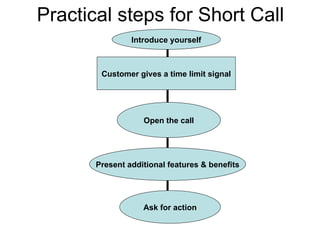
Practical steps for Short Call Introduce yourself Customer gives a time limit signal Open the call Present additional features & benefits Ask for action
Building Rapport Keys to success : Project competence, confidence, interest Methods : Offer service. Be responsive to needs. Fulfill promises promptly. Be courteous and professional.
Bridging What is Bridging? The skill of managing the sales conversation by making a smooth transition between subjects. Principles of Bridging: Avoid abrupt transitions, and bridge smoothly and naturally from one subject to the next.
Putting it all together The 10 Golden Rules of Successful Selling 1- The successful salesperson is not a “Good” or “Fast talker” the opposite is true – he is a good listener. 2- The good salesperson does not sell to “anybody”; he first finds and qualifies the right prospect. 3- The good salesperson does not go into a call “blindfold"; he is carefully prepares the call by setting objectives and planning his strategy. 4- The good salesperson looks for dialogue right from the start and therefore begins with an approach and question. 5- The good salesperson does not present the product or services until he has learnt what the prospect’s needs and buying motives are.
Putting it all together The 10 Golden Rules of Successful Selling 6- The good salesperson presents only those features and benefits of his product or services that relate to the prospect’s needs. 7- If the prospect raises an" objection” the good salesperson does not view it as resistance but rather as an opportunity to respond to the prospect’s needs in more detail. If it is a real concern, he accepts it, deals with real concerns, satisfies the customer’s need, responds by picking up on anything positive. 8- The successful salesperson tries to close whenever he hears a buying signals indicating that the prospect could be ready to buy. 9- The good salesperson knows that the post call review is already the start of the next call. 10- All in all, the professional sales person’s goal is not to sell, but to help his prospect buy and to arrive together with him at a Win-Win situation.

Professional+basic+selling+skills

  • 1.
    Professional Basic SellingSkills Prepared by : Ahmed Sami المعلومات بالداخل موثوق بها لأنها مراجعه و معتمده من Certified from Pharmacists_coffee magazine
  • 2.
    Upon completion ofthe course, participants will be able to : Understand the meaning of the sales call. Practice sales call planning. Identify buying motives. Practice sales call planning. Implement different approaches and presentation techniques. Transform features into benefits that satisfy partner’s needs. Sharpen questioning techniques. Handle customer’s responses and resistances. Develop various types of closes. Use visual aids. Utilize observation skills. Practice how to sell to a busy customer ( short call ).
  • 3.
    Objectives To sharpenthe skills , abilities & behavior in selling for participants in order to sell better & improve professionalism .
  • 4.
    What is selling?Personal or Impersonal Based on WIN – WIN situation Personal : Face to Face communication. Impersonal : Involve no face to face communication. Act of persuading another person. Process of inducing & assisting. Selling a situation of persuasion
  • 5.
    Need / MotiveNeed Creation or Uncover Need Satisfaction Motive Is what causes people to act
  • 6.
    Features / BenefitsSpecifications of a product or service. Features: Benefits: Value to the customer. Customer always buy Benefits
  • 7.
    Buying Motives Tobuy = To satisfy a need. We know 6 buying motives which are EQUAL IMPORTANCE. To find out buying motives, ASK QUESTIONS. Let customer buy for HIS reasons, not yours!
  • 8.
    Buying Motives PossessionExperience Recognition 1- Making a Gain 2- Avoiding a Loss 3- Having pleasure, enjoyment, comfort ,convenience 4- Avoiding pain, worries, problems 5- Boosting self-satisfaction, pride 6- Gaining social approval, prestige
  • 9.
    Steps of aSales Cycle Before the call 1- Prospecting. 2- preparation. During the call 1- Approach 2- Presentation 3- Responses 4- Close Post call 1- Analyze
  • 10.
    Before the callProspecting Qualifying, classifying / categorizing them
  • 11.
    Before the callPreparation First part : Setting your objectives What do you want to sell? S M A R T Objective Specific Ambitious Measurable Realistic Timely limited
  • 12.
    Before the callPreparation Second part : Planning the call Prepare : 1- Approach 2- Questions to uncover needs & verify assumptions 3- Benefits to satisfy needs 4- Responses to possible reactions 5- Use of visual aid 6- Ways of closing / gaining commitment Plan your work then work your plan
  • 13.
    During the call1- Approach 2- Presentation Probing ( Open & closed ) Reinforcing 3- Customer Responses 4- Closing
  • 14.
    Approach ( Opening) What is Approach ? Skill of capturing the customer’s attention & focusing on the sales call. Why ? Secure access Gain attention Create positive interest Parts ? 1- Greeting / Introduction 2- Techniques Address buyer’s needs Step 1 : Identify a known or presumed customer need Step 2 : Propose a feature & benefit that satisfy this need 3- Ask a questions Why Questioning in Approach? 1- To gain attention 2- Brings customer into presentation 3- To confront the customer with a topic of his interest
  • 15.
    Presentation -The purposeof this step : To satisfy the customer’s needs / buying motives with the features & benefits of our proposal ( product ). -Built on : Positive Two-Way communication.
  • 16.
    Presentation First stepof presentation : -To uncover customer’s need by Effective use of QUESTIONS Second step of presentation : -To start matching product BENEFITS with customer’s NEED / WISHES in order (Reinforcing) -To find the decisive BUYING MOTIVE
  • 17.
    Presentation We helpthe customer to make a buying decision ! We know: The feature of our product ( What it is/has ). We define: As many BENEFITS of our product as needed or as enough ( 6 buying motives! ) ( What it can do ). We look for: The customer’s BUYING MOTIVE and match our benefit with his need.
  • 18.
    What is probing?Probing is the skill of questioning To uncover customer needs & concerns
  • 19.
    Type of ProbesOpen probe : A question that invites as extended explanation. Closed probe : A question that can be answered in a single word, often “YES” or “NO” Never start with closed probe
  • 20.
    Forms of probesClosed-ended questions following one benefit -Present one benefit matching a need. -Obtain decision if benefit appeals. Benefit-Tag Yes / No I Do not know -Get precise, quick response/decision. -Ask for information. -Give information. Closed-ended Who Which Where When What How Careful with: WHY -Find/Clarify needs. -Check assumptions. -Obtain information in breadth. -Demonstrate interest. Open-ended Construction Objective Form
  • 21.
    Probing Strategy Withcommunicative customer Customer signals Selling Skills Begin with an open probe Need Input No Need Input Continue to use open probe Stated clear need Switch to a closed probe To direct conversation to A presumed need Confirmation of presumed need With non communicative customer
  • 22.
    Sequence of QuestioningClose ,Ask for order/Commitment If answer is NO ask another open-Ended Question Here you should know enough Questioning phase discover customer needs/buying motives Presentation phase, Check if specific benefit meets Open-Ended Questions Closed-Ended Questions Benefit of Tag Questions
  • 23.
    Correlation Sales Success/% of Questions Versus Statements % Sales Success Average Most sales reps Ideal for most successful sales calls! % Questions (versus statements) Ideal composition of a conversation 80% questions 20% statements
  • 24.
    Reinforcing Reinforcing is:The skill of satisfying customer needs with product features & benefits . Reinforcing firmly establishes you as a problem-solver and shows the customer why your product is needed .
  • 25.
    Reinforcing What arethe signals that tell you when to reinforce? A clear need stated by the customer in his own words. Confirmation by the customer of a presumed need that was first expressed by you in a closed probe.
  • 26.
    Reinforcing Steps ofReinforcing : Step 1: Paraphrase the customer need -Express direct agreement -Restate the customer need Step 2: Propose a feature and benefit that satisfy this need.
  • 27.
    Customer Responses 1-Positive customer responses. 2- Positive / Negative customer responses. 3- Negative responses.
  • 28.
    Positive customer responsesProspects voice inflections and positive comments. Seller’s reaction: Praise and show approval for “Nice” comment / answer Examples: I’m very glad you mentioned this. I’m very pleased to hear that.
  • 29.
    Positive customer responsesB) Statements which show hesitation Using terms or starting statements like: -” I suppose that…” -” I probably should…” -” I hardly believe that…” -” May be…” -” Perhaps..” -” It seems...” These statements are not rejections of your proposal. They only express hesitation, doubts ,misgivings ,but are also signs to keep selling; the prospect wants to know more about your product/proposal. Perhaps move on to another benefit. Seller’s reaction: Isolates doubt by questioning, then eliminate it and change to another benefit / advantage.
  • 30.
    Positive customer responsesC) Prospect continues talking, but makes statements not appealing to you That means he is talking without dissatisfaction. If the prospect is still talking about the product, he has some interest in it. Statements that do not directly state a dislike or a disapproval of your proposal or product, should be considered positive. Seller’s reaction Let the prospect talk, then point out another benefit; might also be an opportunity to close.
  • 31.
    Positive customer responsesD) Non-verbal customer behavior If he is looking at your visual aid, sample, plan. Keep an eye on body language, whether it expresses rejection, inquisitiveness, approval. He will often signal interest through body language while being verbally skeptical. Or - He makes a verbal positive statement and signals disinterest through body language.
  • 32.
    Positive / NegativeCustomer response Statements with a positive and negative aspect Examples: “ Yes, but…” “ I agree although…” “ I like that, however…” “ It’s an excellent product, but…” Seller’s reaction: Pick up on the positive only use it, just ignore the negative portion!
  • 33.
    Negative response Thereis four types of customer resistance: Misconceptions. Real objections. Lack of interest. Skepticism.
  • 34.
    Negative response Disbeliefthat your product can provide the stated benefits. Skepticism Disinterest in your product because of satisfaction with a competitor product. Lack of interest Legitimate shortcoming or disadvantage of your product. Real Objections An incorrect negative assumption about your product due to a lack of information or misinformation. Misconceptions Definition
  • 35.
    Strategies for dealingwith resistance Offer proof. Directly after a benefit statement Skepticism Turn an area of dissatisfaction with a competitor product into an area of need for your product. At the beginning of the call, after your initial open probe. Lack of interest Reduce shortcomings and emphasizes benefits. Anytime Real Objections Provide correct information. Anytime Misconceptions General Strategy Usually occurs.. Resistance
  • 36.
    Misconception A misconceptionis a customer’s incorrect negative assumption about your product or company, due to a lack of correct information. Strategy for dealing with Misconceptions: Step 1: Probe to clarify the customer’s concern. Step 2: Tactfully provide the correct information to resolve the misconception. Step 3: Emphasize the positive information you have provided.
  • 37.
    Real objection Areal objection is resistance based on a legitimate shortcoming or disadvantage of your product. Strategy for dealing with real objections: Shift the balance in favor of your product benefits. Step 1: Probe to clarify the customer’s concern. Step 2 : Acknowledge the customer’s concern. Step 3 : Reduce the impact of the shortcoming on the customer. Step 4 : Emphasize the benefits of the product.
  • 38.
    Lack of interestLack of interest in your product is almost always due to satisfaction with a competing product. Strategy for dealing with lack of interest: Use series of closed probe to uncover areas of customer need. Selling against the competition. Turn an area of dissatisfaction with the competing product into an area of need for your product . When you uncover a customer need your product can satisfy, you reinforce it.
  • 39.
    Skepticism Skepticism isdisbelief that your product can really provide a benefit that you say it can. Strategy for dealing with skepticism Step 1: Emphasize the benefit in question. Step 2: Prove the benefit. Step 3: Explain the benefit.
  • 40.
    Typical buying signalsYes, I like your product … I think I could use it … It sounds good to me … Who else is using it … I may need to order 100 packs. How about delivery. It’s easy to apply. Do I have to decide at once. How much does it cost …
  • 41.
    Closing ( GainingCommitment ) It’s the skill of obtaining the customer’s agreement to act by asking a closed ended question. Type of requests: Trial Use: to get the customer to use the product on a trial basis. Continued-Use: to get the customer to continue using the product at the same level. Extended-Use: to get the customer to use more of the product.
  • 42.
    Types of closes1- Direct close. “ How many packs of this product do you need this month?” 2- Either /or close. “ Do you want red or blue one?” 3- Step-by-step close. Help the customer to decide. 4- Summery close. Review by summery the accepted benefits only ( Don’t add anything new ) 5- Incentive close. “ If you order now, you'll get additional 5% discount”
  • 43.
    Six Prerequisites beforeclosing 1- prospect completely understood your offer. 2- Real buying motive found out and addressed. 3- Customer has confidence in you & company. 4- A well prepared close. 5- The right timing. 6- Customer has the authority to buy. Win-Win Situation
  • 44.
    Post call analysisMain objectives of post-call analysis : To initiate action / follow through on promises. To make a personal evaluation of your sales call. To help you in your prospecting. Set sales call objectives for your next call.
  • 45.
    Visual Aid Weremember 10% of what we hear We remember 20% of what we see We remember of what we see & hear simultaneously 65%
  • 46.
  • 47.
    Visual Aid Whenusing a visual aid: Illustrate one point only. Relate to prospect’s needs. Keep control of visuals. Make it coincide with what you say/want to stress. Keep it clean & ready for use.
  • 48.
    The Short CallPurpose: To male maximum use of limited time with the customer. Constraints: A time-pressured customer will want information, not conversation.
  • 49.
    The Short CallStrategy: 1- Present product features & benefits to meet known or presumed needs; 2- Ask for action as soon as possible; 3- Attempt to expand the length of the call whenever possible.
  • 50.
    Practical steps forShort Call Introduce yourself Customer gives a time limit signal Open the call Present additional features & benefits Ask for action
  • 51.
    Building Rapport Keysto success : Project competence, confidence, interest Methods : Offer service. Be responsive to needs. Fulfill promises promptly. Be courteous and professional.
  • 52.
    Bridging What isBridging? The skill of managing the sales conversation by making a smooth transition between subjects. Principles of Bridging: Avoid abrupt transitions, and bridge smoothly and naturally from one subject to the next.
  • 53.
    Putting it alltogether The 10 Golden Rules of Successful Selling 1- The successful salesperson is not a “Good” or “Fast talker” the opposite is true – he is a good listener. 2- The good salesperson does not sell to “anybody”; he first finds and qualifies the right prospect. 3- The good salesperson does not go into a call “blindfold"; he is carefully prepares the call by setting objectives and planning his strategy. 4- The good salesperson looks for dialogue right from the start and therefore begins with an approach and question. 5- The good salesperson does not present the product or services until he has learnt what the prospect’s needs and buying motives are.
  • 54.
    Putting it alltogether The 10 Golden Rules of Successful Selling 6- The good salesperson presents only those features and benefits of his product or services that relate to the prospect’s needs. 7- If the prospect raises an" objection” the good salesperson does not view it as resistance but rather as an opportunity to respond to the prospect’s needs in more detail. If it is a real concern, he accepts it, deals with real concerns, satisfies the customer’s need, responds by picking up on anything positive. 8- The successful salesperson tries to close whenever he hears a buying signals indicating that the prospect could be ready to buy. 9- The good salesperson knows that the post call review is already the start of the next call. 10- All in all, the professional sales person’s goal is not to sell, but to help his prospect buy and to arrive together with him at a Win-Win situation.