Part III: Planning and Implementing
Brand Marketing Programs
Chapter 4: CHOOSING BRAND ELEMENTS
TO BUILD BRAND EQUITY
Mateeullah Khan
BUITEMS
E-mail: mateeullahkhan@hotmail.com
Strategic Brand Management – Building, Measuring, and Managing Brand
Equity 3rd Edition – Kevin Lane Keller
• Identify the different types of brand elements
• List the general criteria for choosing brand elements
• Describe key tactics in choosing different brand elements
• Explain the rationale for “mixing and matching” brand
elements
• Highlight some of the legal issues surrounding brand elements
Learning Objectives
Preview
• Brand Elements, sometimes called Brand Identities, are those
trademarkable devices that serves to identify and differentiate
the brand.
• The main ones are; Brand Names, URLs, Logos, Symbols,
Characters, Spokespeople, Jingles, Packages, and Signage.
“The Customer-Based Brand Equity model suggests that marketers
should choose brand elements to enhance brand awareness;
facilitate the formation of strong, favorable, and unique brand
association; or elicit positive brand judgements and feelings.”
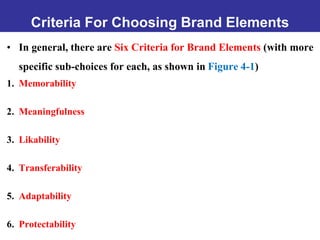
Criteria For Choosing Brand Elements
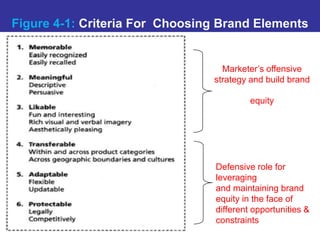
• In general, there are Six Criteria for Brand Elements (with more
specific sub-choices for each, as shown in Figure 4-1)
1. Memorability
2. Meaningfulness
3. Likability
4. Transferability
5. Adaptability
6. Protectability
Figure 4-1: Criteria For Choosing Brand Elements
Marketer’s offensive
strategy and build brand
equity
Defensive role for
leveraging
and maintaining brand
equity in the face of
different opportunities &
constraints
Criteria For Choosing Brand Elements:
1. Memorability
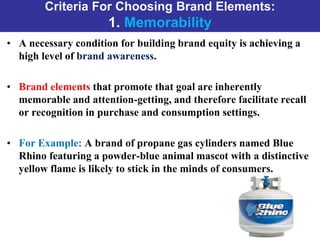
• A necessary condition for building brand equity is achieving a
high level of brand awareness.
• Brand elements that promote that goal are inherently
memorable and attention-getting, and therefore facilitate recall
or recognition in purchase and consumption settings.
• For Example: A brand of propane gas cylinders named Blue
Rhino featuring a powder-blue animal mascot with a distinctive
yellow flame is likely to stick in the minds of consumers.
Criteria For Choosing Brand Elements:
2. Meaningfulness
• Brand Elements may take all kinds of meaning, with either
descriptive or persuasive content.
• Two particularly important criteria are how well the brand
elements conveys the following;
1. General information about the nature of the product
category
• Does the brand element have descriptive meaning and suggest
something about the product category?
• How likely is it that a consumer could correctly identify the product
category for the brand based on any one brand element?
Criteria For Choosing Brand Elements:
2. Meaningfulness
2. Specific information about particular attributes and benefits
of the brand
• Does the brand element have persuasive meaning and
suggest something about the particular kind of product,
or its key attributes or benefits?
• Does it suggest something about a product ingredient or
type of person who might use the brand?
• The first dimension is an important determinant of Brand
Awareness and Salience; the second, of Brand Image and
Positioning.
Criteria For Choosing Brand Elements:
3. Likability
• Do Customers find the Brand Element Aesthetically appealing?
• Is it likable visually, verbally, and in other ways?
• Brand Elements can be rich in imagery and inherently fun and
interesting, even if not always directly related to the product.
• Descriptive and Persuasive elements reduce the burden on
marketing communications to build awareness and link
associations and equity, especially when few other products-
related associations exist.
Criteria For Choosing Brand Elements:
4. Transferability
• Transferability measures the extent to which the Brand
Elements adds to the brand equity of new products for the
brand.
There are several aspects to this criterion;
• First, how useful is the brand element for line or category
extension?
– In general, the less specific the name, the more easily it can be
transferred across categories.
For Example: Amazon connotes a massive South American river
and therefore a brand can be appropriate for a variety of different
types of products, whereas Books “R” Us obviously would not have
afforded the same flexibility.
Criteria For Choosing Brand Elements:
4. Transferability
• Second, To what extent does the brand element add to brand
equity across geographic boundaries and market segments?
– To a large extent this depends on the cultural content and
linguistic qualities of the brand element.
Criteria For Choosing Brand Elements:
5. Adaptability
• The Fifth consideration for Brand elements is their Adaptability
over time.
• Because of changes in Consumer Values and Opinions, or
simply because of a need to remain contemporary, most Brand
Elements must be updated.
• The more Adaptable and Flexible the brand element, the easier
it is to update it to changes in consumer values and opinions.
For Example: logos and characters can be given a new look or a
new design to make them appear more modern and relevant.
Criteria For Choosing Brand Elements:
6. Protectability
• The Sixth and Final general consideration is the extent to which
the Brand Element is Protectable --- both in legal and a
competitive sense.
• Marketers should;
1. Choose brand elements that can be legally protected
internationally.
2. Formally register chosen brand elements with the
appropriate legal bodies.
3. Vigorously defend trademarks from unauthorized
competitive infringement.
– Read and discuss The Science of Branding 4-1 “Counterfeit
Business is Booming”
Criteria For Choosing Brand Elements:
6. Protectability
• Another consideration is whether the brand is competitively
protectable.
– If a name, package, or other attribute is too easily copied,
much of the uniqueness of the brand may disappear.
Options and Tactics for Brand Elements
Consider the Advantages of “APPLE” as the name of a personal
computer. Apple was a simple but well-known word that was distinctive
in the product category --- which helped develop Brand Awareness. The
meaning of the name also gave the company a “friendly shine” and warm
Brand Personality. It could also be reinforced visually with a logo that
would transfer easily across geographical and cultural boundaries.
Finally, the name could serve as a platform for sub-brands like
Macintosh, aiding the introduction of Brand Extensions. As Apple
illustrates, a well-chosen Brand Name can make an appreciable
contribution to the creation of Brand Equity.
Options and Tactics for Brand Elements
• A variety of brand elements can be chosen that
inherently enhance brand awareness or facilitate the
formation of strong, favorable, and unique brand
associations.
1.Brand Names 2. URLs
3.Logos and symbols 4. Characters
5.Slogans 6. Packaging
Options and Tactics for Brand Elements:
BRAND NAMES
• The Brand Name is a fundamentally important choice because it
often captures the central theme or key associations of a product
in a very compact and emotional fashion.
• Brand Names can be extremely effective shorthand means of
communication.
• Because it is so closely tied to the product in the minds of
consumers, however, the Brand Name is also the most difficult
element for marketers to change.
Options and Tactics for Brand Elements:
BRAND NAMES
BRAND NAMING GUIDELINES:
• Selecting a Brand Name for a new product is certainly an art
and a science.
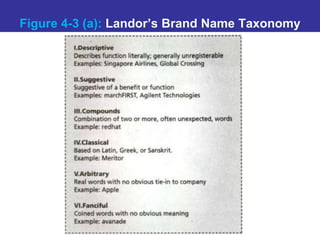
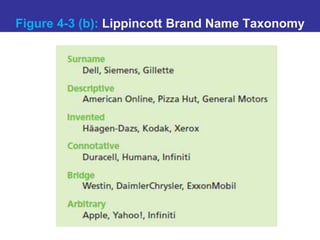
• Figure 4-3 (a)displays different types of possible brand names
according to identity experts Landor Associates and Figure 4-3
(b) displays Lippincot Brand Name Taxonomy.
• Like any brand element, brand names must be chosen with the
six general criteria of memorability, meaningfulness, likability,
transferability, adaptability, and protectability in mind.
• Brand Awareness: Brand Names that are Simple and easy to
pronounce or spell, Familiar and meaningful, and Different,
Figure 4-3 (a): Landor’s Brand Name Taxonomy
Figure 4-3 (b): Lippincott Brand Name Taxonomy
Options and Tactics for Brand Elements:
BRAND NAMES
BRAND NAMING GUIDELINES:
• Brand Awareness:
– Brand Names that are Simple and Easy to
Pronounce or Spell, Familiar and Meaningful,
Different, Distinctive, and Unique can obviously
improve Brand Awareness.
Options and Tactics for Brand Elements:
BRAND NAMES
BRAND NAMING GUIDELINES:
• Brand Associations - “Because the Brand Name is a compact
form of communication, the explicit and implicit meanings
consumers extract from it are important.”
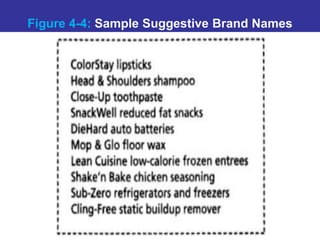
– In particular, the brand name can reinforce an
important attribute or benefit association that makes
up its product positioning. (see Figure 4-4)
– Besides performance-related considerations, Brand
Names can also communicate more abstract
considerations as do names Like Joy dishwashing
liquid, Caress soap, and Obsession perfume
Figure 4-4: Sample Suggestive Brand Names
Options and Tactics for Brand Elements:
BRAND NAMES
BRAND NAMING PROCEDURES:
1.Define Objectives: Define branding objectives in terms of six
general criteria noted earlier, and in particular define the ideal
meaning the brand should convey.
2.Generate Names: With the branding strategy in place, next
generate as many names and concepts as possible. Any potential
sources of names are valid, i.e. company management and
employees, potential customers, ad agencies, etc.
3.Screen Initial Candidates: Screen all the names against the
branding objectives and marketing considerations identified in step
1.
Options and Tactics for Brand Elements:
BRAND NAMES
BRAND NAMING PROCEDURES:
4.Study Candidate Names: Collect more extensive information
about each of the final 5 to 10 names. It is advised to do extensive
international legal search.
5.Research the Final Candidates: Next, conduct consumer research
to confirm management expectations about the memorability and
meaningfulness of the remaining names.
6.Select the Final Name: Based on all the information collected
from the previous step, management should choose the name that
maximizes the firm’s branding and marketing objectives and then
formally register it.
Options and Tactics for Brand Elements:
URLs
• URLs (Uniform Resource Locators) specify locations of pages on
Web and are also commonly referred to as domain names.
• Anyone wishing to own a specific URL must register and pay for
the name with a service such as Register.com
• An issue facing companies with regard to URLs is protecting
their brands from unauthorized use in other domain names.
• A company can either sue the current owner of the URL for
copyright infringement, buy the name from the current owner,
or register all conceivable variations of its brand as domain
names ahead of time.
Options and Tactics for Brand Elements:
LOGOS and SYMBOLS
• Brand Name typically is the central element of the brand, Visual
Elements typically also play a critical role in building Brand
Equity and especially Brand Awareness.
• Logos have a long history as a means to indicate origin,
ownership, or association.
• Logos range from corporate names or trademarks (word marks
with text only) written in a distinctive form, to entirely abstract
designs that may be completely unrelated to the word mark,
Options and Tactics for Brand Elements:
LOGOS and SYMBOLS
• Examples of Brands with strong word marks and no accompanying
logo separate from name include Coca-Cola, Kit Kat, Dunhill, etc.
• Examples of Abstract Logos include the Mercedes Star, Rolex Crown,
Nike Swoosh, etc.
– These Non-Word mark logos are also often called Symbols.
• Like Names, Abstract logos can be quite distinctive and thus
recognizable.
• In updating logos, marketers should make gradual changes and not
lose sight of the inherent advantages of the logo.
Options and Tactics for Brand Elements:
LOGOS and SYMBOLS
Benefits of Logos and Symbols:
1.Logos and symbols are often easily recognized and can be a
valuable way to identify products.
2.Another branding advantage of logos is their Versatility. Because
they are non-verbal, logos transfer well across cultures and over
range of products.
3.Abstract logos offer advantages when the full brand name is
difficult to use for any reason.
4.Finally, unlike brand names, logos can be easily adapted over
time to achieve a more contemporary look.
Options and Tactics for Brand Elements:
CHARACTERS
• Characters represent a special type of Brand Symbol – one that
takes human or real-life characteristics.
• Brand Characters typically are introduced through advertising
and can play a central role in ad campaigns and package
designs.
• Some Characters are animated, like Peter Pan peanut butter’s
character, and others are live-action figures like Ronald
McDonald.
Options and Tactics for Brand Elements:
CHARACTERS
Benefits of Characters:
• Because they are often colorful and rich in imagery, Brand Characters
tend to be attention getting and quite useful for creating Brand
Awareness.
• Brand Characters can help brands break through marketplace clutter
as well as help to communicate a key product benefit.
• The human element of Brand Characters can enhance Likeability and
help to create perception of brand as fun and interesting.
• Finally, because Brand Characters do not typically have direct
product meaning, they may also be transferred relatively easily across
product categories.
Options and Tactics for Brand Elements:
CHARACTERS
CAUTIONS & DRAWBACKS TO USING CHARACTERS:
• Brand Characters can be so attention getting and well liked that they
dominate other brand elements and actually Dampen Brand
Awareness.
• Characters often must be updated over time so that their image and
personality remain relevant to the target market.
• Finally, some characters are so culturally specific that they do not
travel well to other countries.
• The Science of Branding 4-2 describes some guidelines from a leading
consultant.
Options and Tactics for Brand Elements:
SLOGANS
• Slogans are short phrases that communicate descriptive or
persuasive information about the brand.
• They often appear in advertising but can play an important role
on packaging and in other aspects of the marketing program.
• Slogans are powerful branding devices because, like brand
names, they are an extremely efficient, shorthand means to build
Brand Equity.
• They can function as useful “hooks” or “handles” to help
consumers grasp the meaning of a brand – what it is and what
make it special.
Options and Tactics for Brand Elements:
SLOGANS
BENEFITS OF SLOGANS:
• Some Slogans help to build brand awareness by playing off the brand name in
some ways.
• Others build brand awareness even more explicitly by making strong links
between the brand and the corresponding product category.
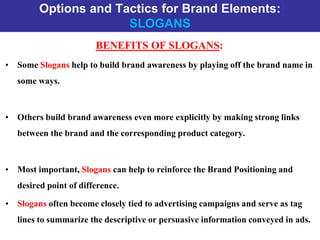
• Most important, Slogans can help to reinforce the Brand Positioning and
desired point of difference.
• Slogans often become closely tied to advertising campaigns and serve as tag
lines to summarize the descriptive or persuasive information conveyed in ads.
Options and Tactics for Brand Elements:
SLOGANS
DESIGNING SLOGANS:
•Some of the most powerful Slogans contribute to Brand Equity in multiple
ways;
1.They can play off the Brand Name to build both Awareness and Image. E.G.
“The Big Q stands for Quality” For Quaker State Motor Oil.
2.Slogans also can contain Product-Related and Other Meanings. E.G.
Champions Sportswear Slogan “ It takes a little More to Make a Champion”
Options and Tactics for Brand Elements:
SLOGANS
UPDATING SLOGANS:
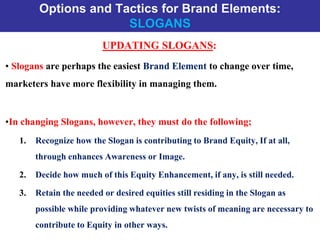
• Slogans are perhaps the easiest Brand Element to change over time,
marketers have more flexibility in managing them.
•In changing Slogans, however, they must do the following;
1. Recognize how the Slogan is contributing to Brand Equity, If at all,
through enhances Awareness or Image.
2. Decide how much of this Equity Enhancement, if any, is still needed.
3. Retain the needed or desired equities still residing in the Slogan as
possible while providing whatever new twists of meaning are necessary to
contribute to Equity in other ways.
Options and Tactics for Brand Elements:
JINGLES
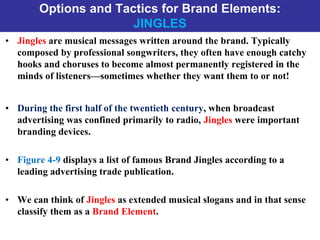
• Jingles are musical messages written around the brand. Typically
composed by professional songwriters, they often have enough catchy
hooks and choruses to become almost permanently registered in the
minds of listeners—sometimes whether they want them to or not!
• During the first half of the twentieth century, when broadcast
advertising was confined primarily to radio, Jingles were important
branding devices.
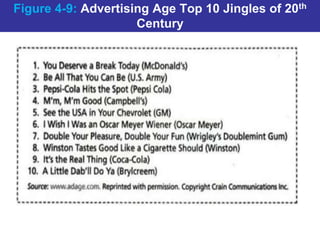
• Figure 4-9 displays a list of famous Brand Jingles according to a
leading advertising trade publication.
• We can think of Jingles as extended musical slogans and in that sense
classify them as a Brand Element.
Options and Tactics for Brand Elements:
JINGLES
• They can communicate Brand Benefits, but they often convey product
meaning in a non-direct and fairly abstract fashion.
• Jingles are perhaps most valuable in enhancing Brand Awareness.
• Often, they repeat Brand Name in clever and amusing ways that allow
consumers multiple encoding opportunities (E.g. Ding Dong Bubble
Gum Ad).
• A well-known Jingle can serve as an Advertising foundation for years.
Figure 4-9: Advertising Age Top 10 Jingles of 20th
Century
Options and Tactics for Brand Elements:
PACKAGING
• Packaging is the activities of designing and producing containers or
wrappers for a product.
• From the perspective of both the Firm and Consumers, Packaging
must achieve a number of objectives:
1. Identify the brand
2. Convey descriptive and persuasive information
3. Facilitate product transportation and protection
4. Assist at-home storage
5. Aid product consumption
Options and Tactics for Brand Elements:
PACKAGING
• Marketers must chose the Aesthetic and Functional components of
Packaging correctly to achieve Marketing Objectives and Meet
Consumer’s need.
– Aesthetic considerations govern a Package’s Size and Shape,
Material Color, Text, and Graphics.
– Functionally, structural design is crucial. E.G., Innovations over
the years have resulted in food packages that are resealable,
tamperproof, and more convenient to use – easy to hold, easy to
open, and squeezable.
Options and Tactics for Brand Elements:
PACKAGING
BENEFITS OF PACKAGING:
• One of the most strongest associations consumers have with a Brand is
inspired by the look of its Packaging.
• The Package can become an important means of Brand Recognition
and convey or imply information to build or reinforce valuable Brand
Associations.
• Structural Packaging innovations can create a Point of Difference that
permits a higher margin.
• New Packages can also expand a market and capture new market
segments.
• Packaging changes can have immediate impact on Sales.
Options and Tactics for Brand Elements:
PACKAGING
PACKAGING AT THE POINT OF PURCHASE:
• Packaging can create strong appeal on the store shelf and stand out
from the clutter.
• Many consumers may first encounter a new Brand on the supermarket
shelf or in the store. Because few product differences exist in some
categories, packaging innovations can provide at least a temporary
edge on competition.
• For the reasons, packaging is particularly a cost-effective way to build
Brand Equity. It is sometimes called the “last five seconds of
marketing” as well as “permanent media” or “the last salesman”.
Options and Tactics for Brand Elements:
PACKAGING
PACKAGING INNOVATIONS:
• In Mature Markets especially, Package innovations can provide
short-term sales boost. E.g. different sizes of bottles made by soft
drink companies.
• The Beverages industry in general has been characterized by a
number of packaging innovations.
Options and Tactics for Brand Elements:
PACKAGING
PACKAGE DESIGN:
• An integral part of product development and launch, package
design has become more sophisticated process.
• These days, specialized package designers bring artistic
techniques and scientific skills to package design in an attempt to
meet the marketing objectives for a Brand.
• Designers often refer to the “shelf impact” of a package.
• One of the most important visual design elements for a package
is its color.
Options and Tactics for Brand Elements:
PACKAGING
PACKAGING CHANGES:
“Although packaging changes can be expensive, they can
be cost-effective compared with other marketing
communication costs”
Options and Tactics for Brand Elements:
PACKAGING
PACKAGING CHANGES:
•Firms change their packaging for a number of reasons.
1. They may upgrade it to signal a higher price, or to more
effectively sell products through new or shifting distribution
channels.
2. Packaging will change when there is a significant product line
expansion that would benefit from a common look.
3. Package redesign may also accompany a new product innovation
to signal changes to consumers.
4. Most common reason for package redesign is that the old package
just looks outdated.
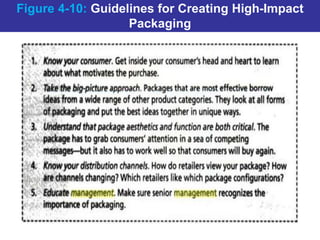
Figure 4-10: Guidelines for Creating High-Impact
Packaging
Putting It All Together
• Each Brand Element can play a different role in building Brand Equity, so
marketers, “mix and match” to maximize Brand Equity.
• The entire set of brand elements makes up the Brand Identity, the
contribution of all brand elements to Awareness and Image.
• Some strong brands have a number of valuable Brand Elements that directly
reinforce each other.
• The cohesiveness of the Brand Identity depends on the extent to which the
brand elements are Consistent.
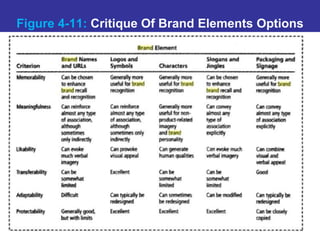
• Finally, the Six Criteria are particularly important (See Figure 4-11)
Figure 4-11: Critique Of Brand Elements Options
THANKS

Choosing brand elements to build brand equity

  • 1.
    Part III: Planningand Implementing Brand Marketing Programs Chapter 4: CHOOSING BRAND ELEMENTS TO BUILD BRAND EQUITY Mateeullah Khan BUITEMS E-mail: mateeullahkhan@hotmail.com Strategic Brand Management – Building, Measuring, and Managing Brand Equity 3rd Edition – Kevin Lane Keller
  • 2.
    • Identify thedifferent types of brand elements • List the general criteria for choosing brand elements • Describe key tactics in choosing different brand elements • Explain the rationale for “mixing and matching” brand elements • Highlight some of the legal issues surrounding brand elements Learning Objectives
  • 3.
    Preview • Brand Elements,sometimes called Brand Identities, are those trademarkable devices that serves to identify and differentiate the brand. • The main ones are; Brand Names, URLs, Logos, Symbols, Characters, Spokespeople, Jingles, Packages, and Signage. “The Customer-Based Brand Equity model suggests that marketers should choose brand elements to enhance brand awareness; facilitate the formation of strong, favorable, and unique brand association; or elicit positive brand judgements and feelings.”
  • 4.
    Criteria For ChoosingBrand Elements • In general, there are Six Criteria for Brand Elements (with more specific sub-choices for each, as shown in Figure 4-1) 1. Memorability 2. Meaningfulness 3. Likability 4. Transferability 5. Adaptability 6. Protectability
  • 5.
    Figure 4-1: CriteriaFor Choosing Brand Elements Marketer’s offensive strategy and build brand equity Defensive role for leveraging and maintaining brand equity in the face of different opportunities & constraints
  • 6.
    Criteria For ChoosingBrand Elements: 1. Memorability • A necessary condition for building brand equity is achieving a high level of brand awareness. • Brand elements that promote that goal are inherently memorable and attention-getting, and therefore facilitate recall or recognition in purchase and consumption settings. • For Example: A brand of propane gas cylinders named Blue Rhino featuring a powder-blue animal mascot with a distinctive yellow flame is likely to stick in the minds of consumers.
  • 7.
    Criteria For ChoosingBrand Elements: 2. Meaningfulness • Brand Elements may take all kinds of meaning, with either descriptive or persuasive content. • Two particularly important criteria are how well the brand elements conveys the following; 1. General information about the nature of the product category • Does the brand element have descriptive meaning and suggest something about the product category? • How likely is it that a consumer could correctly identify the product category for the brand based on any one brand element?
  • 8.
    Criteria For ChoosingBrand Elements: 2. Meaningfulness 2. Specific information about particular attributes and benefits of the brand • Does the brand element have persuasive meaning and suggest something about the particular kind of product, or its key attributes or benefits? • Does it suggest something about a product ingredient or type of person who might use the brand? • The first dimension is an important determinant of Brand Awareness and Salience; the second, of Brand Image and Positioning.
  • 9.
    Criteria For ChoosingBrand Elements: 3. Likability • Do Customers find the Brand Element Aesthetically appealing? • Is it likable visually, verbally, and in other ways? • Brand Elements can be rich in imagery and inherently fun and interesting, even if not always directly related to the product. • Descriptive and Persuasive elements reduce the burden on marketing communications to build awareness and link associations and equity, especially when few other products- related associations exist.
  • 10.
    Criteria For ChoosingBrand Elements: 4. Transferability • Transferability measures the extent to which the Brand Elements adds to the brand equity of new products for the brand. There are several aspects to this criterion; • First, how useful is the brand element for line or category extension? – In general, the less specific the name, the more easily it can be transferred across categories. For Example: Amazon connotes a massive South American river and therefore a brand can be appropriate for a variety of different types of products, whereas Books “R” Us obviously would not have afforded the same flexibility.
  • 11.
    Criteria For ChoosingBrand Elements: 4. Transferability • Second, To what extent does the brand element add to brand equity across geographic boundaries and market segments? – To a large extent this depends on the cultural content and linguistic qualities of the brand element.
  • 12.
    Criteria For ChoosingBrand Elements: 5. Adaptability • The Fifth consideration for Brand elements is their Adaptability over time. • Because of changes in Consumer Values and Opinions, or simply because of a need to remain contemporary, most Brand Elements must be updated. • The more Adaptable and Flexible the brand element, the easier it is to update it to changes in consumer values and opinions. For Example: logos and characters can be given a new look or a new design to make them appear more modern and relevant.
  • 13.
    Criteria For ChoosingBrand Elements: 6. Protectability • The Sixth and Final general consideration is the extent to which the Brand Element is Protectable --- both in legal and a competitive sense. • Marketers should; 1. Choose brand elements that can be legally protected internationally. 2. Formally register chosen brand elements with the appropriate legal bodies. 3. Vigorously defend trademarks from unauthorized competitive infringement. – Read and discuss The Science of Branding 4-1 “Counterfeit Business is Booming”
  • 14.
    Criteria For ChoosingBrand Elements: 6. Protectability • Another consideration is whether the brand is competitively protectable. – If a name, package, or other attribute is too easily copied, much of the uniqueness of the brand may disappear.
  • 15.
    Options and Tacticsfor Brand Elements Consider the Advantages of “APPLE” as the name of a personal computer. Apple was a simple but well-known word that was distinctive in the product category --- which helped develop Brand Awareness. The meaning of the name also gave the company a “friendly shine” and warm Brand Personality. It could also be reinforced visually with a logo that would transfer easily across geographical and cultural boundaries. Finally, the name could serve as a platform for sub-brands like Macintosh, aiding the introduction of Brand Extensions. As Apple illustrates, a well-chosen Brand Name can make an appreciable contribution to the creation of Brand Equity.
  • 16.
    Options and Tacticsfor Brand Elements • A variety of brand elements can be chosen that inherently enhance brand awareness or facilitate the formation of strong, favorable, and unique brand associations. 1.Brand Names 2. URLs 3.Logos and symbols 4. Characters 5.Slogans 6. Packaging
  • 17.
    Options and Tacticsfor Brand Elements: BRAND NAMES • The Brand Name is a fundamentally important choice because it often captures the central theme or key associations of a product in a very compact and emotional fashion. • Brand Names can be extremely effective shorthand means of communication. • Because it is so closely tied to the product in the minds of consumers, however, the Brand Name is also the most difficult element for marketers to change.
  • 18.
    Options and Tacticsfor Brand Elements: BRAND NAMES BRAND NAMING GUIDELINES: • Selecting a Brand Name for a new product is certainly an art and a science. • Figure 4-3 (a)displays different types of possible brand names according to identity experts Landor Associates and Figure 4-3 (b) displays Lippincot Brand Name Taxonomy. • Like any brand element, brand names must be chosen with the six general criteria of memorability, meaningfulness, likability, transferability, adaptability, and protectability in mind. • Brand Awareness: Brand Names that are Simple and easy to pronounce or spell, Familiar and meaningful, and Different,
  • 19.
    Figure 4-3 (a):Landor’s Brand Name Taxonomy
  • 20.
    Figure 4-3 (b):Lippincott Brand Name Taxonomy
  • 21.
    Options and Tacticsfor Brand Elements: BRAND NAMES BRAND NAMING GUIDELINES: • Brand Awareness: – Brand Names that are Simple and Easy to Pronounce or Spell, Familiar and Meaningful, Different, Distinctive, and Unique can obviously improve Brand Awareness.
  • 22.
    Options and Tacticsfor Brand Elements: BRAND NAMES BRAND NAMING GUIDELINES: • Brand Associations - “Because the Brand Name is a compact form of communication, the explicit and implicit meanings consumers extract from it are important.” – In particular, the brand name can reinforce an important attribute or benefit association that makes up its product positioning. (see Figure 4-4) – Besides performance-related considerations, Brand Names can also communicate more abstract considerations as do names Like Joy dishwashing liquid, Caress soap, and Obsession perfume
  • 23.
    Figure 4-4: SampleSuggestive Brand Names
  • 24.
    Options and Tacticsfor Brand Elements: BRAND NAMES BRAND NAMING PROCEDURES: 1.Define Objectives: Define branding objectives in terms of six general criteria noted earlier, and in particular define the ideal meaning the brand should convey. 2.Generate Names: With the branding strategy in place, next generate as many names and concepts as possible. Any potential sources of names are valid, i.e. company management and employees, potential customers, ad agencies, etc. 3.Screen Initial Candidates: Screen all the names against the branding objectives and marketing considerations identified in step 1.
  • 25.
    Options and Tacticsfor Brand Elements: BRAND NAMES BRAND NAMING PROCEDURES: 4.Study Candidate Names: Collect more extensive information about each of the final 5 to 10 names. It is advised to do extensive international legal search. 5.Research the Final Candidates: Next, conduct consumer research to confirm management expectations about the memorability and meaningfulness of the remaining names. 6.Select the Final Name: Based on all the information collected from the previous step, management should choose the name that maximizes the firm’s branding and marketing objectives and then formally register it.
  • 26.
    Options and Tacticsfor Brand Elements: URLs • URLs (Uniform Resource Locators) specify locations of pages on Web and are also commonly referred to as domain names. • Anyone wishing to own a specific URL must register and pay for the name with a service such as Register.com • An issue facing companies with regard to URLs is protecting their brands from unauthorized use in other domain names. • A company can either sue the current owner of the URL for copyright infringement, buy the name from the current owner, or register all conceivable variations of its brand as domain names ahead of time.
  • 27.
    Options and Tacticsfor Brand Elements: LOGOS and SYMBOLS • Brand Name typically is the central element of the brand, Visual Elements typically also play a critical role in building Brand Equity and especially Brand Awareness. • Logos have a long history as a means to indicate origin, ownership, or association. • Logos range from corporate names or trademarks (word marks with text only) written in a distinctive form, to entirely abstract designs that may be completely unrelated to the word mark,
  • 28.
    Options and Tacticsfor Brand Elements: LOGOS and SYMBOLS • Examples of Brands with strong word marks and no accompanying logo separate from name include Coca-Cola, Kit Kat, Dunhill, etc. • Examples of Abstract Logos include the Mercedes Star, Rolex Crown, Nike Swoosh, etc. – These Non-Word mark logos are also often called Symbols. • Like Names, Abstract logos can be quite distinctive and thus recognizable. • In updating logos, marketers should make gradual changes and not lose sight of the inherent advantages of the logo.
  • 29.
    Options and Tacticsfor Brand Elements: LOGOS and SYMBOLS Benefits of Logos and Symbols: 1.Logos and symbols are often easily recognized and can be a valuable way to identify products. 2.Another branding advantage of logos is their Versatility. Because they are non-verbal, logos transfer well across cultures and over range of products. 3.Abstract logos offer advantages when the full brand name is difficult to use for any reason. 4.Finally, unlike brand names, logos can be easily adapted over time to achieve a more contemporary look.
  • 30.
    Options and Tacticsfor Brand Elements: CHARACTERS • Characters represent a special type of Brand Symbol – one that takes human or real-life characteristics. • Brand Characters typically are introduced through advertising and can play a central role in ad campaigns and package designs. • Some Characters are animated, like Peter Pan peanut butter’s character, and others are live-action figures like Ronald McDonald.
  • 31.
    Options and Tacticsfor Brand Elements: CHARACTERS Benefits of Characters: • Because they are often colorful and rich in imagery, Brand Characters tend to be attention getting and quite useful for creating Brand Awareness. • Brand Characters can help brands break through marketplace clutter as well as help to communicate a key product benefit. • The human element of Brand Characters can enhance Likeability and help to create perception of brand as fun and interesting. • Finally, because Brand Characters do not typically have direct product meaning, they may also be transferred relatively easily across product categories.
  • 32.
    Options and Tacticsfor Brand Elements: CHARACTERS CAUTIONS & DRAWBACKS TO USING CHARACTERS: • Brand Characters can be so attention getting and well liked that they dominate other brand elements and actually Dampen Brand Awareness. • Characters often must be updated over time so that their image and personality remain relevant to the target market. • Finally, some characters are so culturally specific that they do not travel well to other countries. • The Science of Branding 4-2 describes some guidelines from a leading consultant.
  • 33.
    Options and Tacticsfor Brand Elements: SLOGANS • Slogans are short phrases that communicate descriptive or persuasive information about the brand. • They often appear in advertising but can play an important role on packaging and in other aspects of the marketing program. • Slogans are powerful branding devices because, like brand names, they are an extremely efficient, shorthand means to build Brand Equity. • They can function as useful “hooks” or “handles” to help consumers grasp the meaning of a brand – what it is and what make it special.
  • 34.
    Options and Tacticsfor Brand Elements: SLOGANS BENEFITS OF SLOGANS: • Some Slogans help to build brand awareness by playing off the brand name in some ways. • Others build brand awareness even more explicitly by making strong links between the brand and the corresponding product category. • Most important, Slogans can help to reinforce the Brand Positioning and desired point of difference. • Slogans often become closely tied to advertising campaigns and serve as tag lines to summarize the descriptive or persuasive information conveyed in ads.
  • 35.
    Options and Tacticsfor Brand Elements: SLOGANS DESIGNING SLOGANS: •Some of the most powerful Slogans contribute to Brand Equity in multiple ways; 1.They can play off the Brand Name to build both Awareness and Image. E.G. “The Big Q stands for Quality” For Quaker State Motor Oil. 2.Slogans also can contain Product-Related and Other Meanings. E.G. Champions Sportswear Slogan “ It takes a little More to Make a Champion”
  • 36.
    Options and Tacticsfor Brand Elements: SLOGANS UPDATING SLOGANS: • Slogans are perhaps the easiest Brand Element to change over time, marketers have more flexibility in managing them. •In changing Slogans, however, they must do the following; 1. Recognize how the Slogan is contributing to Brand Equity, If at all, through enhances Awareness or Image. 2. Decide how much of this Equity Enhancement, if any, is still needed. 3. Retain the needed or desired equities still residing in the Slogan as possible while providing whatever new twists of meaning are necessary to contribute to Equity in other ways.
  • 37.
    Options and Tacticsfor Brand Elements: JINGLES • Jingles are musical messages written around the brand. Typically composed by professional songwriters, they often have enough catchy hooks and choruses to become almost permanently registered in the minds of listeners—sometimes whether they want them to or not! • During the first half of the twentieth century, when broadcast advertising was confined primarily to radio, Jingles were important branding devices. • Figure 4-9 displays a list of famous Brand Jingles according to a leading advertising trade publication. • We can think of Jingles as extended musical slogans and in that sense classify them as a Brand Element.
  • 38.
    Options and Tacticsfor Brand Elements: JINGLES • They can communicate Brand Benefits, but they often convey product meaning in a non-direct and fairly abstract fashion. • Jingles are perhaps most valuable in enhancing Brand Awareness. • Often, they repeat Brand Name in clever and amusing ways that allow consumers multiple encoding opportunities (E.g. Ding Dong Bubble Gum Ad). • A well-known Jingle can serve as an Advertising foundation for years.
  • 39.
    Figure 4-9: AdvertisingAge Top 10 Jingles of 20th Century
  • 40.
    Options and Tacticsfor Brand Elements: PACKAGING • Packaging is the activities of designing and producing containers or wrappers for a product. • From the perspective of both the Firm and Consumers, Packaging must achieve a number of objectives: 1. Identify the brand 2. Convey descriptive and persuasive information 3. Facilitate product transportation and protection 4. Assist at-home storage 5. Aid product consumption
  • 41.
    Options and Tacticsfor Brand Elements: PACKAGING • Marketers must chose the Aesthetic and Functional components of Packaging correctly to achieve Marketing Objectives and Meet Consumer’s need. – Aesthetic considerations govern a Package’s Size and Shape, Material Color, Text, and Graphics. – Functionally, structural design is crucial. E.G., Innovations over the years have resulted in food packages that are resealable, tamperproof, and more convenient to use – easy to hold, easy to open, and squeezable.
  • 42.
    Options and Tacticsfor Brand Elements: PACKAGING BENEFITS OF PACKAGING: • One of the most strongest associations consumers have with a Brand is inspired by the look of its Packaging. • The Package can become an important means of Brand Recognition and convey or imply information to build or reinforce valuable Brand Associations. • Structural Packaging innovations can create a Point of Difference that permits a higher margin. • New Packages can also expand a market and capture new market segments. • Packaging changes can have immediate impact on Sales.
  • 43.
    Options and Tacticsfor Brand Elements: PACKAGING PACKAGING AT THE POINT OF PURCHASE: • Packaging can create strong appeal on the store shelf and stand out from the clutter. • Many consumers may first encounter a new Brand on the supermarket shelf or in the store. Because few product differences exist in some categories, packaging innovations can provide at least a temporary edge on competition. • For the reasons, packaging is particularly a cost-effective way to build Brand Equity. It is sometimes called the “last five seconds of marketing” as well as “permanent media” or “the last salesman”.
  • 44.
    Options and Tacticsfor Brand Elements: PACKAGING PACKAGING INNOVATIONS: • In Mature Markets especially, Package innovations can provide short-term sales boost. E.g. different sizes of bottles made by soft drink companies. • The Beverages industry in general has been characterized by a number of packaging innovations.
  • 45.
    Options and Tacticsfor Brand Elements: PACKAGING PACKAGE DESIGN: • An integral part of product development and launch, package design has become more sophisticated process. • These days, specialized package designers bring artistic techniques and scientific skills to package design in an attempt to meet the marketing objectives for a Brand. • Designers often refer to the “shelf impact” of a package. • One of the most important visual design elements for a package is its color.
  • 46.
    Options and Tacticsfor Brand Elements: PACKAGING PACKAGING CHANGES: “Although packaging changes can be expensive, they can be cost-effective compared with other marketing communication costs”
  • 47.
    Options and Tacticsfor Brand Elements: PACKAGING PACKAGING CHANGES: •Firms change their packaging for a number of reasons. 1. They may upgrade it to signal a higher price, or to more effectively sell products through new or shifting distribution channels. 2. Packaging will change when there is a significant product line expansion that would benefit from a common look. 3. Package redesign may also accompany a new product innovation to signal changes to consumers. 4. Most common reason for package redesign is that the old package just looks outdated.
  • 48.
    Figure 4-10: Guidelinesfor Creating High-Impact Packaging
  • 49.
    Putting It AllTogether • Each Brand Element can play a different role in building Brand Equity, so marketers, “mix and match” to maximize Brand Equity. • The entire set of brand elements makes up the Brand Identity, the contribution of all brand elements to Awareness and Image. • Some strong brands have a number of valuable Brand Elements that directly reinforce each other. • The cohesiveness of the Brand Identity depends on the extent to which the brand elements are Consistent. • Finally, the Six Criteria are particularly important (See Figure 4-11)
  • 50.
    Figure 4-11: CritiqueOf Brand Elements Options
  • 51.