Caffeine :
Good & bad effects on human
Food Engineering and Technology Department
Tezpur University, Tezpur, Assam, 784028
Presenting by
Jayanta Pal (FPL 13015)
Yesmin Ara Begum (FPL 13004)
INTRODUCTION
Caffeine (1,3,7-trimethylxanthine) is a purine alkaloid that
occurs naturally in coffee beans
Some physiological effects associated with caffeine
administration include central nervous system stimulation,
acute elevation of blood pressure, increased metabolic rate,
and diuresis.
Caffeine is rapidly and almost completely absorbed in the
stomach and small intestine and distributed to all tissues,
including the brain.
It is found in varying quantities in the seeds, leaves
fruits of some plants, where it act as a natural
pesticide.
Beverage containing coffee such as coffee, tea
soft drinks, & energy drinks.
HISTORY
 1st use of caffeine as early as 600,000 BCE .
 1820 - Caffeine was first isolated from coffee by German chemist Friedlieb
Ferdinand Runge,.
 1821 - . Pelletier coined the term "caffeine" from the French word for coffee
(café), and this term became the English word "caffeine".
 1821 - Pure caffeine extracted from coffee.
 1880 - Caffeinated soft drinks appear.
 1903 - Researchers remove caffeine from beans ‘without destroying the flavor’.
 1923 - Decaffeinated coffee is introduced to the United States.
 1940 - The US imports 70 percent of the world coffee crop.
 1962 - American per-capita coffee consumption peaks at more than three cups
a day.
 1995 - Coffee becomes the worlds most popular beverage (overtaking tea ) .
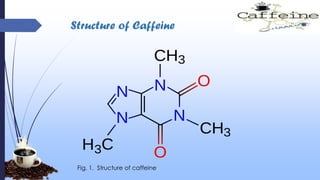
Structure of Caffeine
Fig. 1. Structure of caffeine
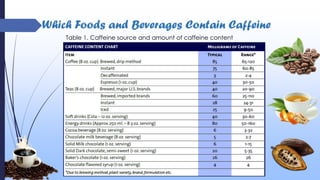
Which Foods and Beverages Contain Caffeine
Table 1. Caffeine source and amount of caffeine content
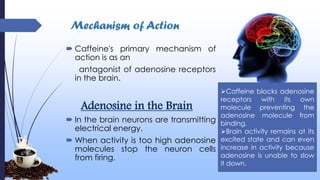
Mechanism of Action
 Caffeine's primary mechanism of
action is as an
antagonist of adenosine receptors
in the brain.
Adenosine in the Brain
 In the brain neurons are transmitting
electrical energy.
 When activity is too high adenosine
molecules stop the neuron cells
from firing.
Caffeine blocks adenosine
receptors with its own
molecule preventing the
adenosine molecule from
binding.
Brain activity remains at its
excited state and can even
increase in activity because
adenosine is unable to slow
it down.
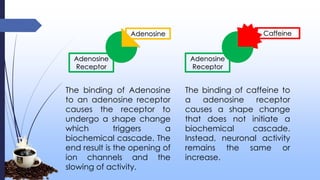
The binding of Adenosine
to an adenosine receptor
causes the receptor to
undergo a shape change
which triggers a
biochemical cascade. The
end result is the opening of
ion channels and the
slowing of activity.
The binding of caffeine to
a adenosine receptor
causes a shape change
that does not initiate a
biochemical cascade.
Instead, neuronal activity
remains the same or
increase.
Adenosine Caffeine
Adenosine
Receptor
Adenosine
Receptor
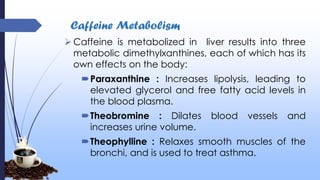
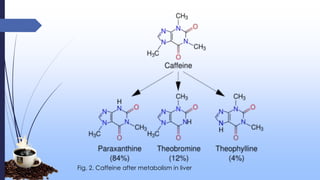
Caffeine Metabolism
 Caffeine is metabolized in liver results into three
metabolic dimethylxanthines, each of which has its
own effects on the body:
Paraxanthine : Increases lipolysis, leading to
elevated glycerol and free fatty acid levels in
the blood plasma.
Theobromine : Dilates blood vessels and
increases urine volume.
Theophylline : Relaxes smooth muscles of the
bronchi, and is used to treat asthma.
Fig. 2. Caffeine after metabolism in liver
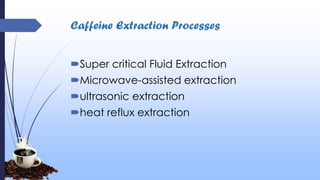
Caffeine Extraction Processes
Super critical Fluid Extraction
Microwave-assisted extraction
ultrasonic extraction
heat reflux extraction
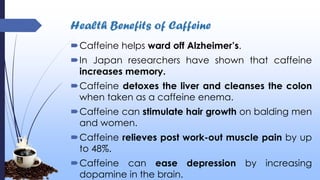
Health Benefits of Caffeine
Caffeine helps ward off Alzheimer’s.
In Japan researchers have shown that caffeine
increases memory.
Caffeine detoxes the liver and cleanses the colon
when taken as a caffeine enema.
Caffeine can stimulate hair growth on balding men
and women.
Caffeine relieves post work-out muscle pain by up
to 48%.
Caffeine can ease depression by increasing
dopamine in the brain.
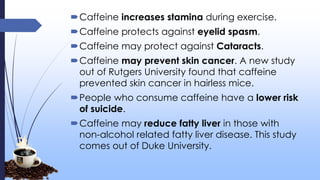
Caffeine increases stamina during exercise.
Caffeine protects against eyelid spasm.
Caffeine may protect against Cataracts.
Caffeine may prevent skin cancer. A new study
out of Rutgers University found that caffeine
prevented skin cancer in hairless mice.
People who consume caffeine have a lower risk
of suicide.
Caffeine may reduce fatty liver in those with
non-alcohol related fatty liver disease. This study
comes out of Duke University.
Caffeine For Treatment of Alzheimer Disease (AD)
Epidemiologic studies have increasingly
suggested that caffeine could be an effective
therapeutic against Alzheimer’s disease (AD).
An in vivo experiments was conducted on a
transgenic mouse model for AD to determine if
caffeine have beneficial actions to protect
against or reverse AD-like cognitive impairment
and AD pathology.
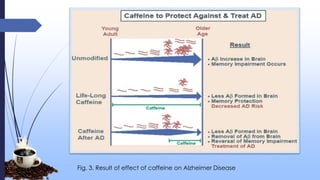
AD transgenic (Tg) mice of age between
4 and 9 months were given (300 mg/L)
caffeine in their drinking water from young
adulthood into older age.
 The resultant amount of caffeine intake
for each mouse (approximately 1.5
mg/day) was the human equivalent of
500 mg or 5 cups of coffee per day
showed protection against memory
impairment and lower brain levels of the
abnormal protein (amyloid-β; Aβ).
Fig. 3. Result of effect of caffeine on Alzheimer Disease
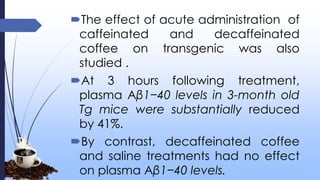
The effect of acute administration of
caffeinated and decaffeinated
coffee on transgenic was also
studied .
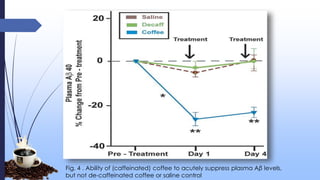
At 3 hours following treatment,
plasma Aβ1−40 levels in 3-month old
Tg mice were substantially reduced
by 41%.
By contrast, decaffeinated coffee
and saline treatments had no effect
on plasma Aβ1−40 levels.
Fig. 4 . Ability of (caffeinated) coffee to acutely suppress plasma Aβ levels,
but not de-caffeinated coffee or saline control
A similar finding was found in a
clinical extension of this study in AD
mice.
This initial clinical studies reported
that acute oral caffeine
administration (400 mg) to aged
humans induces an immediate
decrease in blood Aβ levels.
Negative Side Effects of Caffeine
Effects on Heart Rate and Blood
Pressure
Osteoporosis
Diabetes
Loss of sleep
Fertility and miscarriage
Hormonal Effects
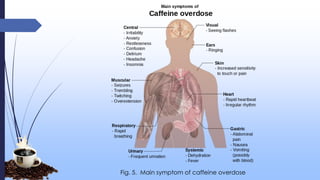
Fig. 5. Main symptom of caffeine overdose
Bad Effect of Caffeine on Coronary Heart
Diseases
 Several studies have examined the relationship between
coffee consumption and coronary heart disease (CHD)
risk. In general, case-control studies have found high
coffein intakes to be associated with significantly
increased risk of CHD or myocardial infarction (MI).
 Two separate meta-analyses that combined the results
of eight case-control studies found that CHD risk was 40–
60% higher in those who consumed 5 or more cups of
coffee daily compared to those who did not drink
coffee.
 The effect of coffee or caffeine consumption on people
with established CHD has not been well studied. One
case-control study found that heavy coffee
consumption, defined as more than 10 cups daily, was
associated with a significant increase in the risk of
sudden cardiac arrest in patients with established
coronary artery disease.
 However, a multi center prospective study of 1935
patients who survived a MI found no association
between coffee consumption and survival over the next
4 years, even in the heaviest coffee consumers.
 It should be noted that few patients reported consuming
more than 5-10 cups of coffee daily in all study.
Decaffeination
 Decaffeination is a commercial process used to remove caffeine
from coffee.
 There are four major commercial processes used to remove
caffeine from coffee.
a) Conventional decaffeination uses the chemical Methylene
Chloride.
b) "Natural" decaffeination uses the chemical Ethyl Acetate.
c) Water decaffeination uses water.
d) Carbon Dioxide decaffeination uses CO2 (SCFE).
Benefits of Decaffeination
Decaffeination markedly reduces the
amount of caffeine in a product without
affecting the flavor,
Making a Choice
The choice of caffeinated versus
decaffeinated comes down to personal
preference, states Fit Day. Caffeine is safe
when consumed regularly in moderate
amounts.
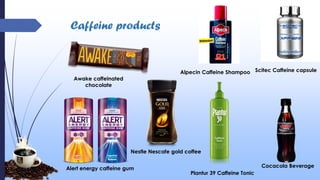
Caffeine products
Scitec Caffeine capsuleAlpecin Caffeine Shampoo
Plantur 39 Caffeine Tonic
Alert energy caffeine gum
Nestle Nescafe gold coffee
Cocacola Beverage
Awake caffeinated
chocolate
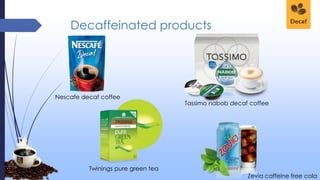
Decaffeinated products
Nescafe decaf coffee
Tassimo nabob decaf coffee
Zevia caffeine free cola
Twinings pure green tea
Conclusion
The good and bad of caffeine
Caffeine is part of modern life. Regular coffee
drinkers include the majority of adults and a growing
number of children. The recommendation for most
people is to enjoy one or two cups of coffee a day,
which will allow you to capitalize on its health benefits
without incurring health drawbacks. Extensive recent
research has put forth that coffee is far more healthful
than it is harmful. Very little bad and a lot of good
come from drinking it.
References
 Carrillo, J.A., and Benitez, J. 2000. Clinically significant pharmacokinetic interactions
between dietary caffeine and medications. Clin. Pharmacokinet, 39:127–153.
 de Vreede-Swagemakers, J.J., Gorgels, A.P., Weijenberg, M.P. et al. 1999. Risk indicators
for out-of-hospital cardiac arrest in patients with coronary artery disease. J. Clin
Epidemiol., 52:601–607.
 Gary W. Arendasha,b,∗ and Chuanhai Caob,c. 2010. “Caffeine and Coffee as
Therapeutics Against Alzheimer’s Disease” Journal of Alzheimer’s Disease 20 S117–S126
 Greenland, S. 1993. A meta-analysis of coffee, myocardial infarction, and coronary death.
Epidemiology., 4:366–374.
 Hammar, N., Andersson, T., Alfredsson, L. et al. 2003. Association of boiled and filtered
coffee with incidence of first nonfatal myocardial infarction: the SHEEP and the VHEEP
study. J. Intern. Med., 253:653–659.
 Haskó G, Linden J, Cronstein B, Pacher P (September 2008). "Adenosine receptors:
therapeutic aspects for inflammatory and immune diseases". Nat Rev Drug Discov 7 (9):
759–70. doi:10.1038/nrd2638. PMC 2568887. PMID 18758473.
 Higdon, Jane V., And Frei, Balz., 2006. ” Coffee and Health: A Reviewof Recent
Human Research”. Critical Reviews in Food Science and Nutrition, 46:101–123
 http://www.energyfiend.com/top-10-caffeine-health-benefits
 James, J.E. 2004. Critical review of dietary caffeine and blood pressure:A relationship
that should be taken more seriously. Psychosom. Med.,66:63–71.
 Kawachi, I., Colditz, G. A., and Stone, C. B. 1994. Does coffee drinking increase the
risk of coronary heart disease? Results from a meta-analysis. Br. Heart J., 72:269–275.
 Kuffler SW, Edwards C (November 1958). "Mechanism of gamma aminobutyric acid
(GABA) action and its relation to synaptic inhibition". J. Neurophysiol. 21 (6): 589–610.
PMID 13599049.
 Mukamal, K.J., Maclure, M., and Muller, J.E., 2004. Caffeinated coffee consumption
and mortality after acute myocardial infarction. Am. Heart J., 147:999–1004.
 Spiller, M.A. 1998. The Chemical Components of Coffee. In: Caffeine.pp. 97–161.
Spiller, G. A., Ed., CRC Press, Boca Raton.
 Tavani, A., Bertuzzi, M., Negri, E. et al. 2001. Alcohol, smoking, coffee and risk of non-
fatal acute myocardial infarction in Italy. Eur. J. Epidemiol., 17:1131–1137
Food Engineering and Technology Department
Tezpur University, Tezpur, Assam, 784028
Caffeine presentation

Caffeine presentation

  • 1.
    Caffeine : Good &bad effects on human Food Engineering and Technology Department Tezpur University, Tezpur, Assam, 784028 Presenting by Jayanta Pal (FPL 13015) Yesmin Ara Begum (FPL 13004)
  • 2.
    INTRODUCTION Caffeine (1,3,7-trimethylxanthine) isa purine alkaloid that occurs naturally in coffee beans Some physiological effects associated with caffeine administration include central nervous system stimulation, acute elevation of blood pressure, increased metabolic rate, and diuresis. Caffeine is rapidly and almost completely absorbed in the stomach and small intestine and distributed to all tissues, including the brain. It is found in varying quantities in the seeds, leaves fruits of some plants, where it act as a natural pesticide. Beverage containing coffee such as coffee, tea soft drinks, & energy drinks.
  • 3.
    HISTORY  1st useof caffeine as early as 600,000 BCE .  1820 - Caffeine was first isolated from coffee by German chemist Friedlieb Ferdinand Runge,.  1821 - . Pelletier coined the term "caffeine" from the French word for coffee (café), and this term became the English word "caffeine".  1821 - Pure caffeine extracted from coffee.  1880 - Caffeinated soft drinks appear.  1903 - Researchers remove caffeine from beans ‘without destroying the flavor’.  1923 - Decaffeinated coffee is introduced to the United States.  1940 - The US imports 70 percent of the world coffee crop.  1962 - American per-capita coffee consumption peaks at more than three cups a day.  1995 - Coffee becomes the worlds most popular beverage (overtaking tea ) .
  • 4.
    Structure of Caffeine Fig.1. Structure of caffeine
  • 5.
    Which Foods andBeverages Contain Caffeine Table 1. Caffeine source and amount of caffeine content
  • 6.
    Mechanism of Action Caffeine's primary mechanism of action is as an antagonist of adenosine receptors in the brain. Adenosine in the Brain  In the brain neurons are transmitting electrical energy.  When activity is too high adenosine molecules stop the neuron cells from firing. Caffeine blocks adenosine receptors with its own molecule preventing the adenosine molecule from binding. Brain activity remains at its excited state and can even increase in activity because adenosine is unable to slow it down.
  • 7.
    The binding ofAdenosine to an adenosine receptor causes the receptor to undergo a shape change which triggers a biochemical cascade. The end result is the opening of ion channels and the slowing of activity. The binding of caffeine to a adenosine receptor causes a shape change that does not initiate a biochemical cascade. Instead, neuronal activity remains the same or increase. Adenosine Caffeine Adenosine Receptor Adenosine Receptor
  • 8.
    Caffeine Metabolism  Caffeineis metabolized in liver results into three metabolic dimethylxanthines, each of which has its own effects on the body: Paraxanthine : Increases lipolysis, leading to elevated glycerol and free fatty acid levels in the blood plasma. Theobromine : Dilates blood vessels and increases urine volume. Theophylline : Relaxes smooth muscles of the bronchi, and is used to treat asthma.
  • 9.
    Fig. 2. Caffeineafter metabolism in liver
  • 10.
    Caffeine Extraction Processes Supercritical Fluid Extraction Microwave-assisted extraction ultrasonic extraction heat reflux extraction
  • 11.
    Health Benefits ofCaffeine Caffeine helps ward off Alzheimer’s. In Japan researchers have shown that caffeine increases memory. Caffeine detoxes the liver and cleanses the colon when taken as a caffeine enema. Caffeine can stimulate hair growth on balding men and women. Caffeine relieves post work-out muscle pain by up to 48%. Caffeine can ease depression by increasing dopamine in the brain.
  • 12.
    Caffeine increases staminaduring exercise. Caffeine protects against eyelid spasm. Caffeine may protect against Cataracts. Caffeine may prevent skin cancer. A new study out of Rutgers University found that caffeine prevented skin cancer in hairless mice. People who consume caffeine have a lower risk of suicide. Caffeine may reduce fatty liver in those with non-alcohol related fatty liver disease. This study comes out of Duke University.
  • 13.
    Caffeine For Treatmentof Alzheimer Disease (AD) Epidemiologic studies have increasingly suggested that caffeine could be an effective therapeutic against Alzheimer’s disease (AD). An in vivo experiments was conducted on a transgenic mouse model for AD to determine if caffeine have beneficial actions to protect against or reverse AD-like cognitive impairment and AD pathology.
  • 14.
    AD transgenic (Tg)mice of age between 4 and 9 months were given (300 mg/L) caffeine in their drinking water from young adulthood into older age.  The resultant amount of caffeine intake for each mouse (approximately 1.5 mg/day) was the human equivalent of 500 mg or 5 cups of coffee per day showed protection against memory impairment and lower brain levels of the abnormal protein (amyloid-β; Aβ).
  • 15.
    Fig. 3. Resultof effect of caffeine on Alzheimer Disease
  • 16.
    The effect ofacute administration of caffeinated and decaffeinated coffee on transgenic was also studied . At 3 hours following treatment, plasma Aβ1−40 levels in 3-month old Tg mice were substantially reduced by 41%. By contrast, decaffeinated coffee and saline treatments had no effect on plasma Aβ1−40 levels.
  • 17.
    Fig. 4 .Ability of (caffeinated) coffee to acutely suppress plasma Aβ levels, but not de-caffeinated coffee or saline control
  • 18.
    A similar findingwas found in a clinical extension of this study in AD mice. This initial clinical studies reported that acute oral caffeine administration (400 mg) to aged humans induces an immediate decrease in blood Aβ levels.
  • 19.
    Negative Side Effectsof Caffeine Effects on Heart Rate and Blood Pressure Osteoporosis Diabetes Loss of sleep Fertility and miscarriage Hormonal Effects
  • 20.
    Fig. 5. Mainsymptom of caffeine overdose
  • 21.
    Bad Effect ofCaffeine on Coronary Heart Diseases  Several studies have examined the relationship between coffee consumption and coronary heart disease (CHD) risk. In general, case-control studies have found high coffein intakes to be associated with significantly increased risk of CHD or myocardial infarction (MI).  Two separate meta-analyses that combined the results of eight case-control studies found that CHD risk was 40– 60% higher in those who consumed 5 or more cups of coffee daily compared to those who did not drink coffee.
  • 22.
     The effectof coffee or caffeine consumption on people with established CHD has not been well studied. One case-control study found that heavy coffee consumption, defined as more than 10 cups daily, was associated with a significant increase in the risk of sudden cardiac arrest in patients with established coronary artery disease.  However, a multi center prospective study of 1935 patients who survived a MI found no association between coffee consumption and survival over the next 4 years, even in the heaviest coffee consumers.  It should be noted that few patients reported consuming more than 5-10 cups of coffee daily in all study.
  • 23.
    Decaffeination  Decaffeination isa commercial process used to remove caffeine from coffee.  There are four major commercial processes used to remove caffeine from coffee. a) Conventional decaffeination uses the chemical Methylene Chloride. b) "Natural" decaffeination uses the chemical Ethyl Acetate. c) Water decaffeination uses water. d) Carbon Dioxide decaffeination uses CO2 (SCFE).
  • 24.
    Benefits of Decaffeination Decaffeinationmarkedly reduces the amount of caffeine in a product without affecting the flavor, Making a Choice The choice of caffeinated versus decaffeinated comes down to personal preference, states Fit Day. Caffeine is safe when consumed regularly in moderate amounts.
  • 25.
    Caffeine products Scitec CaffeinecapsuleAlpecin Caffeine Shampoo Plantur 39 Caffeine Tonic Alert energy caffeine gum Nestle Nescafe gold coffee Cocacola Beverage Awake caffeinated chocolate
  • 26.
    Decaffeinated products Nescafe decafcoffee Tassimo nabob decaf coffee Zevia caffeine free cola Twinings pure green tea
  • 27.
    Conclusion The good andbad of caffeine Caffeine is part of modern life. Regular coffee drinkers include the majority of adults and a growing number of children. The recommendation for most people is to enjoy one or two cups of coffee a day, which will allow you to capitalize on its health benefits without incurring health drawbacks. Extensive recent research has put forth that coffee is far more healthful than it is harmful. Very little bad and a lot of good come from drinking it.
  • 28.
    References  Carrillo, J.A.,and Benitez, J. 2000. Clinically significant pharmacokinetic interactions between dietary caffeine and medications. Clin. Pharmacokinet, 39:127–153.  de Vreede-Swagemakers, J.J., Gorgels, A.P., Weijenberg, M.P. et al. 1999. Risk indicators for out-of-hospital cardiac arrest in patients with coronary artery disease. J. Clin Epidemiol., 52:601–607.  Gary W. Arendasha,b,∗ and Chuanhai Caob,c. 2010. “Caffeine and Coffee as Therapeutics Against Alzheimer’s Disease” Journal of Alzheimer’s Disease 20 S117–S126  Greenland, S. 1993. A meta-analysis of coffee, myocardial infarction, and coronary death. Epidemiology., 4:366–374.  Hammar, N., Andersson, T., Alfredsson, L. et al. 2003. Association of boiled and filtered coffee with incidence of first nonfatal myocardial infarction: the SHEEP and the VHEEP study. J. Intern. Med., 253:653–659.  Haskó G, Linden J, Cronstein B, Pacher P (September 2008). "Adenosine receptors: therapeutic aspects for inflammatory and immune diseases". Nat Rev Drug Discov 7 (9): 759–70. doi:10.1038/nrd2638. PMC 2568887. PMID 18758473.
  • 29.
     Higdon, JaneV., And Frei, Balz., 2006. ” Coffee and Health: A Reviewof Recent Human Research”. Critical Reviews in Food Science and Nutrition, 46:101–123  http://www.energyfiend.com/top-10-caffeine-health-benefits  James, J.E. 2004. Critical review of dietary caffeine and blood pressure:A relationship that should be taken more seriously. Psychosom. Med.,66:63–71.  Kawachi, I., Colditz, G. A., and Stone, C. B. 1994. Does coffee drinking increase the risk of coronary heart disease? Results from a meta-analysis. Br. Heart J., 72:269–275.  Kuffler SW, Edwards C (November 1958). "Mechanism of gamma aminobutyric acid (GABA) action and its relation to synaptic inhibition". J. Neurophysiol. 21 (6): 589–610. PMID 13599049.  Mukamal, K.J., Maclure, M., and Muller, J.E., 2004. Caffeinated coffee consumption and mortality after acute myocardial infarction. Am. Heart J., 147:999–1004.  Spiller, M.A. 1998. The Chemical Components of Coffee. In: Caffeine.pp. 97–161. Spiller, G. A., Ed., CRC Press, Boca Raton.  Tavani, A., Bertuzzi, M., Negri, E. et al. 2001. Alcohol, smoking, coffee and risk of non- fatal acute myocardial infarction in Italy. Eur. J. Epidemiol., 17:1131–1137
  • 30.
    Food Engineering andTechnology Department Tezpur University, Tezpur, Assam, 784028