Cholinergic drugs
Dr Chintan
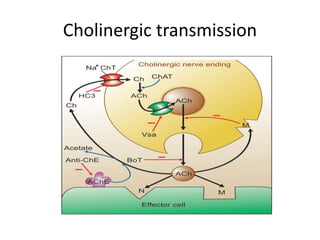
Cholinergic transmission
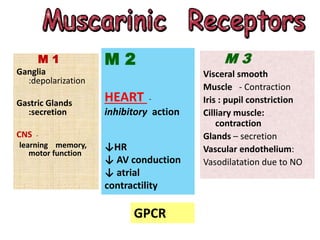
M 1
Ganglia
:depolarization
Gastric Glands
:secretion
CNS -
learning memory,
motor function
M 2
HEART -
inhibitory action
↓HR
↓ AV conduction
↓ atrial
contractility
M 3
Visceral smooth
Muscle - Contraction
Iris : pupil constriction
Cilliary muscle:
contraction
Glands – secretion
Vascular endothelium:
Vasodilatation due to NO
GPCR
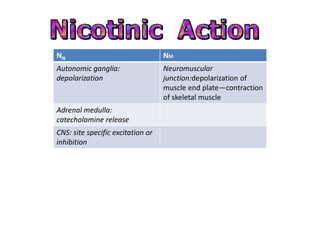
NN NM
Autonomic ganglia:
depolarization
Neuromuscular
junction:depolarization of
muscle end plate—contraction
of skeletal muscle
Adrenal medulla:
catecholamine release
CNS: site specific excitation or
inhibition
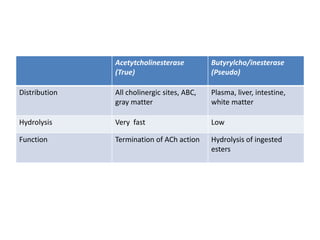
Acetytcholinesterase
(True)
Butyrylcho/inesterase
(Pseudo)
Distribution All cholinergic sites, ABC,
gray matter
Plasma, liver, intestine,
white matter
Hydrolysis Very fast Low
Function Termination of ACh action Hydrolysis of ingested
esters
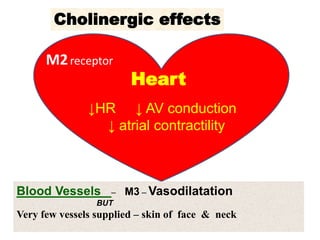
Heart
↓HR ↓ AV conduction
↓ atrial contractility
Cholinergic effects
M2receptor
Blood Vessels – M3 – Vasodilatation
BUT
Very few vessels supplied – skin of face & neck
Muscarinic
action
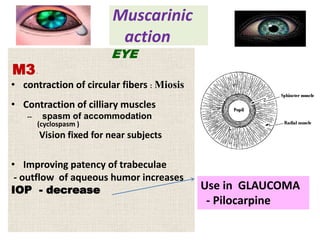
EYE
M3-
• contraction of circular fibers : Miosis
• Contraction of cilliary muscles
-- spasm of accommodation
(cyclospasm )
Vision fixed for near subjects
• Improving patency of trabeculae
- outflow of aqueous humor increases
IOP - decrease Use in GLAUCOMA
- Pilocarpine
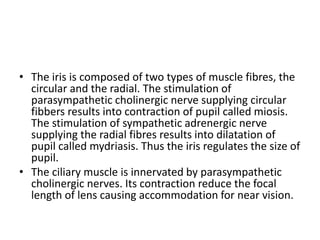
• The iris is composed of two types of muscle fibres, the
circular and the radial. The stimulation of
parasympathetic cholinergic nerve supplying circular
fibbers results into contraction of pupil called miosis.
The stimulation of sympathetic adrenergic nerve
supplying the radial fibres results into dilatation of
pupil called mydriasis. Thus the iris regulates the size of
pupil.
• The ciliary muscle is innervated by parasympathetic
cholinergic nerves. Its contraction reduce the focal
length of lens causing accommodation for near vision.
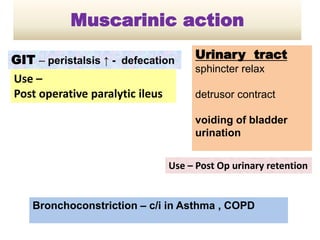
Muscarinic action
GIT – peristalsis ↑ - defecation
Use –
Post operative paralytic ileus
Urinary tract
sphincter relax
detrusor contract
voiding of bladder
urination
Bronchoconstriction – c/i in Asthma , COPD
Use – Post Op urinary retention
Glands
Gastric – acid secretion - M1
M3
Salivation
Lacrimation
Sweating
Tracheobronchial secretion ↑
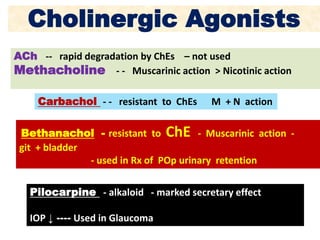
Cholinergic Agonists
ACh -- rapid degradation by ChEs – not used
Methacholine - - Muscarinic action > Nicotinic action
Carbachol - - resistant to ChEs M + N action
Bethanachol - resistant to ChE - Muscarinic action -
git + bladder
- used in Rx of POp urinary retention
Pilocarpine - alkaloid - marked secretary effect
IOP ↓ ---- Used in Glaucoma
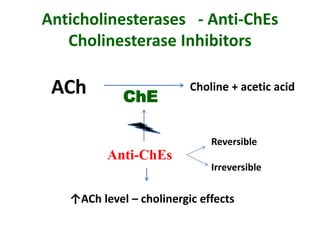
Anticholinesterases - Anti-ChEs
Cholinesterase Inhibitors
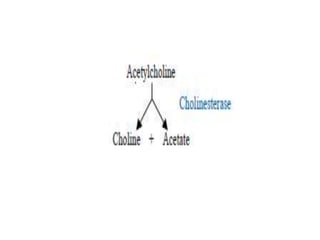
ACh Choline + acetic acid
ChE
Anti-ChEs
↑ACh level – cholinergic effects
Reversible
Irreversible
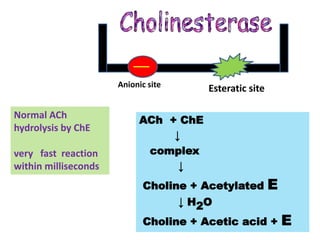
Anionic site Esteratic site
Normal ACh
hydrolysis by ChE
very fast reaction
within milliseconds
ACh + ChE
↓
complex
↓
Choline + Acetylated E
↓ H2O
Choline + Acetic acid + E
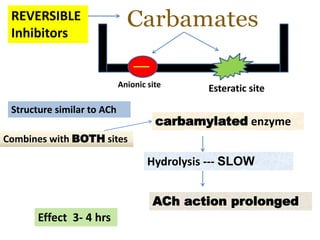
Anionic site Esteratic site
REVERSIBLE
Inhibitors
Combines with BOTH sites
carbamylated enzyme
Hydrolysis --- SLOW
ACh action prolonged
Structure similar to ACh
Effect 3- 4 hrs
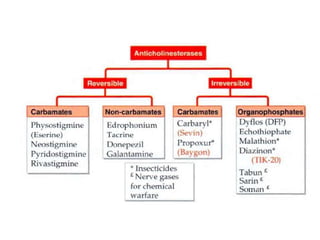
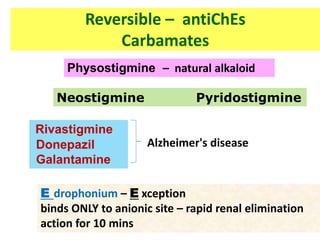
Reversible – antiChEs
Carbamates
Physostigmine – natural alkaloid
Neostigmine Pyridostigmine
Rivastigmine
Donepazil
Galantamine
Alzheimer's disease
E drophonium – E xception
binds ONLY to anionic site – rapid renal elimination
action for 10 mins
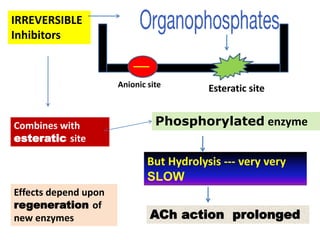
Anionic site Esteratic site
IRREVERSIBLE
Inhibitors
Combines with
esteratic site
Phosphorylated enzyme
But Hydrolysis --- very very
SLOW
ACh action prolonged
Effects depend upon
regeneration of
new enzymes
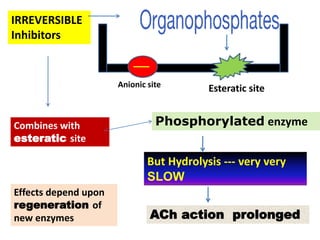
Anionic site Esteratic site
IRREVERSIBLE
Inhibitors
Combines with
esteratic site
Phosphorylated enzyme
But Hydrolysis --- very very
SLOW
ACh action prolonged
Effects depend upon
regeneration of
new enzymes
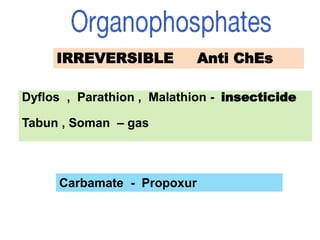
Dyflos , Parathion , Malathion - insecticide
Tabun , Soman – gas
IRREVERSIBLE Anti ChEs
Carbamate - Propoxur
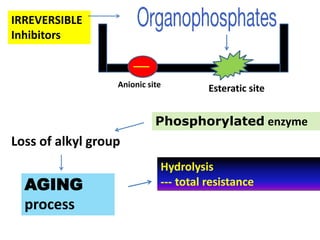
Anionic site Esteratic site
IRREVERSIBLE
Inhibitors
Phosphorylated enzyme
Hydrolysis
--- total resistance
Loss of alkyl group
AGING
process
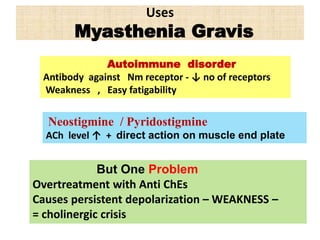
Uses
Myasthenia Gravis
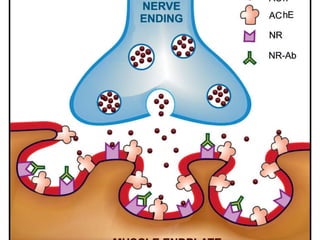
Autoimmune disorder
Antibody against Nm receptor - ↓ no of receptors
Weakness , Easy fatigability
Neostigmine / Pyridostigmine
ACh level ↑ + direct action on muscle end plate
But One Problem
Overtreatment with Anti ChEs
Causes persistent depolarization – WEAKNESS –
= cholinergic crisis
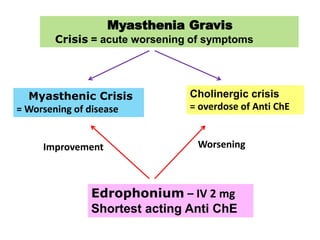
Myasthenia Gravis
Crisis = acute worsening of symptoms
Myasthenic Crisis
= Worsening of disease
Cholinergic crisis
= overdose of Anti ChE
Edrophonium – IV 2 mg
Shortest acting Anti ChE
Improvement Worsening
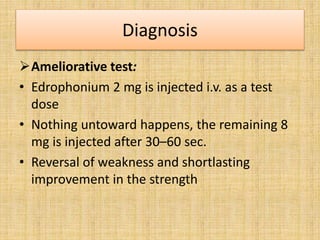
Diagnosis
Ameliorative test:
• Edrophonium 2 mg is injected i.v. as a test
dose
• Nothing untoward happens, the remaining 8
mg is injected after 30–60 sec.
• Reversal of weakness and shortlasting
improvement in the strength
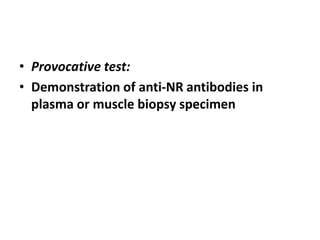
• Provocative test:
• Demonstration of anti-NR antibodies in
plasma or muscle biopsy specimen
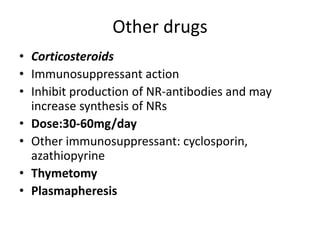
Other drugs
• Corticosteroids
• Immunosuppressant action
• Inhibit production of NR-antibodies and may
increase synthesis of NRs
• Dose:30-60mg/day
• Other immunosuppressant: cyclosporin,
azathiopyrine
• Thymetomy
• Plasmapheresis
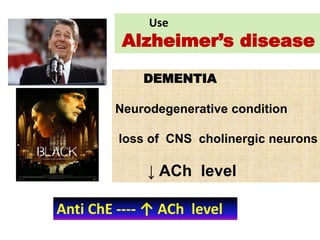
Use
Alzheimer’s disease
DEMENTIA
Neurodegenerative condition
loss of CNS cholinergic neurons
↓ ACh level
Anti ChE ---- ↑ ACh level
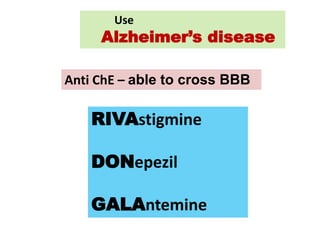
Use
Alzheimer’s disease
RIVAstigmine
DONepezil
GALAntemine
Anti ChE – able to cross BBB
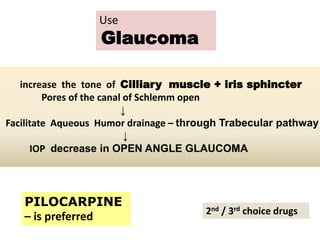
increase the tone of Cilliary muscle + iris sphincter
Pores of the canal of Schlemm open
↓
Facilitate Aqueous Humor drainage – through Trabecular pathway
↓
IOP decrease in OPEN ANGLE GLAUCOMA
PILOCARPINE
– is preferred 2nd / 3rd choice drugs
Use
Glaucoma
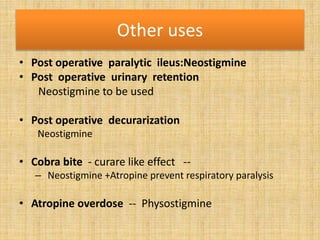
Other uses
• Post operative paralytic ileus:Neostigmine
• Post operative urinary retention
Neostigmine to be used
• Post operative decurarization
Neostigmine
• Cobra bite - curare like effect --
– Neostigmine +Atropine prevent respiratory paralysis
• Atropine overdose -- Physostigmine
Other uses
Other drug overdosages
• Tricyclic antidepressants, phenothiazines
• Additional anticholinergic property
Organophosphrus poisoning
• Easily available
• Extensively used as agricultural and household
insecticides
• Accidental as well as suicidal and homicidal
poisoning is common.
• Local muscarinic manifestations at the site of
exposure (skin, eye, g.i.t.) occur immediately
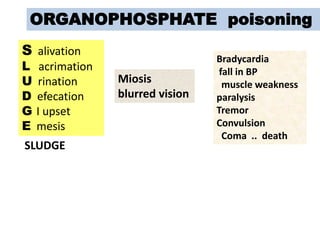
S alivation
L acrimation
U rination
D efecation
G I upset
E mesis
Miosis
blurred vision
Bradycardia
fall in BP
muscle weakness
paralysis
Tremor
Convulsion
Coma .. death
ORGANOPHOSPHATE poisoning
SLUDGE
General measures
Termination of further exposure to the
poison—
• fresh air,
• Wash the skin and mucous membranes with
soap and water,
• Gastric lavage according to need
Maintain patent airway, positive pressure
respiration
Contd.
Supportive measures—
• maintain BP
• hydration
• control of convulsions with diazepam
Specific antidote
Atropine
• Highly effective in counteracting the
muscarinic symptom
• Higher doses are required to antagonize the
central effects
• Does not reverse peripheral muscular
paralysis
Atropine 2 mg i.v. repeated every 10 min till dryness of
mouth or other signs of atropinization appear
Contd.
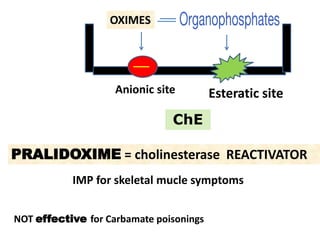
Cholinesterase reactivators
• Oximes are used
• Pralidoxime
• Restore neuromuscular transmission only in
case of organophosphate anti-ChE poisoning
• Dose: 1-2 gm i.v
Anionic site Esteratic site
ChE
OXIMES
PRALIDOXIME = cholinesterase REACTIVATOR
NOT effective for Carbamate poisonings
IMP for skeletal mucle symptoms
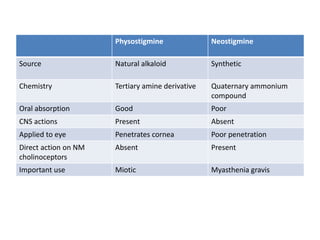
Physostigmine Neostigmine
Source Natural alkaloid Synthetic
Chemistry Tertiary amine derivative Quaternary ammonium
compound
Oral absorption Good Poor
CNS actions Present Absent
Applied to eye Penetrates cornea Poor penetration
Direct action on NM
cholinoceptors
Absent Present
Important use Miotic Myasthenia gravis
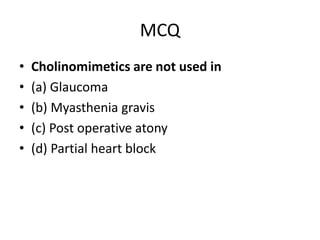
MCQ
• Cholinomimetics are not used in
• (a) Glaucoma
• (b) Myasthenia gravis
• (c) Post operative atony
• (d) Partial heart block
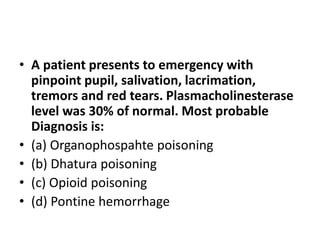
• A patient presents to emergency with
pinpoint pupil, salivation, lacrimation,
tremors and red tears. Plasmacholinesterase
level was 30% of normal. Most probable
Diagnosis is:
• (a) Organophospahte poisoning
• (b) Dhatura poisoning
• (c) Opioid poisoning
• (d) Pontine hemorrhage
• Which of the following cranical nerve does
not contain parasympathetic motor (GVE)
fibers?
• (a) III
• (b) VI
• (c) IX
• (d) X
• Major neurotransmitter released at end
organ effectors of the sympathic division of
the autonomic nervous system is:
• (a) Adrenaline
• (b) Noradrenaline
• (c) Dopamine
• (d) Acetylcholine
• Mechanism of action of pralidoxime is:
• (a) Stimulation of ACh receptors
• (b) Inhibition of breakdown of ACh
• (c) Blockade of ACh receptors
• (d) Reactivation of AChE enzyme
• Dr Sunil used edrophonium for differentiating
myasthenic crisis from cholinergic crisis. He
preferred it over other anticholinesterase
agents because of its:
• (a) Shorter duration of action
• (b) Longer duration of action
• (c) Direct action on muscle end plate
• (d) Selective inhibition of true cholinesterase
• All of the following effects are seen with
cholinergic muscarinic receptor stimulation
except:
• (a) Sweating
• (b) Rise in blood pressure
• (c) Bradycardia
• (d) Urination
• A patient Raj Kishore was given pilocarpine.
All of the following can be the features seen
in him except:
• (a) Sweating
• (b) Salivation
• (c) Miosis
• (d) Cycloplegia
• Which of the following provides the best
explanation for neostigmine being preferred
over physostigmine for treating myasthenia
gravis?
• (a) It is better absorbed orally
• (b) It has longer duration of action
• (c) It has additional direct agonistic action on
nicotinic receptors at the muscle end plate
• (d) It penetrates blood brain barrier
• Which of the following properties make
pyridostigmine different from neostigmine?
• (a) It is more potent
• (b) It is longer acting
• (c) It produces less muscarinic side effects
• (d) It does not have any direct action on NM
receptors
•THANK YOU
Cholinergic drugs

Cholinergic drugs

  • 1.
  • 2.
  • 4.
    M 1 Ganglia :depolarization Gastric Glands :secretion CNS- learning memory, motor function M 2 HEART - inhibitory action ↓HR ↓ AV conduction ↓ atrial contractility M 3 Visceral smooth Muscle - Contraction Iris : pupil constriction Cilliary muscle: contraction Glands – secretion Vascular endothelium: Vasodilatation due to NO GPCR
  • 5.
    NN NM Autonomic ganglia: depolarization Neuromuscular junction:depolarizationof muscle end plate—contraction of skeletal muscle Adrenal medulla: catecholamine release CNS: site specific excitation or inhibition
  • 6.
    Acetytcholinesterase (True) Butyrylcho/inesterase (Pseudo) Distribution All cholinergicsites, ABC, gray matter Plasma, liver, intestine, white matter Hydrolysis Very fast Low Function Termination of ACh action Hydrolysis of ingested esters
  • 7.
    Heart ↓HR ↓ AVconduction ↓ atrial contractility Cholinergic effects M2receptor Blood Vessels – M3 – Vasodilatation BUT Very few vessels supplied – skin of face & neck
  • 8.
    Muscarinic action EYE M3- • contraction ofcircular fibers : Miosis • Contraction of cilliary muscles -- spasm of accommodation (cyclospasm ) Vision fixed for near subjects • Improving patency of trabeculae - outflow of aqueous humor increases IOP - decrease Use in GLAUCOMA - Pilocarpine
  • 9.
    • The irisis composed of two types of muscle fibres, the circular and the radial. The stimulation of parasympathetic cholinergic nerve supplying circular fibbers results into contraction of pupil called miosis. The stimulation of sympathetic adrenergic nerve supplying the radial fibres results into dilatation of pupil called mydriasis. Thus the iris regulates the size of pupil. • The ciliary muscle is innervated by parasympathetic cholinergic nerves. Its contraction reduce the focal length of lens causing accommodation for near vision.
  • 10.
    Muscarinic action GIT –peristalsis ↑ - defecation Use – Post operative paralytic ileus Urinary tract sphincter relax detrusor contract voiding of bladder urination Bronchoconstriction – c/i in Asthma , COPD Use – Post Op urinary retention
  • 11.
    Glands Gastric – acidsecretion - M1 M3 Salivation Lacrimation Sweating Tracheobronchial secretion ↑
  • 12.
    Cholinergic Agonists ACh --rapid degradation by ChEs – not used Methacholine - - Muscarinic action > Nicotinic action Carbachol - - resistant to ChEs M + N action Bethanachol - resistant to ChE - Muscarinic action - git + bladder - used in Rx of POp urinary retention Pilocarpine - alkaloid - marked secretary effect IOP ↓ ---- Used in Glaucoma
  • 13.
    Anticholinesterases - Anti-ChEs CholinesteraseInhibitors ACh Choline + acetic acid ChE Anti-ChEs ↑ACh level – cholinergic effects Reversible Irreversible
  • 14.
    Anionic site Esteraticsite Normal ACh hydrolysis by ChE very fast reaction within milliseconds ACh + ChE ↓ complex ↓ Choline + Acetylated E ↓ H2O Choline + Acetic acid + E
  • 16.
    Anionic site Esteraticsite REVERSIBLE Inhibitors Combines with BOTH sites carbamylated enzyme Hydrolysis --- SLOW ACh action prolonged Structure similar to ACh Effect 3- 4 hrs
  • 17.
    Reversible – antiChEs Carbamates Physostigmine– natural alkaloid Neostigmine Pyridostigmine Rivastigmine Donepazil Galantamine Alzheimer's disease E drophonium – E xception binds ONLY to anionic site – rapid renal elimination action for 10 mins
  • 18.
    Anionic site Esteraticsite IRREVERSIBLE Inhibitors Combines with esteratic site Phosphorylated enzyme But Hydrolysis --- very very SLOW ACh action prolonged Effects depend upon regeneration of new enzymes
  • 19.
    Anionic site Esteraticsite IRREVERSIBLE Inhibitors Combines with esteratic site Phosphorylated enzyme But Hydrolysis --- very very SLOW ACh action prolonged Effects depend upon regeneration of new enzymes
  • 20.
    Dyflos , Parathion, Malathion - insecticide Tabun , Soman – gas IRREVERSIBLE Anti ChEs Carbamate - Propoxur
  • 21.
    Anionic site Esteraticsite IRREVERSIBLE Inhibitors Phosphorylated enzyme Hydrolysis --- total resistance Loss of alkyl group AGING process
  • 22.
    Uses Myasthenia Gravis Autoimmune disorder Antibodyagainst Nm receptor - ↓ no of receptors Weakness , Easy fatigability Neostigmine / Pyridostigmine ACh level ↑ + direct action on muscle end plate But One Problem Overtreatment with Anti ChEs Causes persistent depolarization – WEAKNESS – = cholinergic crisis
  • 24.
    Myasthenia Gravis Crisis =acute worsening of symptoms Myasthenic Crisis = Worsening of disease Cholinergic crisis = overdose of Anti ChE Edrophonium – IV 2 mg Shortest acting Anti ChE Improvement Worsening
  • 25.
    Diagnosis Ameliorative test: • Edrophonium2 mg is injected i.v. as a test dose • Nothing untoward happens, the remaining 8 mg is injected after 30–60 sec. • Reversal of weakness and shortlasting improvement in the strength
  • 26.
    • Provocative test: •Demonstration of anti-NR antibodies in plasma or muscle biopsy specimen
  • 27.
    Other drugs • Corticosteroids •Immunosuppressant action • Inhibit production of NR-antibodies and may increase synthesis of NRs • Dose:30-60mg/day • Other immunosuppressant: cyclosporin, azathiopyrine • Thymetomy • Plasmapheresis
  • 28.
    Use Alzheimer’s disease DEMENTIA Neurodegenerative condition lossof CNS cholinergic neurons ↓ ACh level Anti ChE ---- ↑ ACh level
  • 29.
  • 30.
    increase the toneof Cilliary muscle + iris sphincter Pores of the canal of Schlemm open ↓ Facilitate Aqueous Humor drainage – through Trabecular pathway ↓ IOP decrease in OPEN ANGLE GLAUCOMA PILOCARPINE – is preferred 2nd / 3rd choice drugs Use Glaucoma
  • 31.
    Other uses • Postoperative paralytic ileus:Neostigmine • Post operative urinary retention Neostigmine to be used • Post operative decurarization Neostigmine • Cobra bite - curare like effect -- – Neostigmine +Atropine prevent respiratory paralysis • Atropine overdose -- Physostigmine
  • 32.
    Other uses Other drugoverdosages • Tricyclic antidepressants, phenothiazines • Additional anticholinergic property
  • 33.
    Organophosphrus poisoning • Easilyavailable • Extensively used as agricultural and household insecticides • Accidental as well as suicidal and homicidal poisoning is common. • Local muscarinic manifestations at the site of exposure (skin, eye, g.i.t.) occur immediately
  • 34.
    S alivation L acrimation Urination D efecation G I upset E mesis Miosis blurred vision Bradycardia fall in BP muscle weakness paralysis Tremor Convulsion Coma .. death ORGANOPHOSPHATE poisoning SLUDGE
  • 35.
    General measures Termination offurther exposure to the poison— • fresh air, • Wash the skin and mucous membranes with soap and water, • Gastric lavage according to need Maintain patent airway, positive pressure respiration
  • 36.
    Contd. Supportive measures— • maintainBP • hydration • control of convulsions with diazepam
  • 37.
    Specific antidote Atropine • Highlyeffective in counteracting the muscarinic symptom • Higher doses are required to antagonize the central effects • Does not reverse peripheral muscular paralysis Atropine 2 mg i.v. repeated every 10 min till dryness of mouth or other signs of atropinization appear
  • 38.
    Contd. Cholinesterase reactivators • Oximesare used • Pralidoxime • Restore neuromuscular transmission only in case of organophosphate anti-ChE poisoning • Dose: 1-2 gm i.v
  • 39.
    Anionic site Esteraticsite ChE OXIMES PRALIDOXIME = cholinesterase REACTIVATOR NOT effective for Carbamate poisonings IMP for skeletal mucle symptoms
  • 40.
    Physostigmine Neostigmine Source Naturalalkaloid Synthetic Chemistry Tertiary amine derivative Quaternary ammonium compound Oral absorption Good Poor CNS actions Present Absent Applied to eye Penetrates cornea Poor penetration Direct action on NM cholinoceptors Absent Present Important use Miotic Myasthenia gravis
  • 41.
    MCQ • Cholinomimetics arenot used in • (a) Glaucoma • (b) Myasthenia gravis • (c) Post operative atony • (d) Partial heart block
  • 42.
    • A patientpresents to emergency with pinpoint pupil, salivation, lacrimation, tremors and red tears. Plasmacholinesterase level was 30% of normal. Most probable Diagnosis is: • (a) Organophospahte poisoning • (b) Dhatura poisoning • (c) Opioid poisoning • (d) Pontine hemorrhage
  • 43.
    • Which ofthe following cranical nerve does not contain parasympathetic motor (GVE) fibers? • (a) III • (b) VI • (c) IX • (d) X
  • 44.
    • Major neurotransmitterreleased at end organ effectors of the sympathic division of the autonomic nervous system is: • (a) Adrenaline • (b) Noradrenaline • (c) Dopamine • (d) Acetylcholine
  • 45.
    • Mechanism ofaction of pralidoxime is: • (a) Stimulation of ACh receptors • (b) Inhibition of breakdown of ACh • (c) Blockade of ACh receptors • (d) Reactivation of AChE enzyme
  • 46.
    • Dr Sunilused edrophonium for differentiating myasthenic crisis from cholinergic crisis. He preferred it over other anticholinesterase agents because of its: • (a) Shorter duration of action • (b) Longer duration of action • (c) Direct action on muscle end plate • (d) Selective inhibition of true cholinesterase
  • 47.
    • All ofthe following effects are seen with cholinergic muscarinic receptor stimulation except: • (a) Sweating • (b) Rise in blood pressure • (c) Bradycardia • (d) Urination
  • 48.
    • A patientRaj Kishore was given pilocarpine. All of the following can be the features seen in him except: • (a) Sweating • (b) Salivation • (c) Miosis • (d) Cycloplegia
  • 49.
    • Which ofthe following provides the best explanation for neostigmine being preferred over physostigmine for treating myasthenia gravis? • (a) It is better absorbed orally • (b) It has longer duration of action • (c) It has additional direct agonistic action on nicotinic receptors at the muscle end plate • (d) It penetrates blood brain barrier
  • 50.
    • Which ofthe following properties make pyridostigmine different from neostigmine? • (a) It is more potent • (b) It is longer acting • (c) It produces less muscarinic side effects • (d) It does not have any direct action on NM receptors
  • 51.

Editor's Notes

  • #23 Edrophonium – shortest Test Help in differentiating Cholinergic Crisis or Myasthenic Crisis Inject → if improvement - - Myasthenic Crisis ↓ if worsening - - Cholinergic crisis
  • #25 Edrophonium action – 10 -20 mins Edrophonium test for differentiating CRISIS in Myasthenia Gravis Crisis in Myasthenia are of 2 types Myasthenic Crisis= Worsening of disease 2 . Cholinergic crisis = overdose of Anti ChE To differentiate that Edrophonium is given IV = Shortest acting Anti ChE If improvement occurs --- Myasthenic Crisis If worsening occurs -- Cholinergic Crisis ( dose of Neostigmine / Pyridostigmine has to be reduced )
  • #35 S alivation L acrimation U rination D efecation G I upset E mesis SLUDGE + Miosis At toxic dose Bradycardia fall in BP muscle weakness paralysis Tremor Convulsion Coma .. death Specific antidote - Atropine In case of OP poisoning Pralidoxime -- ChE reactivator to restore transmission at Neuromuscular junction Not used in Carbamate overdose
  • #40 Atropine is virtually without effect against the peripheral neuromuscular compromise