PART-I
Mr. Manojkumar K. Munde
Asst.Prof. Pharmaceutical Chemistry
PES Modern College of Pharmacy (for Ladies), Pune, MS, India
9/15/2019 M K Munde 1
ADRENERGIC DRUGS
The sympathetic system activates and prepares the body for vigorous
muscular activity, stress, and emergencies.
Adrenergic drugs stimulate the adrenergic nerves directly by mimicking the
action of nor-epinephrine or indirectly by stimulating the release of nor-
epinephrine.
Therapeutically, these drugs are used to combat life-threatening disorders,
which include acute attacks of bronchial asthma, shock, cardiac arrest, and
allergic reactions. In addition these drugs are used as nasal decongestants and
appetite suppressants.
ADRENERGIC DRUGS
9/15/2019 2M K Munde
Adrenergic nerves release the neurotransmitters; Norepinephrine
(noradrenaline, (NE)), epinephrine (EP), and dopamine (DA)).
Norepinephrine is released from the nerve ending in response to a nerve
impulse or drug .
NE interacts with alpha and beta-receptor sites.
Its receptor action is terminated by recapture and storage in the original
nerve ending or inactivated by an enzyme.
9/15/2019 3M K Munde
9/15/2019 4M K Munde
9/15/2019 5M K Munde
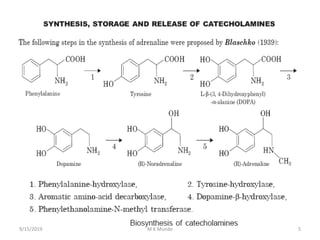
Five enzymes are involved in the pathway of the biosynthesis of adrenaline. The
first enzyme is the iron containing phenylalanine-hydroxylase (also called
phenylalanine-4- monooxygenase).
The second enzyme, tyrosine-hydroxylase, contains iron, too, and catalyses the
conversion of tyrosine to L-β-(3,4-dihydroxyphenyl)-α-alanine (DOPA). After
decarboxylation of DOPA to dopamine (aromatic amino-acid decarboxylase) the
copper-containing enzyme dopamine-β-hydroxylase converts dopamine to
noradrenaline.
The final enzyme noradrenaline- N-methyltransferase then methylates
noradrenaline to adrenaline.
9/15/2019 6M K Munde
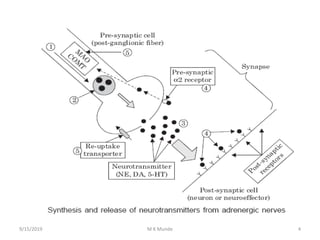
The noradrenaline formed in the adrenergic nerve endings remain stored in
vesicles as its adenosine triphosphate complex.
The adrenal medulla also synthesizes and stores noradrenaline and
adrenaline.
The neurotransmitters are released by increasing the permeability of nerve
terminal membrane to Ca++.
The inflow of Ca++ triggers the fusion of vesicle with the cell membrane,
resulting in exocytosis.
9/15/2019 7M K Munde
The actions of adrenaline and noradrenaline are terminated by three processes
1. Re-uptake into the nerve terminal
2. Dilution by diffusion from the junctional cleft and uptake at non-neuronal sites, and
3. Metabolic transformation
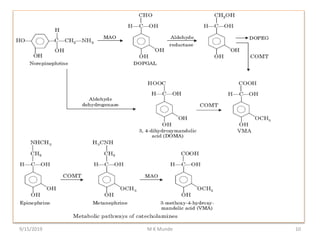
Two enzymes namely monoaminooxidase (MAO) and catechol-o-methyl transferase
(COMT) are important in the biotransformations of catecholamines.
COMT and MAO are distributed widely throughout the body, including the brain the
highest concentrations of each are found in the liver and kidney.
They differ in their cytosolic locations.
89/15/2019 M K Munde
NE released intraneurally is initially deaminated by MAO to 3,4-
dihydroxyphenylglycoaldehyde (DOPGAL).
The aldehyde group is reduced to glycol by aldehyde reductase, yielding 3,4-
dihydroxy-phenylethylene glycol (DOPEG).
Aldehyde dehydrogenase converts 3,4- dihydroxyphenyl glycolaldehyde to 3,4-
dihydroxy-mandelic acid (DOMA).
The final common metabolites formed by the action of COMT are DOMA (3-
methoxy-4-hydroxy mandelic acid) is VMA (3-methoxy-4 hydroxymandelic acid).
9/15/2019 9M K Munde
9/15/2019 10M K Munde
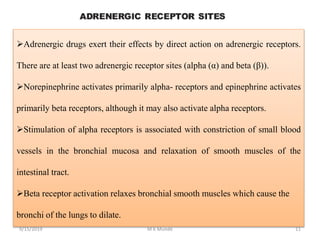
Adrenergic drugs exert their effects by direct action on adrenergic receptors.
There are at least two adrenergic receptor sites (alpha (α) and beta (β)).
Norepinephrine activates primarily alpha- receptors and epinephrine activates
primarily beta receptors, although it may also activate alpha receptors.
Stimulation of alpha receptors is associated with constriction of small blood
vessels in the bronchial mucosa and relaxation of smooth muscles of the
intestinal tract.
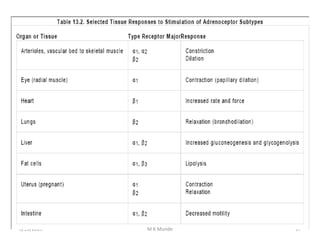
Beta receptor activation relaxes bronchial smooth muscles which cause the
bronchi of the lungs to dilate.
9/15/2019 11M K Munde
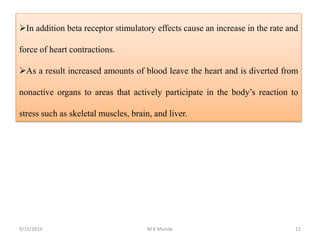
In addition beta receptor stimulatory effects cause an increase in the rate and
force of heart contractions.
As a result increased amounts of blood leave the heart and is diverted from
nonactive organs to areas that actively participate in the body’s reaction to
stress such as skeletal muscles, brain, and liver.
9/15/2019 12M K Munde
ALPHA RECEPTOR SITE
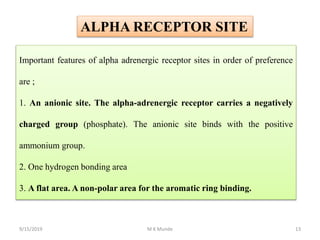
Important features of alpha adrenergic receptor sites in order of preference
are ;
1. An anionic site. The alpha-adrenergic receptor carries a negatively
charged group (phosphate). The anionic site binds with the positive
ammonium group.
2. One hydrogen bonding area
3. A flat area. A non-polar area for the aromatic ring binding.
9/15/2019 13M K Munde
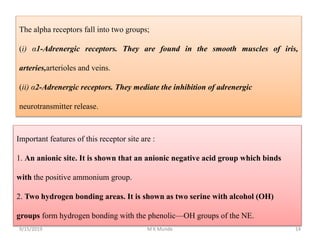
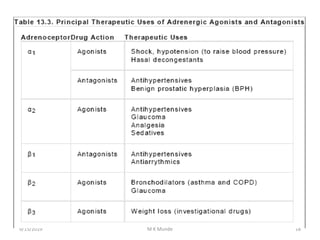
The alpha receptors fall into two groups;
(i) α1-Adrenergic receptors. They are found in the smooth muscles of iris,
arteries,arterioles and veins.
(ii) α2-Adrenergic receptors. They mediate the inhibition of adrenergic
neurotransmitter release.
Important features of this receptor site are :
1. An anionic site. It is shown that an anionic negative acid group which binds
with the positive ammonium group.
2. Two hydrogen bonding areas. It is shown as two serine with alcohol (OH)
groups form hydrogen bonding with the phenolic—OH groups of the NE.
9/15/2019 14M K Munde
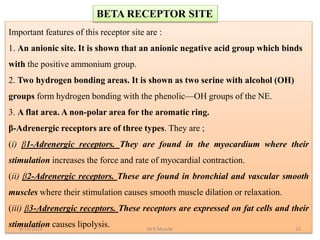
Important features of this receptor site are :
1. An anionic site. It is shown that an anionic negative acid group which binds
with the positive ammonium group.
2. Two hydrogen bonding areas. It is shown as two serine with alcohol (OH)
groups form hydrogen bonding with the phenolic—OH groups of the NE.
3. A flat area. A non-polar area for the aromatic ring.
β-Adrenergic receptors are of three types. They are ;
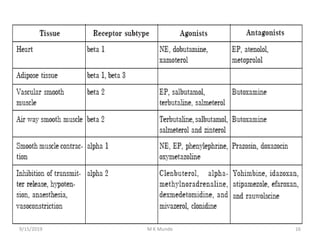
(i) β1-Adrenergic receptors. They are found in the myocardium where their
stimulation increases the force and rate of myocardial contraction.
(ii) β2-Adrenergic receptors. These are found in bronchial and vascular smooth
muscles where their stimulation causes smooth muscle dilation or relaxation.
(iii) β3-Adrenergic receptors. These receptors are expressed on fat cells and their
stimulation causes lipolysis.
BETA RECEPTOR SITE
9/15/2019 15M K Munde
9/15/2019 16M K Munde
9/15/2019 17M K Munde
9/15/2019 18M K Munde

Adrenergic drugs part-I

  • 1.
    PART-I Mr. Manojkumar K.Munde Asst.Prof. Pharmaceutical Chemistry PES Modern College of Pharmacy (for Ladies), Pune, MS, India 9/15/2019 M K Munde 1 ADRENERGIC DRUGS
  • 2.
    The sympathetic systemactivates and prepares the body for vigorous muscular activity, stress, and emergencies. Adrenergic drugs stimulate the adrenergic nerves directly by mimicking the action of nor-epinephrine or indirectly by stimulating the release of nor- epinephrine. Therapeutically, these drugs are used to combat life-threatening disorders, which include acute attacks of bronchial asthma, shock, cardiac arrest, and allergic reactions. In addition these drugs are used as nasal decongestants and appetite suppressants. ADRENERGIC DRUGS 9/15/2019 2M K Munde
  • 3.
    Adrenergic nerves releasethe neurotransmitters; Norepinephrine (noradrenaline, (NE)), epinephrine (EP), and dopamine (DA)). Norepinephrine is released from the nerve ending in response to a nerve impulse or drug . NE interacts with alpha and beta-receptor sites. Its receptor action is terminated by recapture and storage in the original nerve ending or inactivated by an enzyme. 9/15/2019 3M K Munde
  • 4.
  • 5.
  • 6.
    Five enzymes areinvolved in the pathway of the biosynthesis of adrenaline. The first enzyme is the iron containing phenylalanine-hydroxylase (also called phenylalanine-4- monooxygenase). The second enzyme, tyrosine-hydroxylase, contains iron, too, and catalyses the conversion of tyrosine to L-β-(3,4-dihydroxyphenyl)-α-alanine (DOPA). After decarboxylation of DOPA to dopamine (aromatic amino-acid decarboxylase) the copper-containing enzyme dopamine-β-hydroxylase converts dopamine to noradrenaline. The final enzyme noradrenaline- N-methyltransferase then methylates noradrenaline to adrenaline. 9/15/2019 6M K Munde
  • 7.
    The noradrenaline formedin the adrenergic nerve endings remain stored in vesicles as its adenosine triphosphate complex. The adrenal medulla also synthesizes and stores noradrenaline and adrenaline. The neurotransmitters are released by increasing the permeability of nerve terminal membrane to Ca++. The inflow of Ca++ triggers the fusion of vesicle with the cell membrane, resulting in exocytosis. 9/15/2019 7M K Munde
  • 8.
    The actions ofadrenaline and noradrenaline are terminated by three processes 1. Re-uptake into the nerve terminal 2. Dilution by diffusion from the junctional cleft and uptake at non-neuronal sites, and 3. Metabolic transformation Two enzymes namely monoaminooxidase (MAO) and catechol-o-methyl transferase (COMT) are important in the biotransformations of catecholamines. COMT and MAO are distributed widely throughout the body, including the brain the highest concentrations of each are found in the liver and kidney. They differ in their cytosolic locations. 89/15/2019 M K Munde
  • 9.
    NE released intraneurallyis initially deaminated by MAO to 3,4- dihydroxyphenylglycoaldehyde (DOPGAL). The aldehyde group is reduced to glycol by aldehyde reductase, yielding 3,4- dihydroxy-phenylethylene glycol (DOPEG). Aldehyde dehydrogenase converts 3,4- dihydroxyphenyl glycolaldehyde to 3,4- dihydroxy-mandelic acid (DOMA). The final common metabolites formed by the action of COMT are DOMA (3- methoxy-4-hydroxy mandelic acid) is VMA (3-methoxy-4 hydroxymandelic acid). 9/15/2019 9M K Munde
  • 10.
  • 11.
    Adrenergic drugs exerttheir effects by direct action on adrenergic receptors. There are at least two adrenergic receptor sites (alpha (α) and beta (β)). Norepinephrine activates primarily alpha- receptors and epinephrine activates primarily beta receptors, although it may also activate alpha receptors. Stimulation of alpha receptors is associated with constriction of small blood vessels in the bronchial mucosa and relaxation of smooth muscles of the intestinal tract. Beta receptor activation relaxes bronchial smooth muscles which cause the bronchi of the lungs to dilate. 9/15/2019 11M K Munde
  • 12.
    In addition betareceptor stimulatory effects cause an increase in the rate and force of heart contractions. As a result increased amounts of blood leave the heart and is diverted from nonactive organs to areas that actively participate in the body’s reaction to stress such as skeletal muscles, brain, and liver. 9/15/2019 12M K Munde
  • 13.
    ALPHA RECEPTOR SITE Importantfeatures of alpha adrenergic receptor sites in order of preference are ; 1. An anionic site. The alpha-adrenergic receptor carries a negatively charged group (phosphate). The anionic site binds with the positive ammonium group. 2. One hydrogen bonding area 3. A flat area. A non-polar area for the aromatic ring binding. 9/15/2019 13M K Munde
  • 14.
    The alpha receptorsfall into two groups; (i) α1-Adrenergic receptors. They are found in the smooth muscles of iris, arteries,arterioles and veins. (ii) α2-Adrenergic receptors. They mediate the inhibition of adrenergic neurotransmitter release. Important features of this receptor site are : 1. An anionic site. It is shown that an anionic negative acid group which binds with the positive ammonium group. 2. Two hydrogen bonding areas. It is shown as two serine with alcohol (OH) groups form hydrogen bonding with the phenolic—OH groups of the NE. 9/15/2019 14M K Munde
  • 15.
    Important features ofthis receptor site are : 1. An anionic site. It is shown that an anionic negative acid group which binds with the positive ammonium group. 2. Two hydrogen bonding areas. It is shown as two serine with alcohol (OH) groups form hydrogen bonding with the phenolic—OH groups of the NE. 3. A flat area. A non-polar area for the aromatic ring. β-Adrenergic receptors are of three types. They are ; (i) β1-Adrenergic receptors. They are found in the myocardium where their stimulation increases the force and rate of myocardial contraction. (ii) β2-Adrenergic receptors. These are found in bronchial and vascular smooth muscles where their stimulation causes smooth muscle dilation or relaxation. (iii) β3-Adrenergic receptors. These receptors are expressed on fat cells and their stimulation causes lipolysis. BETA RECEPTOR SITE 9/15/2019 15M K Munde
  • 16.
  • 17.
  • 18.