Introduction to
Autonomic Pharmacology
- DR. JERIN
 Autonomic nervous system innervates the heart, smooth muscle,
the glands & the viscera.
 Centres for the autonomic reflexes are present in the
hypothalamus, medulla & spinal cord.
 Hypothalamus coordinates the autonomic activity.
 Two major division : sympathetic & parasympathetic.
 These 2 divisions have opposing effects & normally their effects
are in a state of equilibrium.
 Sympathetic : flight & fight
 Parasympathetic : tissue building [rest & digest / feed & breed]
 The sympathetic divisions arise from thoracolumbar
region (T1 – L3 ) thoracolumbar outflow.
 Parasympathetic divisions arise from 2 regions.
Cranial outflow : Cranial nerves III, VII, IX & X
Sacral outflow : S2, S3 & S4
CHOLINERGIC SYSTEM
Introduction
 Acetylcholine is the neurotransmitter of parasympathetic
nervous system.
 Acetylcholine is the neurotransmitter of cholinergic system.
 The nerves that synthesize, stores & release acetylcholine are
called cholinergic.
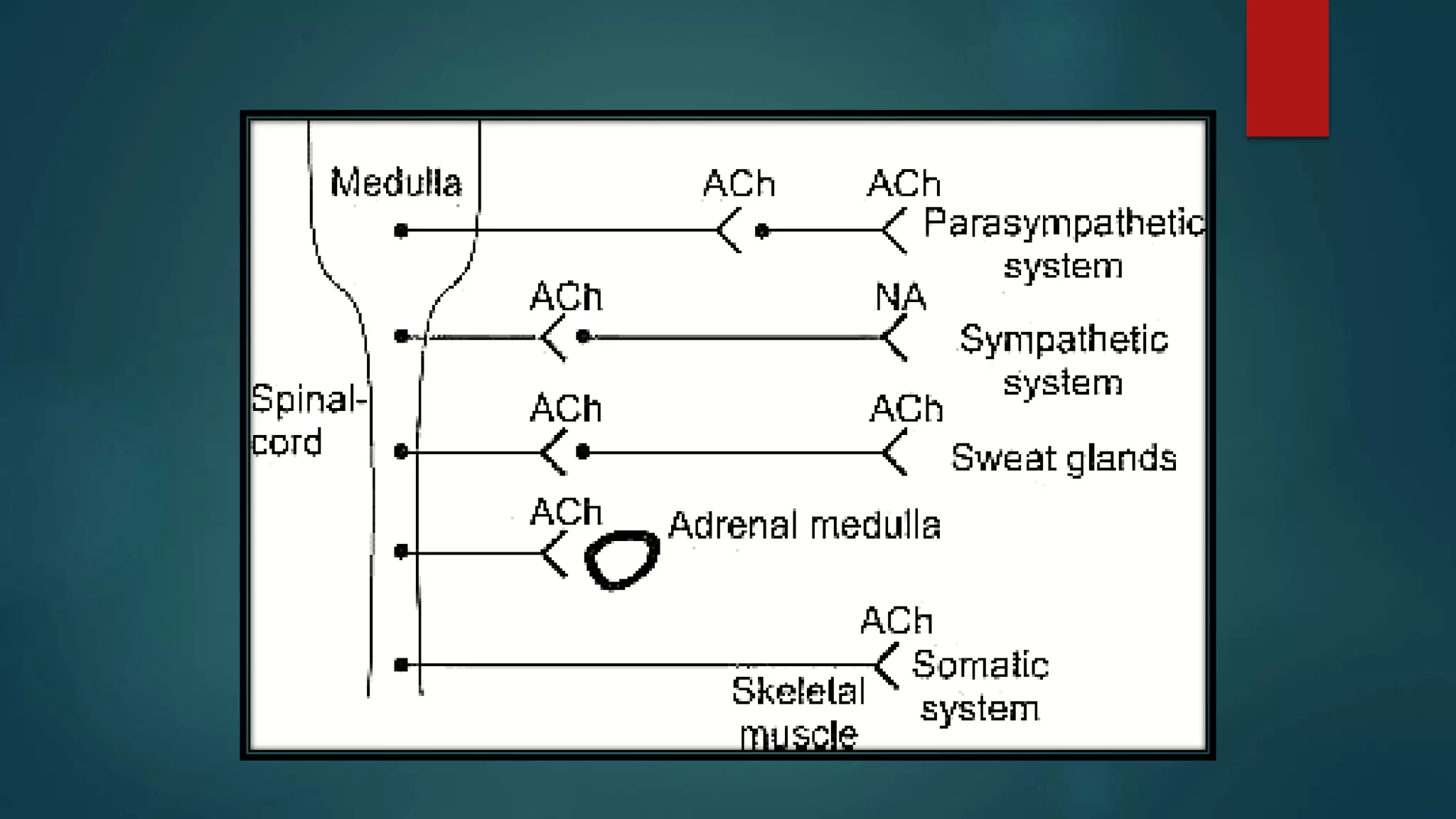
Sites of release of acetylcholine
1. All preganglionic fibres of ANS : both sympathetic &
parasympathetic ganglia
2. Postganglionic parasympathetic nerve endings
3. Sweat glands : the sympathetic postganglionic nerve endings
supplying the sweat glands
4. Skeletal muscles : somatic nerve endings supplying skeletal
muscles
5. Adrenal medulla
6. CNS : brain & spinal cord
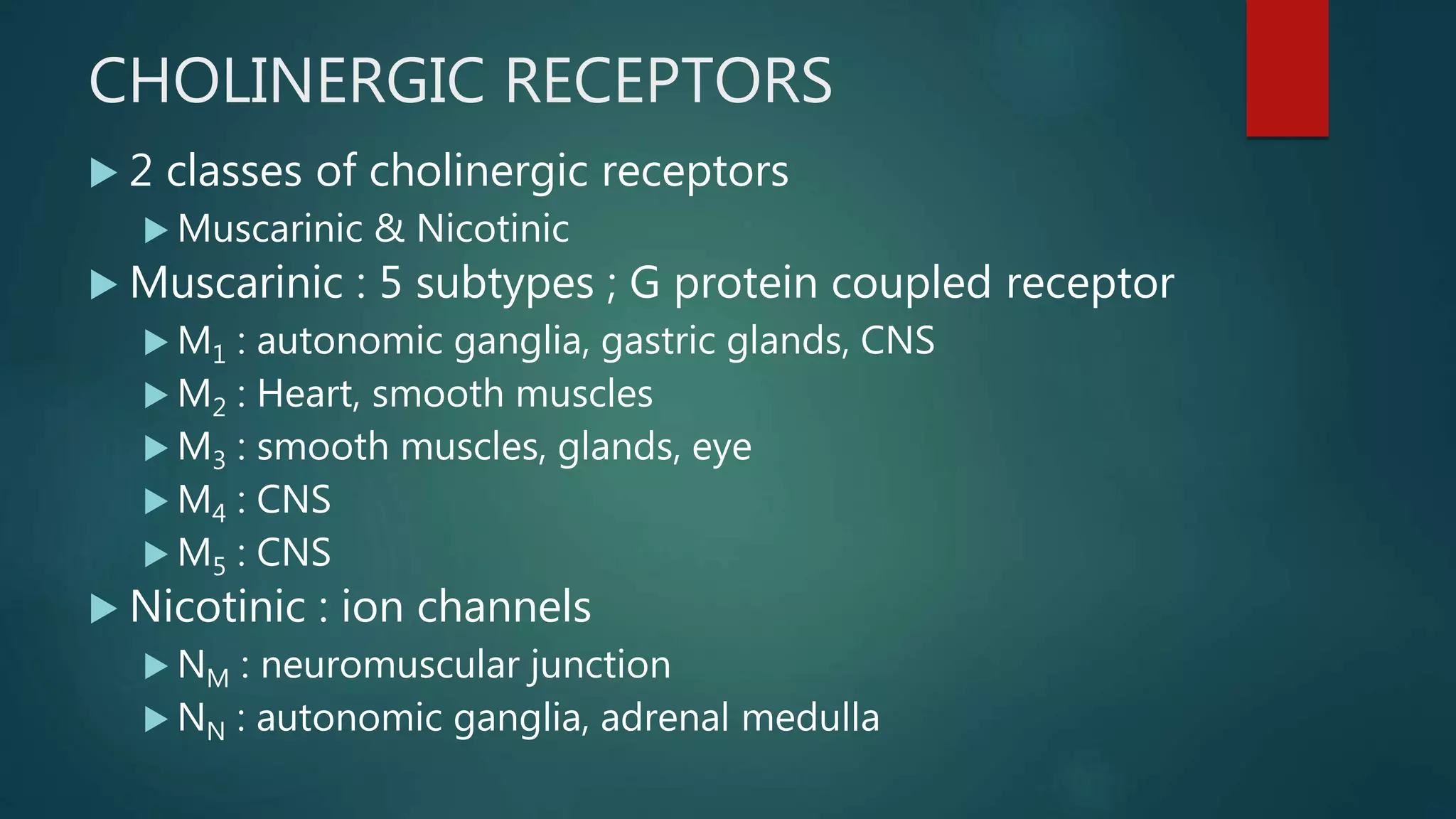
CHOLINERGIC RECEPTORS
 2 classes of cholinergic receptors
 Muscarinic & Nicotinic
 Muscarinic : 5 subtypes ; G protein coupled receptor
 M1 : autonomic ganglia, gastric glands, CNS
 M2 : Heart, smooth muscles
 M3 : smooth muscles, glands, eye
 M4 : CNS
 M5 : CNS
 Nicotinic : ion channels
 NM : neuromuscular junction
 NN : autonomic ganglia, adrenal medulla
Esters of
choline
• Acetylcholine
• Methacholine
• Carbachol
• Bethanechol
Cholinomimetic
alkaloids
• Pilocarpine
• Muscarine
• Arecoline
Carbamates
• Neostigmine
• Pyridostigmine
• Edrophonium
• Physostigmine
• Galantamine
• Ambenonium
Acridine
• Tacrine
Organo-
phosphorus
compound
• Parathion
• Malathion
• Echothiophate
• Sumithion
• Dyflos
• Toxic nerve
gas
• Sarin
• Tabun
Carbamate
insecticide
• Carbaryl
(SEVIN)
• Aldicarb
(TEMIK)
• Propoxure
(BAYGON)
Directly acting Indirectly acting
(anticholinesterases)
Reversible Irreversible
Acetylcholine
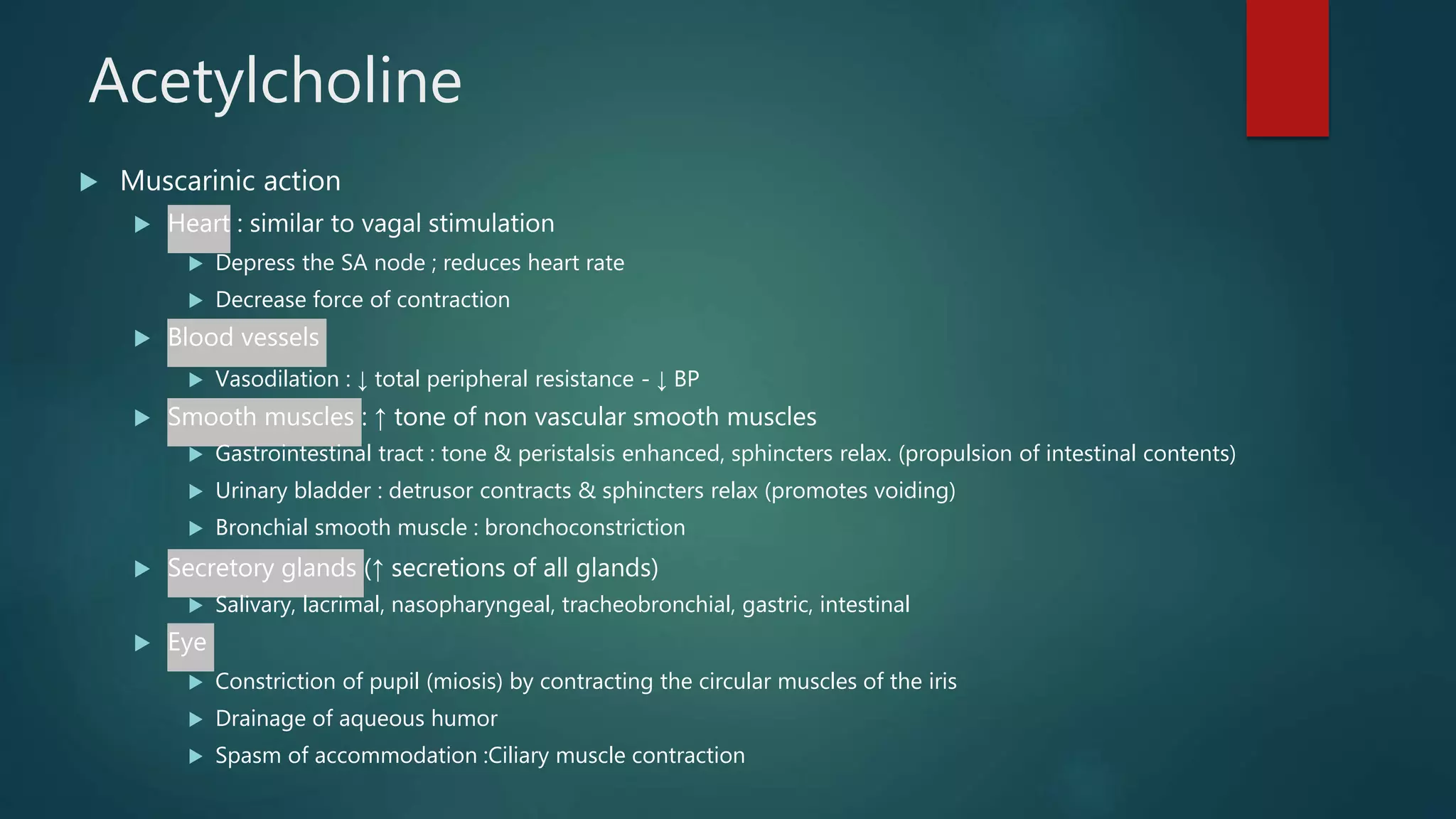
 Muscarinic action
 Heart : similar to vagal stimulation
 Depress the SA node ; reduces heart rate
 Decrease force of contraction
 Blood vessels
 Vasodilation : ↓ total peripheral resistance - ↓ BP
 Smooth muscles : ↑ tone of non vascular smooth muscles
 Gastrointestinal tract : tone & peristalsis enhanced, sphincters relax. (propulsion of intestinal contents)
 Urinary bladder : detrusor contracts & sphincters relax (promotes voiding)
 Bronchial smooth muscle : bronchoconstriction
 Secretory glands (↑ secretions of all glands)
 Salivary, lacrimal, nasopharyngeal, tracheobronchial, gastric, intestinal
 Eye
 Constriction of pupil (miosis) by contracting the circular muscles of the iris
 Drainage of aqueous humor
 Spasm of accommodation :Ciliary muscle contraction
 Nicotinic actions
 Neuromuscular junction
 Contraction of skeletal muscles
 Prolonged : paralysis
 Autonomic ganglia
 Stimulate sympathetic & parasympathetic ganglia & adrenal medulla
 CNS
 Ach does not cross BBB. Hence no CNS effect
 Acetylcholine is rapidly destroyed in gut, when given orally.
 IV administration : rapidly metabolised by pseudocholinesterase
in plasma & true cholinesterase at the site of action.
 Occasionally used as 1% eye drops to produce miosis.
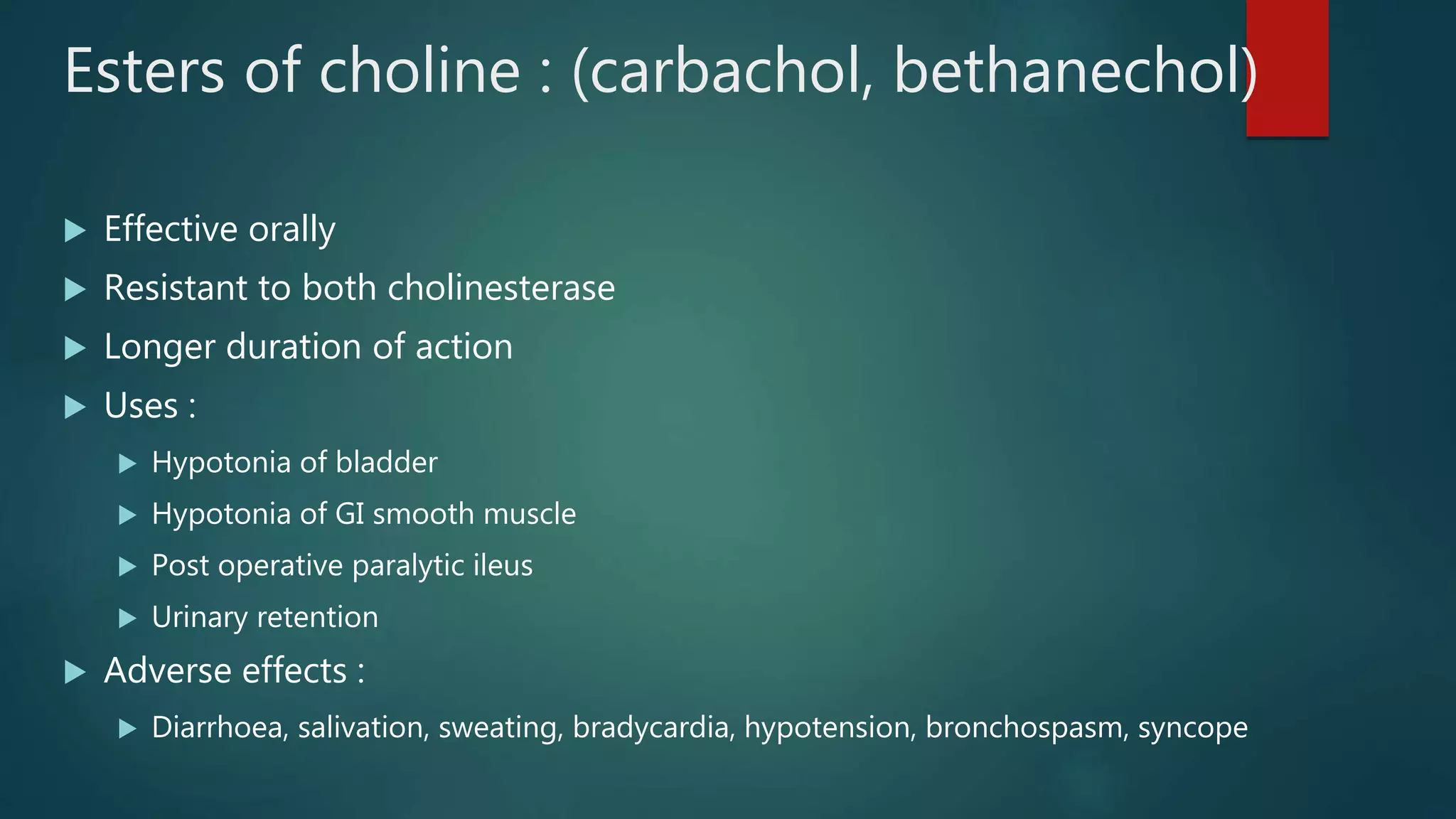
Esters of choline : (carbachol, bethanechol)
 Effective orally
 Resistant to both cholinesterase
 Longer duration of action
 Uses :
 Hypotonia of bladder
 Hypotonia of GI smooth muscle
 Post operative paralytic ileus
 Urinary retention
 Adverse effects :
 Diarrhoea, salivation, sweating, bradycardia, hypotension, bronchospasm, syncope
Cholinomimetic alkaloids
Pilocarpine :
 Obtained from Pilocarpus microphyllus
 Tertiary amine, crosses BBB & cause CNS effects.
Actions :
 Muscarinic actions are more potent.
 Action on eyes are important
 Constriction of pupil (MIOSIS)
 Drainage of aqueous humor (↓ intraocular pressure)
 Contraction of ciliary muscle (spasm of accommodation)
 ↑ sweat (diaphoretic) ; ↑ salivary secretion (sialogogue)
 ↓ BP in therapeutic doses & ↑ BP & tachycardia in higher doses
Uses :
 Glaucoma : eye drops or ocusert
 Used alternately with mydriatics to break the adhesion between
iris & lens
 Dryness of mouth : radiation of head & neck
 Sjogren’s syndrome : dryness of mouth & lack of tears
Adverse effects :
 Eye drops :
burning sensation & painful spasm of accommodation, corneal edema
Long term use : retinal detachment
 Systemic use :
salivation, sweating, bradycardia, diarrhoea & bronchospasm
Indirectly acting cholinergic drugs :
Anticholinesterase :
 These drugs inhibit cholinesterase.
 MOA :
 They are structurally similar to ACh ; thus they bind to acetylcholinesterase &
inactivate them.
 This prevents the hydrolysis of ACh & accumulation of ACh.
 Thus ↑ its activity
 Acetylcholinesterase contains Anionic & Esteratic site.
 Acetylcholine & reversible anticholinesterase(except edrophonium)
bind to both anionic & esteratic site.
 Edrophonium binds to anionic site only. Its binding is quickly
reversible. Hence its very short acting.
 Organophosphorus compounds bind only to esteratic site. But the
enzyme gets phosphorylated (by covalent bond). Hence its stable.
Physostigmine :
 Obtained from Physostigma venenosum
 Its lipid soluble, tertiary ammonium compound : hence has better
penetration into tissue & crosses BBB.
Uses :
 Glaucoma
 Atropine & tricyclic antidepressant poisoning
Neostigmine
 Synthetic quaternary ammonium compound : poorly absorbed
from gut ; does not cross BBB.
Uses :
 Myasthenia gravis
 Post operative ileus
 Atony of urinary bladder
 Edrophonium
• Quaternary ammonium compound
• Binds only to anionic site
• Rapid & short acting (10-20min)
Use :
• diagnosis of Myasthenia gravis
• intravenously : snake bite & curare poisoning
• Edrophonium test : differentiate myasthenic crisis from cholinergic crisis.
on administering edrophonium 2mg IV
• If symptoms worsens : Cholinergic crisis – Rx. Atropine
• If symptoms improve : Myasthenic crisis – Rx. AntiChE
 Rivastigmine :
Longer acting carbamate
Selectively binds to AChE in the brain
Use : Rx of mild to moderate Alzheimer’s
 Pyridostigmine :
Used in myasthenia gravis
Organophosphorus poisoning
 Symptoms :
 Vomiting
 Abdominal cramps
 Diarrhoea
 Miosis
 ↑ Sweating
 ↑ salivation
 ↑ tracheal & bronchial
secretion
 Hypotension
 Muscular twitching, weakness
 convulsions
Treatment :
 Poisoning through skin :
 Remove clothing & wash skin with soap & water
 If consumed orally :
 Gastric lavage
 Patient should be put in prone position to avoid aspiration of
secretions.
 Maintain BP & airways patent
 DRUG OF CHOICE : ATROPINE IV 2mg every 10min till pupil dilates.
 Cholinesterase reactivators : Pralidoxime, obidoxime, diacteylmonoxime

Cholinergic system

  • 1.
  • 3.
     Autonomic nervoussystem innervates the heart, smooth muscle, the glands & the viscera.  Centres for the autonomic reflexes are present in the hypothalamus, medulla & spinal cord.  Hypothalamus coordinates the autonomic activity.  Two major division : sympathetic & parasympathetic.  These 2 divisions have opposing effects & normally their effects are in a state of equilibrium.  Sympathetic : flight & fight  Parasympathetic : tissue building [rest & digest / feed & breed]
  • 4.
     The sympatheticdivisions arise from thoracolumbar region (T1 – L3 ) thoracolumbar outflow.  Parasympathetic divisions arise from 2 regions. Cranial outflow : Cranial nerves III, VII, IX & X Sacral outflow : S2, S3 & S4
  • 5.
  • 6.
    Introduction  Acetylcholine isthe neurotransmitter of parasympathetic nervous system.  Acetylcholine is the neurotransmitter of cholinergic system.  The nerves that synthesize, stores & release acetylcholine are called cholinergic.
  • 7.
    Sites of releaseof acetylcholine 1. All preganglionic fibres of ANS : both sympathetic & parasympathetic ganglia 2. Postganglionic parasympathetic nerve endings 3. Sweat glands : the sympathetic postganglionic nerve endings supplying the sweat glands 4. Skeletal muscles : somatic nerve endings supplying skeletal muscles 5. Adrenal medulla 6. CNS : brain & spinal cord
  • 9.
    CHOLINERGIC RECEPTORS  2classes of cholinergic receptors  Muscarinic & Nicotinic  Muscarinic : 5 subtypes ; G protein coupled receptor  M1 : autonomic ganglia, gastric glands, CNS  M2 : Heart, smooth muscles  M3 : smooth muscles, glands, eye  M4 : CNS  M5 : CNS  Nicotinic : ion channels  NM : neuromuscular junction  NN : autonomic ganglia, adrenal medulla
  • 10.
    Esters of choline • Acetylcholine •Methacholine • Carbachol • Bethanechol Cholinomimetic alkaloids • Pilocarpine • Muscarine • Arecoline Carbamates • Neostigmine • Pyridostigmine • Edrophonium • Physostigmine • Galantamine • Ambenonium Acridine • Tacrine Organo- phosphorus compound • Parathion • Malathion • Echothiophate • Sumithion • Dyflos • Toxic nerve gas • Sarin • Tabun Carbamate insecticide • Carbaryl (SEVIN) • Aldicarb (TEMIK) • Propoxure (BAYGON) Directly acting Indirectly acting (anticholinesterases) Reversible Irreversible
  • 11.
    Acetylcholine  Muscarinic action Heart : similar to vagal stimulation  Depress the SA node ; reduces heart rate  Decrease force of contraction  Blood vessels  Vasodilation : ↓ total peripheral resistance - ↓ BP  Smooth muscles : ↑ tone of non vascular smooth muscles  Gastrointestinal tract : tone & peristalsis enhanced, sphincters relax. (propulsion of intestinal contents)  Urinary bladder : detrusor contracts & sphincters relax (promotes voiding)  Bronchial smooth muscle : bronchoconstriction  Secretory glands (↑ secretions of all glands)  Salivary, lacrimal, nasopharyngeal, tracheobronchial, gastric, intestinal  Eye  Constriction of pupil (miosis) by contracting the circular muscles of the iris  Drainage of aqueous humor  Spasm of accommodation :Ciliary muscle contraction
  • 12.
     Nicotinic actions Neuromuscular junction  Contraction of skeletal muscles  Prolonged : paralysis  Autonomic ganglia  Stimulate sympathetic & parasympathetic ganglia & adrenal medulla  CNS  Ach does not cross BBB. Hence no CNS effect
  • 13.
     Acetylcholine israpidly destroyed in gut, when given orally.  IV administration : rapidly metabolised by pseudocholinesterase in plasma & true cholinesterase at the site of action.  Occasionally used as 1% eye drops to produce miosis.
  • 14.
    Esters of choline: (carbachol, bethanechol)  Effective orally  Resistant to both cholinesterase  Longer duration of action  Uses :  Hypotonia of bladder  Hypotonia of GI smooth muscle  Post operative paralytic ileus  Urinary retention  Adverse effects :  Diarrhoea, salivation, sweating, bradycardia, hypotension, bronchospasm, syncope
  • 15.
    Cholinomimetic alkaloids Pilocarpine : Obtained from Pilocarpus microphyllus  Tertiary amine, crosses BBB & cause CNS effects. Actions :  Muscarinic actions are more potent.  Action on eyes are important  Constriction of pupil (MIOSIS)  Drainage of aqueous humor (↓ intraocular pressure)  Contraction of ciliary muscle (spasm of accommodation)  ↑ sweat (diaphoretic) ; ↑ salivary secretion (sialogogue)  ↓ BP in therapeutic doses & ↑ BP & tachycardia in higher doses
  • 16.
    Uses :  Glaucoma: eye drops or ocusert  Used alternately with mydriatics to break the adhesion between iris & lens  Dryness of mouth : radiation of head & neck  Sjogren’s syndrome : dryness of mouth & lack of tears
  • 17.
    Adverse effects : Eye drops : burning sensation & painful spasm of accommodation, corneal edema Long term use : retinal detachment  Systemic use : salivation, sweating, bradycardia, diarrhoea & bronchospasm
  • 18.
    Indirectly acting cholinergicdrugs : Anticholinesterase :  These drugs inhibit cholinesterase.  MOA :  They are structurally similar to ACh ; thus they bind to acetylcholinesterase & inactivate them.  This prevents the hydrolysis of ACh & accumulation of ACh.  Thus ↑ its activity
  • 19.
     Acetylcholinesterase containsAnionic & Esteratic site.  Acetylcholine & reversible anticholinesterase(except edrophonium) bind to both anionic & esteratic site.  Edrophonium binds to anionic site only. Its binding is quickly reversible. Hence its very short acting.  Organophosphorus compounds bind only to esteratic site. But the enzyme gets phosphorylated (by covalent bond). Hence its stable.
  • 20.
    Physostigmine :  Obtainedfrom Physostigma venenosum  Its lipid soluble, tertiary ammonium compound : hence has better penetration into tissue & crosses BBB. Uses :  Glaucoma  Atropine & tricyclic antidepressant poisoning
  • 21.
    Neostigmine  Synthetic quaternaryammonium compound : poorly absorbed from gut ; does not cross BBB. Uses :  Myasthenia gravis  Post operative ileus  Atony of urinary bladder
  • 23.
     Edrophonium • Quaternaryammonium compound • Binds only to anionic site • Rapid & short acting (10-20min) Use : • diagnosis of Myasthenia gravis • intravenously : snake bite & curare poisoning • Edrophonium test : differentiate myasthenic crisis from cholinergic crisis. on administering edrophonium 2mg IV • If symptoms worsens : Cholinergic crisis – Rx. Atropine • If symptoms improve : Myasthenic crisis – Rx. AntiChE
  • 24.
     Rivastigmine : Longeracting carbamate Selectively binds to AChE in the brain Use : Rx of mild to moderate Alzheimer’s  Pyridostigmine : Used in myasthenia gravis
  • 25.
    Organophosphorus poisoning  Symptoms:  Vomiting  Abdominal cramps  Diarrhoea  Miosis  ↑ Sweating  ↑ salivation  ↑ tracheal & bronchial secretion  Hypotension  Muscular twitching, weakness  convulsions
  • 26.
    Treatment :  Poisoningthrough skin :  Remove clothing & wash skin with soap & water  If consumed orally :  Gastric lavage  Patient should be put in prone position to avoid aspiration of secretions.  Maintain BP & airways patent  DRUG OF CHOICE : ATROPINE IV 2mg every 10min till pupil dilates.  Cholinesterase reactivators : Pralidoxime, obidoxime, diacteylmonoxime