CHOLERA
Dr. Rahul Netragaonkar
Professor
Cholera: The father of Public Health
Cholera
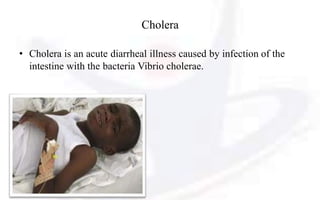
• Cholera is an acute diarrheal illness caused by infection of the
intestine with the bacteria Vibrio cholerae.
Agent
• V cholerae is
– comma-shaped,
– gram-negative aerobic or facultative anaerobic bacillus
– bacillus that varies in size from 1-3 µm in length by
0.5-
0.8 µm in diameter
Pathophysiology
• Its antigenic structure consists of
– flagellar H antigen
– somatic O antigen.
virulence &pathogenicity
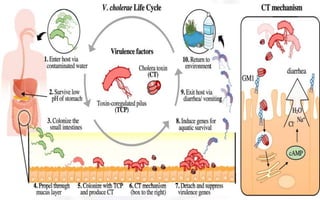
Ingestion of V
.
cholerae
Resistant to gastric
acid
Colonize small
intestine
Virulence of Non-toxigenic V. cholera O1 strain not well
understood
Enterotoxin binds to intestinal cells
Chloride channels activated
Release Large quantities of electrolytes & bicarbonates
Fluid hypersecretion
Diarrhea
Dehydration
Secrete enterotoxin
HOST FACTORS
1. Age: Children: 10x more susceptible than adults, And
Elderly also higher susceptible.
2. Sex: Equal in both male and female.
3. Immunity: Less immune higher risk.
4. People with low gastric acid levels
5. Blood types
O>> B >A >AB
7
• Rare in developed countries
• Common in Asia, Africa, & Latin America
Poor sanitary
conditions
• Contaminated seafood, even in developed
countries.
• Especially shellfish.
• People with low levels of stomach acid
• Such as children, older adults, and some
medications.
• Reasons aren't entirely clear
• Twice more likely
Raw or undercooked
food
Hypochlorhydria
Type O blood
RISK FACTORS
Transmission
• Humans only reservoirs
• Contaminated food or water
– Inadequate sewage treatment
– Lack of water treatment
– Improperly cooked shellfish
• Transmission by casual contact unlikely
Period of Communicability
• During acute stage
• A few days after recovery
• By end of week, 70% of patients non-infectious
• By end of third week, 98% non-infectious
10
• Ranges from a few hours to 5 days
• Average is 1-3 days
• Shorter incubation period:
• High gastric pH (from use of antacids)
• Consumption of high dosage of cholera
Incubation
Infectious Dose
• water, the infectious dose is 103-106 organisms.
• ingested with food, fewer organisms (102 -104)
Symptoms
• Usually mild, or no symptoms at all
• 75% asymptomatic
• 20% mild disease
• 2-5% severe
• Vomiting
• Cramps
– profuse, painless diarrhea and vomiting of clear fluid.
"rice water" (1L/hour) >20 mL/kg during a 4-hour observation period
• Without treatment, death in 18 hours-several days
• Typical "rice water" diarrhea
Cholera Gravis
• More severe symptoms
• Rapid loss of body fluids
• produce 10 to 20 litres
• 107 vibrios/mL
• Rapidly lose more than 10% of body weight
• Dehydration and shock
• patient's skin turning a bluish-gray hue from extreme loss of fluids.
• Death within 12 hours or less
• Death can occur within 2-3 hours
Cholera sicca
• Cholera sicca is an old term describing a rare, severe form of cholera that occurs in
epidemic cholera.
• This form of cholera manifests as ileus and abdominal distention from
massive outpouring of fluid and electrolytes into dilated
intestinal loops.
• Mortality is high, with death resulting from toxemia before the onset of diarrhea and
vomiting.
• The mortality in this condition is high.
– Because of the unusual presentation, failure to recognize the condition as a form of cholera is common.
CHOLERA IN CHILDREN
Breast-fed infants are protected.
Symptoms are severe & fever is frequent. Shock,
drowsiness & coma are common. Hypoglycemia
is a recognized complication,
which may lead to convulsions.
Rotavirus infection may give similar picture
& need to be excluded.
Consequences of Severe Dehydration
1. Intravascular volume depletion
2. Severe metabolic acidosis
3. Hypokalemia →cardiac arrest
4. low blood sugar (hypoglycemia)
1. Seizures
2. coma, especially in the young
5. Cardiac and renal failure
6. Sunken eyes, decreased skin turgor
7. Almost no urine production
DIAGNOSIS
Clinical diagnosis
Cholera should be considered in all
cases with severe watery diarrhea
and vomiting.
Traveling to affected areas and
eating shellfish
No distinguishing clinical
manifestations for cholera.
Differential diagnosis
Enterotoxigenic e. Coli
Bacterial food
poisoning
Viral gastroenteritis
(Rotavirus )
Diagnosis
• Stool culture
• Confirm presence of cholera toxin
• Cholera Rapid Test Dipsticks
OTHER LAB FINDINGS
Dehydration leads to high blood urea & serum creatinine.
Hematocrit & WBC will also be high due to
hemoconcentration.
Dehydration & bicarbonate loss in stool leads to metabolic
acidosis with wide-anion gap.
Total body potassium is depleted, but serum level may be
normal due to effect of acidosis.
Treatment
REHYDRATI
ON
• Oral
• Intravenous
ANTIMICROBIAL
THERAPY
WHO Guidelines for Cholera Management
Steps in the treatment of a patient with suspected cholera are as follows:
1. Assess for dehydration (see Table 1)
2. Rehydrate the patient and monitor frequently, then reassess hydration status
3. Maintain hydration; replace ongoing fluid losses until diarrhea stops
4. Administer an oral antibiotic to the patient with severe dehydration
5. Feed the patient
More detailed guidelines for the treatment of cholera are as follows:
 Evaluate the degree of dehydration upon arrival
 Rehydrate the patient in 2 phases; these include rehydration (for 2-4 h) and maintenance (until diarrhea
abates)
 Register output and intake volumes on predesigned charts and periodically review these data
 Use the intravenous route only (1) during the rehydration phase for severely dehydrated patients for
whom an infusion rate of 50-100 mL/kg/h is advised, (2) for moderately dehydrated patients who do not
tolerate the oral route, and (3) during the maintenance phase in patients considered high stool purgers (ie,
>10 mL/kg/h)
 During the maintenance phase, use oral rehydration solution at a rate of 800-1000 mL/h; match ongoing
losses with ORS administration
 Discharge patients to the treatment center if oral tolerance is greater than or equal to 1000 mL/h, urine
volume is greater than or equal to 40 mL/h, and stool volume is less than or equal to 400 mL/h.
Clinical feature
Predicted degree of dehydration
None
(<5 percent)
Some
dehydration
(5-10 percent)
Severe
dehydration
(>10 percent)
General
appearance
Well, alert Restless, irritable Abnormally sleepy
or lethargic
Eyes Normal Sunken Sunken
Thirst Drinks normally,
not thirsty
Thirsty, drinks
eagerly
Drinks poorly or
unable to drink
Skin pinch Goes back quickly Goes back slowly(<
2 sec)
Goes back very
slowly(>2 sec)
Estimated fluid
deficit
<50 mL/kg 50-100 mL/kg >100 mL/kg
Assessment of the Patient With Diarrhea for Dehydration
(based on WHO classification)
Clinical feature
Predicted degree of dehydration
None (<5
percent)
Some dehydration
(5-10 percent)
Severe
dehydration (>10
percent)
Decision Patient has no
dehydration
If the patient has
2 or
more signs, some
dehydration is
present
If the patient has 2 or
more of these signs,
severe dehydration is
present
Assessment of the Patient With Diarrhea for Dehydration
(based on WHO classification)
Treatment of Cholera
• Rehydration is accomplished in 2 phases:
A.Rehydration
B. Maintenance.
Treatment of Cholera; Rehydration
• The goal of the rehydration phase is to restore normal
hydration status, which should take no more than 4 hours.
• Set the rate of intravenous infusion in severely dehydrated
patients at 50-100 mL/kg/hr.
• Lactated Ringer solution is preferred over isotonic sodium
chloride solution because saline does not correct metabolic
acidosis
Treatment of cholera; Maintenance
• The goal of the maintenance phase is to maintain normal
hydration status by replacing ongoing losses.
• The oral route is preferred, and the use of oral rehydration
solution (ORS) at a rate of 500-1000 mL/hr is recommended
• Fluids should never be restricted
SIGN OFDEHYDRATION
No dehydration
(<5 percent) Some dehydration
(5-10 percent)
2 or more of the following signs?
1. sunken eyes
2. absence of tears
3. dry mouth and tongue
4. thirsty and drinks eagerly
5. Goes back slowly(< 2 sec)
Oral Rehydration
If NO If YES
2 or more of the following signs?
1. lethargic, unconscious or floppy
2. unable to drink
3. radial pulse is weak
4. Goes back very slowly(>2 sec)
If YES
Severe
dehydration
(>10 percent)
If NO
Age AmountAfter Loose Stool
< 24 mo 50-100 mL
2-9 y 100-200 mL
>10 y As much as is wanted
Age < 4 mo 4-11 mo 12-23 mo 2-4 y 5-14 y >15 y
Weight < 5 kg 5-7.9 kg 8-10.9 kg 11-15.9 kg 16-29.9 kg >30 kg
ORS solution in
mL
200-400 400-600 600-800 800-1200 1200-2200 2200-4000
ORS solution to give in the first 4 hours
If
improv
DR/
Reyad
Al-
Faky
Treat Severe dehydration in cholera
younger than 1 year
100 mL/kg IV in 6 hours
older than 1 year + adult
30 mL/kg in the first hour then 70
mL/kg in the next 5 hours.
30 mL/kg as rapidly as possible (within 30
min) then 70 mL/kg in the next 2 hours.
DR/
Reyad
Al-
Faky
Fluids should never be
restricted.
maintained intravenously with RL
Total amount per day RL+ORS = 200 ml/kg during the first 24 hours + Administer ORS solution (about
5 mL/kg/h) as soon as the patient can drink, in addition to IV fluid.
Continue to reassess at least every 4 hours; radial pulse should be strong and Bld pressur should be normal.
goal of the rehydration phase is to restore normal hydration status, must be less than 4 hours The goal of
maintenance phase is to maintain normal hydration by replacing ongoing losses.
100 mL/kg IV in 6 hours
Continue
monitor
Criteria for hospital discharge
• After receiving therapy of adequate hydration, patients that fulfill
these three criteria can be discharged of the hospital:
1. Adequate oral intake
2. Normal urinary flow (40-50 cc by hour)
3. Maximum diarrhea flow of 400 cc per hour
Antibiotic treatment
• Antimicrobial therapy is useful for
1. prompt eradication of the vibrio
2. diminish the duration of diarrhea
3. decrease the fluid loss.
• Antibiotics should be administered to moderate or severe cases
Antibiotic treatment
Option
Adults Doxycycline, 300 mg po single dose ,Ciprofloxacin, 1g po
single dose OR
Azithromycin 1g po single dose.
Pregnant Erythromycin 500 mg/ 6 hours for 3 days OR azithromycin, 1g
po single dose
Children> 3yrs Erythromycin 12.5mg/kg/ 6 hours for 3dys OR azithromycin 20
mg/kg, in a single dose, without exceeding 1 g
Children < 3yrs Erythromycin 12.5mg/kg/ 6 hours for 3dys OR azithromycin 20
mg/kg, in a single dose
Prevention
• Comprehensive
Multidisciplinary
Approach: water, sanitation,
education, and
communication
• Basic health education and
hygiene
• Mass chemoprophylaxis
• Provision of safe water and
sanitation
Thank You

Cholera updated.pptx

  • 1.
  • 2.
    Cholera: The fatherof Public Health
  • 3.
    Cholera • Cholera isan acute diarrheal illness caused by infection of the intestine with the bacteria Vibrio cholerae.
  • 7.
    Agent • V choleraeis – comma-shaped, – gram-negative aerobic or facultative anaerobic bacillus – bacillus that varies in size from 1-3 µm in length by 0.5- 0.8 µm in diameter
  • 8.
    Pathophysiology • Its antigenicstructure consists of – flagellar H antigen – somatic O antigen.
  • 10.
    virulence &pathogenicity Ingestion ofV . cholerae Resistant to gastric acid Colonize small intestine Virulence of Non-toxigenic V. cholera O1 strain not well understood
  • 11.
    Enterotoxin binds tointestinal cells Chloride channels activated Release Large quantities of electrolytes & bicarbonates Fluid hypersecretion Diarrhea Dehydration Secrete enterotoxin
  • 12.
    HOST FACTORS 1. Age:Children: 10x more susceptible than adults, And Elderly also higher susceptible. 2. Sex: Equal in both male and female. 3. Immunity: Less immune higher risk. 4. People with low gastric acid levels 5. Blood types O>> B >A >AB 7
  • 13.
    • Rare indeveloped countries • Common in Asia, Africa, & Latin America Poor sanitary conditions • Contaminated seafood, even in developed countries. • Especially shellfish. • People with low levels of stomach acid • Such as children, older adults, and some medications. • Reasons aren't entirely clear • Twice more likely Raw or undercooked food Hypochlorhydria Type O blood RISK FACTORS
  • 14.
    Transmission • Humans onlyreservoirs • Contaminated food or water – Inadequate sewage treatment – Lack of water treatment – Improperly cooked shellfish • Transmission by casual contact unlikely
  • 15.
    Period of Communicability •During acute stage • A few days after recovery • By end of week, 70% of patients non-infectious • By end of third week, 98% non-infectious 10
  • 16.
    • Ranges froma few hours to 5 days • Average is 1-3 days • Shorter incubation period: • High gastric pH (from use of antacids) • Consumption of high dosage of cholera Incubation
  • 17.
    Infectious Dose • water,the infectious dose is 103-106 organisms. • ingested with food, fewer organisms (102 -104)
  • 18.
    Symptoms • Usually mild,or no symptoms at all • 75% asymptomatic • 20% mild disease • 2-5% severe • Vomiting • Cramps – profuse, painless diarrhea and vomiting of clear fluid. "rice water" (1L/hour) >20 mL/kg during a 4-hour observation period • Without treatment, death in 18 hours-several days
  • 19.
    • Typical "ricewater" diarrhea
  • 20.
    Cholera Gravis • Moresevere symptoms • Rapid loss of body fluids • produce 10 to 20 litres • 107 vibrios/mL • Rapidly lose more than 10% of body weight • Dehydration and shock • patient's skin turning a bluish-gray hue from extreme loss of fluids. • Death within 12 hours or less • Death can occur within 2-3 hours
  • 21.
    Cholera sicca • Cholerasicca is an old term describing a rare, severe form of cholera that occurs in epidemic cholera. • This form of cholera manifests as ileus and abdominal distention from massive outpouring of fluid and electrolytes into dilated intestinal loops. • Mortality is high, with death resulting from toxemia before the onset of diarrhea and vomiting. • The mortality in this condition is high. – Because of the unusual presentation, failure to recognize the condition as a form of cholera is common.
  • 22.
    CHOLERA IN CHILDREN Breast-fedinfants are protected. Symptoms are severe & fever is frequent. Shock, drowsiness & coma are common. Hypoglycemia is a recognized complication, which may lead to convulsions. Rotavirus infection may give similar picture & need to be excluded.
  • 23.
    Consequences of SevereDehydration 1. Intravascular volume depletion 2. Severe metabolic acidosis 3. Hypokalemia →cardiac arrest 4. low blood sugar (hypoglycemia) 1. Seizures 2. coma, especially in the young 5. Cardiac and renal failure 6. Sunken eyes, decreased skin turgor 7. Almost no urine production
  • 24.
    DIAGNOSIS Clinical diagnosis Cholera shouldbe considered in all cases with severe watery diarrhea and vomiting. Traveling to affected areas and eating shellfish No distinguishing clinical manifestations for cholera. Differential diagnosis Enterotoxigenic e. Coli Bacterial food poisoning Viral gastroenteritis (Rotavirus )
  • 25.
    Diagnosis • Stool culture •Confirm presence of cholera toxin • Cholera Rapid Test Dipsticks
  • 26.
    OTHER LAB FINDINGS Dehydrationleads to high blood urea & serum creatinine. Hematocrit & WBC will also be high due to hemoconcentration. Dehydration & bicarbonate loss in stool leads to metabolic acidosis with wide-anion gap. Total body potassium is depleted, but serum level may be normal due to effect of acidosis.
  • 27.
  • 28.
    WHO Guidelines forCholera Management Steps in the treatment of a patient with suspected cholera are as follows: 1. Assess for dehydration (see Table 1) 2. Rehydrate the patient and monitor frequently, then reassess hydration status 3. Maintain hydration; replace ongoing fluid losses until diarrhea stops 4. Administer an oral antibiotic to the patient with severe dehydration 5. Feed the patient More detailed guidelines for the treatment of cholera are as follows:  Evaluate the degree of dehydration upon arrival  Rehydrate the patient in 2 phases; these include rehydration (for 2-4 h) and maintenance (until diarrhea abates)  Register output and intake volumes on predesigned charts and periodically review these data  Use the intravenous route only (1) during the rehydration phase for severely dehydrated patients for whom an infusion rate of 50-100 mL/kg/h is advised, (2) for moderately dehydrated patients who do not tolerate the oral route, and (3) during the maintenance phase in patients considered high stool purgers (ie, >10 mL/kg/h)  During the maintenance phase, use oral rehydration solution at a rate of 800-1000 mL/h; match ongoing losses with ORS administration  Discharge patients to the treatment center if oral tolerance is greater than or equal to 1000 mL/h, urine volume is greater than or equal to 40 mL/h, and stool volume is less than or equal to 400 mL/h.
  • 29.
    Clinical feature Predicted degreeof dehydration None (<5 percent) Some dehydration (5-10 percent) Severe dehydration (>10 percent) General appearance Well, alert Restless, irritable Abnormally sleepy or lethargic Eyes Normal Sunken Sunken Thirst Drinks normally, not thirsty Thirsty, drinks eagerly Drinks poorly or unable to drink Skin pinch Goes back quickly Goes back slowly(< 2 sec) Goes back very slowly(>2 sec) Estimated fluid deficit <50 mL/kg 50-100 mL/kg >100 mL/kg Assessment of the Patient With Diarrhea for Dehydration (based on WHO classification)
  • 30.
    Clinical feature Predicted degreeof dehydration None (<5 percent) Some dehydration (5-10 percent) Severe dehydration (>10 percent) Decision Patient has no dehydration If the patient has 2 or more signs, some dehydration is present If the patient has 2 or more of these signs, severe dehydration is present Assessment of the Patient With Diarrhea for Dehydration (based on WHO classification)
  • 31.
    Treatment of Cholera •Rehydration is accomplished in 2 phases: A.Rehydration B. Maintenance.
  • 32.
    Treatment of Cholera;Rehydration • The goal of the rehydration phase is to restore normal hydration status, which should take no more than 4 hours. • Set the rate of intravenous infusion in severely dehydrated patients at 50-100 mL/kg/hr. • Lactated Ringer solution is preferred over isotonic sodium chloride solution because saline does not correct metabolic acidosis
  • 33.
    Treatment of cholera;Maintenance • The goal of the maintenance phase is to maintain normal hydration status by replacing ongoing losses. • The oral route is preferred, and the use of oral rehydration solution (ORS) at a rate of 500-1000 mL/hr is recommended • Fluids should never be restricted
  • 34.
    SIGN OFDEHYDRATION No dehydration (<5percent) Some dehydration (5-10 percent) 2 or more of the following signs? 1. sunken eyes 2. absence of tears 3. dry mouth and tongue 4. thirsty and drinks eagerly 5. Goes back slowly(< 2 sec) Oral Rehydration If NO If YES 2 or more of the following signs? 1. lethargic, unconscious or floppy 2. unable to drink 3. radial pulse is weak 4. Goes back very slowly(>2 sec) If YES Severe dehydration (>10 percent) If NO Age AmountAfter Loose Stool < 24 mo 50-100 mL 2-9 y 100-200 mL >10 y As much as is wanted Age < 4 mo 4-11 mo 12-23 mo 2-4 y 5-14 y >15 y Weight < 5 kg 5-7.9 kg 8-10.9 kg 11-15.9 kg 16-29.9 kg >30 kg ORS solution in mL 200-400 400-600 600-800 800-1200 1200-2200 2200-4000 ORS solution to give in the first 4 hours If improv DR/ Reyad Al- Faky
  • 35.
    Treat Severe dehydrationin cholera younger than 1 year 100 mL/kg IV in 6 hours older than 1 year + adult 30 mL/kg in the first hour then 70 mL/kg in the next 5 hours. 30 mL/kg as rapidly as possible (within 30 min) then 70 mL/kg in the next 2 hours. DR/ Reyad Al- Faky Fluids should never be restricted. maintained intravenously with RL Total amount per day RL+ORS = 200 ml/kg during the first 24 hours + Administer ORS solution (about 5 mL/kg/h) as soon as the patient can drink, in addition to IV fluid. Continue to reassess at least every 4 hours; radial pulse should be strong and Bld pressur should be normal. goal of the rehydration phase is to restore normal hydration status, must be less than 4 hours The goal of maintenance phase is to maintain normal hydration by replacing ongoing losses. 100 mL/kg IV in 6 hours Continue monitor
  • 36.
    Criteria for hospitaldischarge • After receiving therapy of adequate hydration, patients that fulfill these three criteria can be discharged of the hospital: 1. Adequate oral intake 2. Normal urinary flow (40-50 cc by hour) 3. Maximum diarrhea flow of 400 cc per hour
  • 37.
    Antibiotic treatment • Antimicrobialtherapy is useful for 1. prompt eradication of the vibrio 2. diminish the duration of diarrhea 3. decrease the fluid loss. • Antibiotics should be administered to moderate or severe cases
  • 38.
    Antibiotic treatment Option Adults Doxycycline,300 mg po single dose ,Ciprofloxacin, 1g po single dose OR Azithromycin 1g po single dose. Pregnant Erythromycin 500 mg/ 6 hours for 3 days OR azithromycin, 1g po single dose Children> 3yrs Erythromycin 12.5mg/kg/ 6 hours for 3dys OR azithromycin 20 mg/kg, in a single dose, without exceeding 1 g Children < 3yrs Erythromycin 12.5mg/kg/ 6 hours for 3dys OR azithromycin 20 mg/kg, in a single dose
  • 39.
    Prevention • Comprehensive Multidisciplinary Approach: water,sanitation, education, and communication • Basic health education and hygiene • Mass chemoprophylaxis • Provision of safe water and sanitation
  • 41.