AETCOM Module 2.1
Foundation Of Communication-2
Dr. Rahul Netragaonkar
Professor
Dept. Of Community Medicine
Zydus Medical College,
Dahod
Academic Skit - Doctor Patient Relationship.mp4
COMMUNICATION SKILLS IN
MEDICAL PRACTICE
•Developing Strong Communication Skills Is
Integral To Becoming An Effective Health
Provider.
•In Recent Years Good Doctor– Patient
Communication Has Been Linked To Improved
Patient Satisfaction, Better Patient Care And A
Decrease In Malpractice Lawsuits.
WHY COMMUNICATION SKILLS
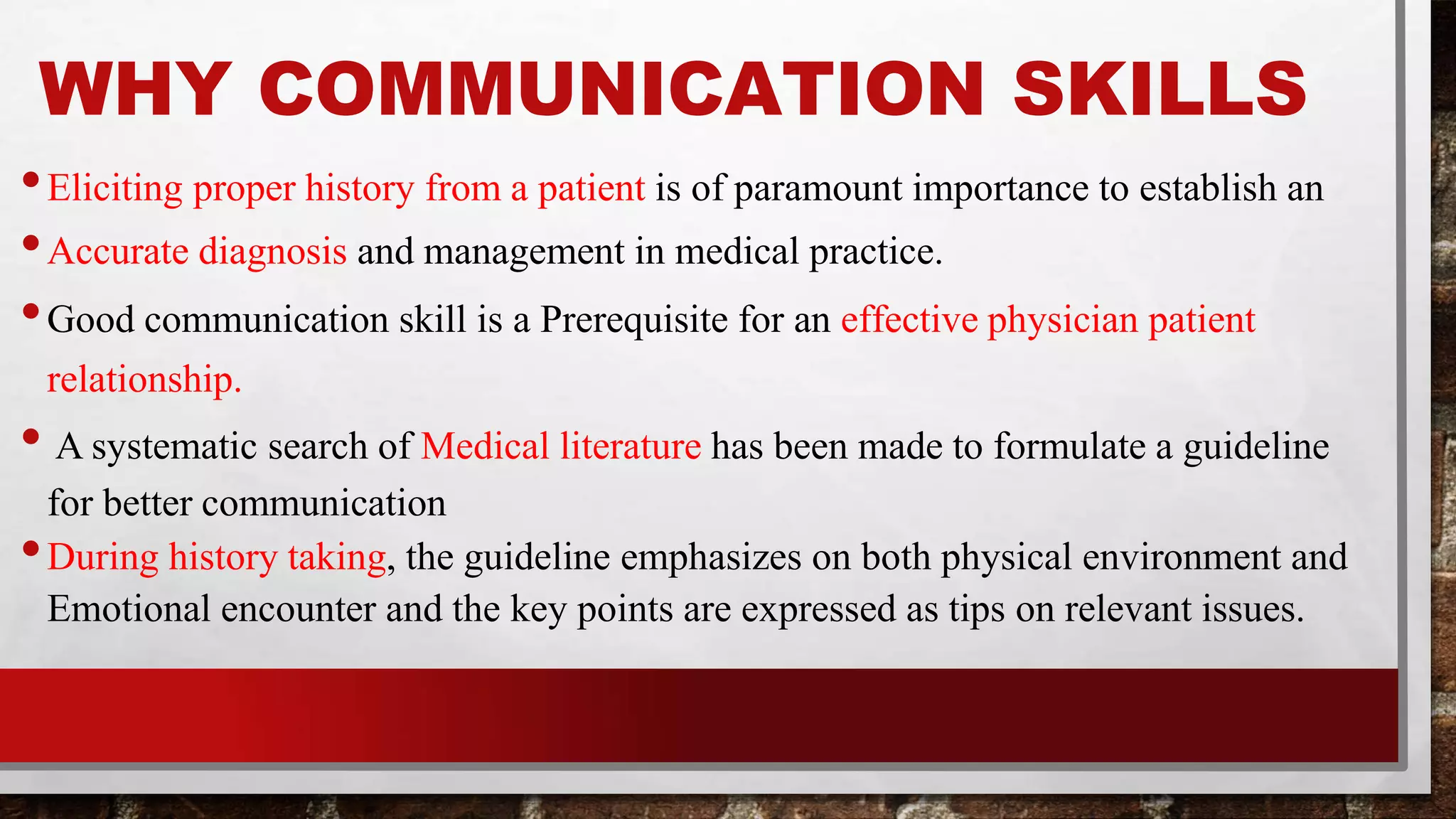
•Eliciting proper history from a patient is of paramount importance to establish an
•Accurate diagnosis and management in medical practice.
•Good communication skill is a Prerequisite for an effective physician patient
relationship.
• A systematic search of Medical literature has been made to formulate a guideline
for better communication
•During history taking, the guideline emphasizes on both physical environment and
Emotional encounter and the key points are expressed as tips on relevant issues.
TYPES OF DOCTOR PATIENT
RELATIONSHIP
•Consumerist
•Doctor Passive, Second Opinion, Referral To Hospital, Sick Note
•Paternalistic
•Doctor Takes On Role Of “Parent”, Patient Submissive
•Mutuality
• Equal Partners, Joint Venture, Exchange Of Ideas
COMPETENCY
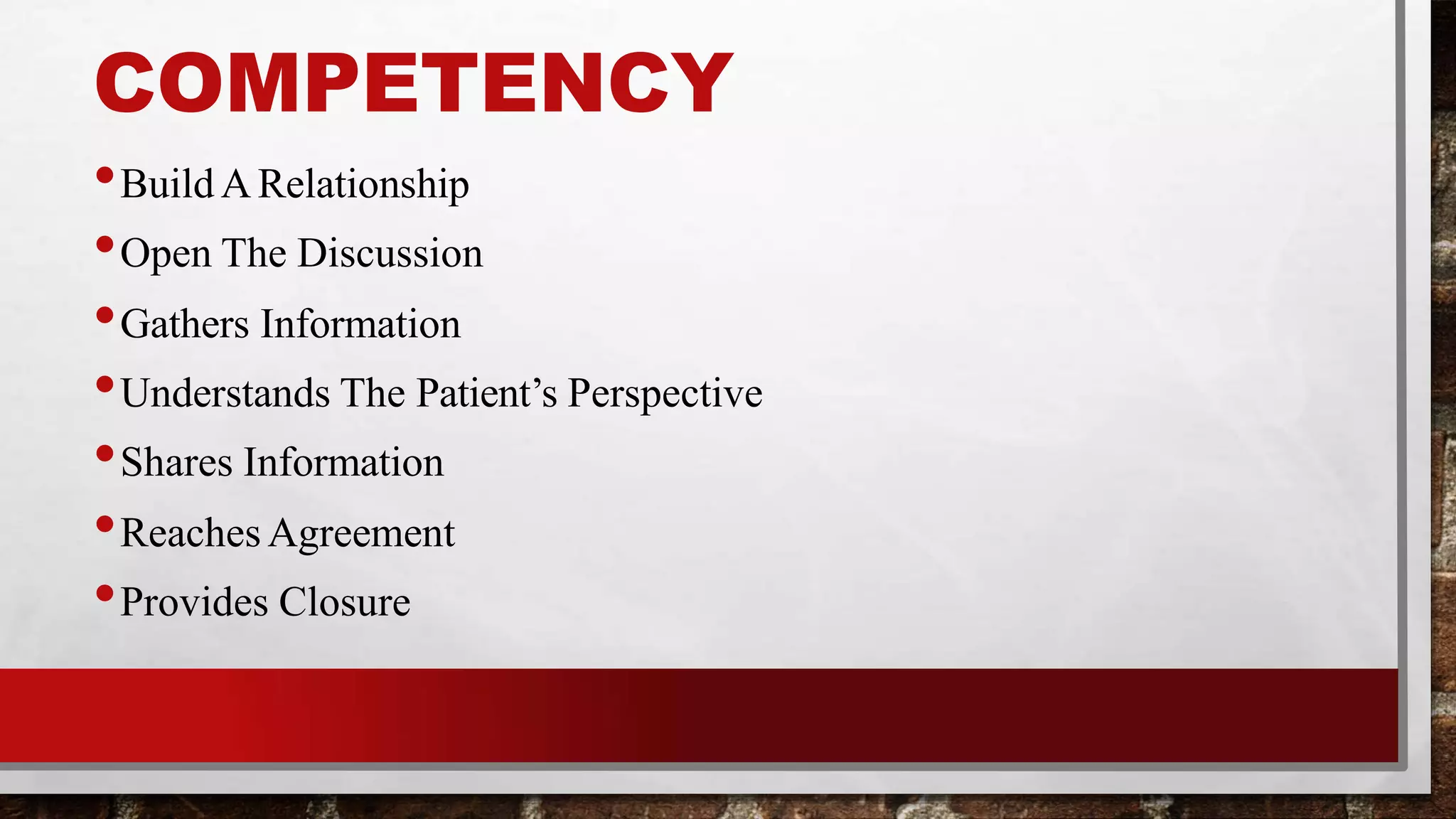
•Build ARelationship
•Open The Discussion
•Gathers Information
•Understands The Patient’s Perspective
•Shares Information
•Reaches Agreement
•Provides Closure
BUILD A RELATIONSHIP
GreetAnd Shows Interest In The PatientAs A Person
• Make sure that your beginning is
smooth.
• All you need to do is – greet the
patient, check the identity of the
patient, introduce yourself, offer
some personal but interesting
and relevant chit chat.
BUILD A RELATIONSHIP
•Introduce Yourself To The Patient.
•Explain Your Role.
•Shake Hands, But Don’t Force Physical Contact If Patient Is
Uncomfortable.
•Call TheAdult Patient Mr., Mrs., Or Ms. (Do Not Use First Name )
•Maintain Privacy.
•Keep DoorsAnd Curtains Closed.
• AcknowledgeAnd Greet Others In The Room.
GreetAnd Shows Interest In The PatientAs A Person
BUILD A RELATIONSHIP
Use Words That Show Care And Concern Throughout The Interview
BUILD A RELATIONSHIP
Use Tone, Pace, Eye Contact,And Posture That Show Care And Concern
•Sits Square On Facing The Patient
•Maintains Open Body Position
•Leans Slightly Forward
•Eye Contact Is Maintained
•Relaxed (In An Appropriate Posture)
(Kaufman 2008)
BUILD A RELATIONSHIP
Responds Explicitly To Patient Statements About Ideas, Feelings,And Values
Allows Patient To Complete Opening Statement Without Interruption
OPEN THE DISCUSSION
“Silence is golden”- so tolerate short silences. The patient may be doing important ‘work’.
OPENS THE DISCUSSION
•Asks ‘Is There Anything Else’To Elicit Full
Set Of Concerns
•Explain An Agenda For The Visit
•Identifying The Reason For The
Consultation
GATHERS INFORMATION
Begins With Patient Narrative Using Open-ended Questions (‘Tell Me About . . .’)
•Open Questions:–Always Start WithAn Open Ended
Question And Take
•The Time To Listen To The Patient’s ‘Story’.
•Closed Questions: – Once The Patient Has Completed
Their Narrative To Closed Questions Which ClarifyAnd
Focus On Aspects Can Be Used.
•Leading Questions:– Questions Based On Your Own
Assumptions That Lead The Patient To The Answer You Want
To Hear. These Should Not Be Used AtAll.
GATHERS INFORMATION
•Clarifies DetailsAs Necessary With More Specific Or
‘Yes/No’ Questions
•SummarizesAnd Gives Patient Opportunity To Correct Or Add
Information
•Transitions Effectively To Additional Questions
UNDERSTANDS THE
PATIENT’S PERSPECTIVE
•Asks About Life Events, Circumstances, Other People That MightAffect Health
UNDERSTANDS THE
PATIENT’S PERSPECTIVE
Elicits Patient’s Beliefs, Concerns And ExpectationsAbout Illness And Treatment
•Mutuality
•Equal Partners
•Exchange Of Ideas
•Joint Venture
SHARE INFORMATION
Assesses Patient’s Understanding Of Problem And Desire For More Information
SHARES INFORMATION
•Explains Using Words ThatAre Easy For Patient To
Understand
•Asks If Patient Has Any Questions
REACHES AGREEMENT
Includes Patient In Choices And Decisions To The Extent She/He Desires
REACHES AGREEMENT
•Checks For Mutual Understanding Of DiagnosticAnd/Or
Treatment Plans
•Asks About Patient’s Ability To Follow DiagnosticAnd/Or
Treatment Plans
•Identifies Additional Resources As Appropriate
PROVIDES CLOSURE
Asks If The Patient Has Questions, Concerns, Or Other Issues
•Advice, Reassurance And Support From
The Doctor Can HaveA Significant
Effect On Recovery
•The Placebo Effect
PROVIDES CLOSURE
•Summarise
•Clarifies Follow-up Or Contact
Arrangements
•Acknowledges Patient And Closes Interview
Communication for Health education
Goal – To bring about the change in the
desired direction
Objectives –
Cognitive – Increase in knowledge
Affective – Changing existing pattern
of behavior & attitude
Psychomotor – acquiring new skills
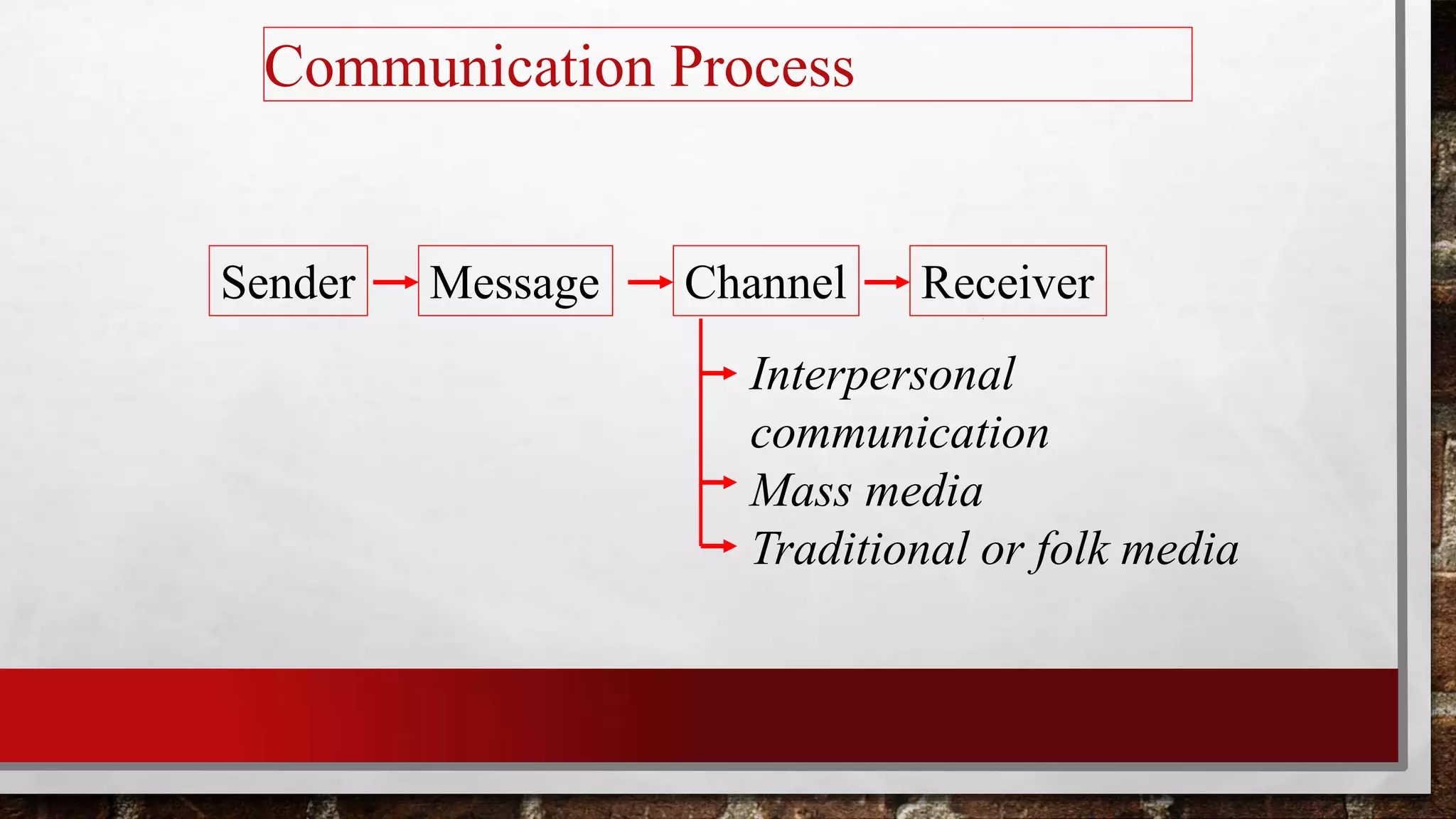
Communication Process
Sender Message Channel Receiver
Feedback
Awareness
Interest
Evaluation
Adoption
Communication Process
Sender Message Channel Receiver
His objectives
His audience
His message
Channels of communication
Professional abilities & limitations
Communication Process
Sender Message Channel Receiver
Meaningful
Based on felt need
Clear & understandable
Specific & accurate
Timely & adequate
Fitting & audience
Interesting
Culturally & socially appropriate
Communication Process
Sender Message Channel Receiver
Interpersonal
communication
Mass media
Traditional or folk media
Communication Process
Sender Message Channel Receiver
Audience
Types of communication
• One way communication
• Two way communication
• Verbal communication
• Non – verbal communication
• Formal & informal communication
• Visual communication
• Telecommunication & internet
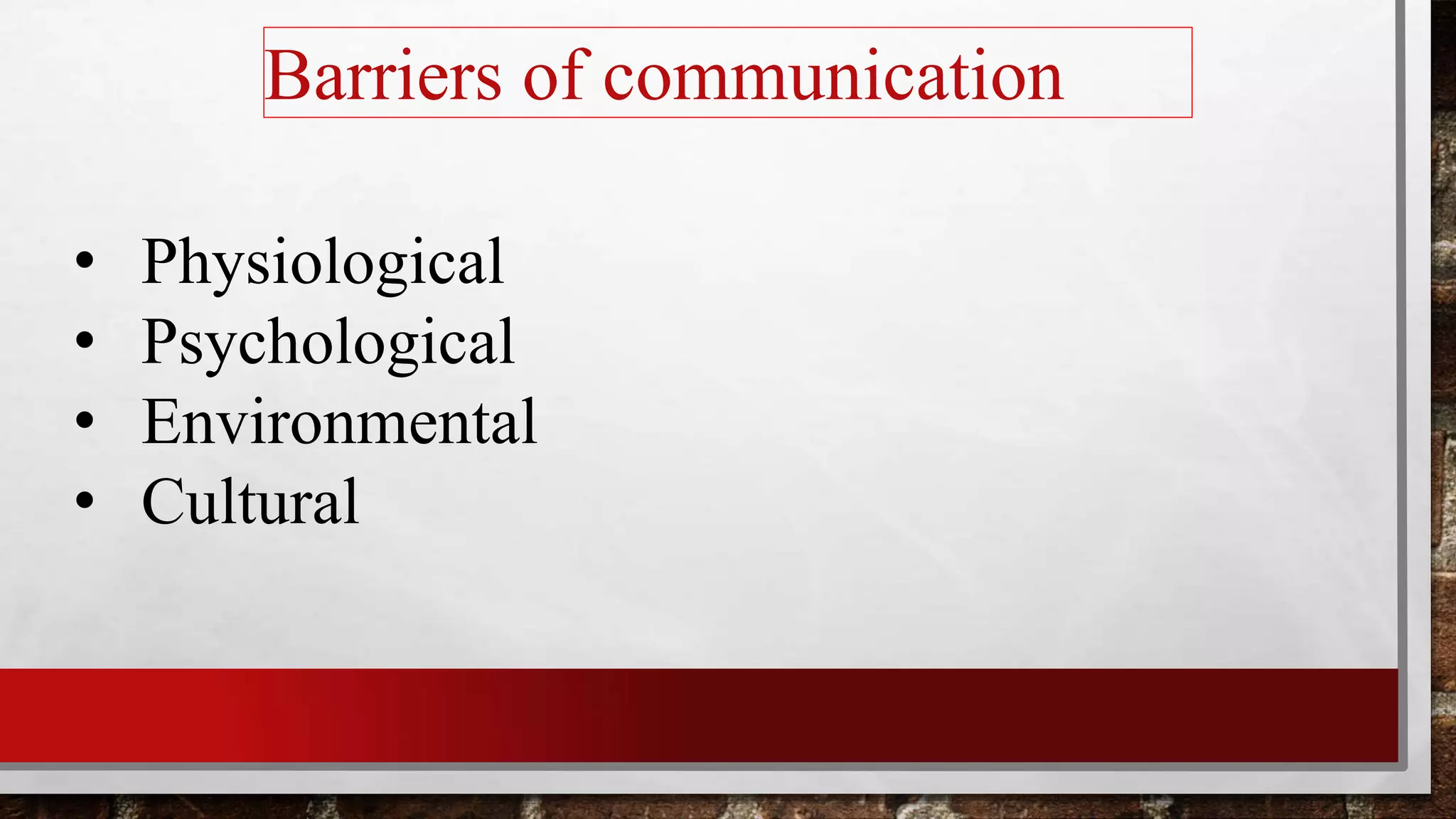
Barriers of communication
• Physiological
• Psychological
• Environmental
• Cultural
Barriers of communication
Physiological
Psychological
Environmental
Cultural
Difficulties in hearing
& Expression
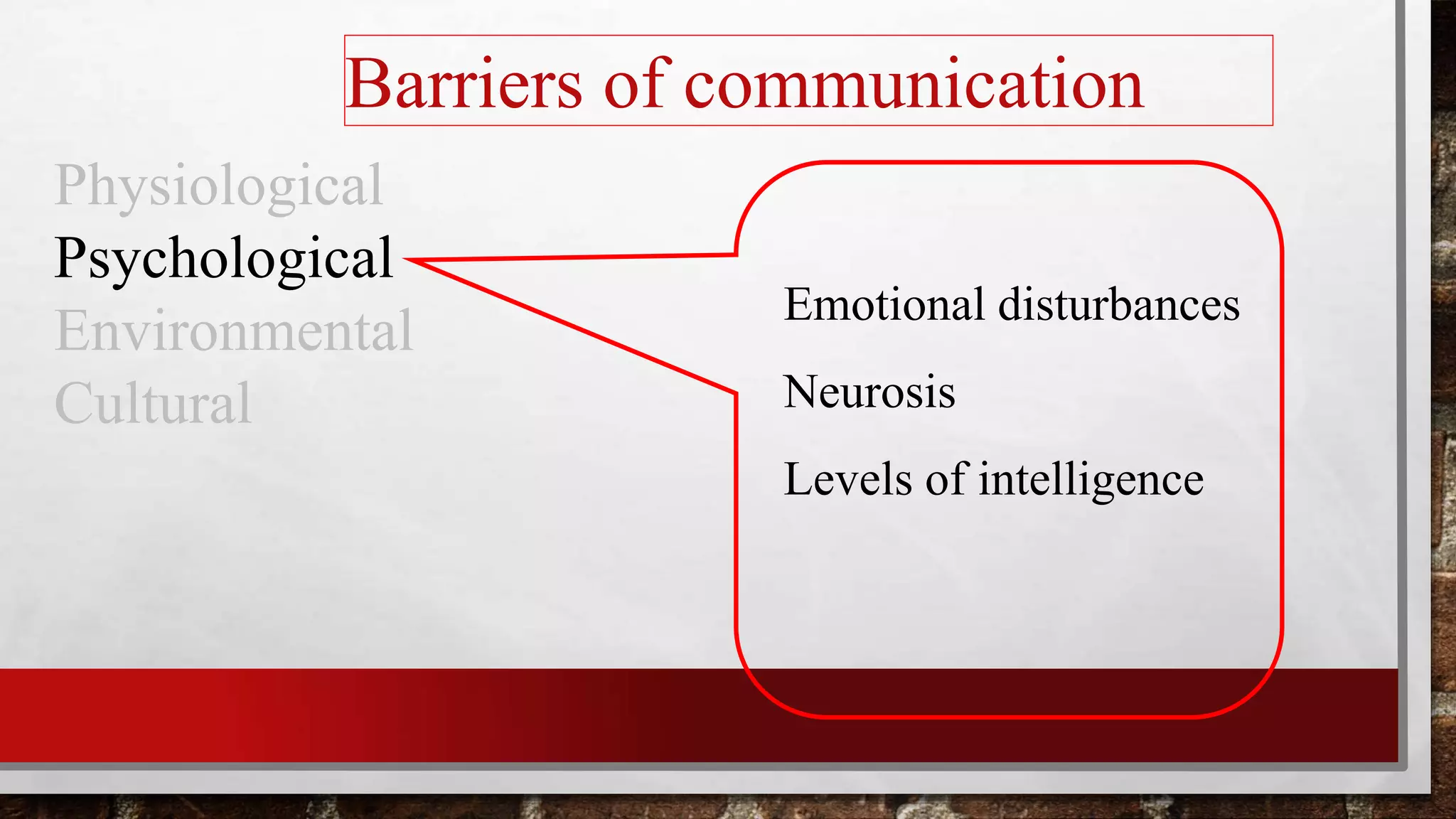
Barriers of communication
Physiological
Psychological
Environmental
Cultural
Emotional disturbances
Neurosis
Levels of intelligence
Barriers of communication
Physiological
Psychological
Environmental
Cultural
Noise
Invisibility
Congestion
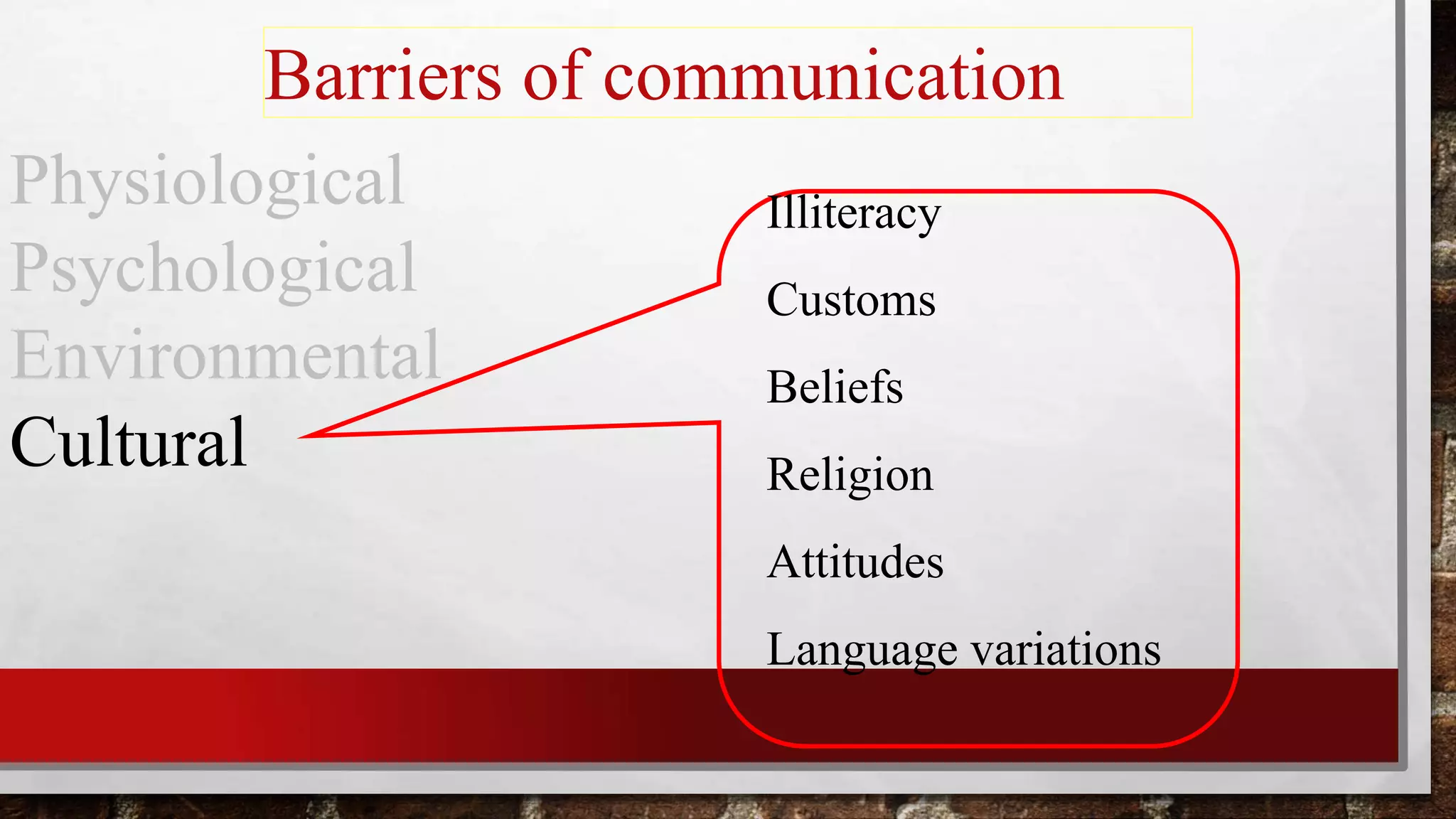
Barriers of communication
Physiological
Psychological
Environmental
Cultural
Illiteracy
Customs
Beliefs
Religion
Attitudes
Language variations
THANK YOU
“We Have Not Lost Faith, But We Have Transferred It From
God To The Medical
Profession.”
George Bernard Shaw
The good doctor.mp4

Foundation Of Communication.pptx