Cholelithiasis and
it’s complications
Department of surgical diseases №1
Assistant lecturer Vasilevsky V.P.
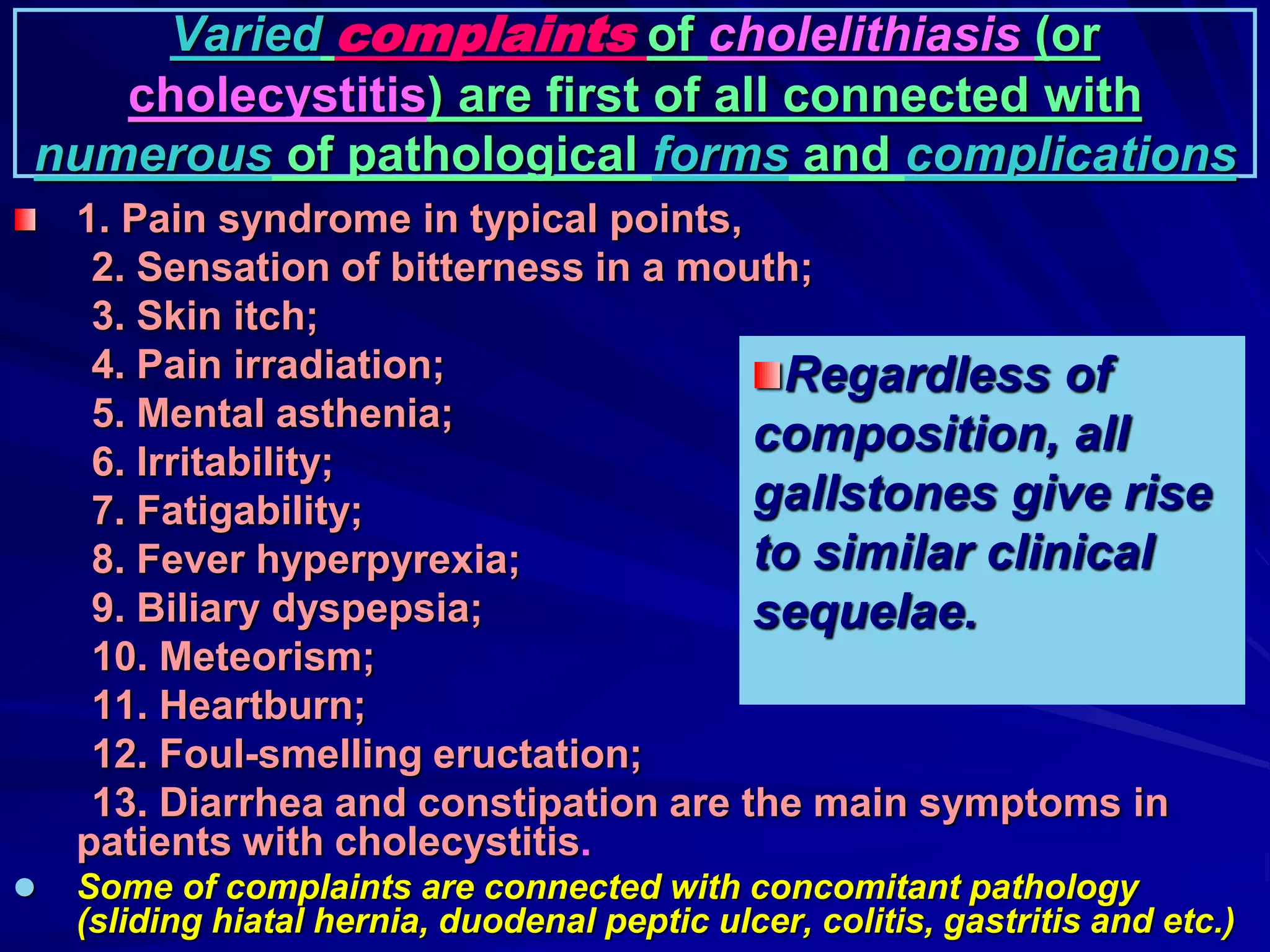
Actuality and practical importance
More than 20 million people in the USA
have gallstones in their gallbladders; about
300,000 operations are performed annually
for this disease, and at least 6000 deaths
result from its complications or treatment.
The incidence of gallstones rises with age,
so that between 50 and 65 years of age
about 20% of women and 5% of men are
affected. About 40% of world population
after forty can have such problem
according to data of Shalimov A.A.
Approximately 15% of patients with stones
in the gallbladder are found to
harborcalculi within the bile ducts.
Common duct stones are usually
accompanied by others in the gallbladder,
but in 5% of cases, the gallbladder is
empty. The number of duct stones may
vary from one to more than 100.
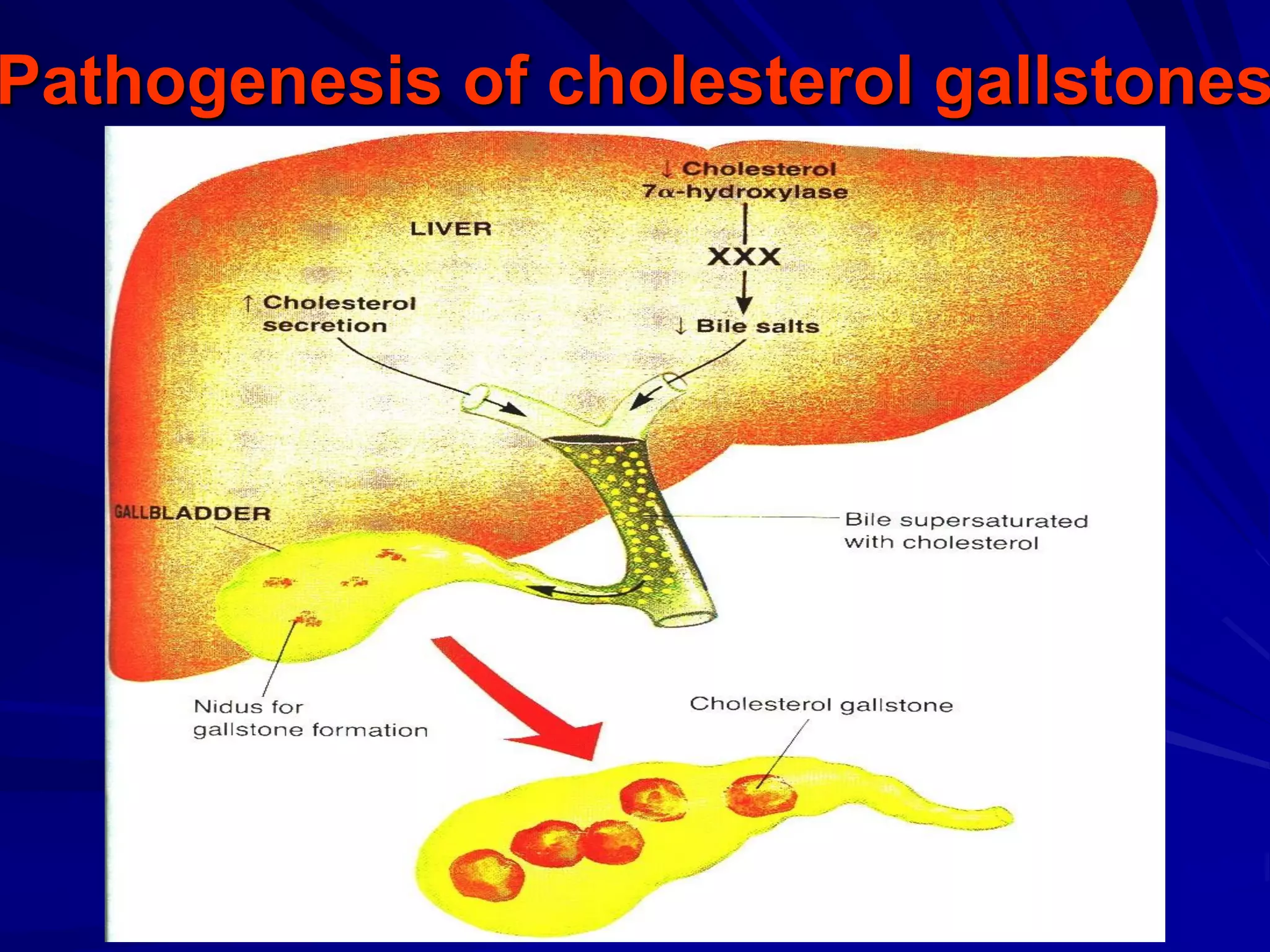
Pathogenesis of cholesterol gallstones
Varied complaints of cholelithiasis (or
cholecystitis) are first of all connected with
numerous of pathological forms and complications
1. Pain syndrome in typical points,
2. Sensation of bitterness in a mouth;
3. Skin itch;
4. Pain irradiation;
5. Mental asthenia;
6. Irritability;
7. Fatigability;
8. Fever hyperpyrexia;
9. Biliary dyspepsia;
10. Meteorism;
11. Heartburn;
12. Foul-smelling eructation;
13. Diarrhea and constipation are the main symptoms in
patients with cholecystitis.
 Some of complaints are connected with concomitant pathology
(sliding hiatal hernia, duodenal peptic ulcer, colitis, gastritis and etc.)
Regardless of
composition, all
gallstones give rise
to similar clinical
sequelae.
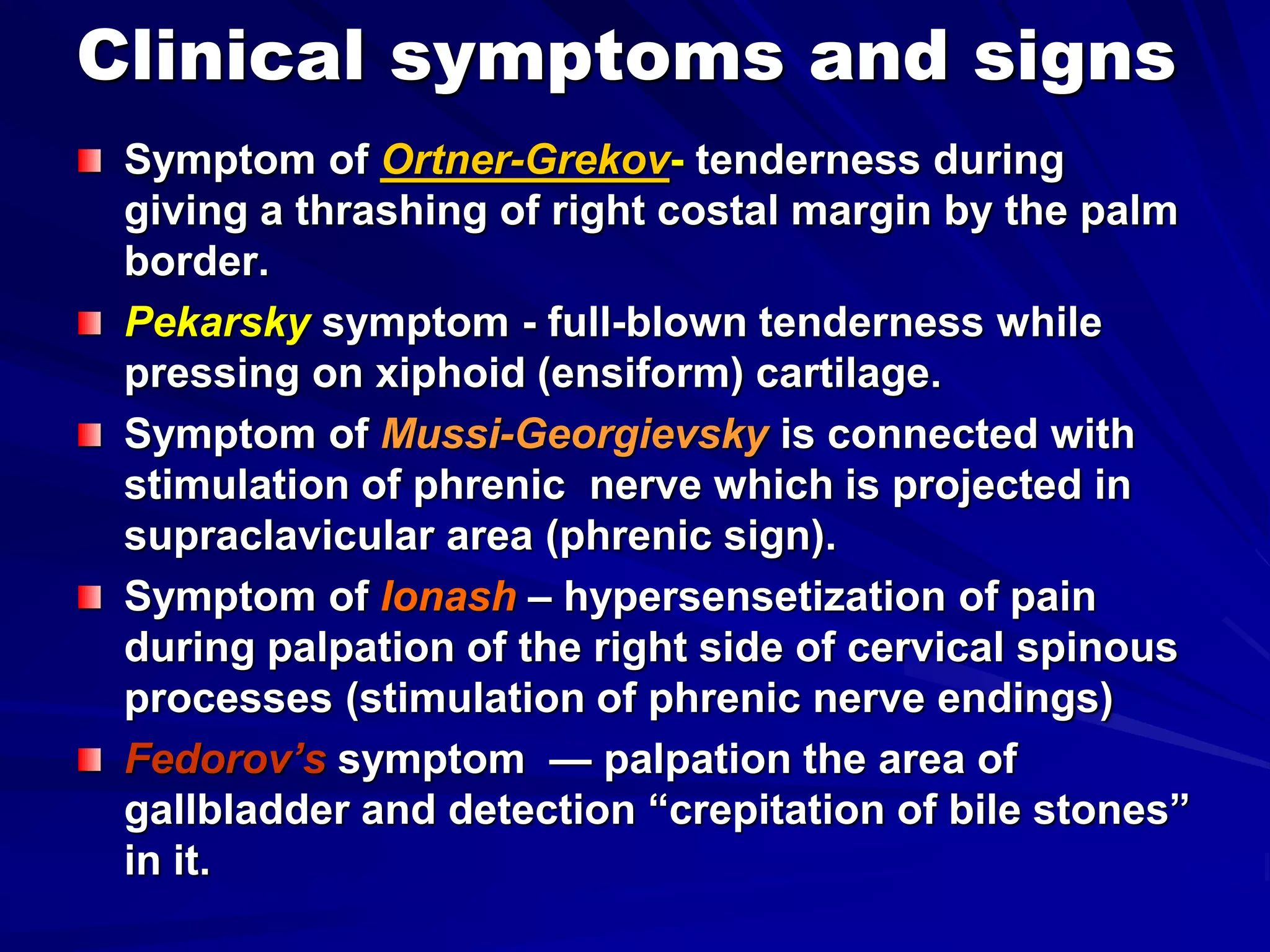
Clinical symptoms and signs
Symptom of Ortner-Grekov- tenderness during
giving a thrashing of right costal margin by the palm
border.
Pekarsky symptom - full-blown tenderness while
pressing on xiphoid (ensiform) cartilage.
Symptom of Mussi-Georgievsky is connected with
stimulation of phrenic nerve which is projected in
supraclavicular area (phrenic sign).
Symptom of Ionash – hypersensetization of pain
during palpation of the right side of cervical spinous
processes (stimulation of phrenic nerve endings)
Fedorov’s symptom — palpation the area of
gallbladder and detection “crepitation of bile stones”
in it.
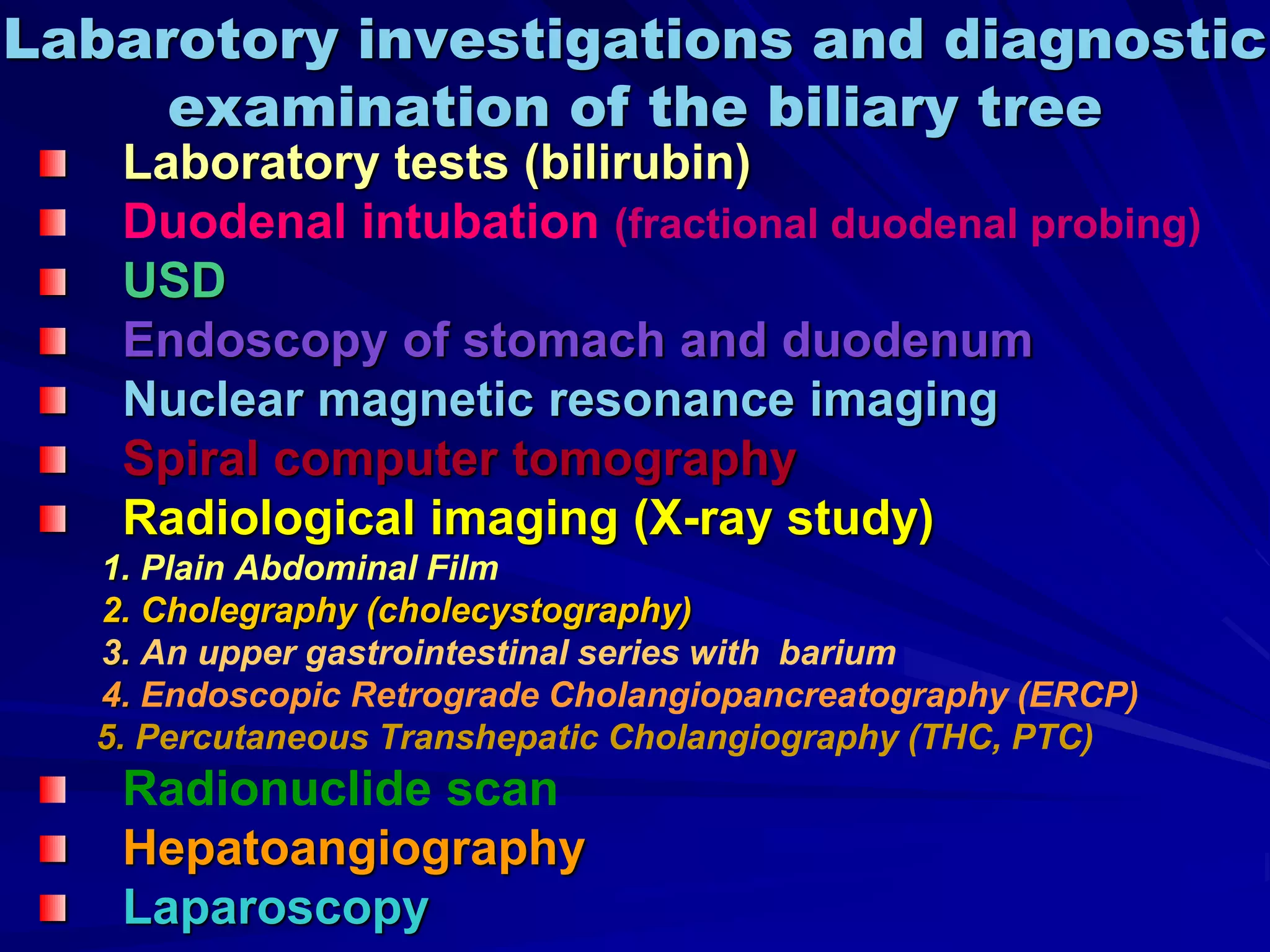
Labarotory investigations and diagnostic
examination of the biliary tree
Laboratory tests (bilirubin)
Duodenal intubation (fractional duodenal probing)
USD
Endoscopy of stomach and duodenum
Nuclear magnetic resonance imaging
Spiral computer tomography
Radiological imaging (X-ray study)
1. Plain Abdominal Film
2. Cholegraphy (cholecystography)
3. An upper gastrointestinal series with barium
4. Endoscopic Retrograde Cholangiopancreatography (ERCP)
5. Percutaneous Transhepatic Cholangiography (THC, PTC)
Radionuclide scan
Hepatoangiography
Laparoscopy
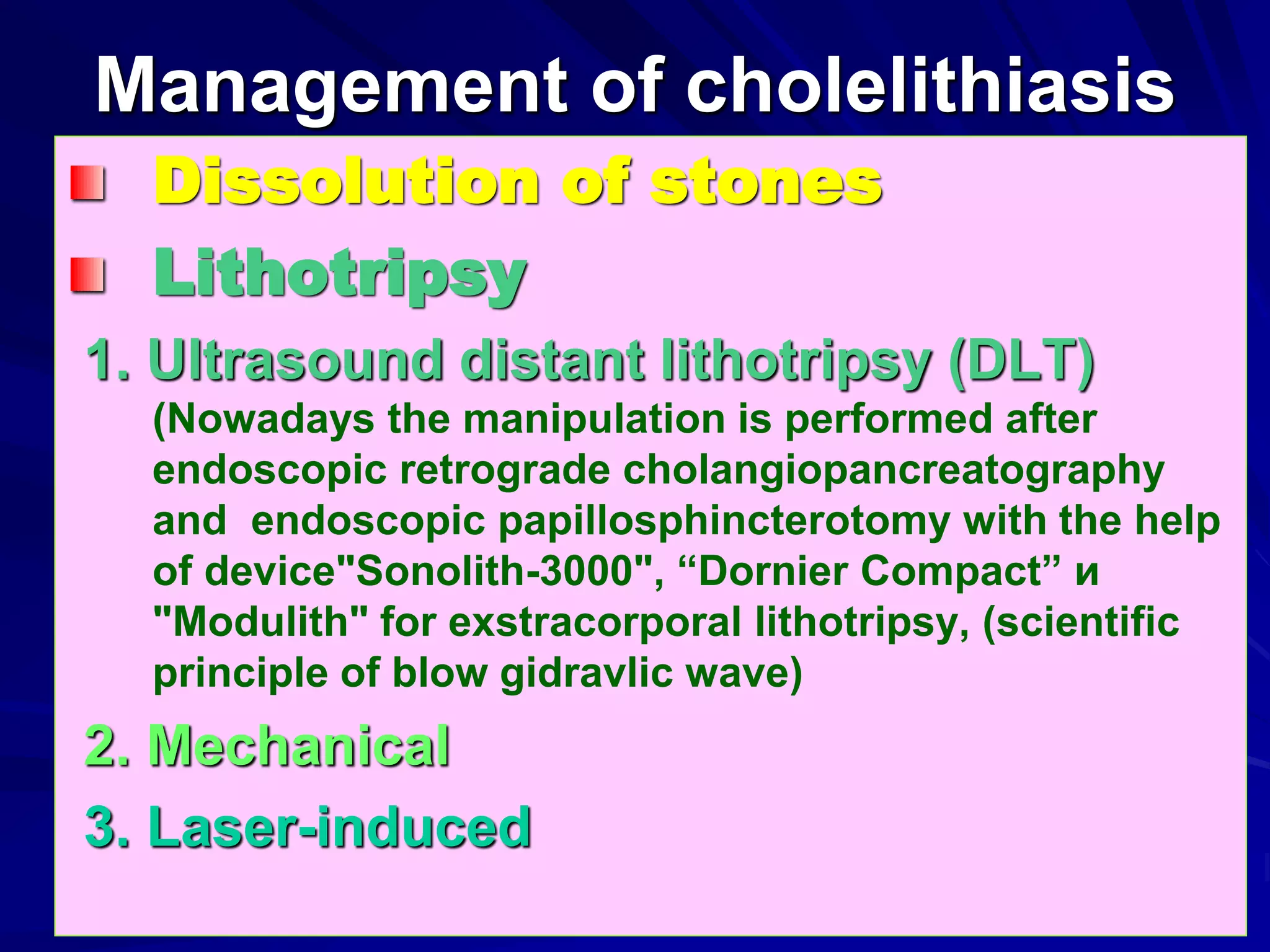
Management of cholelithiasis
Dissolution of stones
Lithotripsy
1. Ultrasound distant lithotripsy (DLT)
(Nowadays the manipulation is performed after
endoscopic retrograde cholangiopancreatography
and endoscopic papillosphincterotomy with the help
of device"Sonolith-3000", “Dornier Compact” и
"Modulith" for exstracorporal lithotripsy, (scientific
principle of blow gidravlic wave)
2. Mechanical
3. Laser-induced
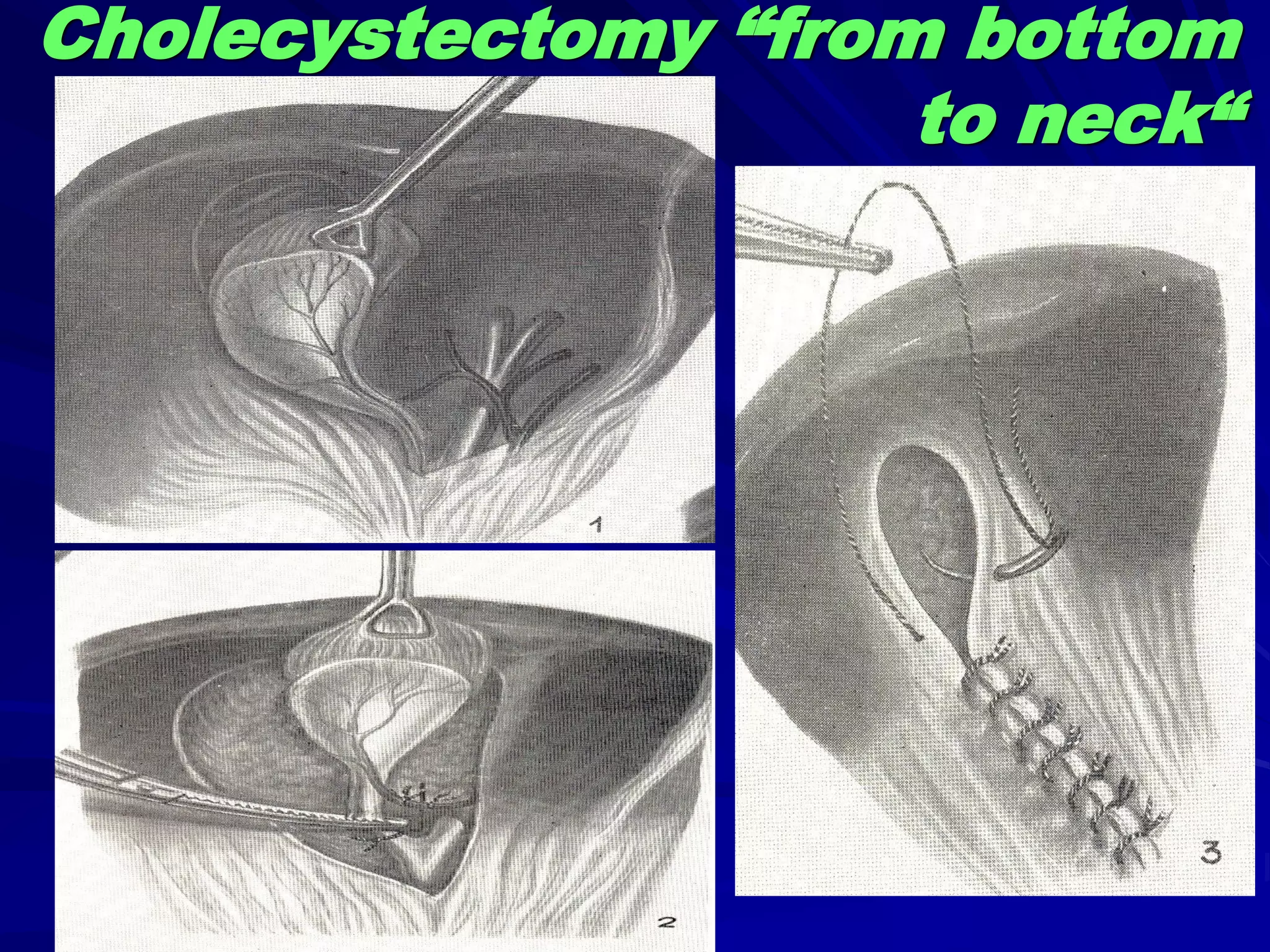
Cholecystectomy “from bottom
to neck“
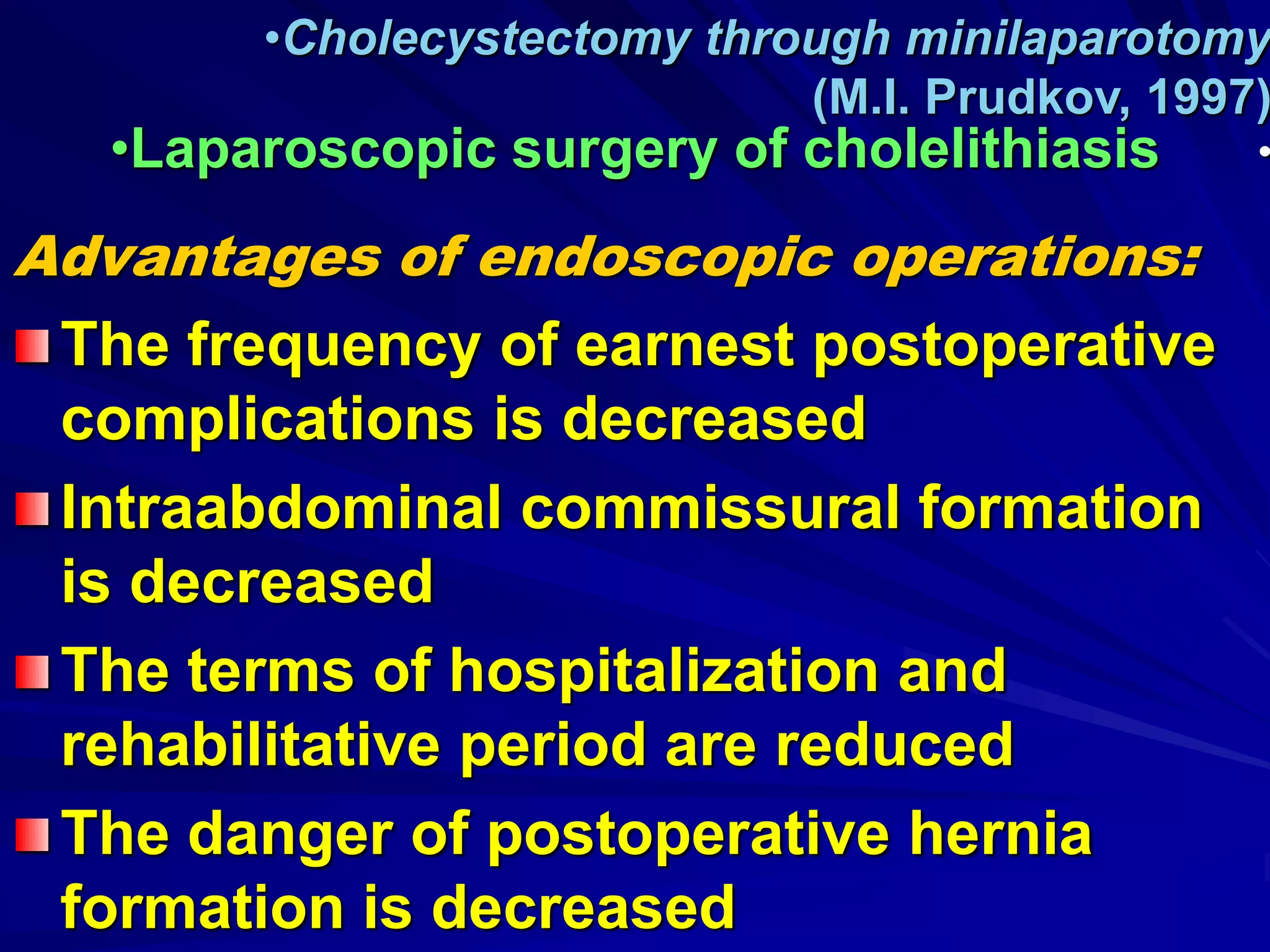
Advantages of endoscopic operations:
The frequency of earnest postoperative
complications is decreased
Intraabdominal commissural formation
is decreased
The terms of hospitalization and
rehabilitative period are reduced
The danger of postoperative hernia
formation is decreased
•Cholecystectomy through minilaparotomy
(M.I. Prudkov, 1997)
•
•Laparoscopic surgery of cholelithiasis
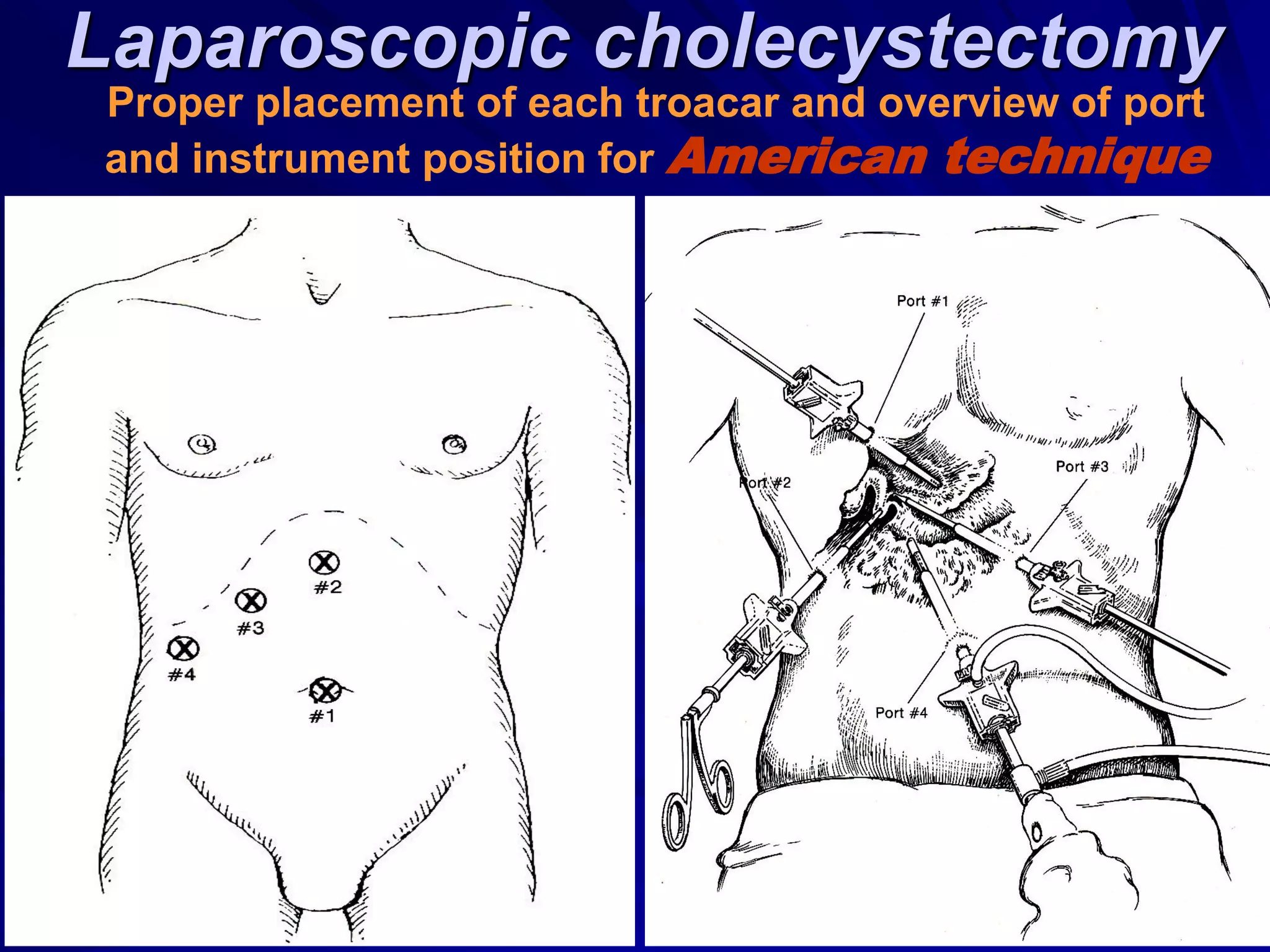
Laparoscopic cholecystectomy
Proper placement of each troacar and overview of port
and instrument position for American technique
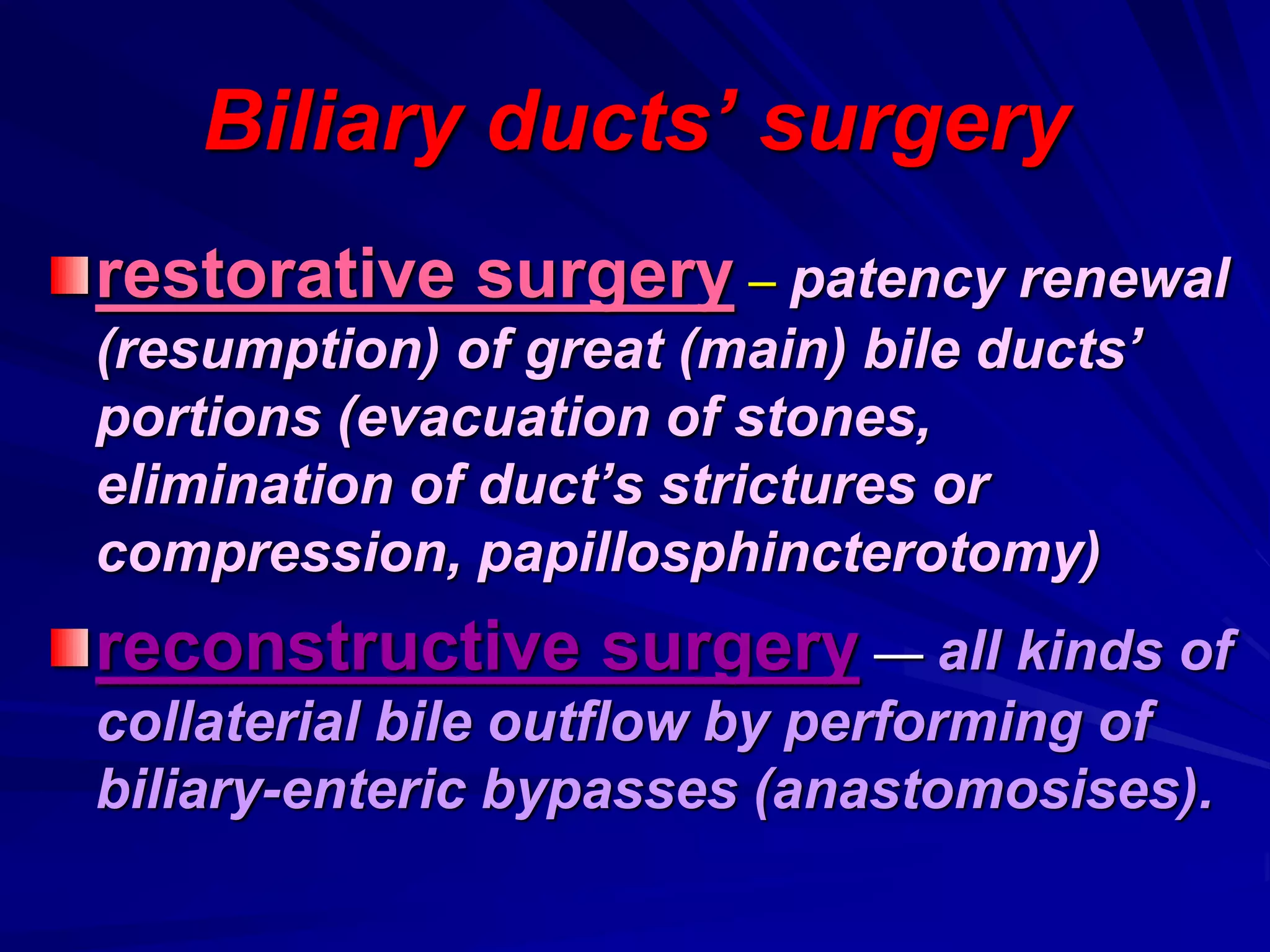
Biliary ducts’ surgery
restorative surgery – patency renewal
(resumption) of great (main) bile ducts’
portions (evacuation of stones,
elimination of duct’s strictures or
compression, papillosphincterotomy)
reconstructive surgery — all kinds of
collaterial bile outflow by performing of
biliary-enteric bypasses (anastomosises).
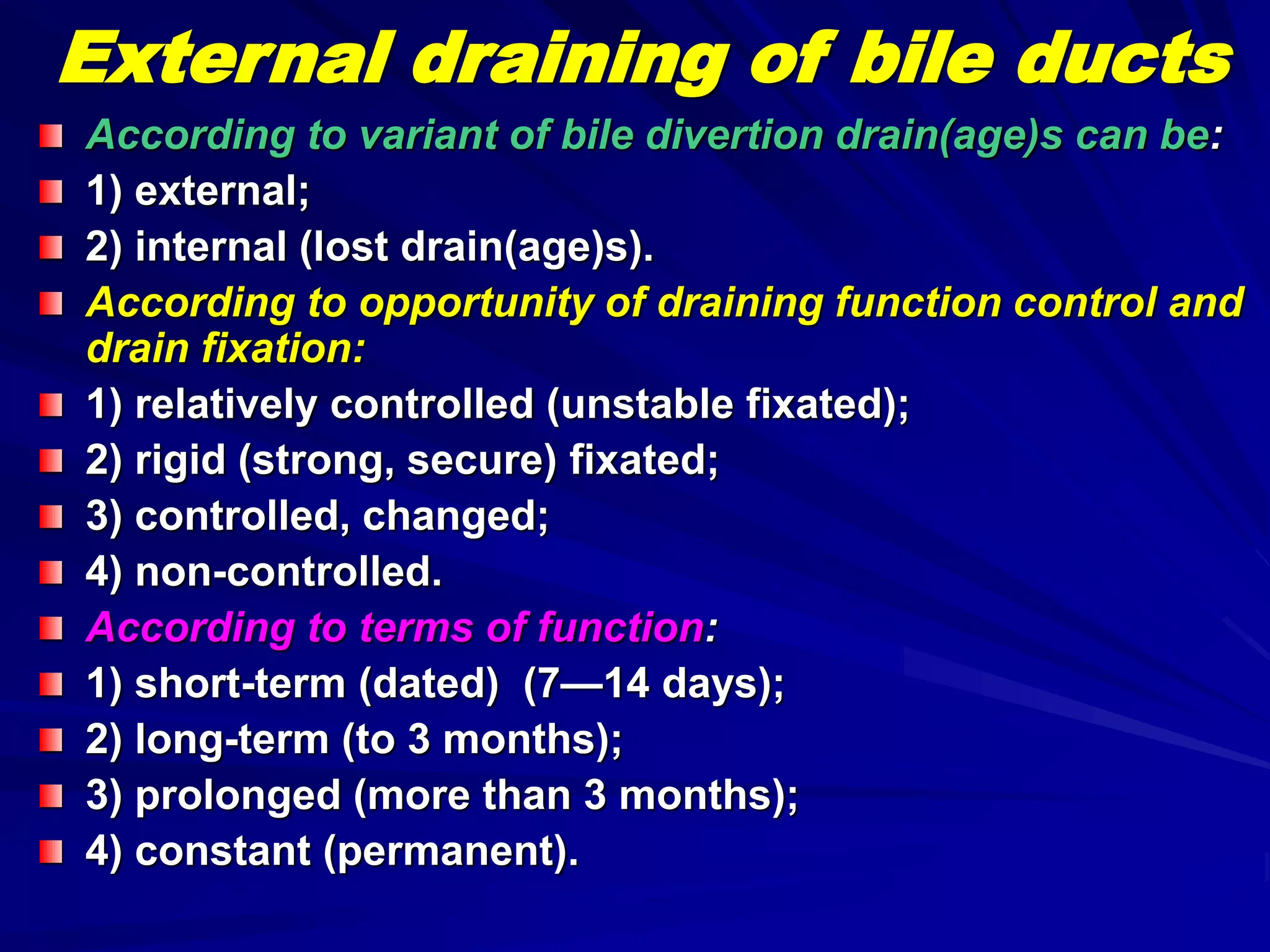
According to variant of bile divertion drain(age)s can be:
1) external;
2) internal (lost drain(age)s).
According to opportunity of draining function control and
drain fixation:
1) relatively controlled (unstable fixated);
2) rigid (strong, secure) fixated;
3) controlled, changed;
4) non-controlled.
According to terms of function:
1) short-term (dated) (7—14 days);
2) long-term (to 3 months);
3) prolonged (more than 3 months);
4) constant (permanent).
External draining of bile ducts
Forms of cholecystitis and
cholecystolithiasis
Chronic form
Chronic acalculous cholecystitis
Chronic calculous cholecystitis
Acute form
Acute acalculous cholecystitis
Acute calculous cholecystitis
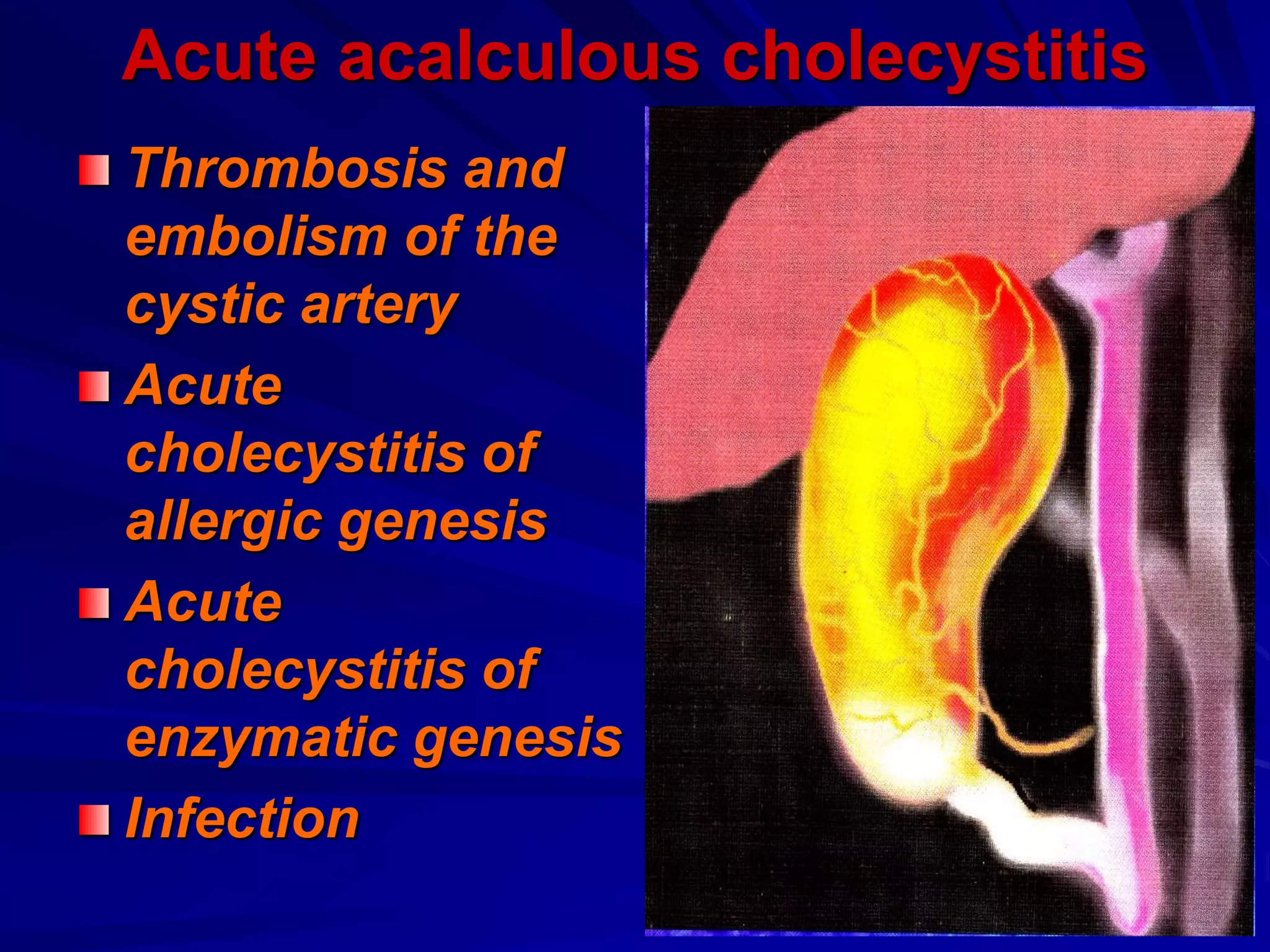
Acute acalculous cholecystitis
Thrombosis and
embolism of the
cystic artery
Acute
cholecystitis of
allergic genesis
Acute
cholecystitis of
enzymatic genesis
Infection

Cholelitiasis and its complications. (lecture vasilevsky v.p.)

  • 1.
    Cholelithiasis and it’s complications Departmentof surgical diseases №1 Assistant lecturer Vasilevsky V.P.
  • 2.
    Actuality and practicalimportance More than 20 million people in the USA have gallstones in their gallbladders; about 300,000 operations are performed annually for this disease, and at least 6000 deaths result from its complications or treatment. The incidence of gallstones rises with age, so that between 50 and 65 years of age about 20% of women and 5% of men are affected. About 40% of world population after forty can have such problem according to data of Shalimov A.A. Approximately 15% of patients with stones in the gallbladder are found to harborcalculi within the bile ducts. Common duct stones are usually accompanied by others in the gallbladder, but in 5% of cases, the gallbladder is empty. The number of duct stones may vary from one to more than 100.
  • 3.
  • 4.
    Varied complaints ofcholelithiasis (or cholecystitis) are first of all connected with numerous of pathological forms and complications 1. Pain syndrome in typical points, 2. Sensation of bitterness in a mouth; 3. Skin itch; 4. Pain irradiation; 5. Mental asthenia; 6. Irritability; 7. Fatigability; 8. Fever hyperpyrexia; 9. Biliary dyspepsia; 10. Meteorism; 11. Heartburn; 12. Foul-smelling eructation; 13. Diarrhea and constipation are the main symptoms in patients with cholecystitis.  Some of complaints are connected with concomitant pathology (sliding hiatal hernia, duodenal peptic ulcer, colitis, gastritis and etc.) Regardless of composition, all gallstones give rise to similar clinical sequelae.
  • 5.
    Clinical symptoms andsigns Symptom of Ortner-Grekov- tenderness during giving a thrashing of right costal margin by the palm border. Pekarsky symptom - full-blown tenderness while pressing on xiphoid (ensiform) cartilage. Symptom of Mussi-Georgievsky is connected with stimulation of phrenic nerve which is projected in supraclavicular area (phrenic sign). Symptom of Ionash – hypersensetization of pain during palpation of the right side of cervical spinous processes (stimulation of phrenic nerve endings) Fedorov’s symptom — palpation the area of gallbladder and detection “crepitation of bile stones” in it.
  • 6.
    Labarotory investigations anddiagnostic examination of the biliary tree Laboratory tests (bilirubin) Duodenal intubation (fractional duodenal probing) USD Endoscopy of stomach and duodenum Nuclear magnetic resonance imaging Spiral computer tomography Radiological imaging (X-ray study) 1. Plain Abdominal Film 2. Cholegraphy (cholecystography) 3. An upper gastrointestinal series with barium 4. Endoscopic Retrograde Cholangiopancreatography (ERCP) 5. Percutaneous Transhepatic Cholangiography (THC, PTC) Radionuclide scan Hepatoangiography Laparoscopy
  • 7.
    Management of cholelithiasis Dissolutionof stones Lithotripsy 1. Ultrasound distant lithotripsy (DLT) (Nowadays the manipulation is performed after endoscopic retrograde cholangiopancreatography and endoscopic papillosphincterotomy with the help of device"Sonolith-3000", “Dornier Compact” и "Modulith" for exstracorporal lithotripsy, (scientific principle of blow gidravlic wave) 2. Mechanical 3. Laser-induced
  • 8.
  • 9.
    Advantages of endoscopicoperations: The frequency of earnest postoperative complications is decreased Intraabdominal commissural formation is decreased The terms of hospitalization and rehabilitative period are reduced The danger of postoperative hernia formation is decreased •Cholecystectomy through minilaparotomy (M.I. Prudkov, 1997) • •Laparoscopic surgery of cholelithiasis
  • 10.
    Laparoscopic cholecystectomy Proper placementof each troacar and overview of port and instrument position for American technique
  • 11.
    Biliary ducts’ surgery restorativesurgery – patency renewal (resumption) of great (main) bile ducts’ portions (evacuation of stones, elimination of duct’s strictures or compression, papillosphincterotomy) reconstructive surgery — all kinds of collaterial bile outflow by performing of biliary-enteric bypasses (anastomosises).
  • 12.
    According to variantof bile divertion drain(age)s can be: 1) external; 2) internal (lost drain(age)s). According to opportunity of draining function control and drain fixation: 1) relatively controlled (unstable fixated); 2) rigid (strong, secure) fixated; 3) controlled, changed; 4) non-controlled. According to terms of function: 1) short-term (dated) (7—14 days); 2) long-term (to 3 months); 3) prolonged (more than 3 months); 4) constant (permanent). External draining of bile ducts
  • 13.
    Forms of cholecystitisand cholecystolithiasis Chronic form Chronic acalculous cholecystitis Chronic calculous cholecystitis Acute form Acute acalculous cholecystitis Acute calculous cholecystitis
  • 14.
    Acute acalculous cholecystitis Thrombosisand embolism of the cystic artery Acute cholecystitis of allergic genesis Acute cholecystitis of enzymatic genesis Infection