Acute appendicitis
Ass. Professor Vasilevsky V.P.
1 st department of surgical diseases
Grodno State Medical University
Definition of idea (problem)
 Acute appendicitis is an acute inflammatory
process of rudimental (vestigial) abdominal
organ (appendix) which is obligatory connected
with cecum and mostly localized in right iliac
area.
 It is an inflammatory disease of the wall of the
vermiform appendix that often results in
transmural necrosis and perforation, with
subsequent localized or generalized peritonitis.
Actuality and practical importance
 Acute appendicitis is one of wide-
spreading surgical pathology of
abdomen. It’s appearance stand on
the first place among acute
abdominal diseases.
 In figures sick-rate will be 1:200-250
persons.
Actuality and practical importance
(continuation)
 This pathology has a very variable clinic
manifestation. Sometimes it has the title
chameleon similar (likeness) disease. Acute
appendicitis can demonstrate the features from
simple catching cold to practically everyone
pathological state of abdomen or retroperitoneal
space.
 Till now there is no 100%-specific method of
instrumental investigation which can give us
absolutely right diagnosis
 This pathology most frequently has
occurred at middle-aged people (20-
40-years adults.
 Mortality rate is aspiring to 0. But
sometimes it can be equal to 0,01-
0,1%.
Actuality and practical importance
(continuation)
History of the question
I period: from ancient times till 80-th years of the XIX
century. The patients had been treated by
conservative methods. Operations had been fulfilled in
patients with peritoneal abscess in right iliac area only.
II period: from 80-th years of XIX century till the beginning
of the XX century.
Fitz had suggested the term “appendicitis” in 1886.
The first appendectomy in Russia had been performed
by A.A. Troyanov in 1890 (Obuhov hospital). The
operation (appendectomy) was fulfilled only if there
had been no positive result from conservative
treatment.
III period: the first quarter of the XX century.
The knowledge of the problem of appendicitis had
become deeper. Appendectomy had been performed in
the first 24-48 hours from the beginning of the disease
or in patients with complications.
History of the question (continuation)
IV period: from the second quarter of the XX century till 70-th
years of the previous century.
Operations of appendectomy had been performed in the
first 6 hours from the appearance of the patient in
surgical clinic and not depend on the terms of the disease
with doubtful diagnosis of acute appendicitis sometimes.
V period: from the 70-th years of the XX century till nowadays.
If we have made the diagnosis of acute appendicitis it is
necessary to perform surgical operation on emergency.
The patients with doubtful diagnosis are investigated
without time terms. We must provide in our actions the
principle “don’t harm”. We can observe the patient if it is
not dangerous to his health. Otherwise the doubtful
diagnosis of acute appendicitis is the indication for
surgical operation.
Etiology and pathogenesis
1. Infectional theory
2. Neurogenic theory
3. Alimentary theory
4. Angio-nevrotic theory
5. Theory of stasis in appendix
6. Verminous appendicitis
Clinical classification of acute
appendicitis (according to Kolesov V.I.)
 Appendalgia (short, not intensive aches
in right iliac region of the abdomen)
 Simple (catarrh, superficial) form
 Destructive forms:
phlegmonous, gangrenous, perforative
 Complications:
infiltrate (mass), abscess, peritonitis,
sepsis, pylephlebitis
Clinical manifestation
The classical clinical manifestation of acute
appendicitis includes abdomen ache, indigestive
disorders and features of the inflammatory process.
Acute appendicitis is typically manifestated as
epigastric or periumbilical cramping pain, but the pain
may be diffuse or initially restricted to the right lower
quadrant. The ache is not very strong but it is
prolonged and sometimes it may be rather intensive.
Shortly thereafter , nausea and vomiting occur , and
the patient develops a low-grade fever and a moderate
leukocytosis. Single vomiting has a reflex character.
Fever and symptoms of intoxication are the main
inflammatory manifestation of the disease. The
temperature rises about subfebrile figures. More rare
it can rise higher than 38 degrees by Celsiush. Such
circumstances mean that the patient has a destructive
form of acute appendicitis or the complications are
getting out.
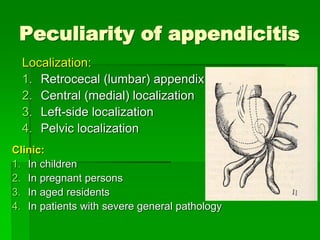
Peculiarity of appendicitis
Localization:
1. Retrocecal (lumbar) appendix
2. Central (medial) localization
3. Left-side localization
4. Pelvic localization
Clinic:
1. In children
2. In pregnant persons
3. In aged residents
4. In patients with severe general pathology
Chronic appendicitis
1. Chronic residual – transformation from acute to chronic
2. Chronic recurrent – acute fits (attacks) are repeated
3. Primary chronic form without acute fit
Other pathology of appendix
1. Leiomyomas, fibromas, lipomas, adenomas
2. Carcinoid tumor – «tumor-like»
3. Pseudomyxoma peritonei
4. Actinomycotic infection
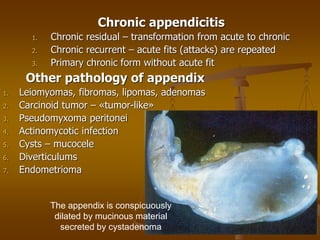
5. Cysts – mucocele
6. Diverticulums
7. Endometrioma
The appendix is conspicuously
dilated by mucinous material
secreted by cystadenoma
Differential diagnosis
1. Acute terminal ileitis (Crohn disease)
2. Acute enteritis,enterocolitis
3. Meckel diverticulitis
4. Perforation of gastro-duodenal ulcers
5. Acute cholecystitis
6. Acute pancreatitis
7. Acute bowel obstruction
8. Renal pathology
9. Mesenteric adenitis
10. Acute salpingitis
11. Mittelschmerz (ovulatory rupture of an
ovarian follicle
12. Pneumonia et al.
Current surgical tactics according to acute appendicitis is not
discussible (simple). If we have made the diagnosis of acute
appendicitis it is necessary to perform surgical operation on
emergency. The treatment of acute appendicitis is urgent
appendectomy
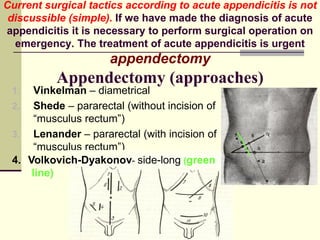
Appendectomy (approaches)
1. Vinkelman – diametrical
2. Shede – pararectal (without incision of
“musculus rectum”)
3. Lenander – pararectal (with incision of
“musculus rectum”)
4. Volkovich-Dyakonov- side-long (green
line)
Complications (sequelae)
I. Before operation
1. Appendiceal infiltrate (mass) is the protective
reaction of visceral and parietal peritoneum on
inflammation in right iliac area. The nature isolates
the destructive changed appendix from the whole
abdomen by forming the inflammatory tumor. This
tumor consists of loops of small and large bowel,
organs of small pelvis which are fixed to
inflammatory changed appendix.
2. Appendiceal abscess
3. Peritonitis and septicemia
4. Pylephlebitis (thrombophlebitis of the intrahepatic
portal vein radicals) and secondary hepatic
abscesses
II. Postoperative
1. Wound disorders and infection
2. Intraabdominal abscesses (pelvic, subdiaphragmatic,
interbowel)
3. Intraabdominal infiltrates
4. Peritonitis

Acute appendicitis(lecture vasilevsky v.p.)

  • 1.
    Acute appendicitis Ass. ProfessorVasilevsky V.P. 1 st department of surgical diseases Grodno State Medical University
  • 2.
    Definition of idea(problem)  Acute appendicitis is an acute inflammatory process of rudimental (vestigial) abdominal organ (appendix) which is obligatory connected with cecum and mostly localized in right iliac area.  It is an inflammatory disease of the wall of the vermiform appendix that often results in transmural necrosis and perforation, with subsequent localized or generalized peritonitis.
  • 3.
    Actuality and practicalimportance  Acute appendicitis is one of wide- spreading surgical pathology of abdomen. It’s appearance stand on the first place among acute abdominal diseases.  In figures sick-rate will be 1:200-250 persons.
  • 4.
    Actuality and practicalimportance (continuation)  This pathology has a very variable clinic manifestation. Sometimes it has the title chameleon similar (likeness) disease. Acute appendicitis can demonstrate the features from simple catching cold to practically everyone pathological state of abdomen or retroperitoneal space.  Till now there is no 100%-specific method of instrumental investigation which can give us absolutely right diagnosis
  • 5.
     This pathologymost frequently has occurred at middle-aged people (20- 40-years adults.  Mortality rate is aspiring to 0. But sometimes it can be equal to 0,01- 0,1%. Actuality and practical importance (continuation)
  • 6.
    History of thequestion I period: from ancient times till 80-th years of the XIX century. The patients had been treated by conservative methods. Operations had been fulfilled in patients with peritoneal abscess in right iliac area only. II period: from 80-th years of XIX century till the beginning of the XX century. Fitz had suggested the term “appendicitis” in 1886. The first appendectomy in Russia had been performed by A.A. Troyanov in 1890 (Obuhov hospital). The operation (appendectomy) was fulfilled only if there had been no positive result from conservative treatment. III period: the first quarter of the XX century. The knowledge of the problem of appendicitis had become deeper. Appendectomy had been performed in the first 24-48 hours from the beginning of the disease or in patients with complications.
  • 7.
    History of thequestion (continuation) IV period: from the second quarter of the XX century till 70-th years of the previous century. Operations of appendectomy had been performed in the first 6 hours from the appearance of the patient in surgical clinic and not depend on the terms of the disease with doubtful diagnosis of acute appendicitis sometimes. V period: from the 70-th years of the XX century till nowadays. If we have made the diagnosis of acute appendicitis it is necessary to perform surgical operation on emergency. The patients with doubtful diagnosis are investigated without time terms. We must provide in our actions the principle “don’t harm”. We can observe the patient if it is not dangerous to his health. Otherwise the doubtful diagnosis of acute appendicitis is the indication for surgical operation.
  • 8.
    Etiology and pathogenesis 1.Infectional theory 2. Neurogenic theory 3. Alimentary theory 4. Angio-nevrotic theory 5. Theory of stasis in appendix 6. Verminous appendicitis
  • 9.
    Clinical classification ofacute appendicitis (according to Kolesov V.I.)  Appendalgia (short, not intensive aches in right iliac region of the abdomen)  Simple (catarrh, superficial) form  Destructive forms: phlegmonous, gangrenous, perforative  Complications: infiltrate (mass), abscess, peritonitis, sepsis, pylephlebitis
  • 10.
    Clinical manifestation The classicalclinical manifestation of acute appendicitis includes abdomen ache, indigestive disorders and features of the inflammatory process. Acute appendicitis is typically manifestated as epigastric or periumbilical cramping pain, but the pain may be diffuse or initially restricted to the right lower quadrant. The ache is not very strong but it is prolonged and sometimes it may be rather intensive. Shortly thereafter , nausea and vomiting occur , and the patient develops a low-grade fever and a moderate leukocytosis. Single vomiting has a reflex character. Fever and symptoms of intoxication are the main inflammatory manifestation of the disease. The temperature rises about subfebrile figures. More rare it can rise higher than 38 degrees by Celsiush. Such circumstances mean that the patient has a destructive form of acute appendicitis or the complications are getting out.
  • 11.
    Peculiarity of appendicitis Localization: 1.Retrocecal (lumbar) appendix 2. Central (medial) localization 3. Left-side localization 4. Pelvic localization Clinic: 1. In children 2. In pregnant persons 3. In aged residents 4. In patients with severe general pathology
  • 12.
    Chronic appendicitis 1. Chronicresidual – transformation from acute to chronic 2. Chronic recurrent – acute fits (attacks) are repeated 3. Primary chronic form without acute fit Other pathology of appendix 1. Leiomyomas, fibromas, lipomas, adenomas 2. Carcinoid tumor – «tumor-like» 3. Pseudomyxoma peritonei 4. Actinomycotic infection 5. Cysts – mucocele 6. Diverticulums 7. Endometrioma The appendix is conspicuously dilated by mucinous material secreted by cystadenoma
  • 13.
    Differential diagnosis 1. Acuteterminal ileitis (Crohn disease) 2. Acute enteritis,enterocolitis 3. Meckel diverticulitis 4. Perforation of gastro-duodenal ulcers 5. Acute cholecystitis 6. Acute pancreatitis 7. Acute bowel obstruction 8. Renal pathology 9. Mesenteric adenitis 10. Acute salpingitis 11. Mittelschmerz (ovulatory rupture of an ovarian follicle 12. Pneumonia et al.
  • 14.
    Current surgical tacticsaccording to acute appendicitis is not discussible (simple). If we have made the diagnosis of acute appendicitis it is necessary to perform surgical operation on emergency. The treatment of acute appendicitis is urgent appendectomy Appendectomy (approaches) 1. Vinkelman – diametrical 2. Shede – pararectal (without incision of “musculus rectum”) 3. Lenander – pararectal (with incision of “musculus rectum”) 4. Volkovich-Dyakonov- side-long (green line)
  • 15.
    Complications (sequelae) I. Beforeoperation 1. Appendiceal infiltrate (mass) is the protective reaction of visceral and parietal peritoneum on inflammation in right iliac area. The nature isolates the destructive changed appendix from the whole abdomen by forming the inflammatory tumor. This tumor consists of loops of small and large bowel, organs of small pelvis which are fixed to inflammatory changed appendix. 2. Appendiceal abscess 3. Peritonitis and septicemia 4. Pylephlebitis (thrombophlebitis of the intrahepatic portal vein radicals) and secondary hepatic abscesses II. Postoperative 1. Wound disorders and infection 2. Intraabdominal abscesses (pelvic, subdiaphragmatic, interbowel) 3. Intraabdominal infiltrates 4. Peritonitis