MICROMETRY
U.DEEPALAKSHMI
I M.Sc MICROBIOLOGY
Introduction:
Microorganisms are microscopic
objects that are visible only with the help of
a microscope. Sometimes it is necessary to
measure its dimensions for its identification
process. But determination of the size of a
microorganism is not an easy process.
Micrometry:
Micrometry refers to the measurement of
dimensions of the desired microorganisms
under a microscope which uses two micro-
scale known as micrometers. These are two
types
Types of Micrometry:
There are usually two types of
micrometers
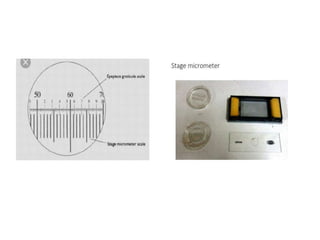
Stage micrometer.
Ocular meter or ocular micrometer.
Stage micrometer:
The measurement on the stage of the
microscope where an object is to be kept. This
micrometer is of a slide’s shape and size and has a
mount of very finely graduated scale. In the centre of
the stage micrometer a known 1mm distance is
etched into 100 equally spaced divisions making
each divisions equals 0.01mm or 10micrometer.
1mm=100 division
1mm=1000mu
Ocular micrometer:
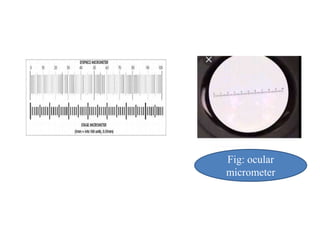
ocular micrometer with microscopic
graduations etched on their surface is a circular
glass disc that fits into the circular shelf inside
the eyepiece of the microscope.
It has 100 equally spaced divisions marked 0-
10. depending on the objective being used the
distance between these graduations will very
that determines the size of the field.
STAGE MICROMETER WORK FLOW:
The stage micrometer kept under the low
power microscope and is observed through the eye
piece having eyepiece reticle.
at this magnification the number of eyepiece
reticule coinciding the stage micrometer are
observed and thence calculated for microns per
ocular divisions.
The correct way to calibrate a
reticle with a stage micrometer is to
line up the left edges of each.
For ex;6 ocular division is
coincide with 8 division of stage
micrometer.
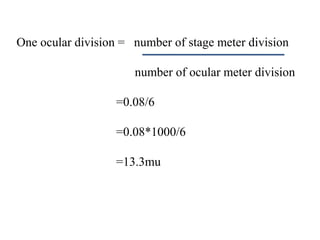
One ocular division = number of stage meter division
number of ocular meter division
=0.08/6
=0.08*1000/6
=13.3mu
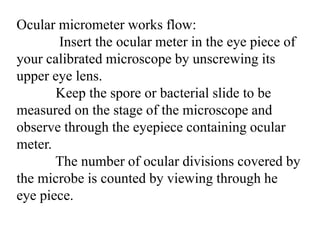
Ocular micrometer works flow:
Insert the ocular meter in the eye piece of
your calibrated microscope by unscrewing its
upper eye lens.
Keep the spore or bacterial slide to be
measured on the stage of the microscope and
observe through the eyepiece containing ocular
meter.
The number of ocular divisions covered by
the microbe is counted by viewing through he
eye piece.
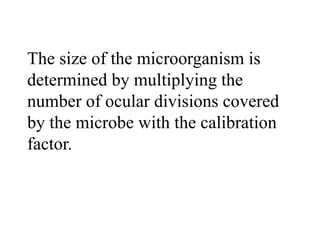
The size of the microorganism is
determined by multiplying the
number of ocular divisions covered
by the microbe with the calibration
factor.
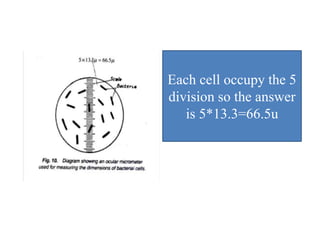
Each cell occupy the 5
division so the answer
is 5*13.3=66.5u
Fig: ocular
micrometer
Application:
This method is more important in
microbiological laboratory.
The main purpose of this method to
identified the length if the organism
such as bacteria, virus, human RBC
cells, yeast cell etc..
Thank you

Micrometry

  • 1.
  • 2.
    Introduction: Microorganisms are microscopic objectsthat are visible only with the help of a microscope. Sometimes it is necessary to measure its dimensions for its identification process. But determination of the size of a microorganism is not an easy process.
  • 3.
    Micrometry: Micrometry refers tothe measurement of dimensions of the desired microorganisms under a microscope which uses two micro- scale known as micrometers. These are two types
  • 4.
    Types of Micrometry: Thereare usually two types of micrometers Stage micrometer. Ocular meter or ocular micrometer.
  • 5.
    Stage micrometer: The measurementon the stage of the microscope where an object is to be kept. This micrometer is of a slide’s shape and size and has a mount of very finely graduated scale. In the centre of the stage micrometer a known 1mm distance is etched into 100 equally spaced divisions making each divisions equals 0.01mm or 10micrometer. 1mm=100 division 1mm=1000mu
  • 6.
    Ocular micrometer: ocular micrometerwith microscopic graduations etched on their surface is a circular glass disc that fits into the circular shelf inside the eyepiece of the microscope. It has 100 equally spaced divisions marked 0- 10. depending on the objective being used the distance between these graduations will very that determines the size of the field.
  • 7.
    STAGE MICROMETER WORKFLOW: The stage micrometer kept under the low power microscope and is observed through the eye piece having eyepiece reticle. at this magnification the number of eyepiece reticule coinciding the stage micrometer are observed and thence calculated for microns per ocular divisions.
  • 8.
    The correct wayto calibrate a reticle with a stage micrometer is to line up the left edges of each. For ex;6 ocular division is coincide with 8 division of stage micrometer.
  • 9.
    One ocular division= number of stage meter division number of ocular meter division =0.08/6 =0.08*1000/6 =13.3mu
  • 11.
    Ocular micrometer worksflow: Insert the ocular meter in the eye piece of your calibrated microscope by unscrewing its upper eye lens. Keep the spore or bacterial slide to be measured on the stage of the microscope and observe through the eyepiece containing ocular meter. The number of ocular divisions covered by the microbe is counted by viewing through he eye piece.
  • 12.
    The size ofthe microorganism is determined by multiplying the number of ocular divisions covered by the microbe with the calibration factor.
  • 13.
    Each cell occupythe 5 division so the answer is 5*13.3=66.5u
  • 14.
  • 15.
    Application: This method ismore important in microbiological laboratory. The main purpose of this method to identified the length if the organism such as bacteria, virus, human RBC cells, yeast cell etc..
  • 16.