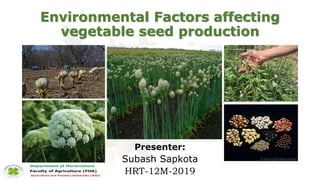
Environmental Factors affecting
vegetable seed production
Presenter:
Subash Sapkota
HRT-12M-2019
Presentation outline
• Introduction
• Factor affecting vegetable quality seed
production
• Environmental factors
• Temperature
• Photoperiod
• Soil
• Rainfall and humidity
• Wind
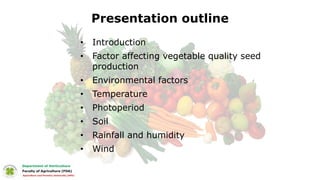
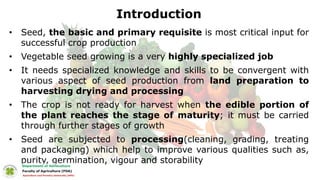
Introduction
• Seed, the basic and primary requisite is most critical input for
successful crop production
• Vegetable seed growing is a very highly specialized job
• It needs specialized knowledge and skills to be convergent with
various aspect of seed production from land preparation to
harvesting drying and processing
• The crop is not ready for harvest when the edible portion of
the plant reaches the stage of maturity; it must be carried
through further stages of growth
• Seed are subjected to processing(cleaning, grading, treating
and packaging) which help to improve various qualities such as,
purity, germination, vigour and storability
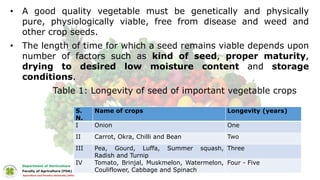
• A good quality vegetable must be genetically and physically
pure, physiologically viable, free from disease and weed and
other crop seeds.
• The length of time for which a seed remains viable depends upon
number of factors such as kind of seed, proper maturity,
drying to desired low moisture content and storage
conditions.
Table 1: Longevity of seed of important vegetable crops
S.
N.
Name of crops Longevity (years)
I Onion One
II Carrot, Okra, Chilli and Bean Two
III Pea, Gourd, Luffa, Summer squash,
Radish and Turnip
Three
IV Tomato, Brinjal, Muskmelon, Watermelon,
Couliflower, Cabbage and Spinach
Four - Five
Factor affecting vegetable quality seed
production includes
• Genotype of seed
• Environmental condition
• Position of seed on parent plant
• Post-harvest handling of seed
• Seed quality control factor
• Pre-sowing treatment
Environmental Factors affecting vegetable
seed production
• The seed production of vegetable should be carried out
carefully in the region where they are well adopted
• Each kind of vegetable has its own optimum growth
requirements, with some being fastidious and other less
• Breeding and selection of new cultivars have allowed for a
greater adaptability to less favorable growing conditions than was
possible in the past, but the inherent climatic requirements
of a specific kind of vegetable have not changed materially
• Before seeds can be produced from vegetables it is necessary for
the crop to flower.
• Flowering is required by the plant for sexual reproduction and
maintenance of generation
• Some plant species pass from vegetative phase to the reproductive
phase with special requirement or stimulus, whereas in others such
stimulus is not required
• Some plant species requires special physiology to pass from the
vegetative phase to reproductive phase which either dependent on
day length (photoperiod) or have a low temperature requirement
(vernalization)
• Not only photoperiod and temperature but some other climatic
factors, e.g. rainfall, wind etc. are also responsible for best yield of
high quality seeds
1. Photoperiod
• Photoperiod influences vegetable seed production by affecting
photosynthesis and day length
• The transition from vegetative to the reproductive phase in
some vegetable crop can occur only at the season when the
days are of particular length (Thomson, 1979) But now with
the species, cultivar adopted to different day length have been
developed
• Light intensity influences pollination, drying and ripening of
seeds Within the limits, higher the light intensity, the higher will
be the rate of photosynthesis required to manufacture
important constituents of the seed
• Crop species of temperate regions tends to flower in long days of
summer while tropical crop species require shorter days
• Short day plants: Day light period 10-12 hours. for example
amaranthus sps, soyabean, pepper (some varieties), kidney bean
• Long day plants: Day light period 12 - 14 hours, for example,
spinach cauliflower, broccoli, turnip etc.
• Day neutral plants: This group does not have a specific day
length requirement for flowering, for example, tomato, brinjal,
lettuce, cucurbits, carrot etc.
2. Temperature
• Seed germination, crop growth, bolting, seed development
and maturity and viability of vegetable seeds are influenced by
temperature.
• Some vegetable species do not initiate flowers until the plant has
received a cold stimulus (vernalization) e.g. cabbage Brussels
sprout, beet, biennial radish, European carrot, onion etc.
• Particularly in cross and often cross pollinated vegetables,
pollinators are of important component for quality seed
production. These pollinators stop working at low temperature
(below 20 °C) or high temperature beyond (38 °C), for bee, 24-
38 °C is favorable for pollination activity
• In some vegetables high temperature inhibits development of
ovules, pollen growth and fruits and causes shedding of
flower buds and young pods/flowers
• Higher temperature also results in shriveling of seeds, lower
yield and poor seed quality
• Although vegetables harvested for market-use such as onion,
radish, brassicas, and lettuce are typically grown in areas with
lower temperatures, requires higher temperatures to
encourage bolting
• Vegetable seeds also vary greatly in their tolerance to soil
temperatures at planting
• Pea, radish, and spinach require cool soil temperatures for
optimum seedling emergence
• Squash and melons require warm soil temperatures for
optimum seedling emergence
• Beets, cabbage, carrot, and onion are tolerant of cool soil
temperatures although they do better in warmer soils
• In regions with high summer temperatures, vegetables such as
tomato, pepper, eggplant, and cucurbits are planted in the
early spring to optimize flowering and seed set in early
summer
3. Soil
• The preparation of a field for vegetable seed production differs
little from that for vegetable production
• Soils should have a high water holding capacity to encourage
uniform vegetative growth, Conservation tillage practices can be
used for seed production as well
• Vegetable seed crops have nutrient requirements similar to
those of crops grown for vegetable production
• Generally, lower nitrogen and phosphorus levels are used in
seed production
• Excess nitrogen helps the seed plants grow more vegetative
leading to more proneness to disease and insects resulting
reduction in seed quality and yield.
• Soil should have adequate macro and micro nutrients for
producing vigorous and viable seeds. Boron deficiency causes
black rot in cabbage & cauliflower and hollow heart in garden
pea. Molybdenum deficiency causes whiptail physiological
disorder in crucifers
• Crops like onion, garlic, carrot, beet, radish, turnip, garden beet,
potato, yams, sweet potato and tapioca do well in lighter soils ,
A heavier soil causes splitting of onion and malformed root
4. Rainfall and Relative Humidity
• High rainfall along with high temperature causes infestation of
insect pest and disease. Rainfall spread pathogens and
pests apart from this, it leads to mould attack causing seed
discoloration & bleached seeds in peas.
• Excessive rainfall also interferes with pollination. Activity of
pollinators (bees) is particularly nil during rains and when
flowers are wet.
• Rain at physiological maturity causes poor quality seeds and
its keeping quality also poor
• Planting of vegetable for seed production should be done in such
a way that maturity does not coincide with rainfall
• Normally humid areas are unfit for most quality seed
production. Slightly warm dry climate is suitable for
production of disease free seed
• High RH>90% causes flower drop while lesser < 40%
produces hard seeds that affects plant stand
• Higher RH tends to increase the moisture content of stored
seeds there by increasing the respiration rate, thus moderate
rain and dry condition are best for seed production
5. Wind
• Wind is necessary for pollination in wind pollinated crops
• Improves seed setting in highly cross pollinated crops like
onion and crucifers
• Heavy winds may carry pollen too far or prevent deposition on
stigma thus reducing seed set
• Heavy winds dislodge seed production crops and seed loss
through shattering of seeds/pod
• Dry winds also desiccate pollen losing its viability
Thank you!!!

Environmental factors affecting vegetable seed production

  • 1.
    Environmental Factors affecting vegetableseed production Presenter: Subash Sapkota HRT-12M-2019
  • 2.
    Presentation outline • Introduction •Factor affecting vegetable quality seed production • Environmental factors • Temperature • Photoperiod • Soil • Rainfall and humidity • Wind
  • 3.
    Introduction • Seed, thebasic and primary requisite is most critical input for successful crop production • Vegetable seed growing is a very highly specialized job • It needs specialized knowledge and skills to be convergent with various aspect of seed production from land preparation to harvesting drying and processing • The crop is not ready for harvest when the edible portion of the plant reaches the stage of maturity; it must be carried through further stages of growth • Seed are subjected to processing(cleaning, grading, treating and packaging) which help to improve various qualities such as, purity, germination, vigour and storability
  • 4.
    • A goodquality vegetable must be genetically and physically pure, physiologically viable, free from disease and weed and other crop seeds. • The length of time for which a seed remains viable depends upon number of factors such as kind of seed, proper maturity, drying to desired low moisture content and storage conditions. Table 1: Longevity of seed of important vegetable crops S. N. Name of crops Longevity (years) I Onion One II Carrot, Okra, Chilli and Bean Two III Pea, Gourd, Luffa, Summer squash, Radish and Turnip Three IV Tomato, Brinjal, Muskmelon, Watermelon, Couliflower, Cabbage and Spinach Four - Five
  • 5.
    Factor affecting vegetablequality seed production includes • Genotype of seed • Environmental condition • Position of seed on parent plant • Post-harvest handling of seed • Seed quality control factor • Pre-sowing treatment
  • 6.
    Environmental Factors affectingvegetable seed production • The seed production of vegetable should be carried out carefully in the region where they are well adopted • Each kind of vegetable has its own optimum growth requirements, with some being fastidious and other less • Breeding and selection of new cultivars have allowed for a greater adaptability to less favorable growing conditions than was possible in the past, but the inherent climatic requirements of a specific kind of vegetable have not changed materially • Before seeds can be produced from vegetables it is necessary for the crop to flower.
  • 7.
    • Flowering isrequired by the plant for sexual reproduction and maintenance of generation • Some plant species pass from vegetative phase to the reproductive phase with special requirement or stimulus, whereas in others such stimulus is not required • Some plant species requires special physiology to pass from the vegetative phase to reproductive phase which either dependent on day length (photoperiod) or have a low temperature requirement (vernalization) • Not only photoperiod and temperature but some other climatic factors, e.g. rainfall, wind etc. are also responsible for best yield of high quality seeds
  • 8.
    1. Photoperiod • Photoperiodinfluences vegetable seed production by affecting photosynthesis and day length • The transition from vegetative to the reproductive phase in some vegetable crop can occur only at the season when the days are of particular length (Thomson, 1979) But now with the species, cultivar adopted to different day length have been developed • Light intensity influences pollination, drying and ripening of seeds Within the limits, higher the light intensity, the higher will be the rate of photosynthesis required to manufacture important constituents of the seed
  • 9.
    • Crop speciesof temperate regions tends to flower in long days of summer while tropical crop species require shorter days • Short day plants: Day light period 10-12 hours. for example amaranthus sps, soyabean, pepper (some varieties), kidney bean • Long day plants: Day light period 12 - 14 hours, for example, spinach cauliflower, broccoli, turnip etc. • Day neutral plants: This group does not have a specific day length requirement for flowering, for example, tomato, brinjal, lettuce, cucurbits, carrot etc.
  • 10.
    2. Temperature • Seedgermination, crop growth, bolting, seed development and maturity and viability of vegetable seeds are influenced by temperature. • Some vegetable species do not initiate flowers until the plant has received a cold stimulus (vernalization) e.g. cabbage Brussels sprout, beet, biennial radish, European carrot, onion etc. • Particularly in cross and often cross pollinated vegetables, pollinators are of important component for quality seed production. These pollinators stop working at low temperature (below 20 °C) or high temperature beyond (38 °C), for bee, 24- 38 °C is favorable for pollination activity
  • 11.
    • In somevegetables high temperature inhibits development of ovules, pollen growth and fruits and causes shedding of flower buds and young pods/flowers • Higher temperature also results in shriveling of seeds, lower yield and poor seed quality • Although vegetables harvested for market-use such as onion, radish, brassicas, and lettuce are typically grown in areas with lower temperatures, requires higher temperatures to encourage bolting • Vegetable seeds also vary greatly in their tolerance to soil temperatures at planting
  • 12.
    • Pea, radish,and spinach require cool soil temperatures for optimum seedling emergence • Squash and melons require warm soil temperatures for optimum seedling emergence • Beets, cabbage, carrot, and onion are tolerant of cool soil temperatures although they do better in warmer soils • In regions with high summer temperatures, vegetables such as tomato, pepper, eggplant, and cucurbits are planted in the early spring to optimize flowering and seed set in early summer
  • 13.
    3. Soil • Thepreparation of a field for vegetable seed production differs little from that for vegetable production • Soils should have a high water holding capacity to encourage uniform vegetative growth, Conservation tillage practices can be used for seed production as well • Vegetable seed crops have nutrient requirements similar to those of crops grown for vegetable production • Generally, lower nitrogen and phosphorus levels are used in seed production
  • 14.
    • Excess nitrogenhelps the seed plants grow more vegetative leading to more proneness to disease and insects resulting reduction in seed quality and yield. • Soil should have adequate macro and micro nutrients for producing vigorous and viable seeds. Boron deficiency causes black rot in cabbage & cauliflower and hollow heart in garden pea. Molybdenum deficiency causes whiptail physiological disorder in crucifers • Crops like onion, garlic, carrot, beet, radish, turnip, garden beet, potato, yams, sweet potato and tapioca do well in lighter soils , A heavier soil causes splitting of onion and malformed root
  • 15.
    4. Rainfall andRelative Humidity • High rainfall along with high temperature causes infestation of insect pest and disease. Rainfall spread pathogens and pests apart from this, it leads to mould attack causing seed discoloration & bleached seeds in peas. • Excessive rainfall also interferes with pollination. Activity of pollinators (bees) is particularly nil during rains and when flowers are wet. • Rain at physiological maturity causes poor quality seeds and its keeping quality also poor
  • 16.
    • Planting ofvegetable for seed production should be done in such a way that maturity does not coincide with rainfall • Normally humid areas are unfit for most quality seed production. Slightly warm dry climate is suitable for production of disease free seed • High RH>90% causes flower drop while lesser < 40% produces hard seeds that affects plant stand • Higher RH tends to increase the moisture content of stored seeds there by increasing the respiration rate, thus moderate rain and dry condition are best for seed production
  • 17.
    5. Wind • Windis necessary for pollination in wind pollinated crops • Improves seed setting in highly cross pollinated crops like onion and crucifers • Heavy winds may carry pollen too far or prevent deposition on stigma thus reducing seed set • Heavy winds dislodge seed production crops and seed loss through shattering of seeds/pod • Dry winds also desiccate pollen losing its viability
  • 18.