SUBMITTED BY
PUNAM BISWAS
M.SC. NURSING 1ST YEAR
COLLEGE OF NURSING,
AIIMS BHUBANESWAR
GROWTH AND DEVELOPMENT
OF PRESCHOOLER AGE
PRESCHOOLER AGE (3-6
YEARS)
INTRODUCTION:
 Growth and development is an unique process in
every child’s life, which occurs in a predictable
orderly sequence during different stages of
development.
 GOAL:
 To monitor child’s growth and development.
 To improve their personality and behavior.
 GROWTH AND DEVELOPMENT OF
PRESCHOOLER CHILDREN(3-6 YEARS):
 Preschooler continue to need physical affection and
love. School children continue to learn values and
competencies they will bring into the adult world.
 Physical growth:
 The rate of physical growth slows and
stabilizes during the preschooler years.
 Average weight : 14.5kg at the age of 3 years
 16.7kg at the age of 4 years
 18.7kg at the age of 5 years
CONT
 Average height : 95cm at the age of 3 years
 103cm at the age of 4 years
 110cm at the age of 5 years
 Vital signs : PR = 85-115 bpm
 RR= 19 – 26 breaths/min
 BP= 86-114/50-70 mm of hg
DEVELOPMENTAL THEORIES OF
PRESCHOOLER AGE:
 PSYCHOSEXUAL DEVELOPMENT : (SIGMOID
FREUD)
Freud describes phallic stage of this age group.
During this stage the primary focus on the libido is
on the genitals.
Boys wanting to possess the mother(Oedipus
complex) and girls desire to replace the father
(electra complex).
 PSYCHOSOCIAL DEVELOPMENT : (ERIK
ERIKSON)
During this year children begins to assert their
power. Giving freedom and offurtunity it is helpful
for initiation and inhibiting from doing anything
 COGNITIVE DEVELOPMENT : (JEAN PIAGET)
preoperational phase
Preschooler develop intuitive thought , a tendency to look at an
object and see only one of its characteristics , called
centering. An example of centering is child observes
medicine taests bad but does not understand it will helpful.
Preschooler thinking is influenced by role fantasy , they
believe that wishesh are real dreams are real .
 MORAL DEVELOPMENT : ( LAWRENCE KOHLBERG)
PRECONVENTIONAL LEVEL
In the punishment and obedience orientation , children judge
whether the action is good or bad depending upon the results
Wheather it is result or punishment.
 SPIRITUAL DEVELOPMENT : ( FOWLER)
Children generally learn about faith and religion from
significant others in their environment. Preschooler have a
concrete concept of a god with a physical characteristics.
 GROWTH AND DEVELOPMENT OF 3-4 YEARS
 Biological development
 Gross motor:
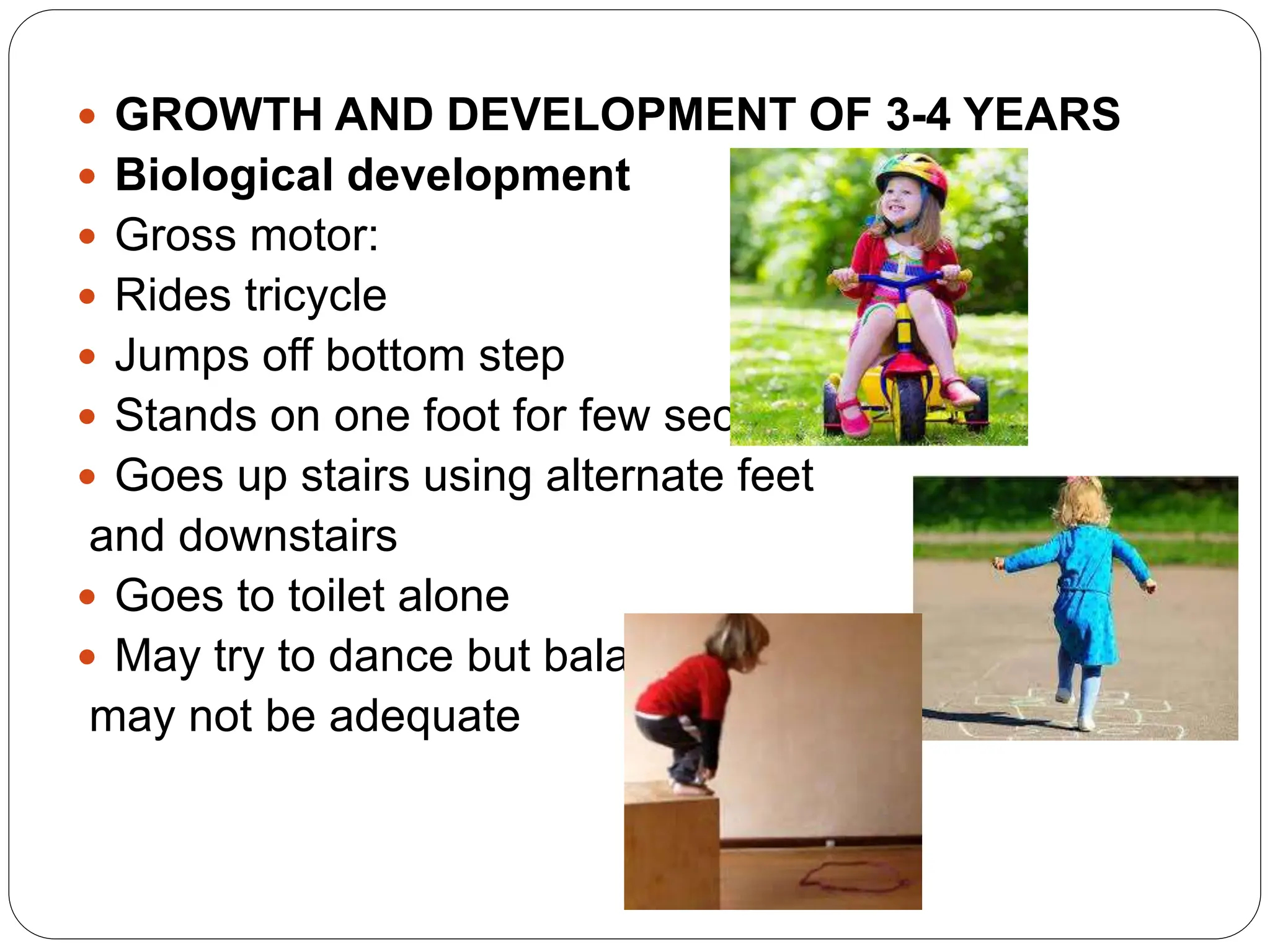
 Rides tricycle
 Jumps off bottom step
 Stands on one foot for few seconds
 Goes up stairs using alternate feet
and downstairs
 Goes to toilet alone
 May try to dance but balance
may not be adequate
 Fine motor :
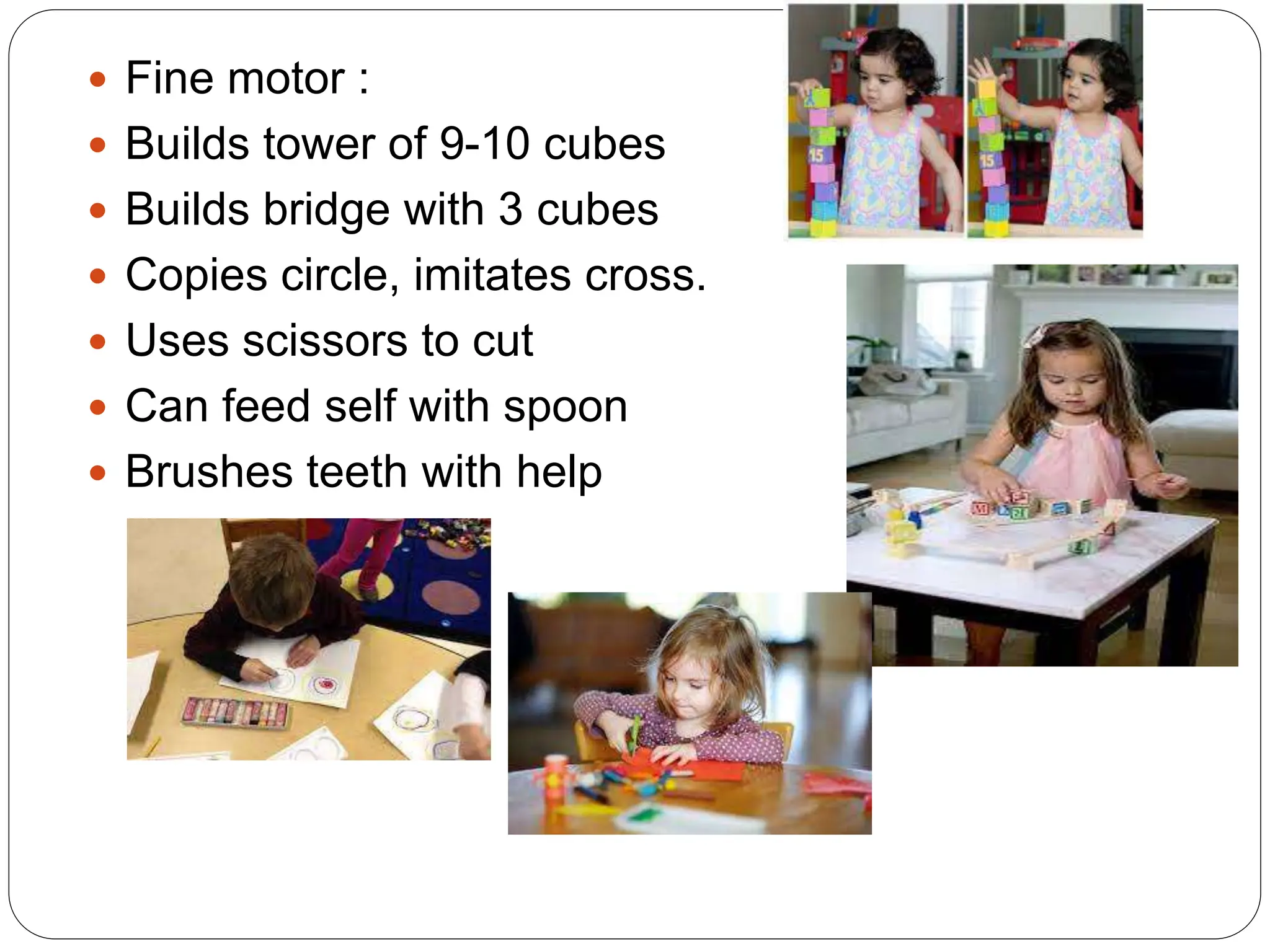
 Builds tower of 9-10 cubes
 Builds bridge with 3 cubes
 Copies circle, imitates cross.
 Uses scissors to cut
 Can feed self with spoon
 Brushes teeth with help
 Language development:
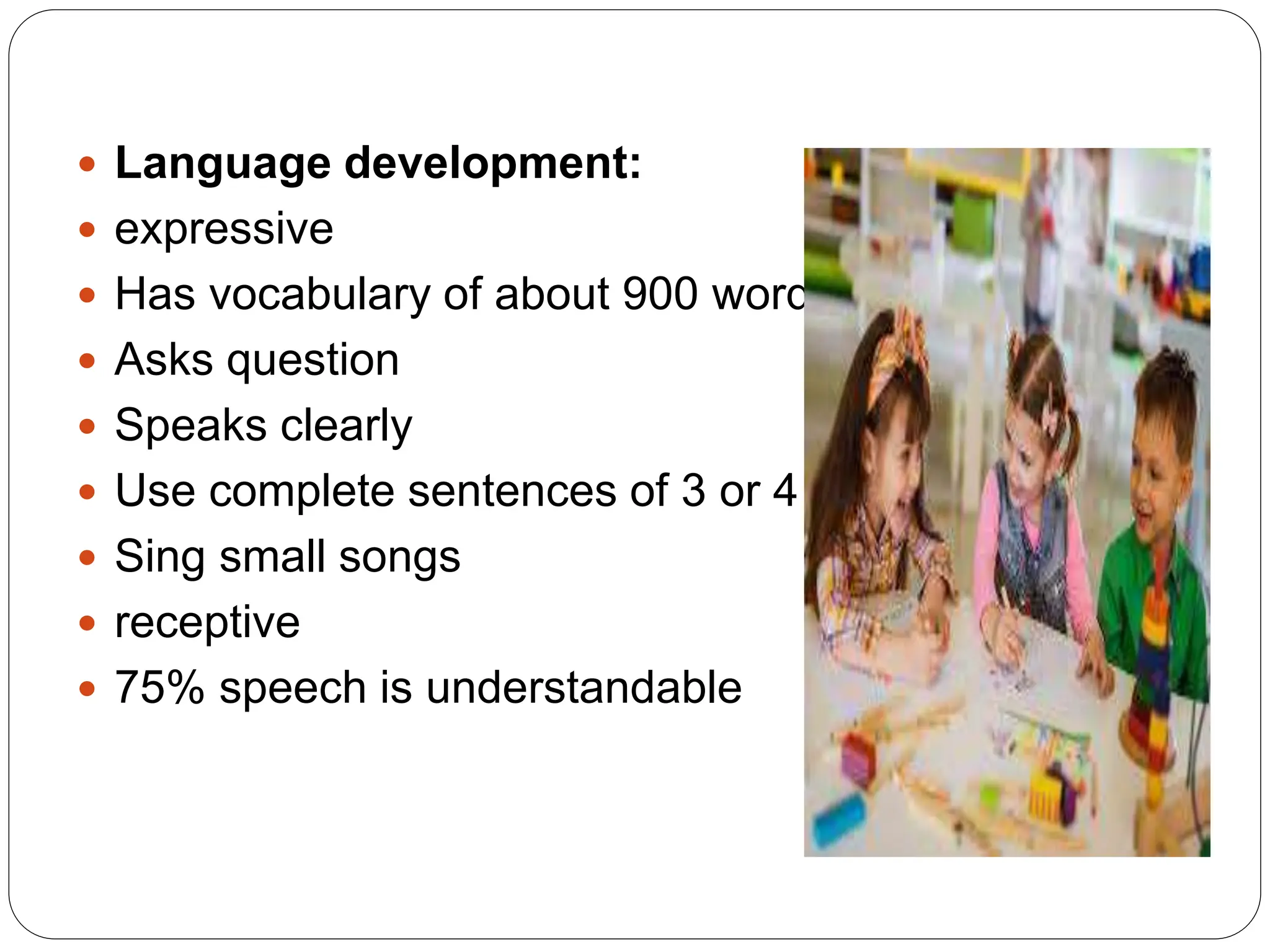
 expressive
 Has vocabulary of about 900 words
 Asks question
 Speaks clearly
 Use complete sentences of 3 or 4 words
 Sing small songs
 receptive
 75% speech is understandable
 Cognitive development:
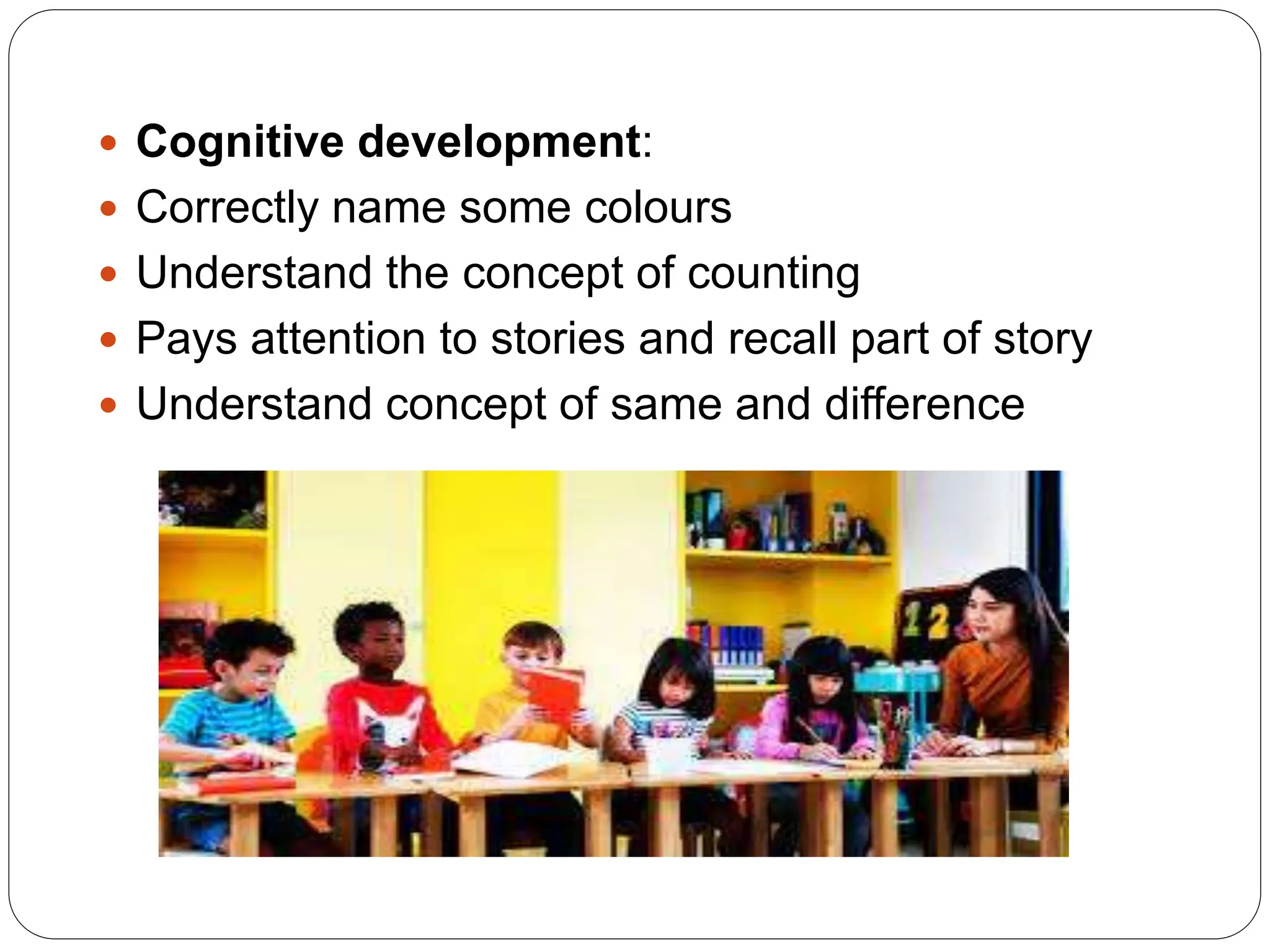
 Correctly name some colours
 Understand the concept of counting
 Pays attention to stories and recall part of story
 Understand concept of same and difference
 Social development:
 Dresses self almost completely
 Pulls on shoes
 Has increased attention span
 Feeds self completely
 Knows own gender and gender of others
 Play is parallel and associative
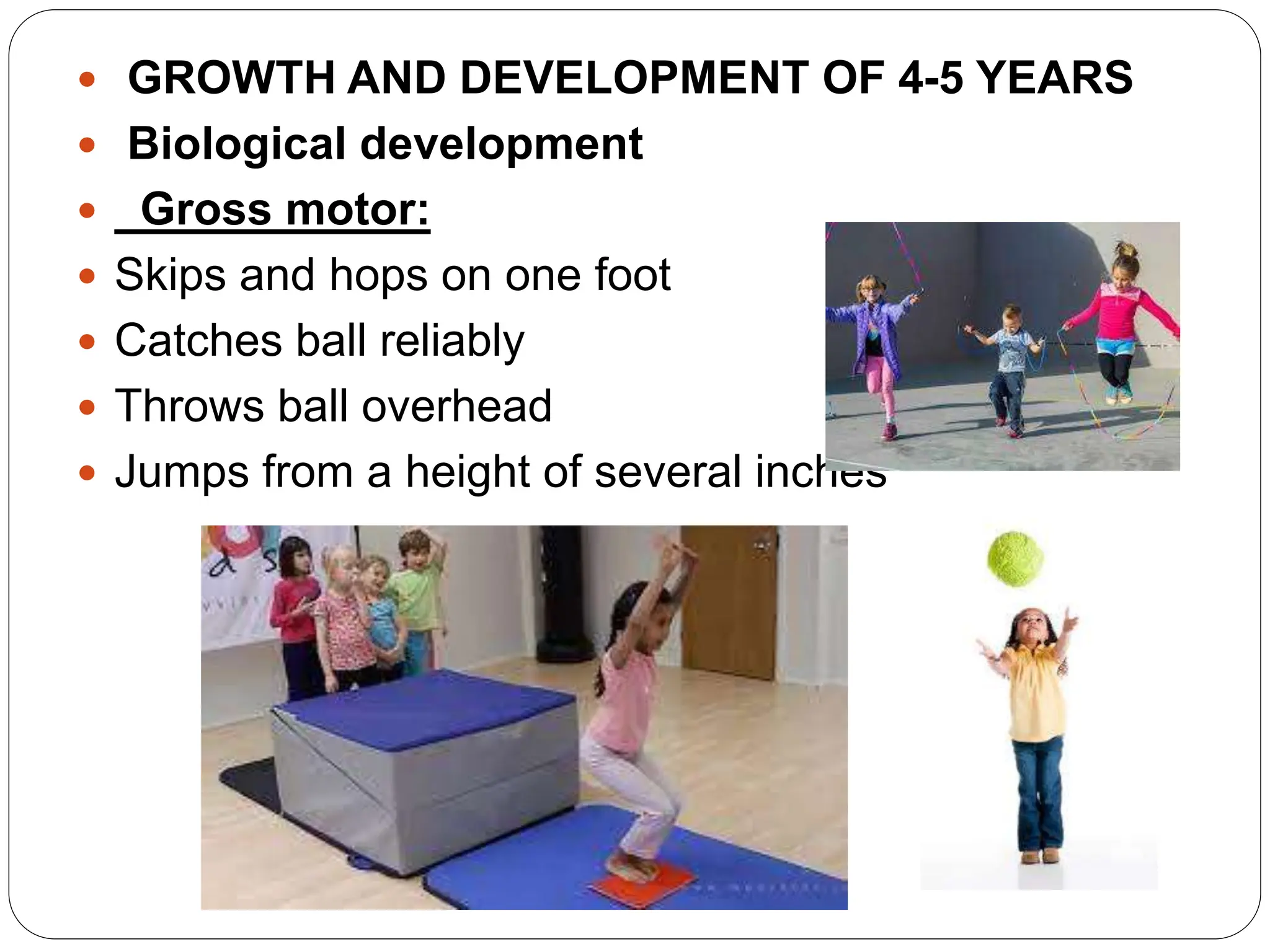
 GROWTH AND DEVELOPMENT OF 4-5 YEARS
 Biological development
 Gross motor:
 Skips and hops on one foot
 Catches ball reliably
 Throws ball overhead
 Jumps from a height of several inches
 Fine motor
 Copies square
 Draw simple face
 Uses scissor to cut the outline
 Hold fork with fingers
 Language development
 Receptive
 Understand words that relate one idea to another-
if , why, when
 Expressive
 Has vocabulary of 1500 words
 Uses sentences of 4-5 words
 Says name and address
 Cognition development
 Correctly names at least 4 colours
 Knows about things use every day in the room
 Obeys parents
 Understand number concept such as more,bigger
 Starting developing logical thinking grasp the concept
of past , present, future
 Highly imaginitive
 Social development
 Tends to selfish and impatient
 Aggressive
 Has mood swings
 Imaginary playmates common
 Sexual exploration and curiosity
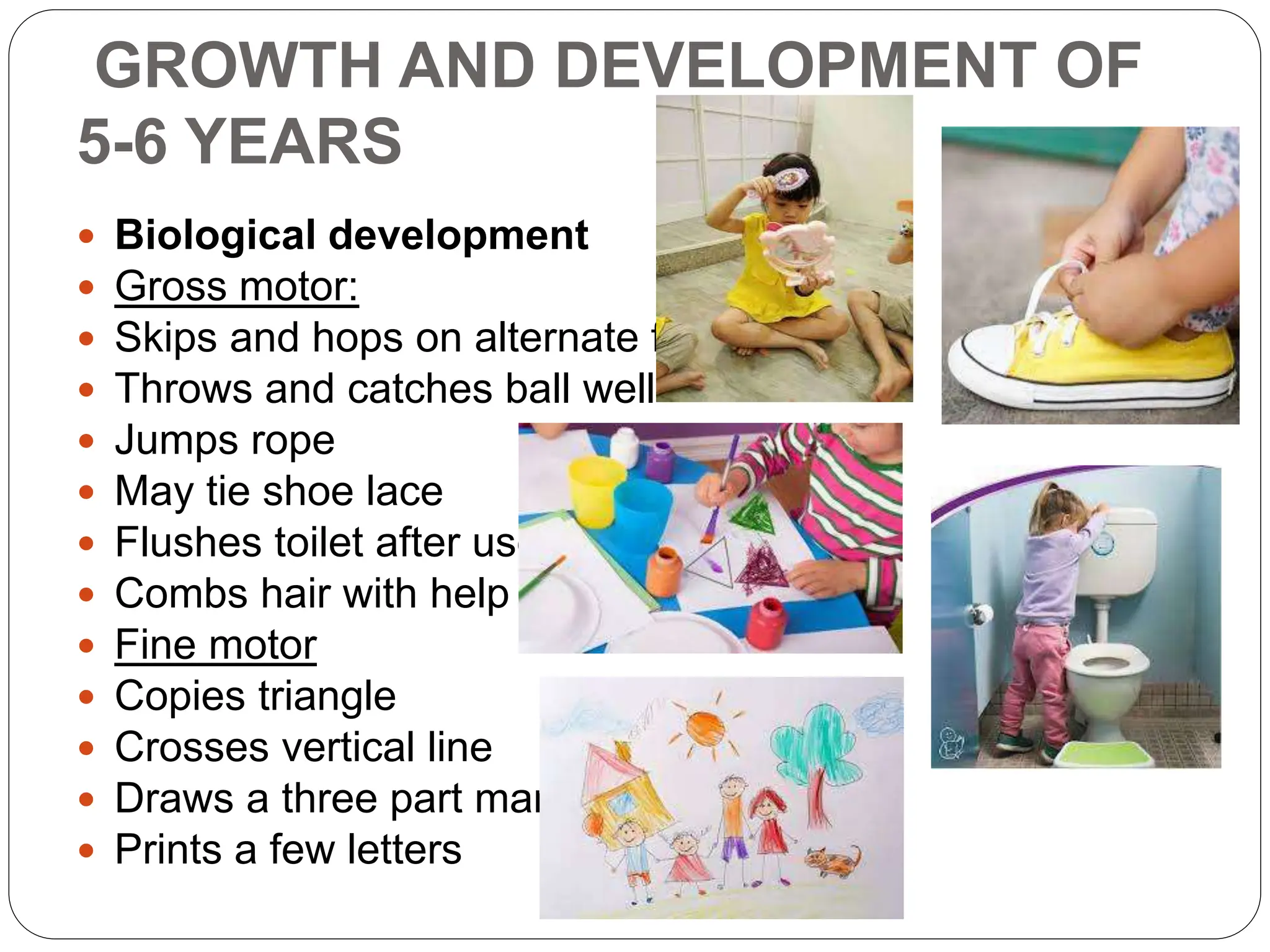
GROWTH AND DEVELOPMENT OF
5-6 YEARS
 Biological development
 Gross motor:
 Skips and hops on alternate feet
 Throws and catches ball well
 Jumps rope
 May tie shoe lace
 Flushes toilet after use
 Combs hair with help
 Fine motor
 Copies triangle
 Crosses vertical line
 Draws a three part man
 Prints a few letters
 Language development
 Receptive
 Carries out simple instruction
 Expressive
 Use vocabulary of about 2100 words
 Uses sentences of 6-8 words
 Describes drawing pictures
 Knows name of days of weeks, months
 Cognition development
 Begins to question what parent thinks by
comparing them with age mates and other
 May notice prejudice
 Uses time oriented words
 Is more able to view others prospective
 Social development
 Independent
 Has fewer fears: relies on outer authority control
 In play try to follow rules
 Has better manner
Addressing common
development concern:
 Sex education:
Children are given the sex education. They will
engage in games of sexual curiosity. A positive
approach is to neither condon nor condemn the
sexual curiosity but to express that if children
have questions. Masturbation occurs at any
stage, for this age group it is a part of sexual
curiosity. In the case of excessive masturbation it
may be associated with emotional , behavioural
problems and physical and sexual abuse.
 Fear:
A great number of real and imagined fears are
present during the preschooler years, including
fear of dark, fear of ghost, they have concept of
animism, fear of annihilation ( loss of body parts).
 The best way to overcome this fear is by actively
involving them in finding practical method to deal
with the frightening experience.
 Stress:
 Young children are specially vulnerable because
of their limited capacity to cope. Parents should
monitor the amount of stress so that levels do not
exceed their coping ability.
 Aggression :
 Aggression differs from anger , which is
temporary state, anger may be expressed through
aggression.
 Factors that tend to increase aggressive behavior
are-
 Gender : Boys exhibit more physical aggression than
girls.
 Speech problem :
 Stuttering affects boys more frequently than girls.
The best therapy is prevention and early detection.
Common causes include hearing loss,
developmental delay , autism.
 Referral for further evaluation and treatment may
be necessary. Denver articulation screening test is
an excellent tool for assessing articulation skills of a
child and for explaining to parents the expected
progression of sound.
 Promoting optimum health during preschooler:
 Nutrition:
 Preschooler eat half the amount of adult. Cal.
Requirement is 1300-1700 kcal and 50 gm of
protein. They need 3 meals. They should at fruits,
vegetables, lean meat and low fat diet.
 Play :
 Preschooler especially enjoy associative play,
group play in similar or identical activity but without
rigid organization rules. It enhances motor activity
include jumping , running and climbing.tricycle,
gym and sport equipmentand some activities like
swimming, skating help develop muscle
coordination.
 They are enjoyed crafts, electronic
games, computer learn basic skills.
 Sleep and activity:
Average preschooler sleeps approximately 12
hours a night and infrequently takes day time nap.
Somnambulism is common throughout early
childhood. An appropriate and consistent bedtime ,
nap schedule and bedtime routine can help prevent
and treat common sleep problem.
 Dental health :
The eruption of deciduous teeth is complete.
Primary care providers are in an ideal position to
perform dental screening and risk assessments.
 Injury prevention :
Preschoolers explore things inside and outside
house. Excessive curiosity and experimental attitude
put them in danger. Pedestrian motor vehicle injuries
increase because of activites such as playing in the
street , riding tricycle or forgetting safety regulations
when crossing street. Children should be taught
safety rules and potential hazard in home and during
play.
CONCLUSION:
 From the class we have learned about Growth
and Development of preschooler and now we can
able to recognize thr growth and developmentof
preschooler and we can able to take care of that
age group children. This class helps us to provide
a comprehensive care for preschooler according
to their needs.
JOURNAL:
 1) Clark david and Cifelli Christopher (2020) Nutrition to Promote Child
Development, Growth and Diet Quality in middle- to Low-Income
Countries, volume – 12, page no 3556
Undernutrition in young children is a global health issue. The ability to meet
energy and nutrient needs during this critical stage of development is
necessary, not only to achieve physical and mental potential but also socio-
economic achievement later in life. Given ongoing discussions regarding
optimization of dietary patterns to support achievement of the Sustainable
Development Goals established by the United Nations, it is important to
identify foods/food groups that have shown efficacy in reducing the
negative impacts of undernutrition in young children. This narrative review
addresses the impact of dairy intake, with a focus on linear growth,
cognitive development and weight gain in early childhood (12–60 months).
The impact of country economic status is also examined, to help elucidate
regional specific recommendations and/or future research needs. Overall,
the body of research addressing this age group is somewhat limited. Based
on the data available, there is a positive association between dairy intake
and linear growth. The impact of milk or dairy products on cognitive
development is less clear due to a lack of evidence and is a gap in the
literature that should be addressed. Regarding the impact on body weight,
the majority of evidence suggests there is either no association or an
inverse association between milk intake by preschool children on
overweight and obesity later in life. This evidence is exclusively in high
income countries, however, so additional work in lower income countries
may be warranted.
 2) Hussain Abul, (2021) GROWTH AND
DEVELOPMENT OF CHILDREN; PAGE NO 4-9
The primary purpose of studying the growth and
development of children is to understand them better. As
a teacher or a parent, can manage children more
effectively if he is aware of how they grow and develop
in a systematic manner right from the moment of
conception. An orderly pattern is found in the growth of
every organ of the body and area of
development.Although the development process is
continuous, the rate or speed of development varies at
different ages of the child. For example, children grow
most rapidly during the first three years of life. In their
middle childhood, i.e., from 6 - 12 years, their rate of
growth is comparatively slow whereas it is accelerated
again when they approach adolescence. A knowledge of
the trends and patterns of growth and development will
enable he to know how children grow and develop;
when and what to expect from them, how to guide them
in each stage and provide the environment for their
optimum development. The purpose of this article is to
 BIBLIOGRAPHY
 1)Hockenberry j marilyn, wilson david ; Wong’s
essential of pediatric nursing; 2nd edition: 2019; the
healthy child growth and development; Elsevier; 283-
302
 2)Hockenberry , wilson ; Wong’s nursing care of
infants and children ; 11th edition ;2019 ; health
promotion of the preschool age and family ; Elsevier ;
423-438
 3)Kyle terri and charman susan ;Eessential of
pediatric nursing; 2nd edition ; 2017 ; growth and
development of preschool children ; Kluwer ; 128-140
 4)Pal Panchali ; Textbook of pediatric nursing ; 3rd
edition ; 2018; growth and development of
preschooler age : paras medical publisher; 80-
growth and development in preschooler age group in pediatric nursing

growth and development in preschooler age group in pediatric nursing

  • 1.
    SUBMITTED BY PUNAM BISWAS M.SC.NURSING 1ST YEAR COLLEGE OF NURSING, AIIMS BHUBANESWAR GROWTH AND DEVELOPMENT OF PRESCHOOLER AGE
  • 2.
  • 3.
    INTRODUCTION:  Growth anddevelopment is an unique process in every child’s life, which occurs in a predictable orderly sequence during different stages of development.  GOAL:  To monitor child’s growth and development.  To improve their personality and behavior.
  • 4.
     GROWTH ANDDEVELOPMENT OF PRESCHOOLER CHILDREN(3-6 YEARS):  Preschooler continue to need physical affection and love. School children continue to learn values and competencies they will bring into the adult world.  Physical growth:  The rate of physical growth slows and stabilizes during the preschooler years.  Average weight : 14.5kg at the age of 3 years  16.7kg at the age of 4 years  18.7kg at the age of 5 years
  • 5.
    CONT  Average height: 95cm at the age of 3 years  103cm at the age of 4 years  110cm at the age of 5 years  Vital signs : PR = 85-115 bpm  RR= 19 – 26 breaths/min  BP= 86-114/50-70 mm of hg
  • 6.
    DEVELOPMENTAL THEORIES OF PRESCHOOLERAGE:  PSYCHOSEXUAL DEVELOPMENT : (SIGMOID FREUD) Freud describes phallic stage of this age group. During this stage the primary focus on the libido is on the genitals. Boys wanting to possess the mother(Oedipus complex) and girls desire to replace the father (electra complex).  PSYCHOSOCIAL DEVELOPMENT : (ERIK ERIKSON) During this year children begins to assert their power. Giving freedom and offurtunity it is helpful for initiation and inhibiting from doing anything
  • 7.
     COGNITIVE DEVELOPMENT: (JEAN PIAGET) preoperational phase Preschooler develop intuitive thought , a tendency to look at an object and see only one of its characteristics , called centering. An example of centering is child observes medicine taests bad but does not understand it will helpful. Preschooler thinking is influenced by role fantasy , they believe that wishesh are real dreams are real .  MORAL DEVELOPMENT : ( LAWRENCE KOHLBERG) PRECONVENTIONAL LEVEL In the punishment and obedience orientation , children judge whether the action is good or bad depending upon the results Wheather it is result or punishment.  SPIRITUAL DEVELOPMENT : ( FOWLER) Children generally learn about faith and religion from significant others in their environment. Preschooler have a concrete concept of a god with a physical characteristics.
  • 8.
     GROWTH ANDDEVELOPMENT OF 3-4 YEARS  Biological development  Gross motor:  Rides tricycle  Jumps off bottom step  Stands on one foot for few seconds  Goes up stairs using alternate feet and downstairs  Goes to toilet alone  May try to dance but balance may not be adequate
  • 9.
     Fine motor:  Builds tower of 9-10 cubes  Builds bridge with 3 cubes  Copies circle, imitates cross.  Uses scissors to cut  Can feed self with spoon  Brushes teeth with help
  • 10.
     Language development: expressive  Has vocabulary of about 900 words  Asks question  Speaks clearly  Use complete sentences of 3 or 4 words  Sing small songs  receptive  75% speech is understandable
  • 11.
     Cognitive development: Correctly name some colours  Understand the concept of counting  Pays attention to stories and recall part of story  Understand concept of same and difference
  • 12.
     Social development: Dresses self almost completely  Pulls on shoes  Has increased attention span  Feeds self completely  Knows own gender and gender of others  Play is parallel and associative
  • 13.
     GROWTH ANDDEVELOPMENT OF 4-5 YEARS  Biological development  Gross motor:  Skips and hops on one foot  Catches ball reliably  Throws ball overhead  Jumps from a height of several inches
  • 14.
     Fine motor Copies square  Draw simple face  Uses scissor to cut the outline  Hold fork with fingers
  • 15.
     Language development Receptive  Understand words that relate one idea to another- if , why, when  Expressive  Has vocabulary of 1500 words  Uses sentences of 4-5 words  Says name and address
  • 16.
     Cognition development Correctly names at least 4 colours  Knows about things use every day in the room  Obeys parents  Understand number concept such as more,bigger  Starting developing logical thinking grasp the concept of past , present, future  Highly imaginitive
  • 17.
     Social development Tends to selfish and impatient  Aggressive  Has mood swings  Imaginary playmates common  Sexual exploration and curiosity
  • 18.
    GROWTH AND DEVELOPMENTOF 5-6 YEARS  Biological development  Gross motor:  Skips and hops on alternate feet  Throws and catches ball well  Jumps rope  May tie shoe lace  Flushes toilet after use  Combs hair with help  Fine motor  Copies triangle  Crosses vertical line  Draws a three part man  Prints a few letters
  • 19.
     Language development Receptive  Carries out simple instruction  Expressive  Use vocabulary of about 2100 words  Uses sentences of 6-8 words  Describes drawing pictures  Knows name of days of weeks, months
  • 20.
     Cognition development Begins to question what parent thinks by comparing them with age mates and other  May notice prejudice  Uses time oriented words  Is more able to view others prospective  Social development  Independent  Has fewer fears: relies on outer authority control  In play try to follow rules  Has better manner
  • 21.
    Addressing common development concern: Sex education: Children are given the sex education. They will engage in games of sexual curiosity. A positive approach is to neither condon nor condemn the sexual curiosity but to express that if children have questions. Masturbation occurs at any stage, for this age group it is a part of sexual curiosity. In the case of excessive masturbation it may be associated with emotional , behavioural problems and physical and sexual abuse.
  • 22.
     Fear: A greatnumber of real and imagined fears are present during the preschooler years, including fear of dark, fear of ghost, they have concept of animism, fear of annihilation ( loss of body parts).  The best way to overcome this fear is by actively involving them in finding practical method to deal with the frightening experience.
  • 23.
     Stress:  Youngchildren are specially vulnerable because of their limited capacity to cope. Parents should monitor the amount of stress so that levels do not exceed their coping ability.  Aggression :  Aggression differs from anger , which is temporary state, anger may be expressed through aggression.  Factors that tend to increase aggressive behavior are-  Gender : Boys exhibit more physical aggression than girls.
  • 24.
     Speech problem:  Stuttering affects boys more frequently than girls. The best therapy is prevention and early detection. Common causes include hearing loss, developmental delay , autism.  Referral for further evaluation and treatment may be necessary. Denver articulation screening test is an excellent tool for assessing articulation skills of a child and for explaining to parents the expected progression of sound.
  • 25.
     Promoting optimumhealth during preschooler:  Nutrition:  Preschooler eat half the amount of adult. Cal. Requirement is 1300-1700 kcal and 50 gm of protein. They need 3 meals. They should at fruits, vegetables, lean meat and low fat diet.
  • 27.
     Play : Preschooler especially enjoy associative play, group play in similar or identical activity but without rigid organization rules. It enhances motor activity include jumping , running and climbing.tricycle, gym and sport equipmentand some activities like swimming, skating help develop muscle coordination.  They are enjoyed crafts, electronic games, computer learn basic skills.
  • 28.
     Sleep andactivity: Average preschooler sleeps approximately 12 hours a night and infrequently takes day time nap. Somnambulism is common throughout early childhood. An appropriate and consistent bedtime , nap schedule and bedtime routine can help prevent and treat common sleep problem.
  • 29.
     Dental health: The eruption of deciduous teeth is complete. Primary care providers are in an ideal position to perform dental screening and risk assessments.
  • 30.
     Injury prevention: Preschoolers explore things inside and outside house. Excessive curiosity and experimental attitude put them in danger. Pedestrian motor vehicle injuries increase because of activites such as playing in the street , riding tricycle or forgetting safety regulations when crossing street. Children should be taught safety rules and potential hazard in home and during play.
  • 31.
    CONCLUSION:  From theclass we have learned about Growth and Development of preschooler and now we can able to recognize thr growth and developmentof preschooler and we can able to take care of that age group children. This class helps us to provide a comprehensive care for preschooler according to their needs.
  • 32.
    JOURNAL:  1) Clarkdavid and Cifelli Christopher (2020) Nutrition to Promote Child Development, Growth and Diet Quality in middle- to Low-Income Countries, volume – 12, page no 3556 Undernutrition in young children is a global health issue. The ability to meet energy and nutrient needs during this critical stage of development is necessary, not only to achieve physical and mental potential but also socio- economic achievement later in life. Given ongoing discussions regarding optimization of dietary patterns to support achievement of the Sustainable Development Goals established by the United Nations, it is important to identify foods/food groups that have shown efficacy in reducing the negative impacts of undernutrition in young children. This narrative review addresses the impact of dairy intake, with a focus on linear growth, cognitive development and weight gain in early childhood (12–60 months). The impact of country economic status is also examined, to help elucidate regional specific recommendations and/or future research needs. Overall, the body of research addressing this age group is somewhat limited. Based on the data available, there is a positive association between dairy intake and linear growth. The impact of milk or dairy products on cognitive development is less clear due to a lack of evidence and is a gap in the literature that should be addressed. Regarding the impact on body weight, the majority of evidence suggests there is either no association or an inverse association between milk intake by preschool children on overweight and obesity later in life. This evidence is exclusively in high income countries, however, so additional work in lower income countries may be warranted.
  • 33.
     2) HussainAbul, (2021) GROWTH AND DEVELOPMENT OF CHILDREN; PAGE NO 4-9 The primary purpose of studying the growth and development of children is to understand them better. As a teacher or a parent, can manage children more effectively if he is aware of how they grow and develop in a systematic manner right from the moment of conception. An orderly pattern is found in the growth of every organ of the body and area of development.Although the development process is continuous, the rate or speed of development varies at different ages of the child. For example, children grow most rapidly during the first three years of life. In their middle childhood, i.e., from 6 - 12 years, their rate of growth is comparatively slow whereas it is accelerated again when they approach adolescence. A knowledge of the trends and patterns of growth and development will enable he to know how children grow and develop; when and what to expect from them, how to guide them in each stage and provide the environment for their optimum development. The purpose of this article is to
  • 34.
     BIBLIOGRAPHY  1)Hockenberryj marilyn, wilson david ; Wong’s essential of pediatric nursing; 2nd edition: 2019; the healthy child growth and development; Elsevier; 283- 302  2)Hockenberry , wilson ; Wong’s nursing care of infants and children ; 11th edition ;2019 ; health promotion of the preschool age and family ; Elsevier ; 423-438  3)Kyle terri and charman susan ;Eessential of pediatric nursing; 2nd edition ; 2017 ; growth and development of preschool children ; Kluwer ; 128-140  4)Pal Panchali ; Textbook of pediatric nursing ; 3rd edition ; 2018; growth and development of preschooler age : paras medical publisher; 80-