Devanshi Padaliya
Psychologist
Welcome! Today we will discuss both challenges and
rewards in parenting, the importance of your
preparation in educating and raising children , and how
you can ensure children grow up to be healthy both
physically and mentally.
PARENTS
ENGAGEMENT
IN
EDUCATION
Goals: To help parents understand their child’s
needs, build healthy relationships, and promote
the child’s overall well-being.
Emotional and Physical Exhaustion
Constant demands, especially in early childhood and teenage
years & Balancing personal needs with family responsibilities.
Financial Strain
Cost of raising a child (education, healthcare, extracurricular
activities).
Stress of providing a stable and secure environment.
Disciplinary Challenges
Finding the right balance between discipline and
encouragement.
Dealing with tantrums, defiance, and peer influence.
Work-Life Balance
Managing career and household responsibilities.
Feeling guilt over time spent away from children.
Uncertainty and Fear
Concerns about children's future, safety, and well-being.
The challenge of making the right parenting choices.
HOW DO YOU FEEL BEING A
PARENT HAS CHANGED YOUR
LIFE?
Emotional Fulfillment
Unconditional love and deep emotional bonds.
The joy of watching a child grow and achieve milestones.
Personal Growth
Development of patience, resilience, and empathy.
Learning life skills such as problem-solving,
communication, and adaptability.
Sense of Purpose
Feeling a strong sense of responsibility and motivation.
Creating a lasting legacy through values, traditions, and
knowledge.
Mutual Learning
Parents learn from children (curiosity, joy in small things,
adaptability).
Strengthening relationships through shared
experiences.
Pride and Accomplishment
Seeing children succeed in education, career, and
personal life.
Feeling satisfaction in shaping a responsible and kind
human being.
Rewards Challenges
MAJOR
CHALLENGES
OUR
CHILDREN
FACE
Discipline and Behavior Management
• Struggling to set boundaries without being too strict or too
lenient.
• Dealing with tantrums, defiance, and disobedience in young
children.
• Teen rebellion—peer pressure, breaking rules, or questioning
authority.
Screen Time and Technology Use
• Excessive phone, TV, and gaming time can impact health
and focus.
• Exposure to inappropriate online content and
cyberbullying.
• Struggles with social media addiction among teens.
Peer Pressure and Social Influences
• Children, especially teenagers, are influenced by friends, trends,
and social media.
• Fear of bad company, substance abuse, and risky behaviors.
• Children comparing their lives to others, leading to self-esteem
issues.
Education and Academic Pressure
• Worrying about academic performance and future success.
• Struggling with homework battles and lack of motivation.
• Pressuring children too much, leading to stress and anxiety.
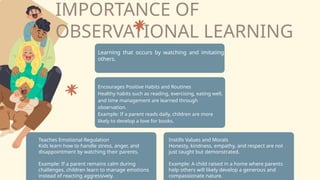
IMPORTANCE OF
OBSERVATIONAL LEARNING
Learning that occurs by watching and imitating
others.
Instills Values and Morals
Honesty, kindness, empathy, and respect are not
just taught but demonstrated.
Example: A child raised in a home where parents
help others will likely develop a generous and
compassionate nature.
Teaches Emotional Regulation
Kids learn how to handle stress, anger, and
disappointment by watching their parents.
Example: If a parent remains calm during
challenges, children learn to manage emotions
instead of reacting aggressively.
Encourages Positive Habits and Routines
Healthy habits such as reading, exercising, eating well,
and time management are learned through
observation.
Example: If a parent reads daily, children are more
likely to develop a love for books.
HOW TO OVERCOME THE
PARENTING CHALLENGES
Build Trust
Develop strong communication
Show and gain respect
Manage Anger
Be a Consistent and Reliable Parent
Be predictable and provide stability in routines.
Show up for important moments (school events, sports, or emotional support).
Communicate Openly and Honestly
Listen without judgment when your child shares their thoughts.
Encourage open-ended conversations instead of just giving orders.
Admit mistakes and apologize when necessary—this teaches honesty and humility.
Show Respect for Their Feelings
Validate their emotions instead of dismissing them.
Let them express their thoughts and opinions, even if you disagree.
Avoid harsh criticism, which can damage self-esteem and trust.
Set Boundaries with Love and Fairness
Allow children to make age-appropriate choices.
Trust them with responsibilities (chores, decision-making).
Encourage problem-solving rather than fixing everything for them.
Be Present and Engaged
Spend quality time together without distractions (phones, work).
Show interest in their hobbies and activities.
Small moments of connection build a strong foundation of trust.
Handle Conflicts with Understanding
Avoid yelling or reacting with anger—stay calm and listen.
Teach healthy conflict resolution by discussing problems, not punishing emotions.
Model the behavior you want to see in your child.
Be an Active Listener
• Give full attention when your child is speaking (put away distractions like phones).
• Use eye contact, nodding, and verbal affirmations to show engagement.
• Avoid interrupting—let them express their thoughts fully.
• Reflect back what they say: “So, you’re feeling upset because…”
Encourage Open Conversations
• Create a safe space where children feel comfortable expressing their thoughts and emotions.
• Use open-ended questions instead of just “yes” or “no” questions. (“What was the best part of your day?”)
• Be non-judgmental, even if you disagree with their views.
Use Positive and Clear Language
• Replace criticism with encouragement: Instead of “You never listen,” say, “I appreciate it when you pay attention.”
• Use “I & We” statements instead of “You” accusations (“I feel concerned when you stay out late” instead of “You
never follow the rules”).
• Keep instructions clear and age-appropriate to avoid confusion.
Overcoming Common Communication Barriers
🚫 Lack of time Set aside dedicated one-on-one time.
→
🚫 Overreacting to mistakes Stay calm and use situations as learning moments.
→
🚫 Lecturing instead of conversing Allow children to express their viewpoints.
→
🚫 Dismissing emotions Validate and acknowledge their feelings.
→
Model Respectful Behavior
• Speak politely and avoid yelling or using harsh words.
• Show empathy and understanding towards their feelings.
• Treat children as individuals, not just as dependents.
Set Clear but Fair Boundaries
• Establish household rules together rather than imposing them.
• Be consistent but flexible—adapt rules as children grow and mature.
Use Positive Discipline, Not Fear
• Avoid harsh punishments, which can lead to resentment.
• Instead of yelling or controlling, guide them with patience and understanding.
• Teach responsibility by allowing natural consequences.
Apologize When Necessary
• If you make a mistake, acknowledge it and apologize.
• This teaches children that respect goes both ways.
• It also helps in building trust and emotional intelligence.
Benefits of Mutual Respect in Parenting
✅ Stronger parent-child bond.
✅ More open communication and fewer conflicts.
✅ Increased self-confidence and independence in children.
✅ Encourages children to respect others in relationships and society.
Stay Calm and Model Healthy Reactions
• Avoid yelling, threatening, or using harsh punishments.
• Show patience and self-control—children learn by observing.
• Use a calm tone and body language to de-escalate situations.
Teach Healthy Ways to Express Anger
• Encourage them to use words to express feelings instead of
aggression.
• Teach coping techniques like deep breathing, counting to 10, or
squeezing a stress ball.
• Help them identify triggers and develop strategies to handle them.
Validate Their Feelings
• Say things like "I understand you're upset" instead of "Stop being
so angry!".
• Teach them that all emotions are okay, but behaviors must be
managed.
• Show empathy and active listening when they express their
frustrations.
Set Clear Boundaries and Consequences
• Teach that anger is okay, but hitting, screaming, or breaking things
is not.
• Set consistent and fair consequences for aggressive behavior.
• Encourage problem-solving instead of punishing emotions.
Help Children Develop Emotional Regulation Skills
• Use role-playing to teach conflict resolution.
• Encourage physical activity (sports, dance, outdoor play) to release
built-up energy.
Why Do Children Get Angry?
Frustration – When things don’t go their way.
Lack of communication skills – Unable to express feelings properly.
Tiredness, hunger, or overstimulation – Basic needs not met.
Feeling misunderstood or unheard – Lack of validation from parents
Seeking attention or control – Testing boundaries and independence
What Parents Should Avoid
🚫 Ignoring or dismissing anger – Teach them to manage, not suppre
🚫 Reacting with anger – This reinforces aggressive behavior.
🚫 Labeling them as “bad” or “angry” – Focus on behavior, not identit
🚫 Always solving problems for them – Teach independence in handl
frustration.
Set Clear Screen Time Limits
• Follow age-appropriate guidelines (e.g., max 1 hour for toddlers, 2
hours for older kids).
• Use parental control settings to monitor and limit usage.
• Establish a screen-free routine before bedtime for better sleep.
Encourage Alternative Activities
• Promote outdoor play, reading, or hands-on hobbies.
• Encourage family activities like board games, sports, or storytelling.
• Involve children in chores and creative tasks to keep them
engaged.
Create Screen-Free Zones
• No screens at the dining table to encourage family conversations.
• No devices during homework time to improve concentration.
• Limit screen use before bedtime to promote better sleep.
Use Screens for Learning, Not Just Entertainment
• Encourage educational apps, documentaries, and creative content.
• Watch programs together and discuss the content.
• Teach children about safe internet use and digital responsibility.
Lead by Example
• Parents should model healthy screen habits—avoid excessive
phone use.
• Prioritize face-to-face interactions over digital distractions.
• Show interest in children’s digital activities and discuss online
experiences.
Overcoming Challenges in Limiting Screen Time
🚫 Tantrums and resistance Set rules early and stay consistent.
→
🚫 Dependency on screens for boredom Provide engaging alternativ
→
🚫 Peer pressure and social media influence Teach digital literacy and
→
balance.
🚫 Parents' own screen habits Set family-wide screen-free times.
→
ACTIVITIES TO INVOLVE IN YOUR
CHILD’S TIME TABLE
1.Puzzles & Logic Games 🧩
2. Reading & Storytelling 📚
3. Memory & Matching Games 🃏
4. Building & Construction Play
️ 🏗️
5. Science Experiments 🔬
6. Math & Number Games 🔢
7. Arts & Music Activities 🎨🎶
8. Role-Playing & Pretend Play 🎭
9. Cooking & Baking Together 🍪
10. Indoor Obstacle Course & Movement Games ‍
THAN
K
Devanshi Padaliya
Psychologist

School Orientation Program on Parenting.pptx

  • 1.
  • 2.
    Welcome! Today wewill discuss both challenges and rewards in parenting, the importance of your preparation in educating and raising children , and how you can ensure children grow up to be healthy both physically and mentally. PARENTS ENGAGEMENT IN EDUCATION Goals: To help parents understand their child’s needs, build healthy relationships, and promote the child’s overall well-being.
  • 3.
    Emotional and PhysicalExhaustion Constant demands, especially in early childhood and teenage years & Balancing personal needs with family responsibilities. Financial Strain Cost of raising a child (education, healthcare, extracurricular activities). Stress of providing a stable and secure environment. Disciplinary Challenges Finding the right balance between discipline and encouragement. Dealing with tantrums, defiance, and peer influence. Work-Life Balance Managing career and household responsibilities. Feeling guilt over time spent away from children. Uncertainty and Fear Concerns about children's future, safety, and well-being. The challenge of making the right parenting choices. HOW DO YOU FEEL BEING A PARENT HAS CHANGED YOUR LIFE? Emotional Fulfillment Unconditional love and deep emotional bonds. The joy of watching a child grow and achieve milestones. Personal Growth Development of patience, resilience, and empathy. Learning life skills such as problem-solving, communication, and adaptability. Sense of Purpose Feeling a strong sense of responsibility and motivation. Creating a lasting legacy through values, traditions, and knowledge. Mutual Learning Parents learn from children (curiosity, joy in small things, adaptability). Strengthening relationships through shared experiences. Pride and Accomplishment Seeing children succeed in education, career, and personal life. Feeling satisfaction in shaping a responsible and kind human being. Rewards Challenges
  • 4.
    MAJOR CHALLENGES OUR CHILDREN FACE Discipline and BehaviorManagement • Struggling to set boundaries without being too strict or too lenient. • Dealing with tantrums, defiance, and disobedience in young children. • Teen rebellion—peer pressure, breaking rules, or questioning authority. Screen Time and Technology Use • Excessive phone, TV, and gaming time can impact health and focus. • Exposure to inappropriate online content and cyberbullying. • Struggles with social media addiction among teens. Peer Pressure and Social Influences • Children, especially teenagers, are influenced by friends, trends, and social media. • Fear of bad company, substance abuse, and risky behaviors. • Children comparing their lives to others, leading to self-esteem issues. Education and Academic Pressure • Worrying about academic performance and future success. • Struggling with homework battles and lack of motivation. • Pressuring children too much, leading to stress and anxiety.
  • 5.
    IMPORTANCE OF OBSERVATIONAL LEARNING Learningthat occurs by watching and imitating others. Instills Values and Morals Honesty, kindness, empathy, and respect are not just taught but demonstrated. Example: A child raised in a home where parents help others will likely develop a generous and compassionate nature. Teaches Emotional Regulation Kids learn how to handle stress, anger, and disappointment by watching their parents. Example: If a parent remains calm during challenges, children learn to manage emotions instead of reacting aggressively. Encourages Positive Habits and Routines Healthy habits such as reading, exercising, eating well, and time management are learned through observation. Example: If a parent reads daily, children are more likely to develop a love for books.
  • 6.
    HOW TO OVERCOMETHE PARENTING CHALLENGES Build Trust Develop strong communication Show and gain respect Manage Anger
  • 7.
    Be a Consistentand Reliable Parent Be predictable and provide stability in routines. Show up for important moments (school events, sports, or emotional support). Communicate Openly and Honestly Listen without judgment when your child shares their thoughts. Encourage open-ended conversations instead of just giving orders. Admit mistakes and apologize when necessary—this teaches honesty and humility. Show Respect for Their Feelings Validate their emotions instead of dismissing them. Let them express their thoughts and opinions, even if you disagree. Avoid harsh criticism, which can damage self-esteem and trust. Set Boundaries with Love and Fairness Allow children to make age-appropriate choices. Trust them with responsibilities (chores, decision-making). Encourage problem-solving rather than fixing everything for them. Be Present and Engaged Spend quality time together without distractions (phones, work). Show interest in their hobbies and activities. Small moments of connection build a strong foundation of trust. Handle Conflicts with Understanding Avoid yelling or reacting with anger—stay calm and listen. Teach healthy conflict resolution by discussing problems, not punishing emotions. Model the behavior you want to see in your child.
  • 8.
    Be an ActiveListener • Give full attention when your child is speaking (put away distractions like phones). • Use eye contact, nodding, and verbal affirmations to show engagement. • Avoid interrupting—let them express their thoughts fully. • Reflect back what they say: “So, you’re feeling upset because…” Encourage Open Conversations • Create a safe space where children feel comfortable expressing their thoughts and emotions. • Use open-ended questions instead of just “yes” or “no” questions. (“What was the best part of your day?”) • Be non-judgmental, even if you disagree with their views. Use Positive and Clear Language • Replace criticism with encouragement: Instead of “You never listen,” say, “I appreciate it when you pay attention.” • Use “I & We” statements instead of “You” accusations (“I feel concerned when you stay out late” instead of “You never follow the rules”). • Keep instructions clear and age-appropriate to avoid confusion. Overcoming Common Communication Barriers 🚫 Lack of time Set aside dedicated one-on-one time. → 🚫 Overreacting to mistakes Stay calm and use situations as learning moments. → 🚫 Lecturing instead of conversing Allow children to express their viewpoints. → 🚫 Dismissing emotions Validate and acknowledge their feelings. →
  • 9.
    Model Respectful Behavior •Speak politely and avoid yelling or using harsh words. • Show empathy and understanding towards their feelings. • Treat children as individuals, not just as dependents. Set Clear but Fair Boundaries • Establish household rules together rather than imposing them. • Be consistent but flexible—adapt rules as children grow and mature. Use Positive Discipline, Not Fear • Avoid harsh punishments, which can lead to resentment. • Instead of yelling or controlling, guide them with patience and understanding. • Teach responsibility by allowing natural consequences. Apologize When Necessary • If you make a mistake, acknowledge it and apologize. • This teaches children that respect goes both ways. • It also helps in building trust and emotional intelligence. Benefits of Mutual Respect in Parenting ✅ Stronger parent-child bond. ✅ More open communication and fewer conflicts. ✅ Increased self-confidence and independence in children. ✅ Encourages children to respect others in relationships and society.
  • 10.
    Stay Calm andModel Healthy Reactions • Avoid yelling, threatening, or using harsh punishments. • Show patience and self-control—children learn by observing. • Use a calm tone and body language to de-escalate situations. Teach Healthy Ways to Express Anger • Encourage them to use words to express feelings instead of aggression. • Teach coping techniques like deep breathing, counting to 10, or squeezing a stress ball. • Help them identify triggers and develop strategies to handle them. Validate Their Feelings • Say things like "I understand you're upset" instead of "Stop being so angry!". • Teach them that all emotions are okay, but behaviors must be managed. • Show empathy and active listening when they express their frustrations. Set Clear Boundaries and Consequences • Teach that anger is okay, but hitting, screaming, or breaking things is not. • Set consistent and fair consequences for aggressive behavior. • Encourage problem-solving instead of punishing emotions. Help Children Develop Emotional Regulation Skills • Use role-playing to teach conflict resolution. • Encourage physical activity (sports, dance, outdoor play) to release built-up energy. Why Do Children Get Angry? Frustration – When things don’t go their way. Lack of communication skills – Unable to express feelings properly. Tiredness, hunger, or overstimulation – Basic needs not met. Feeling misunderstood or unheard – Lack of validation from parents Seeking attention or control – Testing boundaries and independence What Parents Should Avoid 🚫 Ignoring or dismissing anger – Teach them to manage, not suppre 🚫 Reacting with anger – This reinforces aggressive behavior. 🚫 Labeling them as “bad” or “angry” – Focus on behavior, not identit 🚫 Always solving problems for them – Teach independence in handl frustration.
  • 11.
    Set Clear ScreenTime Limits • Follow age-appropriate guidelines (e.g., max 1 hour for toddlers, 2 hours for older kids). • Use parental control settings to monitor and limit usage. • Establish a screen-free routine before bedtime for better sleep. Encourage Alternative Activities • Promote outdoor play, reading, or hands-on hobbies. • Encourage family activities like board games, sports, or storytelling. • Involve children in chores and creative tasks to keep them engaged. Create Screen-Free Zones • No screens at the dining table to encourage family conversations. • No devices during homework time to improve concentration. • Limit screen use before bedtime to promote better sleep. Use Screens for Learning, Not Just Entertainment • Encourage educational apps, documentaries, and creative content. • Watch programs together and discuss the content. • Teach children about safe internet use and digital responsibility. Lead by Example • Parents should model healthy screen habits—avoid excessive phone use. • Prioritize face-to-face interactions over digital distractions. • Show interest in children’s digital activities and discuss online experiences. Overcoming Challenges in Limiting Screen Time 🚫 Tantrums and resistance Set rules early and stay consistent. → 🚫 Dependency on screens for boredom Provide engaging alternativ → 🚫 Peer pressure and social media influence Teach digital literacy and → balance. 🚫 Parents' own screen habits Set family-wide screen-free times. →
  • 12.
    ACTIVITIES TO INVOLVEIN YOUR CHILD’S TIME TABLE 1.Puzzles & Logic Games 🧩 2. Reading & Storytelling 📚 3. Memory & Matching Games 🃏 4. Building & Construction Play ️ 🏗️ 5. Science Experiments 🔬 6. Math & Number Games 🔢 7. Arts & Music Activities 🎨🎶 8. Role-Playing & Pretend Play 🎭 9. Cooking & Baking Together 🍪 10. Indoor Obstacle Course & Movement Games ‍
  • 15.
  • 16.