

CHIARI
MALFORMATIONS
Dr. Shaheer Anwar
Introductio
n• These comprise a group of abnormalities involving the
rhombencephalon (hindbrain) and the contents of the CV
junction.
• Presentlythere is no consensus regarding the precise
definition, classification, etiology and the surgical
management .
• Series of hindbrain anomalies
• Four types•
Definitions of Chiari
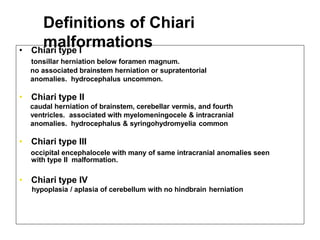
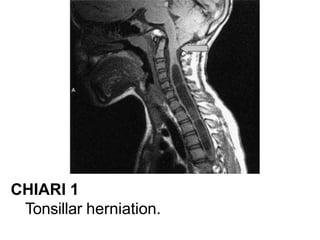
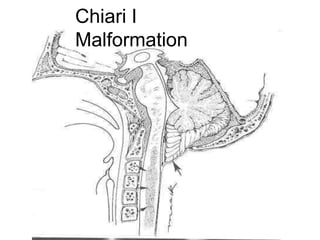
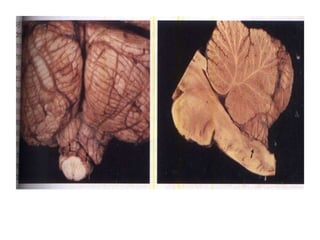
malformations• Chiari type I
tonsillar herniation below foramen magnum.
no associated brainstem herniation or supratentorial
anomalies. hydrocephalus uncommon.
• Chiari type II
caudal herniation of brainstem, cerebellar vermis, and fourth
ventricles. associated with myelomeningocele & intracranial
anomalies. hydrocephalus & syringohydromyelia common
• Chiari type III
occipital encephalocele with many of same intracranial anomalies seen
with type II malformation.
• Chiari type IV
hypoplasia / aplasia of cerebellum with no hindbrain herniation
CHIARI 1
Tonsillar herniation.
Chiari I
Malformation
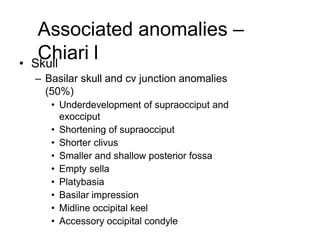
Associated anomalies –
Chiari l• Skull
– Basilar skull and cv junction anomalies
(50%)
• Underdevelopment of supraocciput and
exocciput
• Shortening of supraocciput
• Shorter clivus
• Smaller and shallow posterior fossa
• Empty sella
• Platybasia
• Basilar impression
• Midline occipital keel
• Accessory occipital condyle
Associated anomalies –
Chiari l
• Spine
– Klippel-Feil deformity
– Atlantoaxial assimilation
– Retroflexion of odontoid
process
– Thickening of ligamentum
flavum
– Scoliosis
Associated anomalies –
Chiari l
• Ventricle and cistern
– Hydrocephalus (3-10%)
– Elongated 4th ventricle
– Retrocerebellar CSF space are
obliterated or diminished
Associated anomalies –
Chiari l
• Meninges
-- Elevated slope of tentorium
– Thickening of arachnoid at foramen magnum
– Constricting dural bands at level of
foramen magnum and posterior arch of
atlas
– Veils of arachnoid that obstruct fourth
ventricular outlet
Associated anomalies –
Chiari l
• Spinal cord
– Syrinx (50-
75%)
Associated anomalies –
Chiari l
• Brain
– Elongated midbrain, pons and medulla
– Medullary kinking or flattening
– Tonsils- peg like.
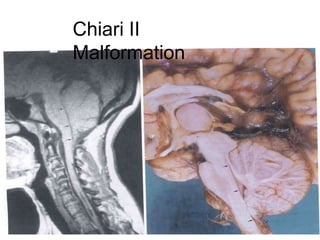
CHIARI
MALFORMATION II
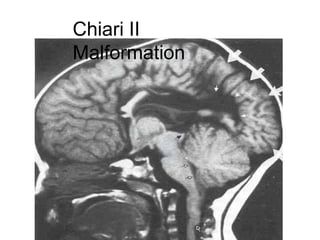
- Caudal herniationof brainstem,
cerebellar vermis, and fourth ventricles.
- associated with myelomeningocele
& intracranial anomalies.
- hydrocephalus&
syringohydromyelia common
Chiari II
Malformation
Associated anomalies –
Chiari ll• Skull
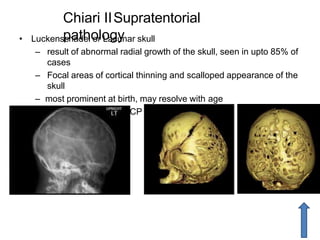
– Craniolcunia or luckenschadel- copper beaten
appearance of calvaria
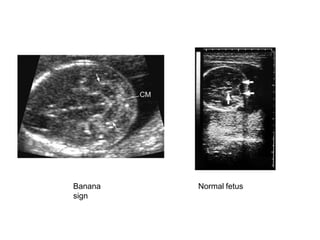
– Anterior scalloped frontal bone (lemon sign )
– Scalloping of pterous and jugular tubercle
– Enlarged FM
– Notched opisthion
– Elongated clivus with concavity
– Lower inion
– Basilar impression
– Assimilation of atlas
Chiari IISupratentorial
pathology• Luckenschadel or Lacunar skull
– result of abnormal radial growth of the skull, seen in upto 85% of
cases
– Focal areas of cortical thinning and scalloped appearance of the
skull
– most prominent at birth, may resolve with age
– not a result of raised ICP and hydrocephalus
Banana
sign
Normal fetus
Chiari II
Malformation
Genetics of
Chiari
• Familial occurrence
• Concordance in twins and triplets
• Association with other genetic
disorder
– Spondyloepiphyseal dysplasia tarda
– Hadelu-Cheney syndrome
– Klippel-Fiel syndrome
– achondroplasia
Chiari
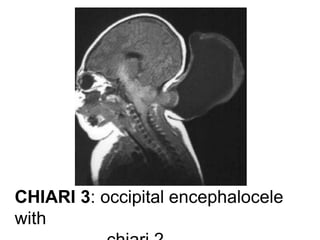
III• herniation of brainstem and cerebellum
into a posterior encephalocoel.
• Very rare; most severe form.
Management difficult.
• Differentiate from cervical myelomeningocoel.
• Severe neurological, developmental and
cranial nerve defects, seizures and
respiratory insufficiency.
• Treatment- well planned encephalocoel
closure
CHIARI 3: occipital encephalocele
with
Chiari
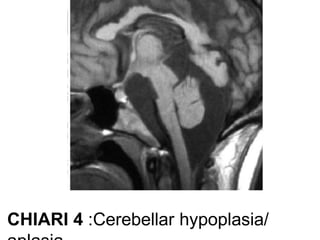
IV• cerebellar hypoplasia or aplasia(1896).
Post fossasizenormal.
• No hindbrain herniation.
• Tentorium cerebelli also
hypoplastic.
CHIARI 4 :Cerebellar hypoplasia/
Clinical
features
Chiari
I• HEADACHE
Most common symptom
(81%) Sub occipital
Radiation to vertex / neck / retro-
bulbar Heavy crushing / pressure
like
↑ed by physical exertion, Valsalva
maneuver, head dependency
and sudden changes In
position
Chiari
I• Spinal cord/ syrinx
– sensory
• Numbness: initial complaint, asymmetric, hands/arms
• Dissociated sensory loss: loss of pain and temp, preserved touch
and JPS
• Dysesthesia and proprioception disturbances – advanced stage
• Deep and boring/ itching/ burning
• C2 dysesthesia
• Interscapular pain
• All pain exacerbated by cough and sneeze
• Valsalva or severe cough may alter findings
• Charcot joints: <5% of patients
Chiari
I• Spinal cord/ syrinx
– Motor:
• Difficulty in performing fine motor tasks in
UL
• Weakness of hand and/or arm
• Wasting – distal and proximal
• Fasciculations
• Absent DTRs
• UMN lower extremities
• Horners’ – complete or partial
• Bowel and bladder control normal
• Occasionally LMN in lower extremities
Chiari
I• Brain stem/ CSF flow/ FM
– Cough headache
– Neck and arm pain – non dermatomal “deep and
boring”
– Down beat nystagmus
– Hoarse voice
– Palatal dysfunction
– Tong– fasciculations/ atrophy
– Dysphagia
– Hiccups
– Severe snoring
– Respiratory dysrhythmias
– Facial numbness
– Drop attacks
– Dysarthria
Chiari
I• Cerebella
r:
– Nystagmus:
– Ataxia
– Dysmetria
Chiari
II• Commonly presents in infancy, childhood and
adolescence
• May stabilize or improve after 6 to 12mths
• Risk of apneic attacks, dysphagia with aspiration
pneumonia,
life threatening vocal cord paralysis
• Leading cause of death in treated myelodysplastics
within first 2 yrs of life
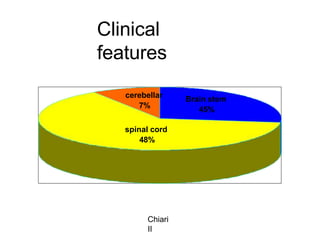
Clinical
features
Brain stem
45%
cerebellar
7%
spinal cord
48%
Chiari
II
Chiari
II• Brain stem
– Nystagmus.
– Poor sucking/ dysphagia/ aspiration
– Arching of head/ fixed retrocollis/ ophistotonus
– Apneic spells – cyanosis/anoxic seizures – exhausted-
sleeps
– Vocal cord abductor palsy
– VII nerve paresis
– Dysconjugate eye movements
– Mirror movements
Chiari
II• Spinal cord/ syrinx
– Spasticity of upper extremities.
– Weakness of lower extremities.
– Persistent cortical thumb.
– Suspended dissociated sensory loss.
– Upper extremity weakness and wasting of hand
muscles.
– Scoliosis.
Chiari
II• Cerebellar:
– Nystagmus: horizontal or rotary
– Appendicular ataxia: “falls so much”, gait
changes
– Dysmetria: inability to feed himself
Management of Chiari-Syrinx
Complex
Establishment of
Diagnosis
• X ray CVJ and cervical spine...
• Computed Tomography Scanning
(CT)
• Magnetic Resonance Imaging (MRI)
MR
I
• Investigation of choice to assess the
degree of tonsillar descent
• T2 weighted saggital MRI of the spine...
• Helps to screen the whole of the spine
and brain for any other associated
anomaly of the neuraxis or presence of
hydrocephalus
• Septations and flow voids within the
syrinx can be seen
Indications for surgical
Intervention• Progressive neurological
deficit
• Progressive enlargement of
syrinx.
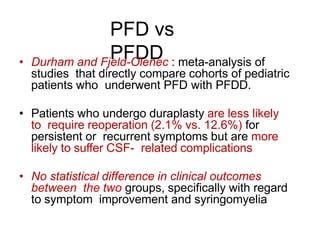
PFD vs
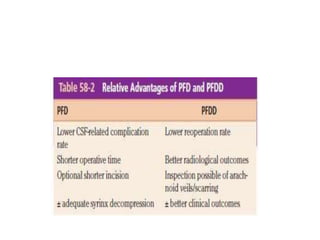
PFDD• Durham and Fjeld-Olenec : meta-analysis of
studies that directly compare cohorts of pediatric
patients who underwent PFD with PFDD.
• Patients who undergo duraplasty are less likely
to require reoperation (2.1% vs. 12.6%) for
persistent or recurrent symptoms but are more
likely to suffer CSF- related complications
• No statistical difference in clinical outcomes
between the two groups, specifically with regard
to symptom improvement and syringomyelia
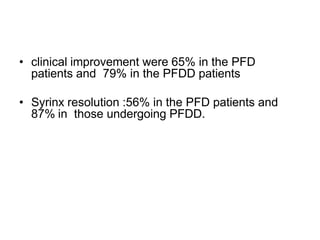
• clinical improvement were 65% in the PFD
patients and 79% in the PFDD patients
• Syrinx resolution :56% in the PFD patients and
87% in those undergoing PFDD.
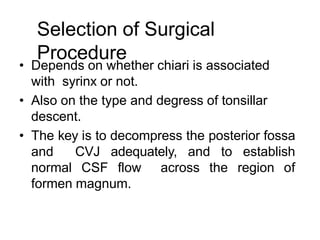
Selection of Surgical
Procedure
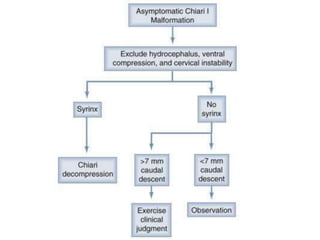
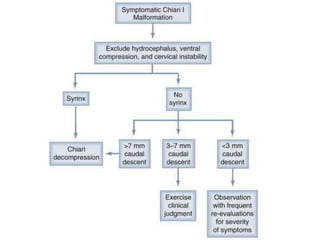
• Depends on whether chiari is associated
with syrinx or not.
• Also on the type and degress of tonsillar
descent.
• The key is to decompress the posterior fossa
and CVJ adequately, and to establish
normal CSF flow across the region of
formen magnum.
Various procedures
adopted
• FMD alone
• FMD with lax duroplasty
• FMD with arachnoid adhesiolysis
and lax duroplasty
• FMD with tonsillar resection, and lax
duraplasty
• FMD with any of the above and
additional removal of C2.
FMD = Suboccipital craniectomy encompassing the
foramen magnum rim and C1 posterior arch
Additional procedures for
associated
problems• Hydrocephalus
– VP shunt
– ETV (Missimi et al - NS 2011)
• CVJ instability
– Posterior fusion
Surgical
Technique
• Bony decompression
• Dural procedures
• Arachnoid handling
• Dealing with the
tonsils
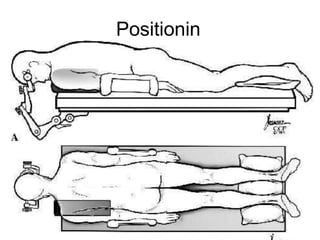
Positionin
g
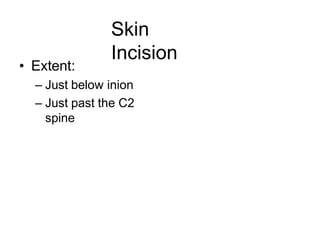
Skin
Incision
• Extent:
– Just below inion
– Just past the C2
spine
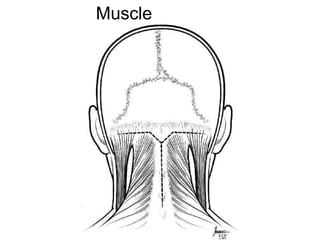
Muscle
dissection
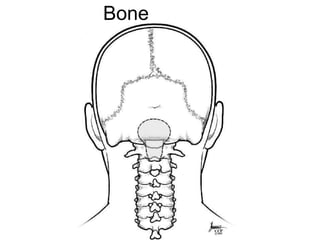
Bone
Removal
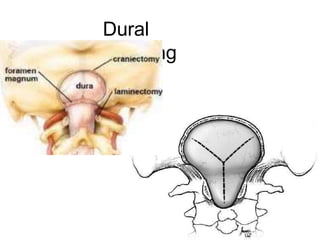
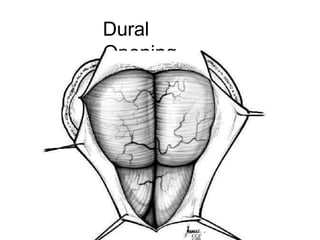
Dural
Opening
Dural
Opening
Bleeding at
durotomy
• Cerebellar dura may have venous lakes
• Circular or occipital sinus may bleed
profusely
• Control
– Proceed slowly
– Bipolar
– Metal Clips
– Figure of 8 stiches
Intradural
exploration
• Arachnoid opening
– Under
magnification
– Midline
– Avoid adherant
PICA
– Only sharp
dissection
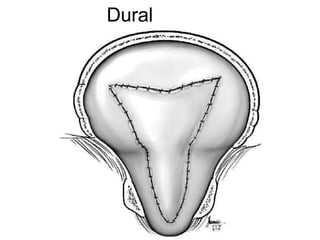
Dural
Closure
Wound
closure
• Layered
closure
– Muscle
– Facia
– Subcuticular
– Skin
Postoperative
complications
• Early
– CSF Leak
• Address HCP
• Resuture
• Lumbar drain
– Meningitis – Infective /
Chemical
• Non autologous graft
• Dura not closed
• Meticulous and clean procedure
Postoperative
Complications
• Early
– Lower cranial nerve
dysfunction
– Brainstem dysfuctions
– Hematoma
Postoperative
Complications
• Late
–Symptom recurrence
• Occur after initial
improvement
• Due to:
– New or enlarging syrinx
– CSF obstruction due to
scarring
– Cerebellar ptosis
–Pain
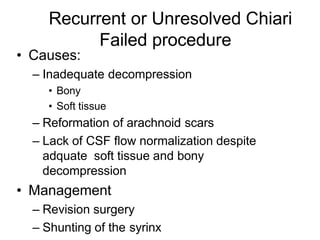
Recurrent or Unresolved Chiari
Failed procedure
• Causes:
– Inadequate decompression
• Bony
• Soft tissue
– Reformation of arachnoid scars
– Lack of CSF flow normalization despite
adquate soft tissue and bony
decompression
• Management
– Revision surgery
– Shunting of the syrinx
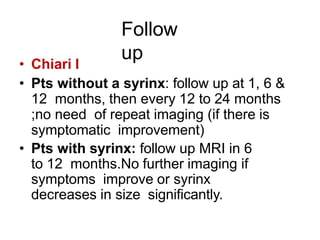
Follow
up• Chiari I
• Pts without a syrinx: follow up at 1, 6 &
12 months, then every 12 to 24 months
;no need of repeat imaging (if there is
symptomatic improvement)
• Pts with syrinx: follow up MRI in 6
to 12 months.No further imaging if
symptoms improve or syrinx
decreases in size significantly.
THANKYOU

Chiarimalformation

  • 1.
  • 2.
    Introductio n• These comprisea group of abnormalities involving the rhombencephalon (hindbrain) and the contents of the CV junction. • Presentlythere is no consensus regarding the precise definition, classification, etiology and the surgical management . • Series of hindbrain anomalies • Four types•
  • 3.
    Definitions of Chiari malformations•Chiari type I tonsillar herniation below foramen magnum. no associated brainstem herniation or supratentorial anomalies. hydrocephalus uncommon. • Chiari type II caudal herniation of brainstem, cerebellar vermis, and fourth ventricles. associated with myelomeningocele & intracranial anomalies. hydrocephalus & syringohydromyelia common • Chiari type III occipital encephalocele with many of same intracranial anomalies seen with type II malformation. • Chiari type IV hypoplasia / aplasia of cerebellum with no hindbrain herniation
  • 4.
  • 5.
  • 7.
    Associated anomalies – Chiaril• Skull – Basilar skull and cv junction anomalies (50%) • Underdevelopment of supraocciput and exocciput • Shortening of supraocciput • Shorter clivus • Smaller and shallow posterior fossa • Empty sella • Platybasia • Basilar impression • Midline occipital keel • Accessory occipital condyle
  • 8.
    Associated anomalies – Chiaril • Spine – Klippel-Feil deformity – Atlantoaxial assimilation – Retroflexion of odontoid process – Thickening of ligamentum flavum – Scoliosis
  • 9.
    Associated anomalies – Chiaril • Ventricle and cistern – Hydrocephalus (3-10%) – Elongated 4th ventricle – Retrocerebellar CSF space are obliterated or diminished
  • 10.
    Associated anomalies – Chiaril • Meninges -- Elevated slope of tentorium – Thickening of arachnoid at foramen magnum – Constricting dural bands at level of foramen magnum and posterior arch of atlas – Veils of arachnoid that obstruct fourth ventricular outlet
  • 11.
    Associated anomalies – Chiaril • Spinal cord – Syrinx (50- 75%)
  • 12.
    Associated anomalies – Chiaril • Brain – Elongated midbrain, pons and medulla – Medullary kinking or flattening – Tonsils- peg like.
  • 13.
    CHIARI MALFORMATION II - Caudalherniationof brainstem, cerebellar vermis, and fourth ventricles. - associated with myelomeningocele & intracranial anomalies. - hydrocephalus& syringohydromyelia common
  • 14.
  • 15.
    Associated anomalies – Chiarill• Skull – Craniolcunia or luckenschadel- copper beaten appearance of calvaria – Anterior scalloped frontal bone (lemon sign ) – Scalloping of pterous and jugular tubercle – Enlarged FM – Notched opisthion – Elongated clivus with concavity – Lower inion – Basilar impression – Assimilation of atlas
  • 16.
    Chiari IISupratentorial pathology• Luckenschadelor Lacunar skull – result of abnormal radial growth of the skull, seen in upto 85% of cases – Focal areas of cortical thinning and scalloped appearance of the skull – most prominent at birth, may resolve with age – not a result of raised ICP and hydrocephalus
  • 17.
  • 18.
  • 19.
    Genetics of Chiari • Familialoccurrence • Concordance in twins and triplets • Association with other genetic disorder – Spondyloepiphyseal dysplasia tarda – Hadelu-Cheney syndrome – Klippel-Fiel syndrome – achondroplasia
  • 20.
    Chiari III• herniation ofbrainstem and cerebellum into a posterior encephalocoel. • Very rare; most severe form. Management difficult. • Differentiate from cervical myelomeningocoel. • Severe neurological, developmental and cranial nerve defects, seizures and respiratory insufficiency. • Treatment- well planned encephalocoel closure
  • 21.
    CHIARI 3: occipitalencephalocele with
  • 22.
    Chiari IV• cerebellar hypoplasiaor aplasia(1896). Post fossasizenormal. • No hindbrain herniation. • Tentorium cerebelli also hypoplastic.
  • 23.
  • 24.
  • 25.
    Chiari I• HEADACHE Most commonsymptom (81%) Sub occipital Radiation to vertex / neck / retro- bulbar Heavy crushing / pressure like ↑ed by physical exertion, Valsalva maneuver, head dependency and sudden changes In position
  • 26.
    Chiari I• Spinal cord/syrinx – sensory • Numbness: initial complaint, asymmetric, hands/arms • Dissociated sensory loss: loss of pain and temp, preserved touch and JPS • Dysesthesia and proprioception disturbances – advanced stage • Deep and boring/ itching/ burning • C2 dysesthesia • Interscapular pain • All pain exacerbated by cough and sneeze • Valsalva or severe cough may alter findings • Charcot joints: <5% of patients
  • 27.
    Chiari I• Spinal cord/syrinx – Motor: • Difficulty in performing fine motor tasks in UL • Weakness of hand and/or arm • Wasting – distal and proximal • Fasciculations • Absent DTRs • UMN lower extremities • Horners’ – complete or partial • Bowel and bladder control normal • Occasionally LMN in lower extremities
  • 28.
    Chiari I• Brain stem/CSF flow/ FM – Cough headache – Neck and arm pain – non dermatomal “deep and boring” – Down beat nystagmus – Hoarse voice – Palatal dysfunction – Tong– fasciculations/ atrophy – Dysphagia – Hiccups – Severe snoring – Respiratory dysrhythmias – Facial numbness – Drop attacks – Dysarthria
  • 29.
  • 30.
    Chiari II• Commonly presentsin infancy, childhood and adolescence • May stabilize or improve after 6 to 12mths • Risk of apneic attacks, dysphagia with aspiration pneumonia, life threatening vocal cord paralysis • Leading cause of death in treated myelodysplastics within first 2 yrs of life
  • 31.
  • 32.
    Chiari II• Brain stem –Nystagmus. – Poor sucking/ dysphagia/ aspiration – Arching of head/ fixed retrocollis/ ophistotonus – Apneic spells – cyanosis/anoxic seizures – exhausted- sleeps – Vocal cord abductor palsy – VII nerve paresis – Dysconjugate eye movements – Mirror movements
  • 33.
    Chiari II• Spinal cord/syrinx – Spasticity of upper extremities. – Weakness of lower extremities. – Persistent cortical thumb. – Suspended dissociated sensory loss. – Upper extremity weakness and wasting of hand muscles. – Scoliosis.
  • 34.
    Chiari II• Cerebellar: – Nystagmus:horizontal or rotary – Appendicular ataxia: “falls so much”, gait changes – Dysmetria: inability to feed himself
  • 35.
  • 36.
    Establishment of Diagnosis • Xray CVJ and cervical spine... • Computed Tomography Scanning (CT) • Magnetic Resonance Imaging (MRI)
  • 37.
    MR I • Investigation ofchoice to assess the degree of tonsillar descent • T2 weighted saggital MRI of the spine... • Helps to screen the whole of the spine and brain for any other associated anomaly of the neuraxis or presence of hydrocephalus • Septations and flow voids within the syrinx can be seen
  • 38.
    Indications for surgical Intervention•Progressive neurological deficit • Progressive enlargement of syrinx.
  • 41.
    PFD vs PFDD• Durhamand Fjeld-Olenec : meta-analysis of studies that directly compare cohorts of pediatric patients who underwent PFD with PFDD. • Patients who undergo duraplasty are less likely to require reoperation (2.1% vs. 12.6%) for persistent or recurrent symptoms but are more likely to suffer CSF- related complications • No statistical difference in clinical outcomes between the two groups, specifically with regard to symptom improvement and syringomyelia
  • 42.
    • clinical improvementwere 65% in the PFD patients and 79% in the PFDD patients • Syrinx resolution :56% in the PFD patients and 87% in those undergoing PFDD.
  • 44.
    Selection of Surgical Procedure •Depends on whether chiari is associated with syrinx or not. • Also on the type and degress of tonsillar descent. • The key is to decompress the posterior fossa and CVJ adequately, and to establish normal CSF flow across the region of formen magnum.
  • 45.
    Various procedures adopted • FMDalone • FMD with lax duroplasty • FMD with arachnoid adhesiolysis and lax duroplasty • FMD with tonsillar resection, and lax duraplasty • FMD with any of the above and additional removal of C2. FMD = Suboccipital craniectomy encompassing the foramen magnum rim and C1 posterior arch
  • 46.
    Additional procedures for associated problems•Hydrocephalus – VP shunt – ETV (Missimi et al - NS 2011) • CVJ instability – Posterior fusion
  • 47.
    Surgical Technique • Bony decompression •Dural procedures • Arachnoid handling • Dealing with the tonsils
  • 48.
  • 49.
    Skin Incision • Extent: – Justbelow inion – Just past the C2 spine
  • 50.
  • 51.
  • 52.
  • 53.
  • 54.
    Bleeding at durotomy • Cerebellardura may have venous lakes • Circular or occipital sinus may bleed profusely • Control – Proceed slowly – Bipolar – Metal Clips – Figure of 8 stiches
  • 55.
    Intradural exploration • Arachnoid opening –Under magnification – Midline – Avoid adherant PICA – Only sharp dissection
  • 56.
  • 57.
    Wound closure • Layered closure – Muscle –Facia – Subcuticular – Skin
  • 58.
    Postoperative complications • Early – CSFLeak • Address HCP • Resuture • Lumbar drain – Meningitis – Infective / Chemical • Non autologous graft • Dura not closed • Meticulous and clean procedure
  • 59.
    Postoperative Complications • Early – Lowercranial nerve dysfunction – Brainstem dysfuctions – Hematoma
  • 60.
    Postoperative Complications • Late –Symptom recurrence •Occur after initial improvement • Due to: – New or enlarging syrinx – CSF obstruction due to scarring – Cerebellar ptosis –Pain
  • 61.
    Recurrent or UnresolvedChiari Failed procedure • Causes: – Inadequate decompression • Bony • Soft tissue – Reformation of arachnoid scars – Lack of CSF flow normalization despite adquate soft tissue and bony decompression • Management – Revision surgery – Shunting of the syrinx
  • 62.
    Follow up• Chiari I •Pts without a syrinx: follow up at 1, 6 & 12 months, then every 12 to 24 months ;no need of repeat imaging (if there is symptomatic improvement) • Pts with syrinx: follow up MRI in 6 to 12 months.No further imaging if symptoms improve or syrinx decreases in size significantly.
  • 63.