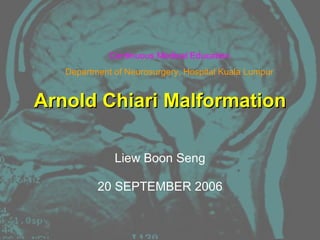
Arnold Chiari Malformation Liew Boon Seng 20 SEPTEMBER 2006 Continuous Medical Education Department of Neurosurgery, Hospital Kuala Lumpur
Chiari Malformation Group of CNS developmental anomalies primarily afflicting the posterior fossa Hans Chiari (1815 -1916)
Chiari Malformation Clinical complaints – headache, sensory changes, difficulty swallowing, vertigo, ataxia, imbalance, hearing loss. Others include cranial nerve palsy, nystagmus, syringomyelia, scoliosis, hydrocephalus Spinal cord involvement include hydromyelia, syringomyelia, compression, and/or herniation
Classification of Chiari Malformation Type I Type II Type III Type IV
Type I Congenital tonsil ectopia 10 y.o – 6mm 2 nd  -3 rd  decade – 5mm 4 th  and 5 th  decade – 4mm Rarely below C2 4 th  ventricle normal Associated with  syringomyelia, hydromyelia, or syringohydromyelia Not associated with myelomeningocele Hydrocephalus in 10%
 
Signs of Chiari I malformation Related to the area of compression: if the cerebellar tonsils are primarily involved, the patient may present with signs related to cerebellar compromise and/or dural irritation (Lhermitte sign) If there is pressure on the posterior aspect of the cervical cord, one may find hypo- or hyperreflexia, or a Babinski sign.
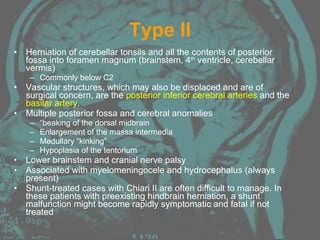
Type II Herniation of cerebellar tonsils and all the contents of posterior fossa into foramen magnum (brainstem, 4 th  ventricle, cerebellar vermis) Commonly below C2 Vascular structures, which may also be displaced and are of surgical concern, are the  posterior inferior cerebral arteries  and the  basilar artery . Multiple posterior fossa and cerebral anomalies “ beaking of the dorsal midbrain Enlargement of the massa intermedia Medullary “kinking” Hypoplasia of the tentorium Lower brainstem and cranial nerve palsy Associated with myelomeningocele and hydrocephalus (always present) Shunt-treated cases with Chiari II are often difficult to manage. In these patients with preexisting hindbrain herniation, a shunt malfunction might become rapidly symptomatic and fatal if not treated
 
Type III Protrusion of a sac from the craniocervical junction that contains portions of the cerebellum and brainstem Have an encephalocele Commonly associated with hydrocephalus
Type IV Complex cerebellar hypoplasia and dysplasia Associated with diminutive posterior fossa
Diagnosis High resolution MRI Degree of tonsillar descent in ACM Significant mass lesions at the craniocervical junction in conjunction with syringomyelia Plain SXR of craniocervical junction Computed tomography (CT) scan Myelography with water-soluable contrast
Posterior Fossa Decompression Main goals: decompression of the inferior aspect of the cerebellum;  enlargement of the total volume of the posterior fossa; and  3) establishment of CSF flow.
Posterior Fossa Decompression Indications Chiari I associated with occipital headache, sensory disturbances, weakness,ataxia, spasticity, bulbar signs, syringomyelia, or scoliosis Chiari II with apnea, bradycardia, stridor in infancy Chiari II with progressive motor or sensory disturbance, syringomyelia, scoliosis in adolescence or adulthood
Posterior Fossa Decompression Contraindications Asymptomatic Chiari I or II Symptomatic Chiari II with possible shunt malfunction or tethered spinal cord
Teo C, Parker EC, Aureli S, et al: The Chiari II Malformation: a surgical series.  Pediatr Neurosurg 27: 223–229, 1997 Magnetic resonance images of the craniocervical junction should be obtained in all three planes (coronal, sagittal and axial) to evaluate the CSF signal around the medulla within the foramen magnum. If there is no CSF signal around the cord at the level of the foramen magnum, or if a restrictive band of fibrous tissue is apparent, then decompression should be undertaken .
Posterior Fossa Decompression Steps:  1) positioning of the patient;  2) incision;  3) craniotomy or craniectomy;  4) dural opening;  5) decompression;  6) resection of arachnoid adhesions;  7) removal of inferior tonsils; 8) opening of the obex;  9) syrinx decompression (if desired);  10) dural closure;  11) closure of the craniotomy; 12) fascial and skin closure
Position of Surgery :  suboccipital approaches Prone position Risk of air embolism less than sitting position No risk of subdural hematoma when CSF is drained intraoperatively Easily to apply fibrin glue to entire dura graft Faster positioning More comfortable to surgeon Head position fixed with Mayfield pin-fixation Avoid excessive neck flexion Neck in neutral or slightly flexed
Incision Midline incision -inion to approximately C-3 The incision is brought down through the skin and midline nuchal fascia. Meticulous hemostasis – avoid pooling of blood in the intradural and subrachnoid space
Craniotomy or craneictomy Posterior fossa craniotomy 2.5-3.0cm Just below transverse sinus to foramen magnum Enough bone should be resected to provide adequate access to the cerebellar tonsils and the obex below. Removal of posterior arch of atlas Laminectomy C2
Dura Opening “ Y” shaped incision Preferable to preserve the arachnoid It is often helpful to clamp across the occipital sinus, with fine hemostats, prior to cutting across the sinus, between the two hemostats. The sinus can then be ligated using No. 4-0 nonabsorbable suture. note the position of a low lying sinus in patients with Chiari II malformation.
Decompression : Resection of arachnoid adhesions Arachnoid bands or adhesions may be cut sharply by using microscissors or a microdissector.
Removal of inferior tonsils The inferior cerebellar tonsils may either be removed using cavitating ultrasonic aspiration, or they may be shrunk using bipolar coagulation. PICA situated behind the tonsil
Opening of the obex The obex may be checked to determine if it is open and if CSF flows easily from the fourth ventricle. Gardner* has described “plugging” of the obex, with muscle or fascia, to obliterate pulsations from the fourth ventricle transmitted to the central canal *Gardner WJ: Hydrodynamic mechanism of syringomyelia: its relationship to myelocele.  J Neurol Neurosurg Psychiatry 28: 247–259, 1965
Opening of the obex A shunt may be placed between the fourth ventricle and the subarachnoid space if there is concern about maintaining an open CSF conduit The   tubing may become displaced or cause the formation of arachnoid adhesions.
Syrinx decompression Feldstein and Munshi reported that suboccipital craniectomy with duraplasty, in most patients, will be sufficient treatment and that the syrinx will resolve after the initial decompression Simple dorsal midline myelotomy or DREZ myelotomy, can be performed at the time  of the initial procedure.  Opening the syrinx to drain its contents or placement of a stent to maintain the CSF conduit are acceptable means to decompress a syrinx.  There are various stents available: syringosubarachnoid, syringopleural, and syringoperitoneal. 1Feldstein NA, Choudhri TF: Management of Chiari I malformations with holocord syringohydromyelia.  Pediatr Neurosurg 31: 143–149, 1999 2Munshi I, Frim D, Stine-Reyes R, et al: Effects of posterior fossa decompression with and without duraplasty on Chiari malformation-associated hydromyelia.  Neurosurgery 46:  1384–1390, 2000
Dura Closure of the Posterior Fossa If the dura is left open, the muscle and fascia must be carefully closed in two watertight layers. If   the dura is closed, use a dural graft to increase the intracranial volume of the posterior fossa (auto- and allografts)
Closure of the craniotomy The bone is replaced, in some cases, with suture, miniplates, or other cranial fixation devices. In other cases, the bone is left out.
Fascial and skin closure The fascia is closed using absorbable suture, and the skin is closed using absorbable or nonabsorbable suture. Surgical staples may also be used for skin closure.
Position of Surgery : CSF Diversion Procedures Syringopleural shunt – prone Syringoperitoneal shunt – lateral
Early Postoperative Care Head elevated 30 º Antibiotics are discontinued within 24 hours of the operation Corticosteroids are generally avoided/ discontinued within 72 hours to reduce risk of impaired dural healing Observed for 24 hours in the ICU – care of aspiration and respiratory problems
Late Postoperative Care Avoid lifting and straining for 3 months – reduce chance of creating dural leak – use of cough suppressant Post-operative MRI few days to 1 week post surgery
Complications Related to Conservative Surgery (Persistent Compression) 1) inadequate craniectomy;  2) persistent occipitoatlantal membrane;  3) inadequate dural opening/duraplasty;  4) residual arachnoid adhesions; and  5) residual tonsillar compression.
Recurrent symptoms post-operation When recurrent symptoms develop or if symptoms persist, MR imaging of the brain and cervical spine is performed.  Persistent compression of the cerebellar tonsils may be apparent on sagittal and axial images, with inadequate CSF spaces around the inferior aspect of the cerebellum.  This may be in part due to inadequate osseous decompression, persistent occipitoatlantal membrane, or an excessively tight, or restenotic, dural closure. If symptoms are mild, the patient may be followed conservatively. If clear compression exists, however, reoperation should be considered with extension of the decompressed region.
Complications of Surgery Immediate Intraoperative air embolism, Intraoperative vasospasm, Vertebral artery injury, bleeding, failure to open the fourth ventricular CSF pathways, coma, autonomic instability Aseptic meningitis Delayed CSF leak, pseudomeningocele, cerebellar sag, occipital cervical instability, hydrocephalus, recurrent or residual syringomyelia
Outcome and Follow-up Good outcome Asymptomatic or only one residual component of disease (e.g sensory loss) Syrinx collapse more than 75% Return to normal lifestyles without restrictions Improved outcome Marked overall symptomatic improvement Syrinx collapse of 50 to 75% Only one major residual deficit (e.g scoliosis, pain, weakness) Return to normal lifestyle but may restrict their sports activity
Outcome and Follow-up Poor outcome No change in the syrinx size Presence of residual severe pain that is recalcitrant to therapy or restriction of lifestyle Long-term follow-up needed
Algorithm For Symptomatic Chiari I Malformation
Algorithm For Asymptomatic Chiari I Malformation
Algorithm For Symptomatic Chiari II Malformation
Algorithm For Asymptomatic Chiari II Malformation
Thank You

Acm Power Pressed

  • 1.
    Arnold Chiari MalformationLiew Boon Seng 20 SEPTEMBER 2006 Continuous Medical Education Department of Neurosurgery, Hospital Kuala Lumpur
  • 2.
    Chiari Malformation Groupof CNS developmental anomalies primarily afflicting the posterior fossa Hans Chiari (1815 -1916)
  • 3.
    Chiari Malformation Clinicalcomplaints – headache, sensory changes, difficulty swallowing, vertigo, ataxia, imbalance, hearing loss. Others include cranial nerve palsy, nystagmus, syringomyelia, scoliosis, hydrocephalus Spinal cord involvement include hydromyelia, syringomyelia, compression, and/or herniation
  • 4.
    Classification of ChiariMalformation Type I Type II Type III Type IV
  • 5.
    Type I Congenitaltonsil ectopia 10 y.o – 6mm 2 nd -3 rd decade – 5mm 4 th and 5 th decade – 4mm Rarely below C2 4 th ventricle normal Associated with syringomyelia, hydromyelia, or syringohydromyelia Not associated with myelomeningocele Hydrocephalus in 10%
  • 6.
  • 7.
    Signs of ChiariI malformation Related to the area of compression: if the cerebellar tonsils are primarily involved, the patient may present with signs related to cerebellar compromise and/or dural irritation (Lhermitte sign) If there is pressure on the posterior aspect of the cervical cord, one may find hypo- or hyperreflexia, or a Babinski sign.
  • 8.
    Type II Herniationof cerebellar tonsils and all the contents of posterior fossa into foramen magnum (brainstem, 4 th ventricle, cerebellar vermis) Commonly below C2 Vascular structures, which may also be displaced and are of surgical concern, are the posterior inferior cerebral arteries and the basilar artery . Multiple posterior fossa and cerebral anomalies “ beaking of the dorsal midbrain Enlargement of the massa intermedia Medullary “kinking” Hypoplasia of the tentorium Lower brainstem and cranial nerve palsy Associated with myelomeningocele and hydrocephalus (always present) Shunt-treated cases with Chiari II are often difficult to manage. In these patients with preexisting hindbrain herniation, a shunt malfunction might become rapidly symptomatic and fatal if not treated
  • 9.
  • 10.
    Type III Protrusionof a sac from the craniocervical junction that contains portions of the cerebellum and brainstem Have an encephalocele Commonly associated with hydrocephalus
  • 11.
    Type IV Complexcerebellar hypoplasia and dysplasia Associated with diminutive posterior fossa
  • 12.
    Diagnosis High resolutionMRI Degree of tonsillar descent in ACM Significant mass lesions at the craniocervical junction in conjunction with syringomyelia Plain SXR of craniocervical junction Computed tomography (CT) scan Myelography with water-soluable contrast
  • 13.
    Posterior Fossa DecompressionMain goals: decompression of the inferior aspect of the cerebellum; enlargement of the total volume of the posterior fossa; and 3) establishment of CSF flow.
  • 14.
    Posterior Fossa DecompressionIndications Chiari I associated with occipital headache, sensory disturbances, weakness,ataxia, spasticity, bulbar signs, syringomyelia, or scoliosis Chiari II with apnea, bradycardia, stridor in infancy Chiari II with progressive motor or sensory disturbance, syringomyelia, scoliosis in adolescence or adulthood
  • 15.
    Posterior Fossa DecompressionContraindications Asymptomatic Chiari I or II Symptomatic Chiari II with possible shunt malfunction or tethered spinal cord
  • 16.
    Teo C, ParkerEC, Aureli S, et al: The Chiari II Malformation: a surgical series. Pediatr Neurosurg 27: 223–229, 1997 Magnetic resonance images of the craniocervical junction should be obtained in all three planes (coronal, sagittal and axial) to evaluate the CSF signal around the medulla within the foramen magnum. If there is no CSF signal around the cord at the level of the foramen magnum, or if a restrictive band of fibrous tissue is apparent, then decompression should be undertaken .
  • 17.
    Posterior Fossa DecompressionSteps: 1) positioning of the patient; 2) incision; 3) craniotomy or craniectomy; 4) dural opening; 5) decompression; 6) resection of arachnoid adhesions; 7) removal of inferior tonsils; 8) opening of the obex; 9) syrinx decompression (if desired); 10) dural closure; 11) closure of the craniotomy; 12) fascial and skin closure
  • 18.
    Position of Surgery: suboccipital approaches Prone position Risk of air embolism less than sitting position No risk of subdural hematoma when CSF is drained intraoperatively Easily to apply fibrin glue to entire dura graft Faster positioning More comfortable to surgeon Head position fixed with Mayfield pin-fixation Avoid excessive neck flexion Neck in neutral or slightly flexed
  • 19.
    Incision Midline incision-inion to approximately C-3 The incision is brought down through the skin and midline nuchal fascia. Meticulous hemostasis – avoid pooling of blood in the intradural and subrachnoid space
  • 20.
    Craniotomy or craneictomyPosterior fossa craniotomy 2.5-3.0cm Just below transverse sinus to foramen magnum Enough bone should be resected to provide adequate access to the cerebellar tonsils and the obex below. Removal of posterior arch of atlas Laminectomy C2
  • 21.
    Dura Opening “Y” shaped incision Preferable to preserve the arachnoid It is often helpful to clamp across the occipital sinus, with fine hemostats, prior to cutting across the sinus, between the two hemostats. The sinus can then be ligated using No. 4-0 nonabsorbable suture. note the position of a low lying sinus in patients with Chiari II malformation.
  • 22.
    Decompression : Resectionof arachnoid adhesions Arachnoid bands or adhesions may be cut sharply by using microscissors or a microdissector.
  • 23.
    Removal of inferiortonsils The inferior cerebellar tonsils may either be removed using cavitating ultrasonic aspiration, or they may be shrunk using bipolar coagulation. PICA situated behind the tonsil
  • 24.
    Opening of theobex The obex may be checked to determine if it is open and if CSF flows easily from the fourth ventricle. Gardner* has described “plugging” of the obex, with muscle or fascia, to obliterate pulsations from the fourth ventricle transmitted to the central canal *Gardner WJ: Hydrodynamic mechanism of syringomyelia: its relationship to myelocele. J Neurol Neurosurg Psychiatry 28: 247–259, 1965
  • 25.
    Opening of theobex A shunt may be placed between the fourth ventricle and the subarachnoid space if there is concern about maintaining an open CSF conduit The tubing may become displaced or cause the formation of arachnoid adhesions.
  • 26.
    Syrinx decompression Feldsteinand Munshi reported that suboccipital craniectomy with duraplasty, in most patients, will be sufficient treatment and that the syrinx will resolve after the initial decompression Simple dorsal midline myelotomy or DREZ myelotomy, can be performed at the time of the initial procedure. Opening the syrinx to drain its contents or placement of a stent to maintain the CSF conduit are acceptable means to decompress a syrinx. There are various stents available: syringosubarachnoid, syringopleural, and syringoperitoneal. 1Feldstein NA, Choudhri TF: Management of Chiari I malformations with holocord syringohydromyelia. Pediatr Neurosurg 31: 143–149, 1999 2Munshi I, Frim D, Stine-Reyes R, et al: Effects of posterior fossa decompression with and without duraplasty on Chiari malformation-associated hydromyelia. Neurosurgery 46: 1384–1390, 2000
  • 27.
    Dura Closure ofthe Posterior Fossa If the dura is left open, the muscle and fascia must be carefully closed in two watertight layers. If the dura is closed, use a dural graft to increase the intracranial volume of the posterior fossa (auto- and allografts)
  • 28.
    Closure of thecraniotomy The bone is replaced, in some cases, with suture, miniplates, or other cranial fixation devices. In other cases, the bone is left out.
  • 29.
    Fascial and skinclosure The fascia is closed using absorbable suture, and the skin is closed using absorbable or nonabsorbable suture. Surgical staples may also be used for skin closure.
  • 30.
    Position of Surgery: CSF Diversion Procedures Syringopleural shunt – prone Syringoperitoneal shunt – lateral
  • 31.
    Early Postoperative CareHead elevated 30 º Antibiotics are discontinued within 24 hours of the operation Corticosteroids are generally avoided/ discontinued within 72 hours to reduce risk of impaired dural healing Observed for 24 hours in the ICU – care of aspiration and respiratory problems
  • 32.
    Late Postoperative CareAvoid lifting and straining for 3 months – reduce chance of creating dural leak – use of cough suppressant Post-operative MRI few days to 1 week post surgery
  • 33.
    Complications Related toConservative Surgery (Persistent Compression) 1) inadequate craniectomy; 2) persistent occipitoatlantal membrane; 3) inadequate dural opening/duraplasty; 4) residual arachnoid adhesions; and 5) residual tonsillar compression.
  • 34.
    Recurrent symptoms post-operationWhen recurrent symptoms develop or if symptoms persist, MR imaging of the brain and cervical spine is performed. Persistent compression of the cerebellar tonsils may be apparent on sagittal and axial images, with inadequate CSF spaces around the inferior aspect of the cerebellum. This may be in part due to inadequate osseous decompression, persistent occipitoatlantal membrane, or an excessively tight, or restenotic, dural closure. If symptoms are mild, the patient may be followed conservatively. If clear compression exists, however, reoperation should be considered with extension of the decompressed region.
  • 35.
    Complications of SurgeryImmediate Intraoperative air embolism, Intraoperative vasospasm, Vertebral artery injury, bleeding, failure to open the fourth ventricular CSF pathways, coma, autonomic instability Aseptic meningitis Delayed CSF leak, pseudomeningocele, cerebellar sag, occipital cervical instability, hydrocephalus, recurrent or residual syringomyelia
  • 36.
    Outcome and Follow-upGood outcome Asymptomatic or only one residual component of disease (e.g sensory loss) Syrinx collapse more than 75% Return to normal lifestyles without restrictions Improved outcome Marked overall symptomatic improvement Syrinx collapse of 50 to 75% Only one major residual deficit (e.g scoliosis, pain, weakness) Return to normal lifestyle but may restrict their sports activity
  • 37.
    Outcome and Follow-upPoor outcome No change in the syrinx size Presence of residual severe pain that is recalcitrant to therapy or restriction of lifestyle Long-term follow-up needed
  • 38.
    Algorithm For SymptomaticChiari I Malformation
  • 39.
    Algorithm For AsymptomaticChiari I Malformation
  • 40.
    Algorithm For SymptomaticChiari II Malformation
  • 41.
    Algorithm For AsymptomaticChiari II Malformation
  • 42.