Chemical Groups and Families
Group 1-Alkali Metals Li Na K Rb Cs Fr shiny solids, malleable, ductile good conductors of electricity low densities, low melting points soft enough to be cut with a knife intense chemical reactivity reacts readily with air and water reactivity increases as you go down the group Na and K most abundant of family (rank 7 th  and 8 th  by mass in earth’s crust) Never found as free elements in nature
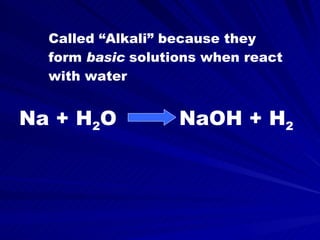
Called “Alkali” because they form  basic  solutions when react with water Na + H 2 O  NaOH + H 2
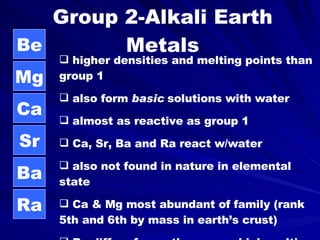
Group 2-Alkali Earth Metals Mg Ca Sr Ba Ra higher densities and melting points than group 1 also form  basic  solutions with water almost as reactive as group 1 Ca, Sr, Ba and Ra react w/water also not found in nature in elemental state Ca & Mg most abundant of family (rank 5th and 6th by mass in earth’s crust) Be differs from others: very high melting point and as strong as steel Be
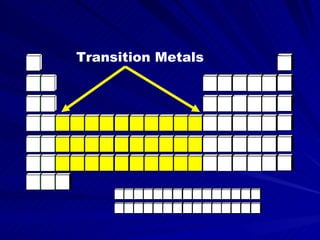
Transition Metals
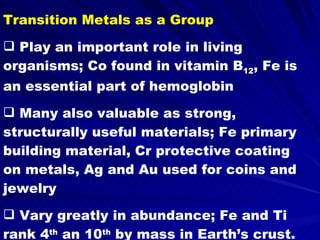
Transition Metals as a Group Play an important role in living organisms; Co found in vitamin B 12 , Fe is an essential part of hemoglobin Many also valuable as strong, structurally useful materials; Fe primary building material, Cr protective coating on metals, Ag and Au used for coins and jewelry Vary greatly in abundance; Fe and Ti rank 4 th  an 10 th  by mass in Earth’s crust. Pt and Ir are very rare
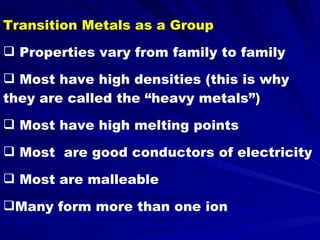
Transition Metals as a Group Properties vary from family to family Most have high densities (this is why they are called the “heavy metals”) Most have high melting points Most  are good conductors of electricity Most are malleable Many form more than one ion
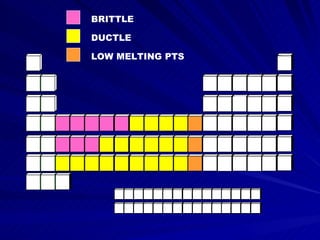
BRITTLE DUCTLE LOW MELTING PTS
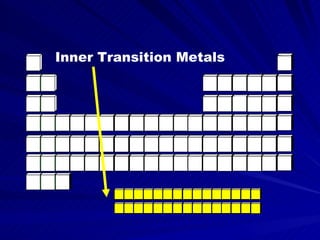
Inner Transition Metals
Lanthanides Elements of the 4f series Very similar to one another because they  all have the same number of valence electrons All readily form 3+ ions (ALL considered part of group 3) Soft, silvery metals Only somewhat less reactive than group 2 React with air and slowly with water Widely distributed in nature, but generally occur together; hard to separate Little commercial importance
Lanthanides Europium is used in television tubes to produce the red color Lanthanium used in studio carbon arc lighting and projection lenses in movie industry Cerium-catalyst used in self cleaning ovens Ytterbium used to strengthen stainless steel knifes Promethium used as a nuclear powered battery
Actinides Elements of the 5f series All Isotopes of these elements are RADIOACTIVE Only Th and U occur in nature All others are artificial, produced by nuclear bombardment reactions Plutonium salts used for coloring glass and enamels Americium used in smoke alarms Uranium nitrate compound used in photographic toners
 
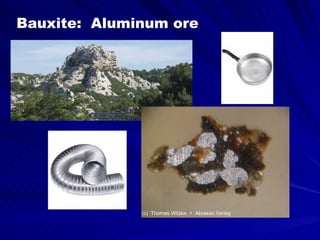
BORON Group B Al Ga In Tl All form 3+ ions Al is most important; 3 rd  most abundant element in Earth’s crust Most Al occurs in ores and compounds in nature; has to be extracted  Al has low density, but when alloyed with other metals is quite strong and does not corrode Many commercial uses Boron used for heat resistant glass and eye disinfectant Ga used in cell phones
Bauxite:  Aluminum ore
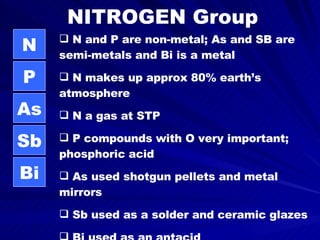
NITROGEN Group N P As Sb Bi N and P are non-metal; As and SB are semi-metals and Bi is a metal N makes up approx 80% earth’s atmosphere N a gas at STP P compounds with O very important; phosphoric acid As used shotgun pellets and metal mirrors Sb used as a solder and ceramic glazes Bi used as an antacid
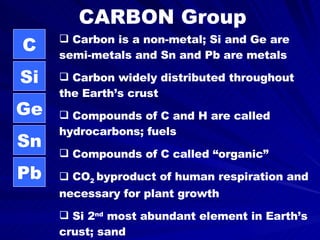
CARBON Group C Si Ge Sn Pb Carbon is a non-metal; Si and Ge are semi-metals and Sn and Pb are metals Carbon widely distributed throughout the Earth’s crust Compounds of C and H are called hydrocarbons; fuels Compounds of C called “organic” CO 2  byproduct of human respiration and necessary for plant growth Si 2 nd  most abundant element in Earth’s crust; sand Si also major component of sand
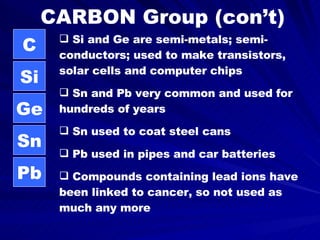
CARBON Group (con’t) C Si Ge Sn Pb Si and Ge are semi-metals; semi-conductors; used to make transistors, solar cells and computer chips Sn and Pb very common and used for hundreds of years Sn used to coat steel cans Pb used in pipes and car batteries Compounds containing lead ions have been linked to cancer, so not used as much any more
OXYGEN GROUP O S Se Te Po Oxygen most abundant element on earth The largest source of elemental oxygen is atmosphere Oxygen also found in compounds called oxides Elemental oxygen exists as both O 2  and O 3  (ozone).  Ozone has strong, irritating odor and is considered a pollutant.  It attacks structural materials and plant/animal tissue.  Ozone absorbs high energy UV radiation from sun
OXYGEN GROUP O S Se Te Po Sulfur occurs pure in nature-known as brimstone Also occurs in compounds such as FeS 2  known as “fools gold” Many sulfur compounds have unpleasant odor.  Sulfur compound added to natural gas to detect leaks Largest use of sulfur is production of Sulfuric acid.  Sulfuric acid has many uses, most commonly lead storage batteries Selenium copies used in photocopiers Polonium used in radioactive power
Halogens F Cl Br I At Name Halogen comes from Greek for “Salt Former”; reaction of most metals with halogens form salts Highly reactive with metals and most non metals Do not occur as free elements in nature F very corrosive gas; most reactive of all non-metals Cl most industrially used At is very rare; all isotopes are radioactive
NOBLE GASES He Ne Ar Kr Xe Mostly non-reactive Ar most abundant; 1% of Earth’s atmosphere Discovered after many of other elements because they do not form compounds Some Xe compounds have been formed, but they are not very stable Rn
HYDROGEN H Typically shown listed with Group 1 but actually a non-metal, colorless, odorless gas So light it escapes the gravitational pull of the earth, so rare in atmosphere Most of Earth’s hydrogen found combined with oxygen in water Also frequently combined with carbon.  Hyrocarbons-class of compounds containing hydrogen and carbon.  All fuels are hydrocarbon (coal, petroleum, natural gas) as well as plants and animals.  (Term “Fossil Fuels”  refers to petroleum that is broken down dinosaurs)
9 th  most abundant element on Earth’s surface. (Crust, water, atmosphere) Most abundant element in universe Elemental hydrogen obtained commercially from hydrocarbons Largest commercial use is in manufacture of ammonia (NH 3 ) which is used in fertilizers Also used to prepare organic compounds like Methanol and Ethanol.  Methanol is used as a fuel in race cars.  Ethanol is currently used as a fuel in some corn producing states. Currently investigating using H fuel cells to power cars H

Chemical Families Notes

  • 1.
  • 2.
    Group 1-Alkali MetalsLi Na K Rb Cs Fr shiny solids, malleable, ductile good conductors of electricity low densities, low melting points soft enough to be cut with a knife intense chemical reactivity reacts readily with air and water reactivity increases as you go down the group Na and K most abundant of family (rank 7 th and 8 th by mass in earth’s crust) Never found as free elements in nature
  • 3.
    Called “Alkali” becausethey form basic solutions when react with water Na + H 2 O NaOH + H 2
  • 4.
    Group 2-Alkali EarthMetals Mg Ca Sr Ba Ra higher densities and melting points than group 1 also form basic solutions with water almost as reactive as group 1 Ca, Sr, Ba and Ra react w/water also not found in nature in elemental state Ca & Mg most abundant of family (rank 5th and 6th by mass in earth’s crust) Be differs from others: very high melting point and as strong as steel Be
  • 5.
  • 6.
    Transition Metals asa Group Play an important role in living organisms; Co found in vitamin B 12 , Fe is an essential part of hemoglobin Many also valuable as strong, structurally useful materials; Fe primary building material, Cr protective coating on metals, Ag and Au used for coins and jewelry Vary greatly in abundance; Fe and Ti rank 4 th an 10 th by mass in Earth’s crust. Pt and Ir are very rare
  • 7.
    Transition Metals asa Group Properties vary from family to family Most have high densities (this is why they are called the “heavy metals”) Most have high melting points Most are good conductors of electricity Most are malleable Many form more than one ion
  • 8.
    BRITTLE DUCTLE LOWMELTING PTS
  • 9.
  • 10.
    Lanthanides Elements ofthe 4f series Very similar to one another because they all have the same number of valence electrons All readily form 3+ ions (ALL considered part of group 3) Soft, silvery metals Only somewhat less reactive than group 2 React with air and slowly with water Widely distributed in nature, but generally occur together; hard to separate Little commercial importance
  • 11.
    Lanthanides Europium isused in television tubes to produce the red color Lanthanium used in studio carbon arc lighting and projection lenses in movie industry Cerium-catalyst used in self cleaning ovens Ytterbium used to strengthen stainless steel knifes Promethium used as a nuclear powered battery
  • 12.
    Actinides Elements ofthe 5f series All Isotopes of these elements are RADIOACTIVE Only Th and U occur in nature All others are artificial, produced by nuclear bombardment reactions Plutonium salts used for coloring glass and enamels Americium used in smoke alarms Uranium nitrate compound used in photographic toners
  • 13.
  • 14.
    BORON Group BAl Ga In Tl All form 3+ ions Al is most important; 3 rd most abundant element in Earth’s crust Most Al occurs in ores and compounds in nature; has to be extracted Al has low density, but when alloyed with other metals is quite strong and does not corrode Many commercial uses Boron used for heat resistant glass and eye disinfectant Ga used in cell phones
  • 15.
  • 16.
    NITROGEN Group NP As Sb Bi N and P are non-metal; As and SB are semi-metals and Bi is a metal N makes up approx 80% earth’s atmosphere N a gas at STP P compounds with O very important; phosphoric acid As used shotgun pellets and metal mirrors Sb used as a solder and ceramic glazes Bi used as an antacid
  • 17.
    CARBON Group CSi Ge Sn Pb Carbon is a non-metal; Si and Ge are semi-metals and Sn and Pb are metals Carbon widely distributed throughout the Earth’s crust Compounds of C and H are called hydrocarbons; fuels Compounds of C called “organic” CO 2 byproduct of human respiration and necessary for plant growth Si 2 nd most abundant element in Earth’s crust; sand Si also major component of sand
  • 18.
    CARBON Group (con’t)C Si Ge Sn Pb Si and Ge are semi-metals; semi-conductors; used to make transistors, solar cells and computer chips Sn and Pb very common and used for hundreds of years Sn used to coat steel cans Pb used in pipes and car batteries Compounds containing lead ions have been linked to cancer, so not used as much any more
  • 19.
    OXYGEN GROUP OS Se Te Po Oxygen most abundant element on earth The largest source of elemental oxygen is atmosphere Oxygen also found in compounds called oxides Elemental oxygen exists as both O 2 and O 3 (ozone). Ozone has strong, irritating odor and is considered a pollutant. It attacks structural materials and plant/animal tissue. Ozone absorbs high energy UV radiation from sun
  • 20.
    OXYGEN GROUP OS Se Te Po Sulfur occurs pure in nature-known as brimstone Also occurs in compounds such as FeS 2 known as “fools gold” Many sulfur compounds have unpleasant odor. Sulfur compound added to natural gas to detect leaks Largest use of sulfur is production of Sulfuric acid. Sulfuric acid has many uses, most commonly lead storage batteries Selenium copies used in photocopiers Polonium used in radioactive power
  • 21.
    Halogens F ClBr I At Name Halogen comes from Greek for “Salt Former”; reaction of most metals with halogens form salts Highly reactive with metals and most non metals Do not occur as free elements in nature F very corrosive gas; most reactive of all non-metals Cl most industrially used At is very rare; all isotopes are radioactive
  • 22.
    NOBLE GASES HeNe Ar Kr Xe Mostly non-reactive Ar most abundant; 1% of Earth’s atmosphere Discovered after many of other elements because they do not form compounds Some Xe compounds have been formed, but they are not very stable Rn
  • 23.
    HYDROGEN H Typicallyshown listed with Group 1 but actually a non-metal, colorless, odorless gas So light it escapes the gravitational pull of the earth, so rare in atmosphere Most of Earth’s hydrogen found combined with oxygen in water Also frequently combined with carbon. Hyrocarbons-class of compounds containing hydrogen and carbon. All fuels are hydrocarbon (coal, petroleum, natural gas) as well as plants and animals. (Term “Fossil Fuels” refers to petroleum that is broken down dinosaurs)
  • 24.
    9 th most abundant element on Earth’s surface. (Crust, water, atmosphere) Most abundant element in universe Elemental hydrogen obtained commercially from hydrocarbons Largest commercial use is in manufacture of ammonia (NH 3 ) which is used in fertilizers Also used to prepare organic compounds like Methanol and Ethanol. Methanol is used as a fuel in race cars. Ethanol is currently used as a fuel in some corn producing states. Currently investigating using H fuel cells to power cars H