Dental College Azamgarh
Department of Periodontology
Seminar On :Chemical plaque control
Guided By: Submitted by
Dr. Deepak Chopra Dr .Rahul Kesharwani
Dr. Kapil Garg PG 2nd year
Dr. Rajesh
Dr. Anjum Vishwas
Dr. Abhishek Sinha
Dr. Vivek Tripathi
Dr. Payal Gupta
CHEMICAL PLAQUE CONTROL
Plaque control:
It is the regular removal of microbial plaque and the
prevention of its accumulation on the teeth and adjacent
gingival tissues. It also deals with the prevention of calculus
formation.
Carranza 11th
Edition
• In an attempt to clarify the various descriptive
terms used the European Federation of
Periodontology in the 1996 European Workshop
on Periodontology recommended definitions for
the terminology employed for agents in chemical
supragingival plaque control (Lang & Newman,
1997) as follows:
 Antimicrobial agents: chemicals that have a bacteriostatic or
bactericidal effect in vitro that alone cannot be extrapolated
to a proven efficacy in vivo against plaque.
 Plaque reducing/inhibitory agents: chemicals that have only
been shown to reduce the quantity and/or affect the quality of
plaque, which may or may not be sufficient to influence
gingivitis and/or caries.
 Antiplaque agents: chemicals that have an effect on plaque
sufficient to benefit gingivitis and/or caries ( Addy et al. 1983).
 Antigingivitis agents: chemicals which reduce gingival
inflammation without necessarily influencing bacterial plaque
(includes anti-inflammatory agents).
• Chemical agents, on the other hand, could influence plaque
quantitatively and qualitatively via a number of processes .The
action of the chemicals could fit into four categories:
1. Anti adhesive
2. Antimicrobial
3. Plaque removal
4. Anti pathogenic
Properties of an
ideal antiplaque agent
1. Should eliminate only the pathogenic bacteria.
2. Prevent development of resistant bacteria.
3. Exhibit substantivity i.e. ability of an agent to bind to tissue surfaces and to
be released over time to deliver an adequate dose of active principal
ingredient the agent carries. (CHX gets adsorbed to oral tissues).
4. Safe to oral tissues at concentrations and dosages recommended.
5. Significantly reduce and gingivitis and prevent colonization of
microorganisms.
6. Should not stain the teeth or alter taste.
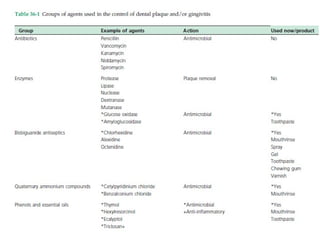
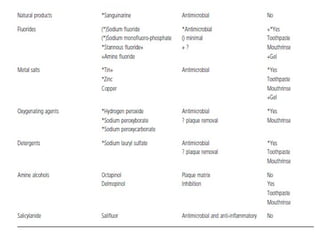
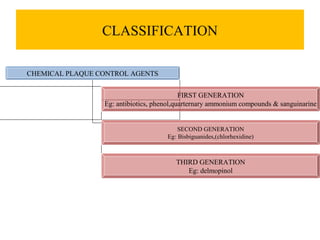
CLASSIFICATION
CHEMICAL PLAQUE CONTROL AGENTS
FIRST GENERATION
Eg: antibiotics, phenol,quarternary ammonium compounds & sanguinarine
SECOND GENERATION
Eg: Bisbiguanides,(chlorhexidine)
THIRD GENERATION
Eg: delmopinol
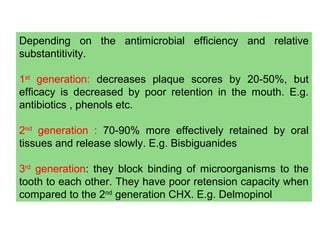
Depending on the antimicrobial efficiency and relative
substantitivity.
1st
generation: decreases plaque scores by 20-50%, but
efficacy is decreased by poor retention in the mouth. E.g.
antibiotics , phenols etc.
2nd
generation : 70-90% more effectively retained by oral
tissues and release slowly. E.g. Bisbiguanides
3rd
generation: they block binding of microorganisms to the
tooth to each other. They have poor retension capacity when
compared to the 2nd
generation CHX. E.g. Delmopinol
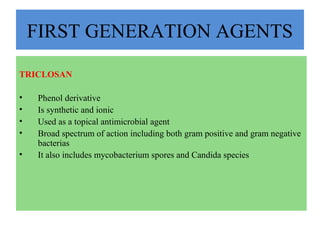
FIRST GENERATION AGENTS
TRICLOSAN
• Phenol derivative
• Is synthetic and ionic
• Used as a topical antimicrobial agent
• Broad spectrum of action including both gram positive and gram negative
bacterias
• It also includes mycobacterium spores and Candida species
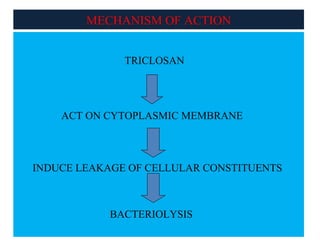
MECHANISM OF ACTION
TRICLOSAN
ACT ON CYTOPLASMIC MEMBRANE
INDUCE LEAKAGE OF CELLULAR CONSTITUENTS
BACTERIOLYSIS
• Triclosan is included in tooth paste to reduce
plaque formation
• Used along with Zinc citrate or co-polymer
Gantrez to enhance its retention within the oral
cavity
• Triclosan delay plaque formation
• It inhibits formation of prostaglandins &
leukotrienes there by reduces the chance of
inflammation
METALLIC IONS
eg: Zn & tin ,copper
MECHANISM OF ACTION
• It reduces the glycolytic activity in bacteria
&delays bacterial growth
QUARTERNARY AMMONIUM
COMPOUNDS
• Cationic antiseptics & surface active agents
• Effective against gram positive organisms
• At oral pH these antiseptics are monocationic
and adsorb readily and quantitatively, to a
greater extent, than chlorhexidine to oral
surfaces (Bonesvoll & Gjermo 1978).
MECHANISM OF ACTION
• Positively charged molecule reacts with
negatively charged cell membrane phosphates
and thereby disrupts the bacterial cell wall
structure
Eg: Benzanthonium chloride, Benzalleonium
chloride and cetylpyredinium
SANGUINARINE
• It is a benzophenanthredine alkaloid
• It is most effective against gram –ve organisms
• Used in mouth rinse
ANTIBIOTICS
• Vancomycin, erythromycin, Niddamycin and
Kanamycin
• Due to bacterial resistance problems the use of
antibiotics has been reduced
BISBIGUANIDES
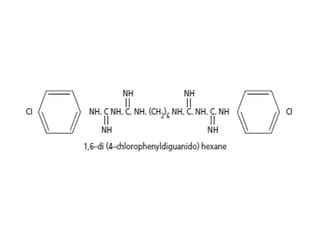
CHLORHEXIDINE GLUCONATE(0.2%)
• It is a cationic bisbiguanide
• Effective against gram +ve, gram –ve organisms, fungi, yeasts and
viruses (herpes simplex, HIV, cytomegalovirus)
• Exhibit antiplaque & antibacterial properties
HISTORY
• Chlorhexidine is available in three forms, the digluconate, acetate, and
hydrochloride salts.
– Most studies and most oral formulations and products have used the
digluconate salt, which is manufactured as a 20% V/V concentrate.
Digluconate and acetate salts are water soluble but hydrochloride is
very sparingly soluble in water.
– Chlorhexidine was developed in the 1940s by Imperial Chemical
Industries, England, and marketed in 1954 as an antiseptic for skin
wounds.
– Later, the antiseptic was more widely used in medicine and surgery
including obstetrics, gynecology, urology, and presurgical skin
preparation for both patient and surgeon.
– JAN LINDHE 5TH
EDITION
. Use in dentistry was initially for presurgical disinfection of the
mouth and in endodontics.
The first definitive study on chlorhexidine was performed by
Löe and Schiott (1970). This study showed that rinsing for 60
seconds twice per day with 10 ml of a 0.2% (20 mg dose)
chlorhexidine gluconate solution in the absence of normal tooth
cleaning, inhibited plaque regrowth and the development of
gingivitis. over a 21-day period of no oral hygiene
The first test of the use of chlorhexidine as a supplement to brushing
was a four month, twice daily rinsing in a group of soldiers (Flotra et
al. 1972). There was a 66% reduction in plaque and a 24% reduction
in gingivitis.
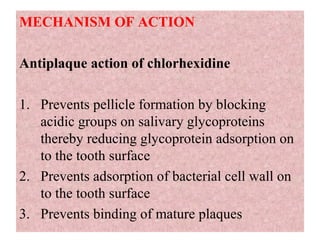
MECHANISM OF ACTION
Antiplaque action of chlorhexidine
1. Prevents pellicle formation by blocking
acidic groups on salivary glycoproteins
thereby reducing glycoprotein adsorption on
to the tooth surface
2. Prevents adsorption of bacterial cell wall on
to the tooth surface
3. Prevents binding of mature plaques
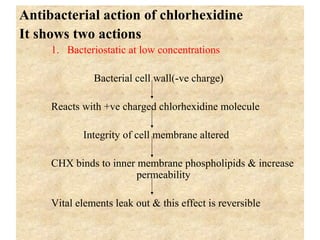
Antibacterial action of chlorhexidine
It shows two actions
1. Bacteriostatic at low concentrations
Bacterial cell wall(-ve charge)
Reacts with +ve charged chlorhexidine molecule
Integrity of cell membrane altered
CHX binds to inner membrane phospholipids & increase
permeability
Vital elements leak out & this effect is reversible
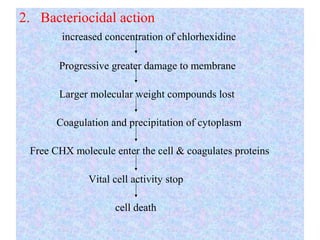
2. Bacteriocidal action
increased concentration of chlorhexidine
Progressive greater damage to membrane
Larger molecular weight compounds lost
Coagulation and precipitation of cytoplasm
Free CHX molecule enter the cell & coagulates proteins
Vital cell activity stop
cell death
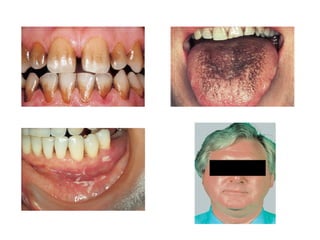
 In oral use as a mouth rinse, chlorhexidine has
been reported to have a number of local side
effects(Flotra et al. 1971). These side effects are:
I. Brownish staining of tooth and tongue or
restorations
II. Taste perturbation where the salt taste appears to
be preferentially affected (Lang et al. 1988) to
leave food and drinks with a rather bland taste.
III.Rarely hypersensitivity to chlorhexidine has
been reported
IV.Stenosis of parotid duct has also been reported
Chlorhexidine Staining
The mechanisms proposed for chlorhexidine staining
can be debated (Eriksen et al. 1985; Addy & Moran
1995; Watts & Addy 2001) but have been proposed as:
1. Degradation of the chlorhexidine molecule to
release parachloraniline
2. Catalysis of Maillard reactions
3. Protein denaturation with metal sulfide formation
4. Precipitation of anionic dietary chromogens.
JAN LINDHE 5TH
EDITION
Chlorhexidine products
 Mouth rinses:
Aqueous alcohol solutions of 0.2% chlorhexidine were first
made available fo mouth rinse products for twice daily use in
Europe in the 1970s.
 Gel:
A 1% chlorhexidine gel product is available and can be
delivered on a toothbrush. The distribution of the gel by toothbrush
around the mouth appears to be poor and preparations must be
delivered to all tooth surfaces to be effective (Saxen et al.1976).
JAN LINDHE 5TH
EDITION
• Sprays:
Sprays containing 0.1% and 0.2% chlorhexidine are
commercially available in some countries. Studies with the
0.2% spray have revealed that small doses of approximately 1–
2 mg delivered to all tooth surfaces produces similar plaque
inhibition to a rinse with 0.2% mouth rinses (Kalaga et al.
1989a).
• Varnishes:
Chlorhexidine varnishes have been used mainly for
prophylaxis against root caries rather than an antiplaque depot
for chlorhexidine in the mouth.
JAN LINDHE 5TH
EDITION
• Slow-release vehicles:
A chlorhexidine chip has been
produced commercially for placement into
periodontal pockets as an adjunct to scaling
and root planning
Clinical uses of chlorhexidine
• As an adjunct to oral hygiene and professional prophylaxis
• Post oral surgery including periodontal surgery or root planing.
• For patients with jaw fixation
• For oral hygiene and gingival health benefits in the mentally and
physically handicapped
• Medically compromised individuals predisposed to oral infections
• High-risk caries patients
• Recurrent oral ulceration
• Denture stomatitis
• Oral malodor
• Immediate pre-operative chlorhexidine rinsing and irrigation
• Removable and fixed orthodontic appliance wearers
• Subgingival irrigation
ENZYMES
• Enzymes has been used as active agents in
antiplaque preparations
• It is due to the fact that enzymes would be able
to breakdown already formed matrix some
plaques and calculus
• Some are proteolytic and have bactericidal
action
Eg: Mucinase, mutanase, dextranase etc
DELMOPINOL
• Inhibits plaque growth and reduces
gingivitis
Mechanism of action
• Interfere with plaque matrix formation
& also reduces bacterial adherence
• It causes weak binding of plaque to
tooth, thus aiding in easy removal of
plaque by mechanical procedures
• It is therefore indicated as a pre
brushing mouth rinse
Adverse effect of delmopinol
1. Staining of tooth & tongue
2. Taste disturbances
3. Mucosal soreness & erosion
DENTIFRICES
Dentifrice is a substance used with a
tooth brush for the purpose of
cleaning the accessible surfaces of the
tooth
It contains
• therapeutic agent such as
fluoride to inhibit caries
• Antimicrobial agents-
chlorhexidine, cetrimide
• Anticalculus agent - Zn-
chloride
COMPOSITION
1. Polishing/ abrasive agents
• Ca carbonate
• Dicalcium phosphate dihydrate
• Alumina
• Silica
Functions
 Mild abrasive action aids in illuminating
plaque
 Removes stained pellicle, restores natural
luster, enhances enamel whiteness
2.Binding/ thickening agents
a. Water soluble agents
• Alginates, Sodium carboxy methyl cellulose etc
a. Water insoluble agents
• Colloidal silica, Magnesium aluminium salts etc
Functions
 Controls stability &constitency of tooth paste
3.Detergents/ surfactants
• Sodium lauryl sulfate
Functions
 Produces foam & removes food debris
 Antimicrobial property
4. Humectants
• Sorbitol, glycerine, polyethylene glycol
Function
 reduces the loss of moisture from tooth paste
5. Flavoring agents
• Peppermint oil, spearmint oil, oil of
wintergreen
Function
 Render the product pleasant to use & leaves a
fresh taste in mouth after use
6. Sweeteners and colouring agents
7. Antibacterial agents
8. Anti bacterial agents
• Triclosan, delmopinol, metallic ions & Zn-citrate
trihydrate
8. Anticaries agents
• Na fluoride, stannous fluoride
8. Active agents-fluoride
9. Anticalculus agents(crystal growth
inhibitors)
• Pyrophosphate, Zn citrate, Zn chloride
8. Desensitizing agents
• Sodium fluoride, potassium nitrate
Recent developments in dentifrices
• Tooth paste for children
• Natural tooth paste (herbal)
• Whitening tooth paste
• Breath freshening tooth paste
• Sodium bicarbonate tooth paste
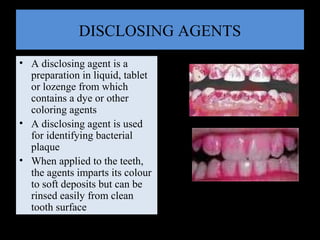
DISCLOSING AGENTS
• A disclosing agent is a
preparation in liquid, tablet
or lozenge from which
contains a dye or other
coloring agents
• A disclosing agent is used
for identifying bacterial
plaque
• When applied to the teeth,
the agents imparts its colour
to soft deposits but can be
rinsed easily from clean
tooth surface
IDEAL PROPERTIES
• Intensity of colour
• Duration of intensity
• Taste
• Irritation to mucous membrane
• Diffusibility
• Astringent and antiseptic property
Agents used for disclosing plaque
a. Iodine preparations
• Skinners iodine solution
– Diluted tincture of iodine
a. Mercurochrome preparations
• Mercurochrome soln 5
• Flavored mercurochrome disclosing solution
a. Bismark brown
b. Mebromin
c. Erythrosine
d. Fast green
e. Fluoresin
f. Two tone solutions
g. Basic fuschin
Conclusions
1. Chlorhexidine to date is the proven most effective antiplaque agent,
for which commercial products are available to the public.
2. Chlorhexidine is free from systemic toxicity in oral use, and microbial
resistance and super-infection do not occur.
3. Local side effects are reported which are mainly cosmetic problems.
4. The antiplaque action of chlorhexidine appears dependent on
prolonged persistence of antimicrobial action in the mouth
(substantivity).
5. A number of vehicles for delivering chlorhexidine are available, but
mouth rinses are most commonly recommended.
6. Extrinsic dental staining and perturbation of taste are variably the
two side effects of chlorhexidine mouth rinse usage, which limit
acceptability to users and the long-term employment of this
antiseptic in preventive dentistry.
References:
 Jan lindhe 5th
edition.
 George Philip et al 2012.
 Carranza 11th
edition.
• International journal of dental clinics Emerging concepts in oral chemical
plaquecontrol – an overview | 2012 volume 4 issue2
• Mhaske M, Samad BN, Jawade R, Bhansali A. Chemical agents in control of
dental plaque in dentistry: An overview of current knowledge and future
challenges. J periodontology. 1974;35:177-86.
 Mandel ID. Chemotherapeutic agents for controlling plaque and gingivitis.
Journal of Clinical Periodontology. 1988;15(8):488-98.

Chemicalplaquecontrol1 090714065320-phpapp01

  • 1.
    Dental College Azamgarh Departmentof Periodontology Seminar On :Chemical plaque control Guided By: Submitted by Dr. Deepak Chopra Dr .Rahul Kesharwani Dr. Kapil Garg PG 2nd year Dr. Rajesh Dr. Anjum Vishwas Dr. Abhishek Sinha Dr. Vivek Tripathi Dr. Payal Gupta
  • 2.
    CHEMICAL PLAQUE CONTROL Plaquecontrol: It is the regular removal of microbial plaque and the prevention of its accumulation on the teeth and adjacent gingival tissues. It also deals with the prevention of calculus formation. Carranza 11th Edition
  • 3.
    • In anattempt to clarify the various descriptive terms used the European Federation of Periodontology in the 1996 European Workshop on Periodontology recommended definitions for the terminology employed for agents in chemical supragingival plaque control (Lang & Newman, 1997) as follows:
  • 4.
     Antimicrobial agents:chemicals that have a bacteriostatic or bactericidal effect in vitro that alone cannot be extrapolated to a proven efficacy in vivo against plaque.  Plaque reducing/inhibitory agents: chemicals that have only been shown to reduce the quantity and/or affect the quality of plaque, which may or may not be sufficient to influence gingivitis and/or caries.  Antiplaque agents: chemicals that have an effect on plaque sufficient to benefit gingivitis and/or caries ( Addy et al. 1983).  Antigingivitis agents: chemicals which reduce gingival inflammation without necessarily influencing bacterial plaque (includes anti-inflammatory agents).
  • 5.
    • Chemical agents,on the other hand, could influence plaque quantitatively and qualitatively via a number of processes .The action of the chemicals could fit into four categories: 1. Anti adhesive 2. Antimicrobial 3. Plaque removal 4. Anti pathogenic
  • 6.
    Properties of an idealantiplaque agent 1. Should eliminate only the pathogenic bacteria. 2. Prevent development of resistant bacteria. 3. Exhibit substantivity i.e. ability of an agent to bind to tissue surfaces and to be released over time to deliver an adequate dose of active principal ingredient the agent carries. (CHX gets adsorbed to oral tissues). 4. Safe to oral tissues at concentrations and dosages recommended. 5. Significantly reduce and gingivitis and prevent colonization of microorganisms. 6. Should not stain the teeth or alter taste.
  • 9.
    CLASSIFICATION CHEMICAL PLAQUE CONTROLAGENTS FIRST GENERATION Eg: antibiotics, phenol,quarternary ammonium compounds & sanguinarine SECOND GENERATION Eg: Bisbiguanides,(chlorhexidine) THIRD GENERATION Eg: delmopinol
  • 10.
    Depending on theantimicrobial efficiency and relative substantitivity. 1st generation: decreases plaque scores by 20-50%, but efficacy is decreased by poor retention in the mouth. E.g. antibiotics , phenols etc. 2nd generation : 70-90% more effectively retained by oral tissues and release slowly. E.g. Bisbiguanides 3rd generation: they block binding of microorganisms to the tooth to each other. They have poor retension capacity when compared to the 2nd generation CHX. E.g. Delmopinol
  • 11.
    FIRST GENERATION AGENTS TRICLOSAN •Phenol derivative • Is synthetic and ionic • Used as a topical antimicrobial agent • Broad spectrum of action including both gram positive and gram negative bacterias • It also includes mycobacterium spores and Candida species
  • 12.
    MECHANISM OF ACTION TRICLOSAN ACTON CYTOPLASMIC MEMBRANE INDUCE LEAKAGE OF CELLULAR CONSTITUENTS BACTERIOLYSIS
  • 13.
    • Triclosan isincluded in tooth paste to reduce plaque formation • Used along with Zinc citrate or co-polymer Gantrez to enhance its retention within the oral cavity • Triclosan delay plaque formation • It inhibits formation of prostaglandins & leukotrienes there by reduces the chance of inflammation
  • 14.
    METALLIC IONS eg: Zn& tin ,copper MECHANISM OF ACTION • It reduces the glycolytic activity in bacteria &delays bacterial growth
  • 15.
    QUARTERNARY AMMONIUM COMPOUNDS • Cationicantiseptics & surface active agents • Effective against gram positive organisms
  • 16.
    • At oralpH these antiseptics are monocationic and adsorb readily and quantitatively, to a greater extent, than chlorhexidine to oral surfaces (Bonesvoll & Gjermo 1978).
  • 17.
    MECHANISM OF ACTION •Positively charged molecule reacts with negatively charged cell membrane phosphates and thereby disrupts the bacterial cell wall structure Eg: Benzanthonium chloride, Benzalleonium chloride and cetylpyredinium
  • 18.
    SANGUINARINE • It isa benzophenanthredine alkaloid • It is most effective against gram –ve organisms • Used in mouth rinse
  • 19.
    ANTIBIOTICS • Vancomycin, erythromycin,Niddamycin and Kanamycin • Due to bacterial resistance problems the use of antibiotics has been reduced
  • 20.
    BISBIGUANIDES CHLORHEXIDINE GLUCONATE(0.2%) • Itis a cationic bisbiguanide • Effective against gram +ve, gram –ve organisms, fungi, yeasts and viruses (herpes simplex, HIV, cytomegalovirus) • Exhibit antiplaque & antibacterial properties
  • 21.
    HISTORY • Chlorhexidine isavailable in three forms, the digluconate, acetate, and hydrochloride salts. – Most studies and most oral formulations and products have used the digluconate salt, which is manufactured as a 20% V/V concentrate. Digluconate and acetate salts are water soluble but hydrochloride is very sparingly soluble in water. – Chlorhexidine was developed in the 1940s by Imperial Chemical Industries, England, and marketed in 1954 as an antiseptic for skin wounds. – Later, the antiseptic was more widely used in medicine and surgery including obstetrics, gynecology, urology, and presurgical skin preparation for both patient and surgeon. – JAN LINDHE 5TH EDITION
  • 22.
    . Use indentistry was initially for presurgical disinfection of the mouth and in endodontics. The first definitive study on chlorhexidine was performed by Löe and Schiott (1970). This study showed that rinsing for 60 seconds twice per day with 10 ml of a 0.2% (20 mg dose) chlorhexidine gluconate solution in the absence of normal tooth cleaning, inhibited plaque regrowth and the development of gingivitis. over a 21-day period of no oral hygiene The first test of the use of chlorhexidine as a supplement to brushing was a four month, twice daily rinsing in a group of soldiers (Flotra et al. 1972). There was a 66% reduction in plaque and a 24% reduction in gingivitis.
  • 23.
    MECHANISM OF ACTION Antiplaqueaction of chlorhexidine 1. Prevents pellicle formation by blocking acidic groups on salivary glycoproteins thereby reducing glycoprotein adsorption on to the tooth surface 2. Prevents adsorption of bacterial cell wall on to the tooth surface 3. Prevents binding of mature plaques
  • 24.
    Antibacterial action ofchlorhexidine It shows two actions 1. Bacteriostatic at low concentrations Bacterial cell wall(-ve charge) Reacts with +ve charged chlorhexidine molecule Integrity of cell membrane altered CHX binds to inner membrane phospholipids & increase permeability Vital elements leak out & this effect is reversible
  • 25.
    2. Bacteriocidal action increasedconcentration of chlorhexidine Progressive greater damage to membrane Larger molecular weight compounds lost Coagulation and precipitation of cytoplasm Free CHX molecule enter the cell & coagulates proteins Vital cell activity stop cell death
  • 26.
     In oraluse as a mouth rinse, chlorhexidine has been reported to have a number of local side effects(Flotra et al. 1971). These side effects are: I. Brownish staining of tooth and tongue or restorations II. Taste perturbation where the salt taste appears to be preferentially affected (Lang et al. 1988) to leave food and drinks with a rather bland taste. III.Rarely hypersensitivity to chlorhexidine has been reported IV.Stenosis of parotid duct has also been reported
  • 28.
    Chlorhexidine Staining The mechanismsproposed for chlorhexidine staining can be debated (Eriksen et al. 1985; Addy & Moran 1995; Watts & Addy 2001) but have been proposed as: 1. Degradation of the chlorhexidine molecule to release parachloraniline 2. Catalysis of Maillard reactions 3. Protein denaturation with metal sulfide formation 4. Precipitation of anionic dietary chromogens. JAN LINDHE 5TH EDITION
  • 30.
    Chlorhexidine products  Mouthrinses: Aqueous alcohol solutions of 0.2% chlorhexidine were first made available fo mouth rinse products for twice daily use in Europe in the 1970s.  Gel: A 1% chlorhexidine gel product is available and can be delivered on a toothbrush. The distribution of the gel by toothbrush around the mouth appears to be poor and preparations must be delivered to all tooth surfaces to be effective (Saxen et al.1976). JAN LINDHE 5TH EDITION
  • 31.
    • Sprays: Sprays containing0.1% and 0.2% chlorhexidine are commercially available in some countries. Studies with the 0.2% spray have revealed that small doses of approximately 1– 2 mg delivered to all tooth surfaces produces similar plaque inhibition to a rinse with 0.2% mouth rinses (Kalaga et al. 1989a). • Varnishes: Chlorhexidine varnishes have been used mainly for prophylaxis against root caries rather than an antiplaque depot for chlorhexidine in the mouth. JAN LINDHE 5TH EDITION
  • 32.
    • Slow-release vehicles: Achlorhexidine chip has been produced commercially for placement into periodontal pockets as an adjunct to scaling and root planning
  • 33.
    Clinical uses ofchlorhexidine • As an adjunct to oral hygiene and professional prophylaxis • Post oral surgery including periodontal surgery or root planing. • For patients with jaw fixation • For oral hygiene and gingival health benefits in the mentally and physically handicapped • Medically compromised individuals predisposed to oral infections • High-risk caries patients • Recurrent oral ulceration • Denture stomatitis • Oral malodor • Immediate pre-operative chlorhexidine rinsing and irrigation • Removable and fixed orthodontic appliance wearers • Subgingival irrigation
  • 34.
    ENZYMES • Enzymes hasbeen used as active agents in antiplaque preparations • It is due to the fact that enzymes would be able to breakdown already formed matrix some plaques and calculus • Some are proteolytic and have bactericidal action Eg: Mucinase, mutanase, dextranase etc
  • 35.
    DELMOPINOL • Inhibits plaquegrowth and reduces gingivitis Mechanism of action • Interfere with plaque matrix formation & also reduces bacterial adherence • It causes weak binding of plaque to tooth, thus aiding in easy removal of plaque by mechanical procedures • It is therefore indicated as a pre brushing mouth rinse
  • 36.
    Adverse effect ofdelmopinol 1. Staining of tooth & tongue 2. Taste disturbances 3. Mucosal soreness & erosion
  • 37.
    DENTIFRICES Dentifrice is asubstance used with a tooth brush for the purpose of cleaning the accessible surfaces of the tooth It contains • therapeutic agent such as fluoride to inhibit caries • Antimicrobial agents- chlorhexidine, cetrimide • Anticalculus agent - Zn- chloride
  • 38.
    COMPOSITION 1. Polishing/ abrasiveagents • Ca carbonate • Dicalcium phosphate dihydrate • Alumina • Silica Functions  Mild abrasive action aids in illuminating plaque  Removes stained pellicle, restores natural luster, enhances enamel whiteness
  • 39.
    2.Binding/ thickening agents a.Water soluble agents • Alginates, Sodium carboxy methyl cellulose etc a. Water insoluble agents • Colloidal silica, Magnesium aluminium salts etc Functions  Controls stability &constitency of tooth paste 3.Detergents/ surfactants • Sodium lauryl sulfate Functions  Produces foam & removes food debris  Antimicrobial property
  • 40.
    4. Humectants • Sorbitol,glycerine, polyethylene glycol Function  reduces the loss of moisture from tooth paste 5. Flavoring agents • Peppermint oil, spearmint oil, oil of wintergreen Function  Render the product pleasant to use & leaves a fresh taste in mouth after use
  • 41.
    6. Sweeteners andcolouring agents 7. Antibacterial agents 8. Anti bacterial agents • Triclosan, delmopinol, metallic ions & Zn-citrate trihydrate 8. Anticaries agents • Na fluoride, stannous fluoride 8. Active agents-fluoride 9. Anticalculus agents(crystal growth inhibitors) • Pyrophosphate, Zn citrate, Zn chloride 8. Desensitizing agents • Sodium fluoride, potassium nitrate
  • 42.
    Recent developments indentifrices • Tooth paste for children • Natural tooth paste (herbal) • Whitening tooth paste • Breath freshening tooth paste • Sodium bicarbonate tooth paste
  • 43.
    DISCLOSING AGENTS • Adisclosing agent is a preparation in liquid, tablet or lozenge from which contains a dye or other coloring agents • A disclosing agent is used for identifying bacterial plaque • When applied to the teeth, the agents imparts its colour to soft deposits but can be rinsed easily from clean tooth surface
  • 44.
    IDEAL PROPERTIES • Intensityof colour • Duration of intensity • Taste • Irritation to mucous membrane • Diffusibility • Astringent and antiseptic property
  • 45.
    Agents used fordisclosing plaque a. Iodine preparations • Skinners iodine solution – Diluted tincture of iodine a. Mercurochrome preparations • Mercurochrome soln 5 • Flavored mercurochrome disclosing solution a. Bismark brown b. Mebromin c. Erythrosine d. Fast green e. Fluoresin f. Two tone solutions g. Basic fuschin
  • 46.
    Conclusions 1. Chlorhexidine todate is the proven most effective antiplaque agent, for which commercial products are available to the public. 2. Chlorhexidine is free from systemic toxicity in oral use, and microbial resistance and super-infection do not occur. 3. Local side effects are reported which are mainly cosmetic problems. 4. The antiplaque action of chlorhexidine appears dependent on prolonged persistence of antimicrobial action in the mouth (substantivity). 5. A number of vehicles for delivering chlorhexidine are available, but mouth rinses are most commonly recommended. 6. Extrinsic dental staining and perturbation of taste are variably the two side effects of chlorhexidine mouth rinse usage, which limit acceptability to users and the long-term employment of this antiseptic in preventive dentistry.
  • 47.
    References:  Jan lindhe5th edition.  George Philip et al 2012.  Carranza 11th edition. • International journal of dental clinics Emerging concepts in oral chemical plaquecontrol – an overview | 2012 volume 4 issue2 • Mhaske M, Samad BN, Jawade R, Bhansali A. Chemical agents in control of dental plaque in dentistry: An overview of current knowledge and future challenges. J periodontology. 1974;35:177-86.  Mandel ID. Chemotherapeutic agents for controlling plaque and gingivitis. Journal of Clinical Periodontology. 1988;15(8):488-98.