Chemical
plaque
control
GUIDED BY
Dr.V.R.Balaji MDS
11
G.Kalaivani
3 rdyr pg
2
content
๏‚ทIntroduction
๏‚ทConcept of chemical plaque control
๏‚ทHistory
๏‚ทRationale of Antiplaque agents
๏‚ทApproaches to Antiplaque agents
๏‚ทMethods to evaluate Antiplaque agents
๏‚ทIdeal properties of Antiplaque agents
๏‚ทGroups of agents used in antiplaque agents
๏‚ทRecent advances
๏‚ทFuture trends
๏‚ทConclusions
๏‚ทReferences
3
INTRODUCTION:
Chemical plaque control
definitive edge
over mechanical plaque control,
in that access to the areas beyond the preview of mechanical
plaque control therapy
provides an effective plaque control.
4
5
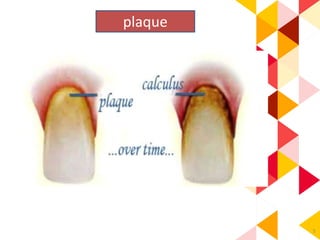
plaque
6
The formation of plaque on a tooth surface is a dynamic and ordered
process, commencing with the attachment of primary plaque-forming
bacteria.
The attachment of these organisms appears essential for initiating the
sequence of attachment of other organisms such that, with time, the
mass and complexity of the plaque increases.
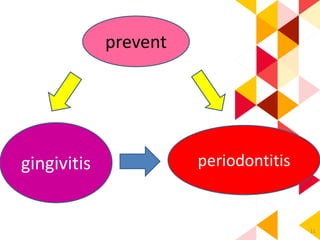
Plaque control, which prevents plaque achieving the critical point where
gingival health deteriorates, will stop gingivitis.
Plaque inhibition has, therefore, targeted plaque formation at particular
points โ€“ bacterial attachment, bacterial proliferation, and plaque
maturation.
7
8
โ€ขThe terminology โ€œoral hygiene productsโ€ is recent
โ€ข6000 years, that formulation and recipes existed to
benefit oral and dental health (Fischman 1997).
โ€ขEbers Papyrus 1500 BC -recipes for tooth powders
and mouth rinses
โ€ขAlcohol-based mouth rinses -the Romans and
included white wine and beer.
โ€ขUrine, as a mouth rinse
โ€ขUse of stale urine- Cantabri and others in Spain
โ€ขUse of fresh urine-Fauchard (1670-1761) of France.
9
19 th centuries:
โ€ขUse of essential oils in the form of
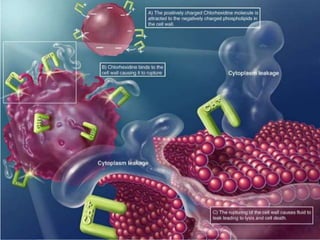
mouth rinse, later with addition of
antimicrobial or antiseptics agents to
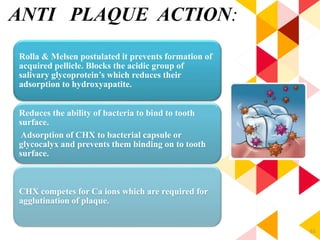
the tooth paste and mouth rinse
developed.
10
RATIONALE FOR
CHEMICAL
PLAQUE
CONTROL:
11
prevent
gingivitis periodontitis
12
The concept of chemical plaque
control may be justified
overcoming
inadequacies of
mechanical cleaning.
13
APPROACHES TO
CHEMICAL
PLAQUE
CONTROL:
14
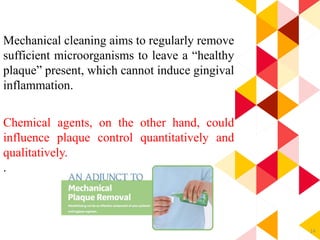
Mechanical cleaning aims to regularly remove
sufficient microorganisms to leave a โ€œhealthy
plaqueโ€ present, which cannot induce gingival
inflammation.
Chemical agents, on the other hand, could
influence plaque control quantitatively and
qualitatively.
.
15
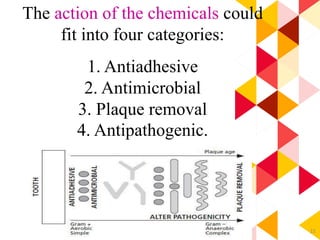
The action of the chemicals could
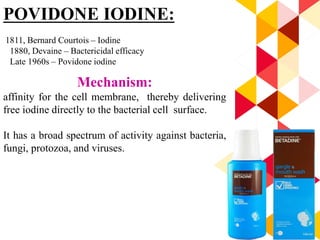
fit into four categories:
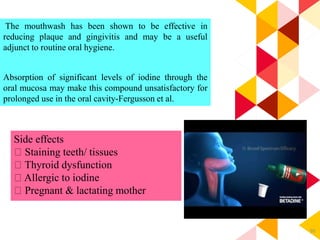
1. Antiadhesive
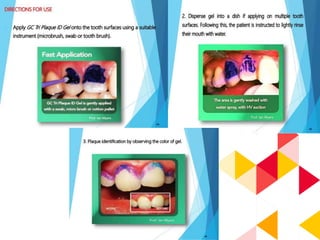
2. Antimicrobial
3. Plaque removal
4. Antipathogenic.
16
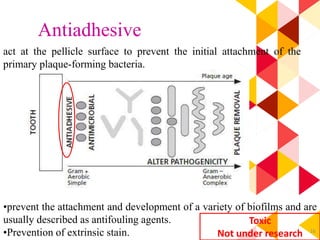
Antiadhesive
act at the pellicle surface to prevent the initial attachment of the
primary plaque-forming bacteria.
โ€ขprevent the attachment and development of a variety of biofilms and are
usually described as antifouling agents.
โ€ขPrevention of extrinsic stain.
Toxic
Not under research
17
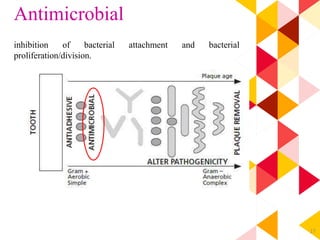
Antimicrobial
inhibition of bacterial attachment and bacterial
proliferation/division.
18
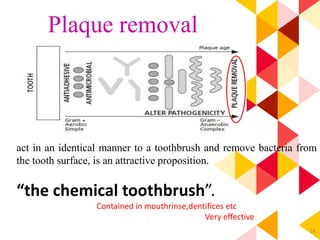
Plaque removal
act in an identical manner to a toothbrush and remove bacteria from
the tooth surface, is an attractive proposition.
โ€œthe chemical toothbrushโ€.
Contained in mouthrinse,dentifices etc
Very effective
19
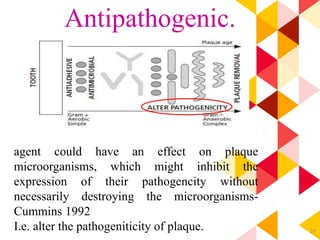
Antipathogenic.
agent could have an effect on plaque
microorganisms, which might inhibit the
expression of their pathogencity without
necessarily destroying the microorganisms-
Cummins 1992
I.e. alter the pathogeniticity of plaque.
20
METHODS IN VITRO OR IN
VIVO
TO EVALUATE ORAL HYGIENE
PRODUCTS:
21
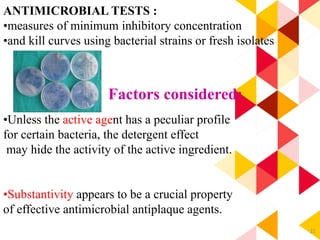
ANTIMICROBIAL TESTS :
โ€ขmeasures of minimum inhibitory concentration
โ€ขand kill curves using bacterial strains or fresh isolates
Factors considered:
โ€ขUnless the active agent has a peculiar profile
for certain bacteria, the detergent effect
may hide the activity of the active ingredient.
โ€ขSubstantivity appears to be a crucial property
of effective antimicrobial antiplaque agents.
22
Other in vitro tests:
๏ถStain removal,
๏ถdetrimental actions, such as abrasivity.
Probably as a function of pH some types of mouth
rinse and toothpaste have the potential to erode
tooth tissue- Addy et al.
Stain control is perhaps more easily modeled,
particularly using forced staining methods
involving chlorhexidine - Addy et al in 1991
evidence
23
In vivo method:
Parallel, randomized control method
to be done
24
Clinical significance can be assessed as
follows:
Benchmark efficacy: -effect similar to other
established products;
Positive efficacy: -effect similar to or greater
than the most effective formulation to date;
Disease efficacy: effect on a causative factor
that reduces a disease or condition;
Proportional efficacy: achieving a previously
agreed proportional reduction in a parameter
compared with control.
25
A major feature of scientific research, particularly in
clinical trials, is the use of controls
Placebo control: one without any expected
activity against the condition under investigation;
Minus active ingredient control: one that is
identical to the test product or formulation
without the active agent or agents;
Benchmark control: a product already in use by
the public or an agent already evaluated; and
Positive control: an accepted effective
formulation or the most effective formulation
available to date
26
Among plaque control agents,
chlorhexidine
has tended to be considered a
positive control or gold standard
by which to compare other
chemicals-
Addy et al and Kornman 1986.
27
IDEAL PROPERTIES OF ANTIPLAQUE
AGENTS:
Elimination of pathogenic bacteria
prevent development of resistant bacteria
exhibit substantivity
safety
reduction in plaque and gingivitis
no staining or alteration of taste
easy to use and inexpensive
no systemic effect
28
CRITERIA FOR USAGE OF
ANTIMICROBIALS:
Substantivity: The ability of an agent to be bound to
the pellicle and tooth surface and to be released over an
extended period of time with the retention of its potency.
Stability: chemical breakdown or modification may
occur during storage, especially at elevated temperatures.
Penetrability: For a drug to be effective, it must be
able to penetrate deep into the formed plaque matrix.
Toxic safety: any agent used for prevention or
treatment of oral diseases must have low toxicity.
29
AGENTS FOR
CHEMICAL PLAQUE
CONTROL
Kornman, 1986; Mandel, 1988
30
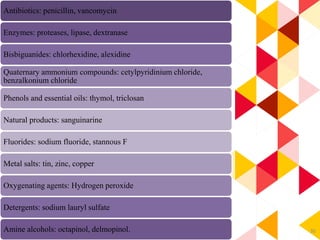
Antibiotics: penicillin, vancomycin
Enzymes: proteases, lipase, dextranase
Bisbiguanides: chlorhexidine, alexidine
Quaternary ammonium compounds: cetylpyridinium chloride,
benzalkonium chloride
Phenols and essential oils: thymol, triclosan
Natural products: sanguinarine
Fluorides: sodium fluoride, stannous F
Metal salts: tin, zinc, copper
Oxygenating agents: Hydrogen peroxide
Detergents: sodium lauryl sulfate
Amine alcohols: octapinol, delmopinol.
31
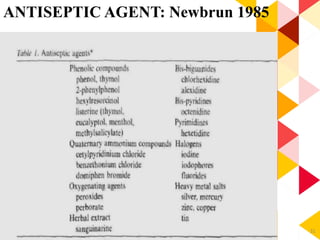
ANTISEPTIC AGENT: Newbrun 1985
32
DEPENDING ON THE
ANTIMICROBIAL
EFFICIENCY
AND
RELATIVE
SUBSTANTITIVITY.
Generation of anti-plaque
agents: Kornman 1986
33
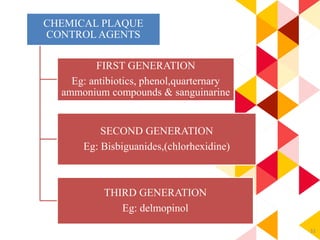
CHEMICAL PLAQUE
CONTROL AGENTS
FIRST GENERATION
Eg: antibiotics, phenol,quarternary
ammonium compounds & sanguinarine
SECOND GENERATION
Eg: Bisbiguanides,(chlorhexidine)
THIRD GENERATION
Eg: delmopinol
34
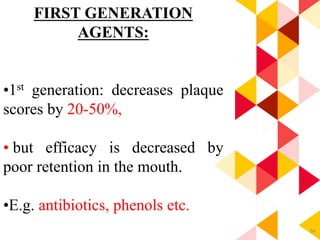
FIRST GENERATION
AGENTS:
โ€ข1st generation: decreases plaque
scores by 20-50%,
โ€ข but efficacy is decreased by
poor retention in the mouth.
โ€ขE.g. antibiotics, phenols etc.
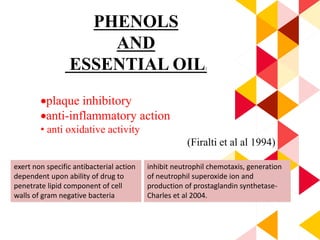
PHENOLS
AND
ESSENTIAL OIL:
๏‚ทplaque inhibitory
๏‚ทanti-inflammatory action
โ€ข anti oxidative activity
(Firalti et al al 1994)
exert non specific antibacterial action
dependent upon ability of drug to
penetrate lipid component of cell
walls of gram negative bacteria
inhibit neutrophil chemotaxis, generation
of neutrophil superoxide ion and
production of prostaglandin synthetase-
Charles et al 2004.
36
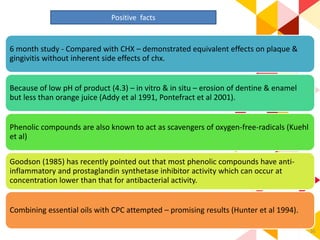
Positive facts
6 month study - Compared with CHX โ€“ demonstrated equivalent effects on plaque &
gingivitis without inherent side effects of chx.
Because of low pH of product (4.3) โ€“ in vitro & in situ โ€“ erosion of dentine & enamel
but less than orange juice (Addy et al 1991, Pontefract et al 2001).
Phenolic compounds are also known to act as scavengers of oxygen-free-radicals (Kuehl
et al)
Goodson (1985) has recently pointed out that most phenolic compounds have anti-
inflammatory and prostaglandin synthetase inhibitor activity which can occur at
concentration lower than that for antibacterial activity.
Combining essential oils with CPC attempted โ€“ promising results (Hunter et al 1994).
37
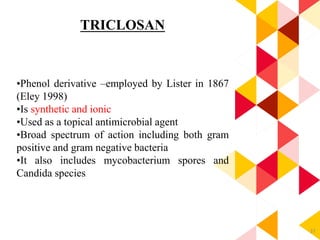
TRICLOSAN
โ€ขPhenol derivative โ€“employed by Lister in 1867
(Eley 1998)
โ€ขIs synthetic and ionic
โ€ขUsed as a topical antimicrobial agent
โ€ขBroad spectrum of action including both gram
positive and gram negative bacteria
โ€ขIt also includes mycobacterium spores and
Candida species.
38
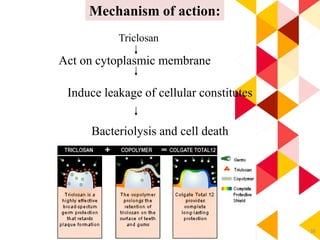
Mechanism of action:
Triclosan
Act on cytoplasmic membrane
Induce leakage of cellular constitutes
Bacteriolysis and cell death
39
AVAILABILITY
tooth paste and mouthrinse
Concentrations (0.2%) and dose (20 mg twice per day), triclosan has
moderate plaque-inhibitory action and antimicrobial substantivity of around
5 hours (Jenkins et al. 1991)
Listerine is an over the counter phenol preparation containing thymol,
eucalyptol, methyl salicylate, benzoic acid and boric acid in hydro alcoholic
vehicle
Some patients find an initial burning sensation and bitter taste, occasional
straining is evident
Become the first over-the-counter mouth rinse to be accepted by the
Council of Dental Therapeutics for its help in controlling plaque and
gingivitis.
40
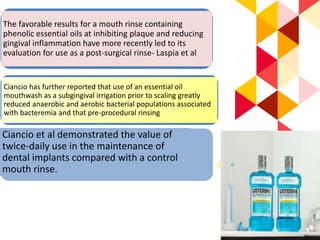
Ciancio et al demonstrated the value of
twice-daily use in the maintenance of
dental implants compared with a control
mouth rinse.
Ciancio has further reported that use of an essential oil
mouthwash as a subgingival irrigation prior to scaling greatly
reduced anaerobic and aerobic bacterial populations associated
with bacteremia and that pre-procedural rinsing
The favorable results for a mouth rinse containing
phenolic essential oils at inhibiting plaque and reducing
gingival inflammation have more recently led to its
evaluation for use as a post-surgical rinse- Laspia et al
41
.
Zinc salts:
โ€ขplaque inhibitor was first described by Hanke in 1940
โ€ขAstringent
โ€ขZinc citrate has been combined
with ionic antimicrobial triclosan in toothpaste form,
โ€ขsignificant anticalculus activity.
โ€ขZinc salts may be of value at reducing volatile sulfu
compounds associated with oral malodor (Rosing et al 2002).
METALLIC IONS
42
Tin salts:
โ€ข Inhibit plaque formation
โ€ขSvatun et al 1977 showed mechanism of
action of tin is through their ability to bind to
teichoic acid present on cell wall of gram
positive organisms changing surface charge
causing decreased adsorption of cells to teeth.
43
Disadvantage of metal salts:
โ€ขMetallic taste
โ€ขDryness of mouth
โ€ขYellowish brown discoloration of teeth and tongue
Stannous fluoride mouth rinses:
โ€ขDifficult to formulate โ€“ stability problems โ€“
hydrolysis in presence of water anhydrous
gel & toothpaste (Beiswanger et al 1995,
Perlich et al 1995)
โ€ขHuman studies confirmed that
antibacterial action of stannous fluoride
was more due to tin ions although they
have synergistic effect (Andreas et al
1974).
44
3. QUARTERNARYAMMONIUM
COMPOUNDS
โ€ขCationic antiseptics & surface active agents
โ€ขEffective against gram positive organisms
Mechanism of action
โ€ขPositively charged molecule reacts with negatively charged cell
membrane phosphates and thereby disrupts the bacterial cell wall
structure
E.g.: Benzanthonium chloride, Benzalleonium chloride and
cetylpyridinium chloride.
4
5
CETYLPYRIDINIUMCHLORIDE (CPC):
โ€ขused as agents for plaque inhibition
cationic
โ€ขCPC at 0.05% conc used in wide variety of
antiseptic mouth rinse products.
Substantivity of cetylpyridinium chloride is only 3โ€“ 5
hours (Roberts & Addy 1981).
Efficacy of CPC โ€“ increased by doubling frequency
of rinsing to 4 times per day (Bonsvoll & Gjermo
1978) โ€“ increased side effects & affect compliance
46
Side effects:
โ€ขBrownish discoloration of teeth
โ€ขRecurrent apthous type ulceration of oral mucosa.
โ€ขMouth rinses combining CPC with CHX โ€“ studies
done โ€“ compare well with CHX (Quirynen et al
2001, 2005) โ€“ cannot be assessed โ€“ whether CPC
actually contributes to activity of chx
โ€ขSlow release system & lozenges to deliver cps โ€“ no
greater plaque inhibition than CPC rinse &
significantly < chx rinse (Vanderkerchove et al
1995).
47
48
SANGUINARINE:
benzophenanthredine alkaloid derived from
Sanguinaria Canadensis.
It is most effective against gram โ€“ve organisms
Properties:
โ€ขUsed in mouth rinse
โ€ขAdverse effects:
โ€ขMouth rinses shown to increase likelihood of
oral precancerous lesions ten-fold even after
cessation of use
49
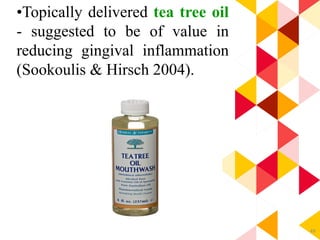
โ€ขTopically delivered tea tree oil
- suggested to be of value in
reducing gingival inflammation
(Sookoulis & Hirsch 2004).
50
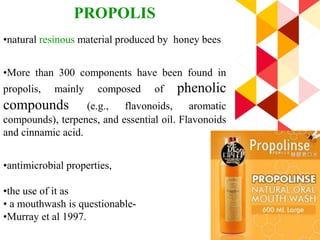
PROPOLIS
โ€ขnatural resinous material produced by honey bees
โ€ขMore than 300 components have been found in
propolis, mainly composed of phenolic
compounds (e.g., flavonoids, aromatic
compounds), terpenes, and essential oil. Flavonoids
and cinnamic acid.
โ€ขantimicrobial properties,
โ€ขthe use of it as
โ€ข a mouthwash is questionable-
โ€ขMurray et al 1997.
51
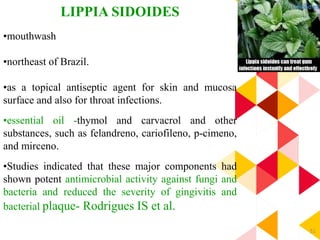
LIPPIA SIDOIDES
โ€ขmouthwash
โ€ขnortheast of Brazil.
โ€ขas a topical antiseptic agent for skin and mucosa
surface and also for throat infections.
โ€ขessential oil -thymol and carvacrol and other
substances, such as felandreno, cariofileno, p-cimeno,
and mirceno.
โ€ขStudies indicated that these major components had
shown potent antimicrobial activity against fungi and
bacteria and reduced the severity of gingivitis and
bacterial plaque- Rodrigues IS et al.
52
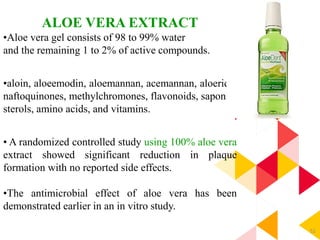
ALOE VERA EXTRACT
โ€ขAloe vera gel consists of 98 to 99% water
and the remaining 1 to 2% of active compounds.
โ€ขaloin, aloeemodin, aloemannan, acemannan, aloeride,
naftoquinones, methylchromones, flavonoids, saponin,
sterols, amino acids, and vitamins.
โ€ข A randomized controlled study using 100% aloe vera
extract showed significant reduction in plaque
formation with no reported side effects.
โ€ขThe antimicrobial effect of aloe vera has been
demonstrated earlier in an in vitro study.
53
54
โ€ขDue to bacterial resistance problems the use
of antibiotics has been reduced.
โ€ขDespite evidence for efficacy โ€“ systemic
antimicrobials used in past (as topical/ systemic)
are Penicillin, Vancomycin, Erythromycin) for
preventing caries & gingivitis.
โ€ขNot be used as preventive agents.
โ€ขRisk-to-benefit ratio is high (Slots & Rams
1990; Addy & Martin 2003).
55
SECOND GENERATION
AGENTS:
โ€ข More effectively retained by oral
tissues and slow release properties
provide reduction in plaque scores
between 70 and 90%
โ€ข E.g.: Bisbiguanides.
56
BISBIGUANIDES
โ€ขConsidered to most effective
antiplaque agents.
โ€ขSecond generation agents
โ€ขexhibiting substantivity
โ€ขbroad antimicrobial properties.
57
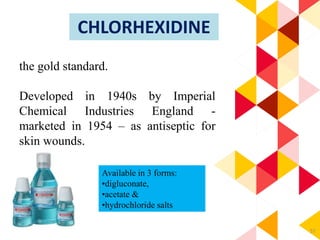
CHLORHEXIDINE
the gold standard.
Developed in 1940s by Imperial
Chemical Industries England -
marketed in 1954 โ€“ as antiseptic for
skin wounds.
Available in 3 forms:
โ€ขdigluconate,
โ€ขacetate &
โ€ขhydrochloride salts
58
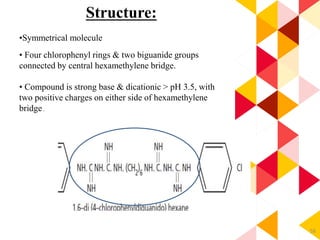
Structure:
โ€ขSymmetrical molecule
โ€ข Four chlorophenyl rings & two biguanide groups
connected by central hexamethylene bridge.
โ€ข Compound is strong base & dicationic > pH 3.5, with
two positive charges on either side of hexamethylene
bridge .
59
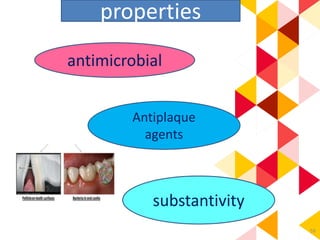
properties
antimicrobial
Antiplaque
agents
substantivity
60
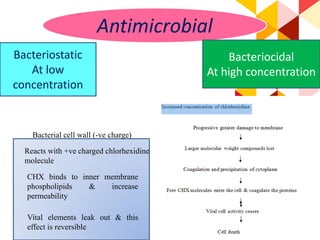
Antimicrobial
Bacteriostatic
At low
concentration
Bacteriocidal
At high concentration
Bacterial cell wall (-ve charge)
Reacts with +ve charged chlorhexidine
molecule
CHX binds to inner membrane
phospholipids & increase
permeability
Vital elements leak out & this
effect is reversible
62
ANTI PLAQUE ACTION:
Rolla & Melsen postulated it prevents formation of
acquired pellicle. Blocks the acidic group of
salivary glycoproteinโ€™s which reduces their
adsorption to hydroxyapatite.
Reduces the ability of bacteria to bind to tooth
surface.
Adsorption of CHX to bacterial capsule or
glycocalyx and prevents them binding on to tooth
surface.
CHX competes for Ca ions which are required for
agglutination of plaque.
63
โ€ขCHX due to its dicationic nature binds to
enamel pellicle or tooth surface and salivary
proteins.
โ€ขThis adsorbed CHX is released of a period
of time.
Substantivity
โ€ขBinds different surfaces within the mouth (teeth and mucosa) and also to the pellicle and
saliva;
โ€ขfor example, after a single rinse with chlorhexidine, the saliva itself exhibits antibacterial
activity for up to 5 hours, whereas persistence at the oral surfaces has been shown to
suppress salivary bacterial counts for over 12 hours
64
Metabolism:
โ€ข Does not penetrate oral epithelium (Lindhe et
al 1970).
โ€ข If accidentally swallowed โ€“ bind to mucosal
surface of alimentary canal - is poorly absorbed
& all of swallowed dose excreted in feces.
65
Oral retention of chlorhexidine:
clinical data
โ€ขEfficacy with respect to other drugs.
โ€ขpersistent bacteriostatic action lasting > 12 hours
(Schiott et al 1970)
โ€ขWhen mouth rinse of 10 ml of 0.2% chlorhexidine is
done for 1 min app- 30% drug is retained in mouth
(Gjermo 1975).
โ€ขReasons:
โ€ขRadio-labeled studies suggest slow release of
antiseptic from surfaces (Bonesvoll et al. 1974)
(Gjermo et al. 1974)
Calcium ions from saliva are able to displace it from
binding sites
66
Optimizing use of chlorhexidine:
โ€ขDoes not distinguish between bacterial protein &
other proteins found within mature plaque so
extraneous protein must first be removed
professionally.
โ€ขPrevents plaque formation; its mode of action does
not allow it to remove plaque efficiently.
โ€ขMay react with anionic surfactants present in
formulations reducing its activity.
โ€ขShould not be used before/ immediately after
toothpaste; interaction anionic surfactants will reduce
effective delivery to tooth surface in active form
67
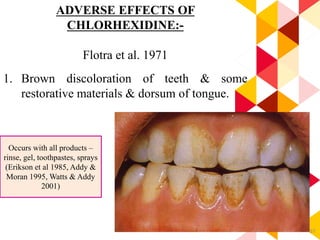
ADVERSE EFFECTS OF
CHLORHEXIDINE:-
Flotra et al. 1971
1. Brown discoloration of teeth & some
restorative materials & dorsum of tongue.
Occurs with all products โ€“
rinse, gel, toothpastes, sprays
(Erikson et al 1985, Addy &
Moran 1995, Watts & Addy
2001)
68
Proposed mechanisms for
chlorhexidine staining:
โ€ขDegradation of CHX molecule to release
parachloraniline.
โ€ขCatalysis of Maillard reactions.
โ€ขProtein denaturation with metal sulfide formation.
โ€ขPrecipitation of anionic dietary chromogens
splitting sulphide bridges to produce free
sulpydryl groups , latter then reacts with iron
or tin ions to produce brown and yellow
pigmented products (Ellingsten et al 1882)
โ€ขChlorhexidine reacts with ketones and
aldehydes in dietary breakdown or intermediary
products to form insoluble colored compounds
( Nordho 1971)
69
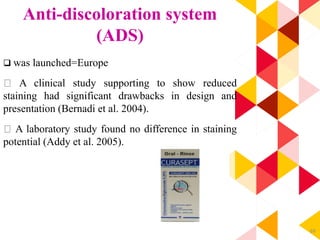
Anti-discoloration system
(ADS)
๏ฑ was launched=Europe
A clinical study supporting to show reduced
staining had significant drawbacks in design and
presentation (Bernadi et al. 2004).
A laboratory study found no difference in staining
potential (Addy et al. 2005).
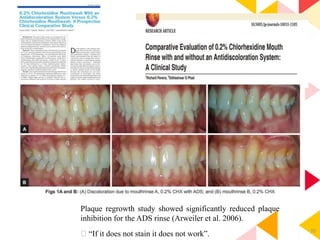
70
Plaque regrowth study showed significantly reduced plaque
inhibition for the ADS rinse (Arweiler et al. 2006).
โ€œIf it does not stain it does not workโ€.
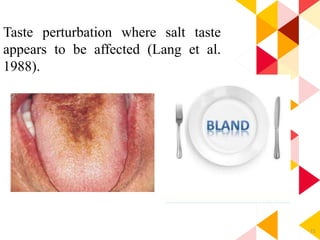
71
Taste perturbation where salt taste
appears to be affected (Lang et al.
1988).
72
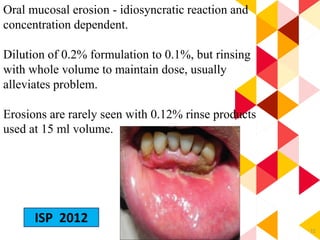
Oral mucosal erosion - idiosyncratic reaction and
concentration dependent.
Dilution of 0.2% formulation to 0.1%, but rinsing
with whole volume to maintain dose, usually
alleviates problem.
Erosions are rarely seen with 0.12% rinse products
used at 15 ml volume.
ISP 2012
73
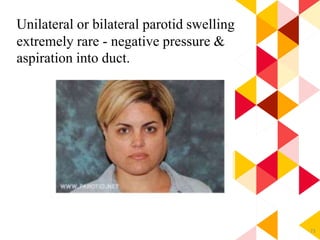
Unilateral or bilateral parotid swelling
extremely rare - negative pressure &
aspiration into duct.
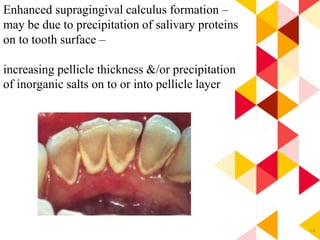
74
Enhanced supragingival calculus formation โ€“
may be due to precipitation of salivary proteins
on to tooth surface โ€“
increasing pellicle thickness &/or precipitation
of inorganic salts on to or into pellicle layer
75
CHLORHEXIDINE
PRODUCTS
โ€ขMode of delivery of CHX:
โ€ข mouth rinse, gels, tooth paste,
dental floss, and tooth picks.
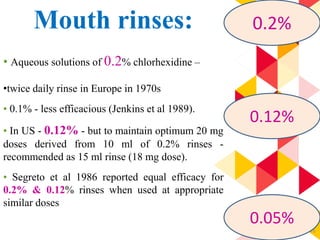
76
Mouth rinses:
โ€ข Aqueous solutions of 0.2% chlorhexidine โ€“
โ€ขtwice daily rinse in Europe in 1970s
โ€ข 0.1% - less efficacious (Jenkins et al 1989).
โ€ข In US - 0.12% - but to maintain optimum 20 mg
doses derived from 10 ml of 0.2% rinses -
recommended as 15 ml rinse (18 mg dose).
โ€ข Segreto et al 1986 reported equal efficacy for
0.2% & 0.12% rinses when used at appropriate
similar doses
0.2%
0.12%
0.05%
77
Gel
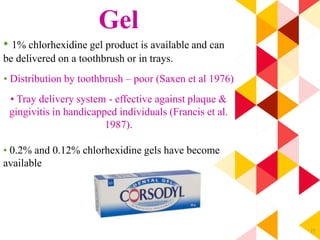
โ€ข 1% chlorhexidine gel product is available and can
be delivered on a toothbrush or in trays.
โ€ข Distribution by toothbrush โ€“ poor (Saxen et al 1976)
โ€ข Tray delivery system - effective against plaque &
gingivitis in handicapped individuals (Francis et al.
1987).
โ€ข 0.2% and 0.12% chlorhexidine gels have become
available
78
Sprays:
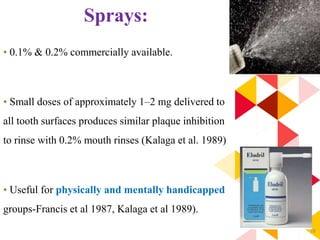
โ€ข 0.1% & 0.2% commercially available.
โ€ข Small doses of approximately 1โ€“2 mg delivered to
all tooth surfaces produces similar plaque inhibition
to rinse with 0.2% mouth rinses (Kalaga et al. 1989)
โ€ข Useful for physically and mentally handicapped
groups-Francis et al 1987, Kalaga et al 1989).
79
Toothpaste:
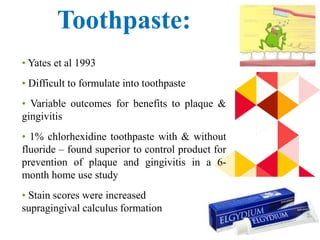
โ€ข Yates et al 1993
โ€ข Difficult to formulate into toothpaste
โ€ข Variable outcomes for benefits to plaque &
gingivitis
โ€ข 1% chlorhexidine toothpaste with & without
fluoride โ€“ found superior to control product for
prevention of plaque and gingivitis in a 6-
month home use study
โ€ข Stain scores were increased
supragingival calculus formation
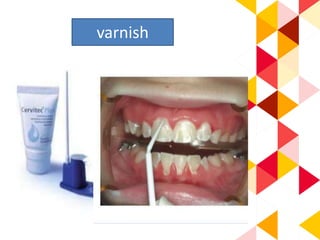
varnish
81
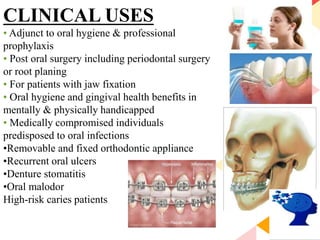
CLINICAL USES
โ€ข Adjunct to oral hygiene & professional
prophylaxis
โ€ข Post oral surgery including periodontal surgery
or root planing
โ€ข For patients with jaw fixation
โ€ข Oral hygiene and gingival health benefits in
mentally & physically handicapped
โ€ข Medically compromised individuals
predisposed to oral infections
โ€ขRemovable and fixed orthodontic appliance
โ€ขRecurrent oral ulcers
โ€ขDenture stomatitis
โ€ขOral malodor
High-risk caries patients
82
PERIOCHIP
(Dexcel Pharmaceuticals, Israel)
orange brown, biodegradable, rectangular chip
rounded at one end that has an active ingredient
of chlorhexidine gluconate (2.5 mg) that is
released into the pocket over a period of 7 to 10
days.
suppress the pocket flora for up to 10- 11 weeks
post application.
approved by the FDA as an adjunct to SRP
procedures for the reduction of probing pocket
depth or as part of a routine periodontal
maintenance program.
83
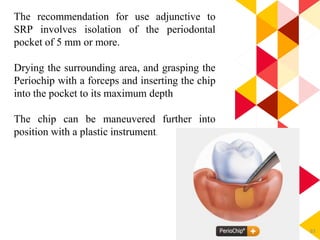
The recommendation for use adjunctive to
SRP involves isolation of the periodontal
pocket of 5 mm or more.
Drying the surrounding area, and grasping the
Periochip with a forceps and inserting the chip
into the pocket to its maximum depth
The chip can be maneuvered further into
position with a plastic instrument.
84
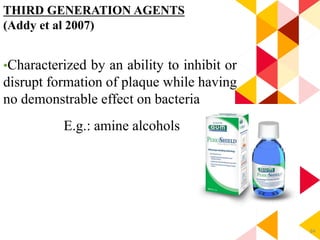
THIRD GENERATION AGENTS
(Addy et al 2007)
โ€ขCharacterized by an ability to inhibit or
disrupt formation of plaque while having
no demonstrable effect on bacteria
E.g.: amine alcohols
85
AMINE ALCOHOLS
do not truly fit into antimicrobial/ antiseptic
category
โ€ข Low surface tension and lipophillic, hydrophilic
property can affect plaque growth without affecting
ecological balance
โ€ขOctopinol - first to be
shown effective as
antiplaque agent โ€“
โ€ขwithdrawn for toxicological
reasons
Delmopinol at 0.1% & 0.2% mouth
rinses โ€“ shown to be effective against
plaque & gingivitis in short term
long term home use studies.
(Collaert et al 1992, Claydon et al
1996, Hase et al 1998, Lang et al
1998)
86
Side effects:
Tooth discoloration - less and easily removed
Transient numbness of tongue
Burning sensations in mouth (Claydon et al 1996,
Hase et al 1998, Lang et al 1998)
Positive facts
โ€ข Effectiveness of delmopinol, coupled with its
qualitatively and quantitatively greatly reduced
potential for tooth staining compared with
chlorhexidine (Lang et al. 1998) makes this
compound potentially an attractive alternative to
chlorhexidine for plaque control.
87
OTHERS:
SALIFLUOR:
A salicylanide with both antibacterial and anti-inflammatory
properties.
โ€ข Studied for its effects of plaque inhibition and retardation of
onset of gingivitis (Furuichi et al. 1996).
โ€ข Initial 4 day plaque regrowth studies & 14- day gingivitis
studies have suggested equivalent efficacy to 0.12%
chlorhexidine mouth rinse (Furuichi et al. 1996)
โ€ข Despite this โ€“ long term studies yet to be carried out
88
ACIDIFIED SODIUM
CHLORITE
โ€ข Yates et al 1997
โ€ข Sodium chlorite is reacted with acid to produce
chlorous acid,
which then liberates oxidant species which has
antimicrobial benefits.
105 experimental formulations shown to be as good
as chlorhexidine against plaque regrowth and
showed same substantivity.
โ€ข Side effects: Low pH of formulations cause dental
erosion
โ€ข To date no commercial products are available
89
ENZYMES:
1st group โ€“ not truly antimicrobial agents, more
plaque removal agents- potential to disrupt early
plaque matrix, dislodge bacteria from the tooth
surface.
โ€ข In late 1960s & early 1970s โ€“
dextranase, mutanase & various proteases โ€“
thought major breakthrough in dental plaque
control
โ€ข
Had poor substantivity & unpleasant local side
effects like mucosal erosion .
90
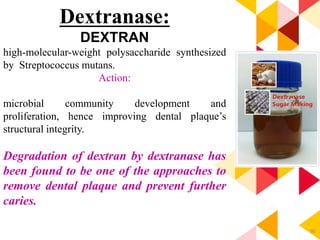
Dextranase:
DEXTRAN
high-molecular-weight polysaccharide synthesized
by Streptococcus mutans.
Action:
microbial community development and
proliferation, hence improving dental plaqueโ€™s
structural integrity.
Degradation of dextran by dextranase has
been found to be one of the approaches to
remove dental plaque and prevent further
caries.
91
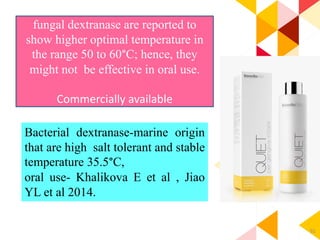
Bacterial dextranase-marine origin
that are high salt tolerant and stable
temperature 35.5ยฐC,
oral use- Khalikova E et al , Jiao
YL et al 2014.
fungal dextranase are reported to
show higher optimal temperature in
the range 50 to 60ยฐC; hence, they
might not be effective in oral use.
Commercially available
92
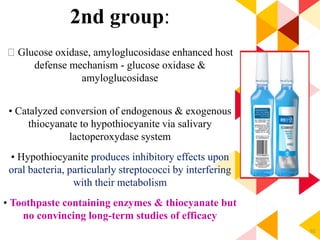
2nd group:
Glucose oxidase, amyloglucosidase enhanced host
defense mechanism - glucose oxidase &
amyloglucosidase
โ€ข Catalyzed conversion of endogenous & exogenous
thiocyanate to hypothiocyanite via salivary
lactoperoxydase system
โ€ข Hypothiocyanite produces inhibitory effects upon
oral bacteria, particularly streptococci by interfering
with their metabolism
โ€ข Toothpaste containing enzymes & thiocyanate but
no convincing long-term studies of efficacy
93
OXYGENATING
AGENTS:
Disinfectants - Hydrogen peroxide โ€“
supragingival plaque control.
Peroxyborate โ€“ acute ulcerative gingivitis.
(Wade 1966)
cleansing action- effervescence
Undesirable tissue changes
94
POVIDONE IODINE:
1811, Bernard Courtois โ€“ Iodine
1880, Devaine โ€“ Bactericidal efficacy
Late 1960s โ€“ Povidone iodine
Mechanism:
affinity for the cell membrane, thereby delivering
free iodine directly to the bacterial cell surface.
It has a broad spectrum of activity against bacteria,
fungi, protozoa, and viruses.
95
The mouthwash has been shown to be effective in
reducing plaque and gingivitis and may be a useful
adjunct to routine oral hygiene.
Absorption of significant levels of iodine through the
oral mucosa may make this compound unsatisfactory for
prolonged use in the oral cavity-Fergusson et al.
Side effects
Staining teeth/ tissues
Thyroid dysfunction
Allergic to iodine
Pregnant & lactating mother
96
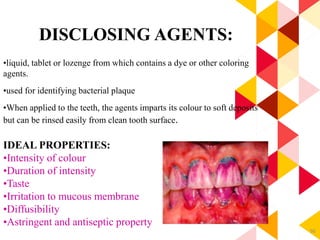
DISCLOSING AGENTS:
โ€ขliquid, tablet or lozenge from which contains a dye or other coloring
agents.
โ€ขused for identifying bacterial plaque
โ€ขWhen applied to the teeth, the agents imparts its colour to soft deposits
but can be rinsed easily from clean tooth surface.
IDEAL PROPERTIES:
โ€ขIntensity of colour
โ€ขDuration of intensity
โ€ขTaste
โ€ขIrritation to mucous membrane
โ€ขDiffusibility
โ€ขAstringent and antiseptic property
97
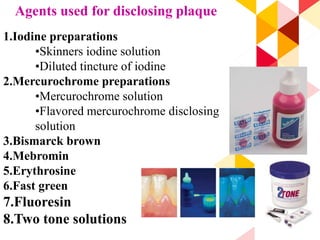
Agents used for disclosing plaque
1.Iodine preparations
โ€ขSkinners iodine solution
โ€ขDiluted tincture of iodine
2.Mercurochrome preparations
โ€ขMercurochrome solution
โ€ขFlavored mercurochrome disclosing
solution
3.Bismarck brown
4.Mebromin
5.Erythrosine
6.Fast green
7.Fluoresin
8.Two tone solutions
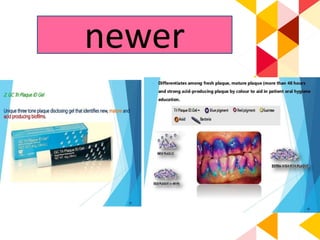
newer
100
101
.
.
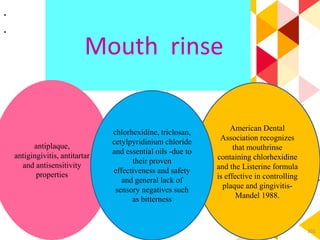
Mouth rinse
antiplaque,
antigingivitis, antitartar
and antisensitivity
properties
American Dental
Association recognizes
that mouthrinse
containing chlorhexidine
and the Listerine formula
is effective in controlling
plaque and gingivitis-
Mandel 1988.
chlorhexidine, triclosan,
cetylpyridinium chloride
and essential oils -due to
their proven
effectiveness and safety
and general lack of
sensory negatives such
as bitterness
102
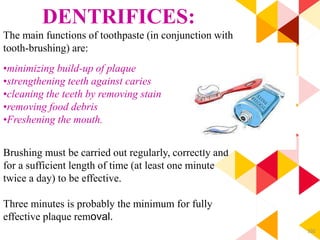
DENTRIFICES:
The main functions of toothpaste (in conjunction with
tooth-brushing) are:
โ€ขminimizing build-up of plaque
โ€ขstrengthening teeth against caries
โ€ขcleaning the teeth by removing stain
โ€ขremoving food debris
โ€ขFreshening the mouth.
Brushing must be carried out regularly, correctly and
for a sufficient length of time (at least one minute
twice a day) to be effective.
Three minutes is probably the minimum for fully
effective plaque removal.
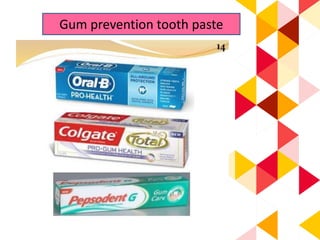
Gum prevention tooth paste
104
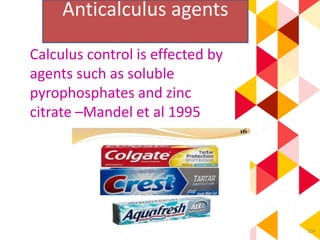
Anticalculus agents
Calculus control is effected by
agents such as soluble
pyrophosphates and zinc
citrate โ€“Mandel et al 1995
105
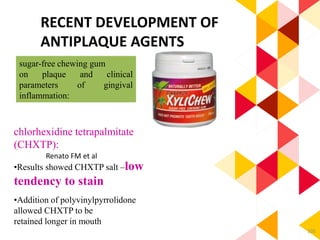
RECENT DEVELOPMENT OF
ANTIPLAQUE AGENTS
sugar-free chewing gum
on plaque and clinical
parameters of gingival
inflammation:
chlorhexidine tetrapalmitate
(CHXTP):
โ€ขResults showed CHXTP salt โ€“low
tendency to stain
โ€ขAddition of polyvinylpyrrolidone
allowed CHXTP to be
retained longer in mouth
Renato FM et al
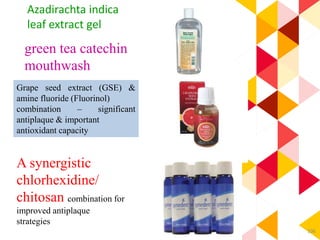
106
green tea catechin
mouthwash
Grape seed extract (GSE) &
amine fluoride (Fluorinol)
combination โ€“ significant
antiplaque & important
antioxidant capacity
A synergistic
chlorhexidine/
chitosan combination for
improved antiplaque
strategies
Azadirachta indica
leaf extract gel
107
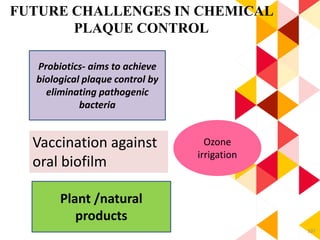
FUTURE CHALLENGES IN CHEMICAL
PLAQUE CONTROL
Probiotics- aims to achieve
biological plaque control by
eliminating pathogenic
bacteria
Vaccination against
oral biofilm
Plant /natural
products
Ozone
irrigation
108
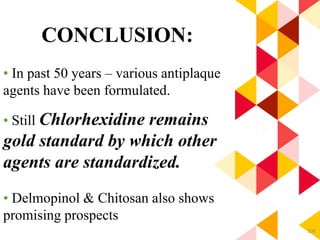
CONCLUSION:
โ€ข In past 50 years โ€“ various antiplaque
agents have been formulated.
โ€ข Still Chlorhexidine remains
gold standard by which other
agents are standardized.
โ€ข Delmopinol & Chitosan also shows
promising prospects
109
Home message
Chlorhexidine
Addy et al
substantivity
110
1. Carranzaโ€™s clinical periodontology 8th, 9th, 10th ,11 thedition
2. Jan Lindhe Clinical periodontology & Implant dentistry 5th
edition
3. Renato FM, Lorena B, Natalia SJ, Antonio CP, Marcos AC,
Magali M, Man CC. A nonstaining and tasteless hydrophobic
salt of chlorhexidine. Journal of pharmaceutical sciences. 2011
Aug;100(8):3130-38.
4. Addy.M. Clinical indications for use of chemical plaque control
agents. Periodontology 2000, Vol. 15, , 52- 54 128.
5. Yates R, Jenkins S, Newcombe R, Wade W, Moran J, Addy M. A
6-month home usage trial of a 1% chlorhexidine toothpaste. J
Clin Periodontol. 1993; 20:130-8.
6. Mohammed HN, MortezaT, Majid RM, Ali F, Fateme F, Mona
M et al. Comparative study of 0.2% and 0.12% digluconate
chlorhexidine mouth rinses on the level of dental staining and
gingival indices. Dent Res J (Isfahan). 2012 May-Jun; 9: 305-8.
References
111
โ€ขHase JC, Attstrom R, Edwardsson S, Kelty E, Kisch J. 6- month use of
0.2% delmopinol hydrochloride in comparison with 0.2% chlorhexidine
digluconate and placebo. J Clin Periodontol. 1998;25:746-53.
โ€ขM Raveendra Pai, Leelavathi D Acharya, N Udupa. Evaluation of
antiplaque activity of Azadirachta indica leaf extract gel โ€“ a 6-week clinical
study. Journal of Ethnopharmacology. 2004 Jan;90:99-103.
โ€ขEM Decker, C Von Ohle, R Weiger, I Wiech, M Brecx. A synergistic
chlorhexidine/ chitosan combination for improved antiplaque strategies.
Journal of Periodontal Research. 2005 Oct;40(5):373-7.
โ€ขPC Baehni, Y Takeuchi. Anti-plaque agents in the prevention of biofilm-
associated oral diseases. Oral Diseases. 2003 Jun;9(s1):23-29.
โ€ขJM Tanzer, AM Slee, B Kamay, ER Scheer. In vitro evaluation of three
iodine-containing compounds as antiplaque agents. Antimicrobial agents
and chemotherapy. 1977 July;12:107-13.
โ€ขKaur H, Jain S, Kaur A. Comparative evaluation of the antiplaque
effectiveness of green tea catechin mouthwash with chlorhexidine
gluconate. J Indian Soc Periodontol. 2014 Mar-Apr;18(2):178-82
โ€ขAddy M, Moran J, Newcombe RG. Meta-analyses of studies of 0.2%
delmopinol mouth rinse as an adjunct to gingival health and plaque control
measures. J Clin Periodontol 2007; 34: 58โ€“65
โ€ขJones.C.Chlorhexidine:is it still the gold standard? Periodontology 2000,
Vol. 15, 1997, 55-62.
112

Chemical plaque control

  • 1.
  • 2.
    2 content ๏‚ทIntroduction ๏‚ทConcept of chemicalplaque control ๏‚ทHistory ๏‚ทRationale of Antiplaque agents ๏‚ทApproaches to Antiplaque agents ๏‚ทMethods to evaluate Antiplaque agents ๏‚ทIdeal properties of Antiplaque agents ๏‚ทGroups of agents used in antiplaque agents ๏‚ทRecent advances ๏‚ทFuture trends ๏‚ทConclusions ๏‚ทReferences
  • 3.
    3 INTRODUCTION: Chemical plaque control definitiveedge over mechanical plaque control, in that access to the areas beyond the preview of mechanical plaque control therapy provides an effective plaque control.
  • 4.
  • 5.
  • 6.
    6 The formation ofplaque on a tooth surface is a dynamic and ordered process, commencing with the attachment of primary plaque-forming bacteria. The attachment of these organisms appears essential for initiating the sequence of attachment of other organisms such that, with time, the mass and complexity of the plaque increases. Plaque control, which prevents plaque achieving the critical point where gingival health deteriorates, will stop gingivitis. Plaque inhibition has, therefore, targeted plaque formation at particular points โ€“ bacterial attachment, bacterial proliferation, and plaque maturation.
  • 7.
  • 8.
    8 โ€ขThe terminology โ€œoralhygiene productsโ€ is recent โ€ข6000 years, that formulation and recipes existed to benefit oral and dental health (Fischman 1997). โ€ขEbers Papyrus 1500 BC -recipes for tooth powders and mouth rinses โ€ขAlcohol-based mouth rinses -the Romans and included white wine and beer. โ€ขUrine, as a mouth rinse โ€ขUse of stale urine- Cantabri and others in Spain โ€ขUse of fresh urine-Fauchard (1670-1761) of France.
  • 9.
    9 19 th centuries: โ€ขUseof essential oils in the form of mouth rinse, later with addition of antimicrobial or antiseptics agents to the tooth paste and mouth rinse developed.
  • 10.
  • 11.
  • 12.
    12 The concept ofchemical plaque control may be justified overcoming inadequacies of mechanical cleaning.
  • 13.
  • 14.
    14 Mechanical cleaning aimsto regularly remove sufficient microorganisms to leave a โ€œhealthy plaqueโ€ present, which cannot induce gingival inflammation. Chemical agents, on the other hand, could influence plaque control quantitatively and qualitatively. .
  • 15.
    15 The action ofthe chemicals could fit into four categories: 1. Antiadhesive 2. Antimicrobial 3. Plaque removal 4. Antipathogenic.
  • 16.
    16 Antiadhesive act at thepellicle surface to prevent the initial attachment of the primary plaque-forming bacteria. โ€ขprevent the attachment and development of a variety of biofilms and are usually described as antifouling agents. โ€ขPrevention of extrinsic stain. Toxic Not under research
  • 17.
    17 Antimicrobial inhibition of bacterialattachment and bacterial proliferation/division.
  • 18.
    18 Plaque removal act inan identical manner to a toothbrush and remove bacteria from the tooth surface, is an attractive proposition. โ€œthe chemical toothbrushโ€. Contained in mouthrinse,dentifices etc Very effective
  • 19.
    19 Antipathogenic. agent could havean effect on plaque microorganisms, which might inhibit the expression of their pathogencity without necessarily destroying the microorganisms- Cummins 1992 I.e. alter the pathogeniticity of plaque.
  • 20.
    20 METHODS IN VITROOR IN VIVO TO EVALUATE ORAL HYGIENE PRODUCTS:
  • 21.
    21 ANTIMICROBIAL TESTS : โ€ขmeasuresof minimum inhibitory concentration โ€ขand kill curves using bacterial strains or fresh isolates Factors considered: โ€ขUnless the active agent has a peculiar profile for certain bacteria, the detergent effect may hide the activity of the active ingredient. โ€ขSubstantivity appears to be a crucial property of effective antimicrobial antiplaque agents.
  • 22.
    22 Other in vitrotests: ๏ถStain removal, ๏ถdetrimental actions, such as abrasivity. Probably as a function of pH some types of mouth rinse and toothpaste have the potential to erode tooth tissue- Addy et al. Stain control is perhaps more easily modeled, particularly using forced staining methods involving chlorhexidine - Addy et al in 1991 evidence
  • 23.
    23 In vivo method: Parallel,randomized control method to be done
  • 24.
    24 Clinical significance canbe assessed as follows: Benchmark efficacy: -effect similar to other established products; Positive efficacy: -effect similar to or greater than the most effective formulation to date; Disease efficacy: effect on a causative factor that reduces a disease or condition; Proportional efficacy: achieving a previously agreed proportional reduction in a parameter compared with control.
  • 25.
    25 A major featureof scientific research, particularly in clinical trials, is the use of controls Placebo control: one without any expected activity against the condition under investigation; Minus active ingredient control: one that is identical to the test product or formulation without the active agent or agents; Benchmark control: a product already in use by the public or an agent already evaluated; and Positive control: an accepted effective formulation or the most effective formulation available to date
  • 26.
    26 Among plaque controlagents, chlorhexidine has tended to be considered a positive control or gold standard by which to compare other chemicals- Addy et al and Kornman 1986.
  • 27.
    27 IDEAL PROPERTIES OFANTIPLAQUE AGENTS: Elimination of pathogenic bacteria prevent development of resistant bacteria exhibit substantivity safety reduction in plaque and gingivitis no staining or alteration of taste easy to use and inexpensive no systemic effect
  • 28.
    28 CRITERIA FOR USAGEOF ANTIMICROBIALS: Substantivity: The ability of an agent to be bound to the pellicle and tooth surface and to be released over an extended period of time with the retention of its potency. Stability: chemical breakdown or modification may occur during storage, especially at elevated temperatures. Penetrability: For a drug to be effective, it must be able to penetrate deep into the formed plaque matrix. Toxic safety: any agent used for prevention or treatment of oral diseases must have low toxicity.
  • 29.
  • 30.
    30 Antibiotics: penicillin, vancomycin Enzymes:proteases, lipase, dextranase Bisbiguanides: chlorhexidine, alexidine Quaternary ammonium compounds: cetylpyridinium chloride, benzalkonium chloride Phenols and essential oils: thymol, triclosan Natural products: sanguinarine Fluorides: sodium fluoride, stannous F Metal salts: tin, zinc, copper Oxygenating agents: Hydrogen peroxide Detergents: sodium lauryl sulfate Amine alcohols: octapinol, delmopinol.
  • 31.
  • 32.
  • 33.
    33 CHEMICAL PLAQUE CONTROL AGENTS FIRSTGENERATION Eg: antibiotics, phenol,quarternary ammonium compounds & sanguinarine SECOND GENERATION Eg: Bisbiguanides,(chlorhexidine) THIRD GENERATION Eg: delmopinol
  • 34.
    34 FIRST GENERATION AGENTS: โ€ข1st generation:decreases plaque scores by 20-50%, โ€ข but efficacy is decreased by poor retention in the mouth. โ€ขE.g. antibiotics, phenols etc.
  • 35.
    PHENOLS AND ESSENTIAL OIL: ๏‚ทplaque inhibitory ๏‚ทanti-inflammatoryaction โ€ข anti oxidative activity (Firalti et al al 1994) exert non specific antibacterial action dependent upon ability of drug to penetrate lipid component of cell walls of gram negative bacteria inhibit neutrophil chemotaxis, generation of neutrophil superoxide ion and production of prostaglandin synthetase- Charles et al 2004.
  • 36.
    36 Positive facts 6 monthstudy - Compared with CHX โ€“ demonstrated equivalent effects on plaque & gingivitis without inherent side effects of chx. Because of low pH of product (4.3) โ€“ in vitro & in situ โ€“ erosion of dentine & enamel but less than orange juice (Addy et al 1991, Pontefract et al 2001). Phenolic compounds are also known to act as scavengers of oxygen-free-radicals (Kuehl et al) Goodson (1985) has recently pointed out that most phenolic compounds have anti- inflammatory and prostaglandin synthetase inhibitor activity which can occur at concentration lower than that for antibacterial activity. Combining essential oils with CPC attempted โ€“ promising results (Hunter et al 1994).
  • 37.
    37 TRICLOSAN โ€ขPhenol derivative โ€“employedby Lister in 1867 (Eley 1998) โ€ขIs synthetic and ionic โ€ขUsed as a topical antimicrobial agent โ€ขBroad spectrum of action including both gram positive and gram negative bacteria โ€ขIt also includes mycobacterium spores and Candida species.
  • 38.
    38 Mechanism of action: Triclosan Acton cytoplasmic membrane Induce leakage of cellular constitutes Bacteriolysis and cell death
  • 39.
    39 AVAILABILITY tooth paste andmouthrinse Concentrations (0.2%) and dose (20 mg twice per day), triclosan has moderate plaque-inhibitory action and antimicrobial substantivity of around 5 hours (Jenkins et al. 1991) Listerine is an over the counter phenol preparation containing thymol, eucalyptol, methyl salicylate, benzoic acid and boric acid in hydro alcoholic vehicle Some patients find an initial burning sensation and bitter taste, occasional straining is evident Become the first over-the-counter mouth rinse to be accepted by the Council of Dental Therapeutics for its help in controlling plaque and gingivitis.
  • 40.
    40 Ciancio et aldemonstrated the value of twice-daily use in the maintenance of dental implants compared with a control mouth rinse. Ciancio has further reported that use of an essential oil mouthwash as a subgingival irrigation prior to scaling greatly reduced anaerobic and aerobic bacterial populations associated with bacteremia and that pre-procedural rinsing The favorable results for a mouth rinse containing phenolic essential oils at inhibiting plaque and reducing gingival inflammation have more recently led to its evaluation for use as a post-surgical rinse- Laspia et al
  • 41.
    41 . Zinc salts: โ€ขplaque inhibitorwas first described by Hanke in 1940 โ€ขAstringent โ€ขZinc citrate has been combined with ionic antimicrobial triclosan in toothpaste form, โ€ขsignificant anticalculus activity. โ€ขZinc salts may be of value at reducing volatile sulfu compounds associated with oral malodor (Rosing et al 2002). METALLIC IONS
  • 42.
    42 Tin salts: โ€ข Inhibitplaque formation โ€ขSvatun et al 1977 showed mechanism of action of tin is through their ability to bind to teichoic acid present on cell wall of gram positive organisms changing surface charge causing decreased adsorption of cells to teeth.
  • 43.
    43 Disadvantage of metalsalts: โ€ขMetallic taste โ€ขDryness of mouth โ€ขYellowish brown discoloration of teeth and tongue Stannous fluoride mouth rinses: โ€ขDifficult to formulate โ€“ stability problems โ€“ hydrolysis in presence of water anhydrous gel & toothpaste (Beiswanger et al 1995, Perlich et al 1995) โ€ขHuman studies confirmed that antibacterial action of stannous fluoride was more due to tin ions although they have synergistic effect (Andreas et al 1974).
  • 44.
    44 3. QUARTERNARYAMMONIUM COMPOUNDS โ€ขCationic antiseptics& surface active agents โ€ขEffective against gram positive organisms Mechanism of action โ€ขPositively charged molecule reacts with negatively charged cell membrane phosphates and thereby disrupts the bacterial cell wall structure E.g.: Benzanthonium chloride, Benzalleonium chloride and cetylpyridinium chloride.
  • 45.
    4 5 CETYLPYRIDINIUMCHLORIDE (CPC): โ€ขused asagents for plaque inhibition cationic โ€ขCPC at 0.05% conc used in wide variety of antiseptic mouth rinse products. Substantivity of cetylpyridinium chloride is only 3โ€“ 5 hours (Roberts & Addy 1981). Efficacy of CPC โ€“ increased by doubling frequency of rinsing to 4 times per day (Bonsvoll & Gjermo 1978) โ€“ increased side effects & affect compliance
  • 46.
    46 Side effects: โ€ขBrownish discolorationof teeth โ€ขRecurrent apthous type ulceration of oral mucosa. โ€ขMouth rinses combining CPC with CHX โ€“ studies done โ€“ compare well with CHX (Quirynen et al 2001, 2005) โ€“ cannot be assessed โ€“ whether CPC actually contributes to activity of chx โ€ขSlow release system & lozenges to deliver cps โ€“ no greater plaque inhibition than CPC rinse & significantly < chx rinse (Vanderkerchove et al 1995).
  • 47.
  • 48.
    48 SANGUINARINE: benzophenanthredine alkaloid derivedfrom Sanguinaria Canadensis. It is most effective against gram โ€“ve organisms Properties: โ€ขUsed in mouth rinse โ€ขAdverse effects: โ€ขMouth rinses shown to increase likelihood of oral precancerous lesions ten-fold even after cessation of use
  • 49.
    49 โ€ขTopically delivered teatree oil - suggested to be of value in reducing gingival inflammation (Sookoulis & Hirsch 2004).
  • 50.
    50 PROPOLIS โ€ขnatural resinous materialproduced by honey bees โ€ขMore than 300 components have been found in propolis, mainly composed of phenolic compounds (e.g., flavonoids, aromatic compounds), terpenes, and essential oil. Flavonoids and cinnamic acid. โ€ขantimicrobial properties, โ€ขthe use of it as โ€ข a mouthwash is questionable- โ€ขMurray et al 1997.
  • 51.
    51 LIPPIA SIDOIDES โ€ขmouthwash โ€ขnortheast ofBrazil. โ€ขas a topical antiseptic agent for skin and mucosa surface and also for throat infections. โ€ขessential oil -thymol and carvacrol and other substances, such as felandreno, cariofileno, p-cimeno, and mirceno. โ€ขStudies indicated that these major components had shown potent antimicrobial activity against fungi and bacteria and reduced the severity of gingivitis and bacterial plaque- Rodrigues IS et al.
  • 52.
    52 ALOE VERA EXTRACT โ€ขAloevera gel consists of 98 to 99% water and the remaining 1 to 2% of active compounds. โ€ขaloin, aloeemodin, aloemannan, acemannan, aloeride, naftoquinones, methylchromones, flavonoids, saponin, sterols, amino acids, and vitamins. โ€ข A randomized controlled study using 100% aloe vera extract showed significant reduction in plaque formation with no reported side effects. โ€ขThe antimicrobial effect of aloe vera has been demonstrated earlier in an in vitro study.
  • 53.
  • 54.
    54 โ€ขDue to bacterialresistance problems the use of antibiotics has been reduced. โ€ขDespite evidence for efficacy โ€“ systemic antimicrobials used in past (as topical/ systemic) are Penicillin, Vancomycin, Erythromycin) for preventing caries & gingivitis. โ€ขNot be used as preventive agents. โ€ขRisk-to-benefit ratio is high (Slots & Rams 1990; Addy & Martin 2003).
  • 55.
    55 SECOND GENERATION AGENTS: โ€ข Moreeffectively retained by oral tissues and slow release properties provide reduction in plaque scores between 70 and 90% โ€ข E.g.: Bisbiguanides.
  • 56.
    56 BISBIGUANIDES โ€ขConsidered to mosteffective antiplaque agents. โ€ขSecond generation agents โ€ขexhibiting substantivity โ€ขbroad antimicrobial properties.
  • 57.
    57 CHLORHEXIDINE the gold standard. Developedin 1940s by Imperial Chemical Industries England - marketed in 1954 โ€“ as antiseptic for skin wounds. Available in 3 forms: โ€ขdigluconate, โ€ขacetate & โ€ขhydrochloride salts
  • 58.
    58 Structure: โ€ขSymmetrical molecule โ€ข Fourchlorophenyl rings & two biguanide groups connected by central hexamethylene bridge. โ€ข Compound is strong base & dicationic > pH 3.5, with two positive charges on either side of hexamethylene bridge .
  • 59.
  • 60.
    60 Antimicrobial Bacteriostatic At low concentration Bacteriocidal At highconcentration Bacterial cell wall (-ve charge) Reacts with +ve charged chlorhexidine molecule CHX binds to inner membrane phospholipids & increase permeability Vital elements leak out & this effect is reversible
  • 62.
    62 ANTI PLAQUE ACTION: Rolla& Melsen postulated it prevents formation of acquired pellicle. Blocks the acidic group of salivary glycoproteinโ€™s which reduces their adsorption to hydroxyapatite. Reduces the ability of bacteria to bind to tooth surface. Adsorption of CHX to bacterial capsule or glycocalyx and prevents them binding on to tooth surface. CHX competes for Ca ions which are required for agglutination of plaque.
  • 63.
    63 โ€ขCHX due toits dicationic nature binds to enamel pellicle or tooth surface and salivary proteins. โ€ขThis adsorbed CHX is released of a period of time. Substantivity โ€ขBinds different surfaces within the mouth (teeth and mucosa) and also to the pellicle and saliva; โ€ขfor example, after a single rinse with chlorhexidine, the saliva itself exhibits antibacterial activity for up to 5 hours, whereas persistence at the oral surfaces has been shown to suppress salivary bacterial counts for over 12 hours
  • 64.
    64 Metabolism: โ€ข Does notpenetrate oral epithelium (Lindhe et al 1970). โ€ข If accidentally swallowed โ€“ bind to mucosal surface of alimentary canal - is poorly absorbed & all of swallowed dose excreted in feces.
  • 65.
    65 Oral retention ofchlorhexidine: clinical data โ€ขEfficacy with respect to other drugs. โ€ขpersistent bacteriostatic action lasting > 12 hours (Schiott et al 1970) โ€ขWhen mouth rinse of 10 ml of 0.2% chlorhexidine is done for 1 min app- 30% drug is retained in mouth (Gjermo 1975). โ€ขReasons: โ€ขRadio-labeled studies suggest slow release of antiseptic from surfaces (Bonesvoll et al. 1974) (Gjermo et al. 1974) Calcium ions from saliva are able to displace it from binding sites
  • 66.
    66 Optimizing use ofchlorhexidine: โ€ขDoes not distinguish between bacterial protein & other proteins found within mature plaque so extraneous protein must first be removed professionally. โ€ขPrevents plaque formation; its mode of action does not allow it to remove plaque efficiently. โ€ขMay react with anionic surfactants present in formulations reducing its activity. โ€ขShould not be used before/ immediately after toothpaste; interaction anionic surfactants will reduce effective delivery to tooth surface in active form
  • 67.
    67 ADVERSE EFFECTS OF CHLORHEXIDINE:- Flotraet al. 1971 1. Brown discoloration of teeth & some restorative materials & dorsum of tongue. Occurs with all products โ€“ rinse, gel, toothpastes, sprays (Erikson et al 1985, Addy & Moran 1995, Watts & Addy 2001)
  • 68.
    68 Proposed mechanisms for chlorhexidinestaining: โ€ขDegradation of CHX molecule to release parachloraniline. โ€ขCatalysis of Maillard reactions. โ€ขProtein denaturation with metal sulfide formation. โ€ขPrecipitation of anionic dietary chromogens splitting sulphide bridges to produce free sulpydryl groups , latter then reacts with iron or tin ions to produce brown and yellow pigmented products (Ellingsten et al 1882) โ€ขChlorhexidine reacts with ketones and aldehydes in dietary breakdown or intermediary products to form insoluble colored compounds ( Nordho 1971)
  • 69.
    69 Anti-discoloration system (ADS) ๏ฑ waslaunched=Europe A clinical study supporting to show reduced staining had significant drawbacks in design and presentation (Bernadi et al. 2004). A laboratory study found no difference in staining potential (Addy et al. 2005).
  • 70.
    70 Plaque regrowth studyshowed significantly reduced plaque inhibition for the ADS rinse (Arweiler et al. 2006). โ€œIf it does not stain it does not workโ€.
  • 71.
    71 Taste perturbation wheresalt taste appears to be affected (Lang et al. 1988).
  • 72.
    72 Oral mucosal erosion- idiosyncratic reaction and concentration dependent. Dilution of 0.2% formulation to 0.1%, but rinsing with whole volume to maintain dose, usually alleviates problem. Erosions are rarely seen with 0.12% rinse products used at 15 ml volume. ISP 2012
  • 73.
    73 Unilateral or bilateralparotid swelling extremely rare - negative pressure & aspiration into duct.
  • 74.
    74 Enhanced supragingival calculusformation โ€“ may be due to precipitation of salivary proteins on to tooth surface โ€“ increasing pellicle thickness &/or precipitation of inorganic salts on to or into pellicle layer
  • 75.
    75 CHLORHEXIDINE PRODUCTS โ€ขMode of deliveryof CHX: โ€ข mouth rinse, gels, tooth paste, dental floss, and tooth picks.
  • 76.
    76 Mouth rinses: โ€ข Aqueoussolutions of 0.2% chlorhexidine โ€“ โ€ขtwice daily rinse in Europe in 1970s โ€ข 0.1% - less efficacious (Jenkins et al 1989). โ€ข In US - 0.12% - but to maintain optimum 20 mg doses derived from 10 ml of 0.2% rinses - recommended as 15 ml rinse (18 mg dose). โ€ข Segreto et al 1986 reported equal efficacy for 0.2% & 0.12% rinses when used at appropriate similar doses 0.2% 0.12% 0.05%
  • 77.
    77 Gel โ€ข 1% chlorhexidinegel product is available and can be delivered on a toothbrush or in trays. โ€ข Distribution by toothbrush โ€“ poor (Saxen et al 1976) โ€ข Tray delivery system - effective against plaque & gingivitis in handicapped individuals (Francis et al. 1987). โ€ข 0.2% and 0.12% chlorhexidine gels have become available
  • 78.
    78 Sprays: โ€ข 0.1% &0.2% commercially available. โ€ข Small doses of approximately 1โ€“2 mg delivered to all tooth surfaces produces similar plaque inhibition to rinse with 0.2% mouth rinses (Kalaga et al. 1989) โ€ข Useful for physically and mentally handicapped groups-Francis et al 1987, Kalaga et al 1989).
  • 79.
    79 Toothpaste: โ€ข Yates etal 1993 โ€ข Difficult to formulate into toothpaste โ€ข Variable outcomes for benefits to plaque & gingivitis โ€ข 1% chlorhexidine toothpaste with & without fluoride โ€“ found superior to control product for prevention of plaque and gingivitis in a 6- month home use study โ€ข Stain scores were increased supragingival calculus formation
  • 80.
  • 81.
    81 CLINICAL USES โ€ข Adjunctto oral hygiene & professional prophylaxis โ€ข Post oral surgery including periodontal surgery or root planing โ€ข For patients with jaw fixation โ€ข Oral hygiene and gingival health benefits in mentally & physically handicapped โ€ข Medically compromised individuals predisposed to oral infections โ€ขRemovable and fixed orthodontic appliance โ€ขRecurrent oral ulcers โ€ขDenture stomatitis โ€ขOral malodor High-risk caries patients
  • 82.
    82 PERIOCHIP (Dexcel Pharmaceuticals, Israel) orangebrown, biodegradable, rectangular chip rounded at one end that has an active ingredient of chlorhexidine gluconate (2.5 mg) that is released into the pocket over a period of 7 to 10 days. suppress the pocket flora for up to 10- 11 weeks post application. approved by the FDA as an adjunct to SRP procedures for the reduction of probing pocket depth or as part of a routine periodontal maintenance program.
  • 83.
    83 The recommendation foruse adjunctive to SRP involves isolation of the periodontal pocket of 5 mm or more. Drying the surrounding area, and grasping the Periochip with a forceps and inserting the chip into the pocket to its maximum depth The chip can be maneuvered further into position with a plastic instrument.
  • 84.
    84 THIRD GENERATION AGENTS (Addyet al 2007) โ€ขCharacterized by an ability to inhibit or disrupt formation of plaque while having no demonstrable effect on bacteria E.g.: amine alcohols
  • 85.
    85 AMINE ALCOHOLS do nottruly fit into antimicrobial/ antiseptic category โ€ข Low surface tension and lipophillic, hydrophilic property can affect plaque growth without affecting ecological balance โ€ขOctopinol - first to be shown effective as antiplaque agent โ€“ โ€ขwithdrawn for toxicological reasons Delmopinol at 0.1% & 0.2% mouth rinses โ€“ shown to be effective against plaque & gingivitis in short term long term home use studies. (Collaert et al 1992, Claydon et al 1996, Hase et al 1998, Lang et al 1998)
  • 86.
    86 Side effects: Tooth discoloration- less and easily removed Transient numbness of tongue Burning sensations in mouth (Claydon et al 1996, Hase et al 1998, Lang et al 1998) Positive facts โ€ข Effectiveness of delmopinol, coupled with its qualitatively and quantitatively greatly reduced potential for tooth staining compared with chlorhexidine (Lang et al. 1998) makes this compound potentially an attractive alternative to chlorhexidine for plaque control.
  • 87.
    87 OTHERS: SALIFLUOR: A salicylanide withboth antibacterial and anti-inflammatory properties. โ€ข Studied for its effects of plaque inhibition and retardation of onset of gingivitis (Furuichi et al. 1996). โ€ข Initial 4 day plaque regrowth studies & 14- day gingivitis studies have suggested equivalent efficacy to 0.12% chlorhexidine mouth rinse (Furuichi et al. 1996) โ€ข Despite this โ€“ long term studies yet to be carried out
  • 88.
    88 ACIDIFIED SODIUM CHLORITE โ€ข Yateset al 1997 โ€ข Sodium chlorite is reacted with acid to produce chlorous acid, which then liberates oxidant species which has antimicrobial benefits. 105 experimental formulations shown to be as good as chlorhexidine against plaque regrowth and showed same substantivity. โ€ข Side effects: Low pH of formulations cause dental erosion โ€ข To date no commercial products are available
  • 89.
    89 ENZYMES: 1st group โ€“not truly antimicrobial agents, more plaque removal agents- potential to disrupt early plaque matrix, dislodge bacteria from the tooth surface. โ€ข In late 1960s & early 1970s โ€“ dextranase, mutanase & various proteases โ€“ thought major breakthrough in dental plaque control โ€ข Had poor substantivity & unpleasant local side effects like mucosal erosion .
  • 90.
    90 Dextranase: DEXTRAN high-molecular-weight polysaccharide synthesized byStreptococcus mutans. Action: microbial community development and proliferation, hence improving dental plaqueโ€™s structural integrity. Degradation of dextran by dextranase has been found to be one of the approaches to remove dental plaque and prevent further caries.
  • 91.
    91 Bacterial dextranase-marine origin thatare high salt tolerant and stable temperature 35.5ยฐC, oral use- Khalikova E et al , Jiao YL et al 2014. fungal dextranase are reported to show higher optimal temperature in the range 50 to 60ยฐC; hence, they might not be effective in oral use. Commercially available
  • 92.
    92 2nd group: Glucose oxidase,amyloglucosidase enhanced host defense mechanism - glucose oxidase & amyloglucosidase โ€ข Catalyzed conversion of endogenous & exogenous thiocyanate to hypothiocyanite via salivary lactoperoxydase system โ€ข Hypothiocyanite produces inhibitory effects upon oral bacteria, particularly streptococci by interfering with their metabolism โ€ข Toothpaste containing enzymes & thiocyanate but no convincing long-term studies of efficacy
  • 93.
    93 OXYGENATING AGENTS: Disinfectants - Hydrogenperoxide โ€“ supragingival plaque control. Peroxyborate โ€“ acute ulcerative gingivitis. (Wade 1966) cleansing action- effervescence Undesirable tissue changes
  • 94.
    94 POVIDONE IODINE: 1811, BernardCourtois โ€“ Iodine 1880, Devaine โ€“ Bactericidal efficacy Late 1960s โ€“ Povidone iodine Mechanism: affinity for the cell membrane, thereby delivering free iodine directly to the bacterial cell surface. It has a broad spectrum of activity against bacteria, fungi, protozoa, and viruses.
  • 95.
    95 The mouthwash hasbeen shown to be effective in reducing plaque and gingivitis and may be a useful adjunct to routine oral hygiene. Absorption of significant levels of iodine through the oral mucosa may make this compound unsatisfactory for prolonged use in the oral cavity-Fergusson et al. Side effects Staining teeth/ tissues Thyroid dysfunction Allergic to iodine Pregnant & lactating mother
  • 96.
    96 DISCLOSING AGENTS: โ€ขliquid, tabletor lozenge from which contains a dye or other coloring agents. โ€ขused for identifying bacterial plaque โ€ขWhen applied to the teeth, the agents imparts its colour to soft deposits but can be rinsed easily from clean tooth surface. IDEAL PROPERTIES: โ€ขIntensity of colour โ€ขDuration of intensity โ€ขTaste โ€ขIrritation to mucous membrane โ€ขDiffusibility โ€ขAstringent and antiseptic property
  • 97.
    97 Agents used fordisclosing plaque 1.Iodine preparations โ€ขSkinners iodine solution โ€ขDiluted tincture of iodine 2.Mercurochrome preparations โ€ขMercurochrome solution โ€ขFlavored mercurochrome disclosing solution 3.Bismarck brown 4.Mebromin 5.Erythrosine 6.Fast green 7.Fluoresin 8.Two tone solutions
  • 98.
  • 100.
  • 101.
    101 . . Mouth rinse antiplaque, antigingivitis, antitartar andantisensitivity properties American Dental Association recognizes that mouthrinse containing chlorhexidine and the Listerine formula is effective in controlling plaque and gingivitis- Mandel 1988. chlorhexidine, triclosan, cetylpyridinium chloride and essential oils -due to their proven effectiveness and safety and general lack of sensory negatives such as bitterness
  • 102.
    102 DENTRIFICES: The main functionsof toothpaste (in conjunction with tooth-brushing) are: โ€ขminimizing build-up of plaque โ€ขstrengthening teeth against caries โ€ขcleaning the teeth by removing stain โ€ขremoving food debris โ€ขFreshening the mouth. Brushing must be carried out regularly, correctly and for a sufficient length of time (at least one minute twice a day) to be effective. Three minutes is probably the minimum for fully effective plaque removal.
  • 103.
  • 104.
    104 Anticalculus agents Calculus controlis effected by agents such as soluble pyrophosphates and zinc citrate โ€“Mandel et al 1995
  • 105.
    105 RECENT DEVELOPMENT OF ANTIPLAQUEAGENTS sugar-free chewing gum on plaque and clinical parameters of gingival inflammation: chlorhexidine tetrapalmitate (CHXTP): โ€ขResults showed CHXTP salt โ€“low tendency to stain โ€ขAddition of polyvinylpyrrolidone allowed CHXTP to be retained longer in mouth Renato FM et al
  • 106.
    106 green tea catechin mouthwash Grapeseed extract (GSE) & amine fluoride (Fluorinol) combination โ€“ significant antiplaque & important antioxidant capacity A synergistic chlorhexidine/ chitosan combination for improved antiplaque strategies Azadirachta indica leaf extract gel
  • 107.
    107 FUTURE CHALLENGES INCHEMICAL PLAQUE CONTROL Probiotics- aims to achieve biological plaque control by eliminating pathogenic bacteria Vaccination against oral biofilm Plant /natural products Ozone irrigation
  • 108.
    108 CONCLUSION: โ€ข In past50 years โ€“ various antiplaque agents have been formulated. โ€ข Still Chlorhexidine remains gold standard by which other agents are standardized. โ€ข Delmopinol & Chitosan also shows promising prospects
  • 109.
  • 110.
    110 1. Carranzaโ€™s clinicalperiodontology 8th, 9th, 10th ,11 thedition 2. Jan Lindhe Clinical periodontology & Implant dentistry 5th edition 3. Renato FM, Lorena B, Natalia SJ, Antonio CP, Marcos AC, Magali M, Man CC. A nonstaining and tasteless hydrophobic salt of chlorhexidine. Journal of pharmaceutical sciences. 2011 Aug;100(8):3130-38. 4. Addy.M. Clinical indications for use of chemical plaque control agents. Periodontology 2000, Vol. 15, , 52- 54 128. 5. Yates R, Jenkins S, Newcombe R, Wade W, Moran J, Addy M. A 6-month home usage trial of a 1% chlorhexidine toothpaste. J Clin Periodontol. 1993; 20:130-8. 6. Mohammed HN, MortezaT, Majid RM, Ali F, Fateme F, Mona M et al. Comparative study of 0.2% and 0.12% digluconate chlorhexidine mouth rinses on the level of dental staining and gingival indices. Dent Res J (Isfahan). 2012 May-Jun; 9: 305-8. References
  • 111.
    111 โ€ขHase JC, AttstromR, Edwardsson S, Kelty E, Kisch J. 6- month use of 0.2% delmopinol hydrochloride in comparison with 0.2% chlorhexidine digluconate and placebo. J Clin Periodontol. 1998;25:746-53. โ€ขM Raveendra Pai, Leelavathi D Acharya, N Udupa. Evaluation of antiplaque activity of Azadirachta indica leaf extract gel โ€“ a 6-week clinical study. Journal of Ethnopharmacology. 2004 Jan;90:99-103. โ€ขEM Decker, C Von Ohle, R Weiger, I Wiech, M Brecx. A synergistic chlorhexidine/ chitosan combination for improved antiplaque strategies. Journal of Periodontal Research. 2005 Oct;40(5):373-7. โ€ขPC Baehni, Y Takeuchi. Anti-plaque agents in the prevention of biofilm- associated oral diseases. Oral Diseases. 2003 Jun;9(s1):23-29. โ€ขJM Tanzer, AM Slee, B Kamay, ER Scheer. In vitro evaluation of three iodine-containing compounds as antiplaque agents. Antimicrobial agents and chemotherapy. 1977 July;12:107-13. โ€ขKaur H, Jain S, Kaur A. Comparative evaluation of the antiplaque effectiveness of green tea catechin mouthwash with chlorhexidine gluconate. J Indian Soc Periodontol. 2014 Mar-Apr;18(2):178-82 โ€ขAddy M, Moran J, Newcombe RG. Meta-analyses of studies of 0.2% delmopinol mouth rinse as an adjunct to gingival health and plaque control measures. J Clin Periodontol 2007; 34: 58โ€“65 โ€ขJones.C.Chlorhexidine:is it still the gold standard? Periodontology 2000, Vol. 15, 1997, 55-62.
  • 112.