
SEMINOR ON
TYPES OF PHOSPHATIC DEPOSITION
INTRODUCTION
PHOSPATE DEPOSITS
DEPOSITIONAL ENVIRONMENT
PRODUCTION
USES
MODE OF OCCURENCE
CONCLUSION
FLORIDA PHOSPHATE DEPOSITS
OCCURRENCE IN INDIA
WORLD FAMOUS PHOSPHATIC DEPOSITS
Chemical sedimentation takes many form and produces
deposits formed in a wide range of Eh-pH composition environments,
although the basic condition of solubility contrast in low temperature
aqueous solution is common to all of them.
A clear distinction between true chemical sediments and
weathering residua is difficult to make. It is generally recognized that
most weathering profiles contain some antigenic constituents , but
these does not normally make them eligible to be classified as
chemical sediments.
INTRODUCTION
Phosphate rich sedimentary rock, or phosphorite material
containing more than 15- 20 % P2O5 and in general economic forms
on continental shelves. phosphate deposits include marine
sediments guano, and fluid enriched part of magmatic bodies
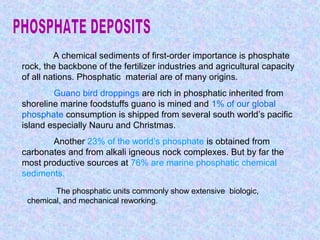
A chemical sediments of first-order importance is phosphate
rock, the backbone of the fertilizer industries and agricultural capacity
of all nations. Phosphatic material are of many origins.
Guano bird droppings are rich in phosphatic inherited from
shoreline marine foodstuffs guano is mined and 1% of our global
phosphate consumption is shipped from several south world’s pacific
island especially Nauru and Christmas.
Another 23% of the world’s phosphate is obtained from
carbonates and from alkali igneous nock complexes. But by far the
most productive sources at 76% are marine phosphatic chemical
sediments.
The phosphatic units commonly show extensive biologic,
chemical, and mechanical reworking.
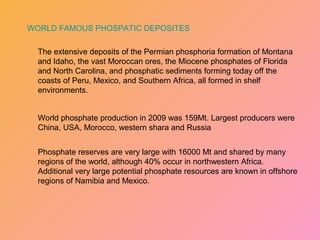
The extensive deposits of the Permian phosphoria formation of Montana
and Idaho, the vast Moroccan ores, the Miocene phosphates of Florida
and North Carolina, and phosphatic sediments forming today off the
coasts of Peru, Mexico, and Southern Africa, all formed in shelf
environments.
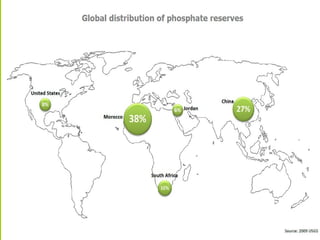
World phosphate production in 2009 was 159Mt. Largest producers were
China, USA, Morocco, western shara and Russia
Phosphate reserves are very large with 16000 Mt and shared by many
regions of the world, although 40% occur in northwestern Africa.
Additional very large potential phosphate resources are known in offshore
regions of Namibia and Mexico.
WORLD FAMOUS PHOSPATIC DEPOSITES
FLORIDA PHOSPHATE DEPOSITS
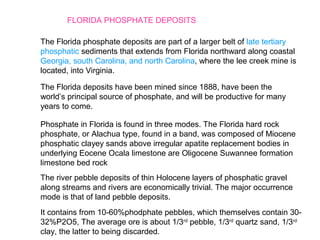
The Florida phosphate deposits are part of a larger belt of late tertiary
phosphatic sediments that extends from Florida northward along coastal
Georgia, south Carolina, and north Carolina, where the lee creek mine is
located, into Virginia.
The Florida deposits have been mined since 1888, have been the
world’s principal source of phosphate, and will be productive for many
years to come.
Phosphate in Florida is found in three modes. The Florida hard rock
phosphate, or Alachua type, found in a band, was composed of Miocene
phosphatic clayey sands above irregular apatite replacement bodies in
underlying Eocene Ocala limestone are Oligocene Suwannee formation
limestone bed rock
The river pebble deposits of thin Holocene layers of phosphatic gravel
along streams and rivers are economically trivial. The major occurrence
mode is that of land pebble deposits.
It contains from 10-60%phodphate pebbles, which themselves contain 30-
32%P2O5, The average ore is about 1/3rd
pebble, 1/3rd
quartz sand, 1/3rd
clay, the latter to being discarded.
DEPOSITIONAL ENVIRONMENTS
Phosphates are known to be deposited in a wide range of depositional
environments. Normally phosphates are deposited in very shallow, near shore
marine or low energy environments. This includes environments such as supratidal
zones, littoral or intertidal zones, and most importantly estuarine
Supratidal zones: Supratidal environments are part of the tidal flat system where
the presence of strong wave activity is nonexistent. Tidal flat systems are created
along open coasts and relatively low wave energy environments.
Littoral environments/ intertidal zones: Intertidal zones are also part of the tidal
flat system. The intertidal zone is located within the mean high and low tide levels. It
is subject to tidal shifts, which means that it is sub aerially exposed once or twice a
day.
Estuarine environments: Estuarine environments, or estuaries, are located at the
lower parts of rivers that stream into the open sea. Since they are in the seaward
section of the downed valley system they receive sediment from both marine and
fluvial sources.
Types of phosphorite
deposition
(1) Nodular phosphorites: These are spherical concentrations that are
randomly distributed along the floor of continental shelves. Most
phosphorite grains are sand size although particles greater than 2mm may
be present. These larger grains, referred to as nodules, can range up to
several tens of centimeters in size
2) Bioclastic phosphates or bone beds: Bone beds are bedded
phosphate deposits that contain concentrations of small skeletal particles
and coprolites. Some also contain invertebrate fossils like brachiopods and
become more enriched in P2O5 after digenetic processes have occurred.
Bioclastic phosphates can also be cemented by phosphate minerals.
(3) Phosphatization: Phosphatization is a type of rare digenetic
processes. It occurs when fluids that are rich in phosphate are leached
from guano. These are then concentrated and reprecipitated in
limestone. Phosphatized fossils or fragments of original phosphatic
shells are important components within some these deposits.
(2) Continental margin phosphorites: Convergent, passive,
upwelling, non-upwelling. This environment accumulates phosphorites
in the form of hardgrounds, nodules and granular beds. These
accumulate by carbonate Fluor apatite precipitation during early
diagnosis in the upper few tens of centimeters of sediment. There are
two different environmental conditions in which phosphorites are
produced within continental margins. Continental margins can consist
of organic rich sedimentation, strong coastal upwelling, and
pronounced low oxygen zones. They can also form in conditions such
as oxygen rich bottom waters and organic poor sediments.
Tectonic and oceanographic settings of marine phosphorites
1) Epeiric sea Phosphorites: Epeiric sea phosphorites are within
marine shelf environments. These are in a broad and shallow cratonic
setting. This is where granular phosphorites, phosphorite
hardgrounds, and nodules occur
(4) Insular phosphorites: Insular phosphorites are located in carbonate
islands, plateaus, coral island consisting of a reef surrounding a lagoon or,
atoll lagoon, marine lakes. The phosphorite here originates from guano.
Replacement of deep sea sediments precipitates, that has been formed in
place on the ocean floor.
3) Seamount phosphorites: These are phosphorites that occur in
seamounts, guyots, or flat topped seamounts, seamount ridges. These
phosphorous are produced in association with iron and magnesium bearing
crusts. In this setting the productivity of phosphorus is recycled within an iron
oxidation reduction phosphorus cycle. This cycle can also form glauconitic
which is normally associated with modern and ancient phosphorites.
Cont……..
Phosphorite mine near Oran, Negev, Israel. Deposits which
contain phosphate in quantity and concentration which are economic to
mine as ore for their phosphate content are not particularly common. The
two main sources for phosphate are guano, formed from bird droppings,
and rocks containing concentrations of the calcium phosphate mineral,
apatite.
Phosphate rock is mined, beneficiated, and either
solubilized to produce wet-process phosphoric acid, or smelted to produce
elemental phosphorus. Phosphoric acid is reacted with phosphate rock to
produce the fertilizer triple super phosphate or with anhydrous ammonia to
produce the ammonium phosphate fertilizers. Elemental phosphorus is the
base for furnace-grade phosphoric acid, phosphorus pent sulfide,
phosphorus pent oxide, and phosphorus trichloride. Approximately 90% of
phosphate rock production is used for fertilizer and animal feed
supplements and the balance for industrial chemicals.
China, the United States and Western Sahara are the
world's largest miners of phosphate rock, each producing about a quarter
of the total world production. Other countries with significant production
include Brazil, Russia, Jordan and Tunisia.
Production
It occurs Sitarampura area near Vizag in Andhra Pradesh with 34-36% of P2O5
in the pegmatite host rock. Here 10,50,000 tones of apatite is available .
In Bihar phosphates occurs has magnetite apatite bearing rocks in
Singhubhum district.
In Rajasthan it occurs as phosphate sandstone with 15% of P2O5 at
Udaipur district.
In Tamilnadu is famous for phosphate nodules that contains
26%P2O5.
It also occurs in Karnataka , Orissa, Uttrapradesh, etc.
For general use in the fertilizer industry, phosphate rock or its
concentrates preferably have levels of 30% phosphorus pent oxide (P2O5),
reasonable amounts of calcium carbonate (5%), and <4% combined iron and
aluminum oxides. Worldwide, the resources of high-grade ore are declining, and
the beneficiation of lower grade ores by washing, flotation and calcining is
becoming more widespread.
In addition to phosphate fertilizers for agriculture, phosphorus
from rock phosphate is also used in animal feed supplements, food preservatives,
anti-corrosion agents, cosmetics, fungicides, ceramics, water treatment and
metallurgy.
The USA is the world's leading producer and exporter of
phosphate fertilizers, accounting for about 37% of world P2O5 exports. The
world’s total economic demonstrated resource of rock phosphate is 18 Gt, which
occurs principally as sedimentary marine phosphorites.
USES OF PHASPATES
MODE OF OCCURENCE
phosphate rock or rock phosphate is a non- detrital sedimentary rock
which contains high amounts of phosphate bearing minerals. The phosphate
content of phosphorite is at least 15 to 20%, which is a large enrichment over the
typical sedimentary rock content of less than 0.2%.
The phosphate is present as Fluor apatite Ca5(PO4)3F (CFA) typically in
cryptocrystalline masses (grain sizes < 1 μm) referred to as collophane It is also
present as hydroxyapatite Ca5(PO4)3OH, which is often dissolved from
vertebrate bones and teeth, whereas Fluor apatite can originate from
hydrothermal veins
The earliest marine phosphate deposits occur in the palaeoproterozoic of
Siberia. Geological periods of enhanced phosphate deposition include the
Cambrian, Permian, late Cretaceous to Eocene and Miocene.
The increase of phosphorite with decreasing age is an effect of evolution
of life.
One of the oldest in the large deposits occur in early Paleozoic platform
sediments of the Mt.Isa region in Queensland, Australia, with resources
of greater than 2000Mt at 17%P2O5 that include 40 Mt at 31% of direct
shipping ore.
CONCLUSIONS
The process appears to be one involving upwelling of deep, cold sea
water and its long shore flow across shallow, warm, sunlit shelf
environments
The recent reports by cook and Mcelhinney(1979), riggs(1979a,b), and
howard(1979) show that phosphorites range from Precambrian to recent
in age, and that they are found on every temperate continent.
John M.Guilbert and Charles Park (1986), The geology of ore deposits,
Pp;715-719, Freeman publications
Websites;
REFERENCE:
www.geology.com
wekipedia, geology. COM
CHEMICAL SEDIMENTATION – PHOSPHATE DEPOSITS

CHEMICAL SEDIMENTATION – PHOSPHATE DEPOSITS

  • 1.
  • 2.
    TYPES OF PHOSPHATICDEPOSITION INTRODUCTION PHOSPATE DEPOSITS DEPOSITIONAL ENVIRONMENT PRODUCTION USES MODE OF OCCURENCE CONCLUSION FLORIDA PHOSPHATE DEPOSITS OCCURRENCE IN INDIA WORLD FAMOUS PHOSPHATIC DEPOSITS
  • 3.
    Chemical sedimentation takesmany form and produces deposits formed in a wide range of Eh-pH composition environments, although the basic condition of solubility contrast in low temperature aqueous solution is common to all of them. A clear distinction between true chemical sediments and weathering residua is difficult to make. It is generally recognized that most weathering profiles contain some antigenic constituents , but these does not normally make them eligible to be classified as chemical sediments. INTRODUCTION Phosphate rich sedimentary rock, or phosphorite material containing more than 15- 20 % P2O5 and in general economic forms on continental shelves. phosphate deposits include marine sediments guano, and fluid enriched part of magmatic bodies
  • 4.
    A chemical sedimentsof first-order importance is phosphate rock, the backbone of the fertilizer industries and agricultural capacity of all nations. Phosphatic material are of many origins. Guano bird droppings are rich in phosphatic inherited from shoreline marine foodstuffs guano is mined and 1% of our global phosphate consumption is shipped from several south world’s pacific island especially Nauru and Christmas. Another 23% of the world’s phosphate is obtained from carbonates and from alkali igneous nock complexes. But by far the most productive sources at 76% are marine phosphatic chemical sediments. The phosphatic units commonly show extensive biologic, chemical, and mechanical reworking.
  • 5.
    The extensive depositsof the Permian phosphoria formation of Montana and Idaho, the vast Moroccan ores, the Miocene phosphates of Florida and North Carolina, and phosphatic sediments forming today off the coasts of Peru, Mexico, and Southern Africa, all formed in shelf environments. World phosphate production in 2009 was 159Mt. Largest producers were China, USA, Morocco, western shara and Russia Phosphate reserves are very large with 16000 Mt and shared by many regions of the world, although 40% occur in northwestern Africa. Additional very large potential phosphate resources are known in offshore regions of Namibia and Mexico. WORLD FAMOUS PHOSPATIC DEPOSITES
  • 6.
    FLORIDA PHOSPHATE DEPOSITS TheFlorida phosphate deposits are part of a larger belt of late tertiary phosphatic sediments that extends from Florida northward along coastal Georgia, south Carolina, and north Carolina, where the lee creek mine is located, into Virginia. The Florida deposits have been mined since 1888, have been the world’s principal source of phosphate, and will be productive for many years to come. Phosphate in Florida is found in three modes. The Florida hard rock phosphate, or Alachua type, found in a band, was composed of Miocene phosphatic clayey sands above irregular apatite replacement bodies in underlying Eocene Ocala limestone are Oligocene Suwannee formation limestone bed rock The river pebble deposits of thin Holocene layers of phosphatic gravel along streams and rivers are economically trivial. The major occurrence mode is that of land pebble deposits. It contains from 10-60%phodphate pebbles, which themselves contain 30- 32%P2O5, The average ore is about 1/3rd pebble, 1/3rd quartz sand, 1/3rd clay, the latter to being discarded.
  • 8.
    DEPOSITIONAL ENVIRONMENTS Phosphates areknown to be deposited in a wide range of depositional environments. Normally phosphates are deposited in very shallow, near shore marine or low energy environments. This includes environments such as supratidal zones, littoral or intertidal zones, and most importantly estuarine Supratidal zones: Supratidal environments are part of the tidal flat system where the presence of strong wave activity is nonexistent. Tidal flat systems are created along open coasts and relatively low wave energy environments. Littoral environments/ intertidal zones: Intertidal zones are also part of the tidal flat system. The intertidal zone is located within the mean high and low tide levels. It is subject to tidal shifts, which means that it is sub aerially exposed once or twice a day. Estuarine environments: Estuarine environments, or estuaries, are located at the lower parts of rivers that stream into the open sea. Since they are in the seaward section of the downed valley system they receive sediment from both marine and fluvial sources.
  • 9.
    Types of phosphorite deposition (1)Nodular phosphorites: These are spherical concentrations that are randomly distributed along the floor of continental shelves. Most phosphorite grains are sand size although particles greater than 2mm may be present. These larger grains, referred to as nodules, can range up to several tens of centimeters in size 2) Bioclastic phosphates or bone beds: Bone beds are bedded phosphate deposits that contain concentrations of small skeletal particles and coprolites. Some also contain invertebrate fossils like brachiopods and become more enriched in P2O5 after digenetic processes have occurred. Bioclastic phosphates can also be cemented by phosphate minerals. (3) Phosphatization: Phosphatization is a type of rare digenetic processes. It occurs when fluids that are rich in phosphate are leached from guano. These are then concentrated and reprecipitated in limestone. Phosphatized fossils or fragments of original phosphatic shells are important components within some these deposits.
  • 10.
    (2) Continental marginphosphorites: Convergent, passive, upwelling, non-upwelling. This environment accumulates phosphorites in the form of hardgrounds, nodules and granular beds. These accumulate by carbonate Fluor apatite precipitation during early diagnosis in the upper few tens of centimeters of sediment. There are two different environmental conditions in which phosphorites are produced within continental margins. Continental margins can consist of organic rich sedimentation, strong coastal upwelling, and pronounced low oxygen zones. They can also form in conditions such as oxygen rich bottom waters and organic poor sediments. Tectonic and oceanographic settings of marine phosphorites 1) Epeiric sea Phosphorites: Epeiric sea phosphorites are within marine shelf environments. These are in a broad and shallow cratonic setting. This is where granular phosphorites, phosphorite hardgrounds, and nodules occur
  • 11.
    (4) Insular phosphorites:Insular phosphorites are located in carbonate islands, plateaus, coral island consisting of a reef surrounding a lagoon or, atoll lagoon, marine lakes. The phosphorite here originates from guano. Replacement of deep sea sediments precipitates, that has been formed in place on the ocean floor. 3) Seamount phosphorites: These are phosphorites that occur in seamounts, guyots, or flat topped seamounts, seamount ridges. These phosphorous are produced in association with iron and magnesium bearing crusts. In this setting the productivity of phosphorus is recycled within an iron oxidation reduction phosphorus cycle. This cycle can also form glauconitic which is normally associated with modern and ancient phosphorites. Cont……..
  • 12.
    Phosphorite mine nearOran, Negev, Israel. Deposits which contain phosphate in quantity and concentration which are economic to mine as ore for their phosphate content are not particularly common. The two main sources for phosphate are guano, formed from bird droppings, and rocks containing concentrations of the calcium phosphate mineral, apatite. Phosphate rock is mined, beneficiated, and either solubilized to produce wet-process phosphoric acid, or smelted to produce elemental phosphorus. Phosphoric acid is reacted with phosphate rock to produce the fertilizer triple super phosphate or with anhydrous ammonia to produce the ammonium phosphate fertilizers. Elemental phosphorus is the base for furnace-grade phosphoric acid, phosphorus pent sulfide, phosphorus pent oxide, and phosphorus trichloride. Approximately 90% of phosphate rock production is used for fertilizer and animal feed supplements and the balance for industrial chemicals. China, the United States and Western Sahara are the world's largest miners of phosphate rock, each producing about a quarter of the total world production. Other countries with significant production include Brazil, Russia, Jordan and Tunisia. Production
  • 13.
    It occurs Sitarampuraarea near Vizag in Andhra Pradesh with 34-36% of P2O5 in the pegmatite host rock. Here 10,50,000 tones of apatite is available . In Bihar phosphates occurs has magnetite apatite bearing rocks in Singhubhum district. In Rajasthan it occurs as phosphate sandstone with 15% of P2O5 at Udaipur district. In Tamilnadu is famous for phosphate nodules that contains 26%P2O5. It also occurs in Karnataka , Orissa, Uttrapradesh, etc.
  • 14.
    For general usein the fertilizer industry, phosphate rock or its concentrates preferably have levels of 30% phosphorus pent oxide (P2O5), reasonable amounts of calcium carbonate (5%), and <4% combined iron and aluminum oxides. Worldwide, the resources of high-grade ore are declining, and the beneficiation of lower grade ores by washing, flotation and calcining is becoming more widespread. In addition to phosphate fertilizers for agriculture, phosphorus from rock phosphate is also used in animal feed supplements, food preservatives, anti-corrosion agents, cosmetics, fungicides, ceramics, water treatment and metallurgy. The USA is the world's leading producer and exporter of phosphate fertilizers, accounting for about 37% of world P2O5 exports. The world’s total economic demonstrated resource of rock phosphate is 18 Gt, which occurs principally as sedimentary marine phosphorites. USES OF PHASPATES
  • 15.
    MODE OF OCCURENCE phosphaterock or rock phosphate is a non- detrital sedimentary rock which contains high amounts of phosphate bearing minerals. The phosphate content of phosphorite is at least 15 to 20%, which is a large enrichment over the typical sedimentary rock content of less than 0.2%. The phosphate is present as Fluor apatite Ca5(PO4)3F (CFA) typically in cryptocrystalline masses (grain sizes < 1 μm) referred to as collophane It is also present as hydroxyapatite Ca5(PO4)3OH, which is often dissolved from vertebrate bones and teeth, whereas Fluor apatite can originate from hydrothermal veins
  • 16.
    The earliest marinephosphate deposits occur in the palaeoproterozoic of Siberia. Geological periods of enhanced phosphate deposition include the Cambrian, Permian, late Cretaceous to Eocene and Miocene. The increase of phosphorite with decreasing age is an effect of evolution of life. One of the oldest in the large deposits occur in early Paleozoic platform sediments of the Mt.Isa region in Queensland, Australia, with resources of greater than 2000Mt at 17%P2O5 that include 40 Mt at 31% of direct shipping ore. CONCLUSIONS The process appears to be one involving upwelling of deep, cold sea water and its long shore flow across shallow, warm, sunlit shelf environments The recent reports by cook and Mcelhinney(1979), riggs(1979a,b), and howard(1979) show that phosphorites range from Precambrian to recent in age, and that they are found on every temperate continent.
  • 17.
    John M.Guilbert andCharles Park (1986), The geology of ore deposits, Pp;715-719, Freeman publications Websites; REFERENCE: www.geology.com wekipedia, geology. COM