1
UNIT I: Benzene and its
derivatives
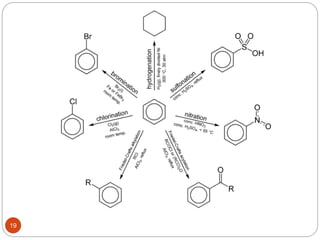
1. Reactions of benzene - nitration,
sulphonation, halogenation reactivity,
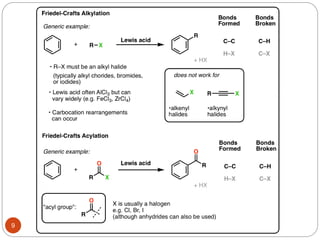
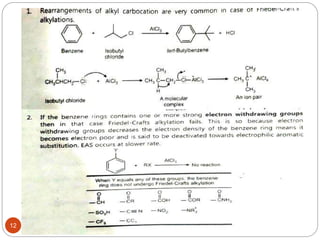
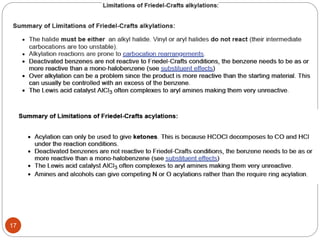
2. Friedel crafts alkylation- reactivity,
limitations,
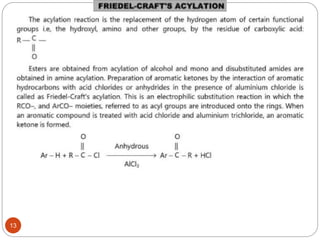
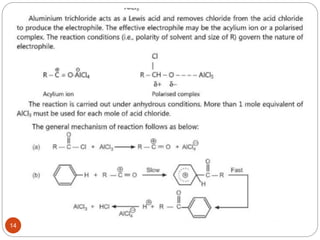
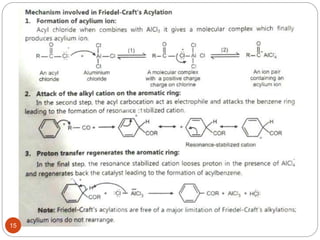
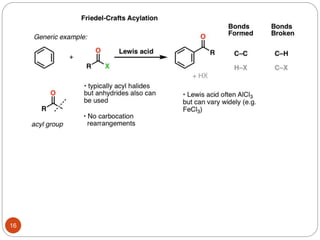
3. Friedel crafts acylation
2
3
4
5
6
7
8
9
10
11
12
13
14
15
16
17
https://www2.chemistry.msu.edu/faculty/reusch/virttxtjml/intro1.htm#contnt
18
19
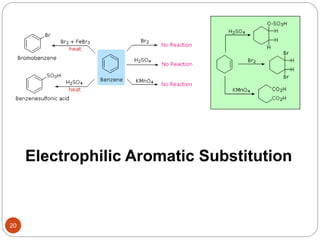
Electrophilic Aromatic Substitution
20
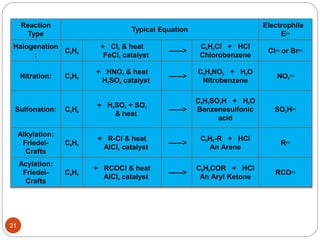
Reaction
Type
Typical Equation
Electrophile
E(+)
Halogenation
:
C6H6
+ Cl2 & heat
FeCl3 catalyst
——>
C6H5Cl + HCl
Chlorobenzene
Cl(+) or Br(+)
Nitration: C6H6
+ HNO3 & heat
H2SO4 catalyst
——>
C6H5NO2 + H2O
Nitrobenzene
NO2
(+)
Sulfonation: C6H6
+ H2SO4 + SO3
& heat
——>
C6H5SO3H + H2O
Benzenesulfonic
acid
SO3H(+)
Alkylation:
Friedel-
Crafts
C6H6
+ R-Cl & heat
AlCl3 catalyst
——>
C6H5-R + HCl
An Arene
R(+)
Acylation:
Friedel-
Crafts
C6H6
+ RCOCl & heat
AlCl3 catalyst
——>
C6H5COR + HCl
An Aryl Ketone
RCO(+)
21
22
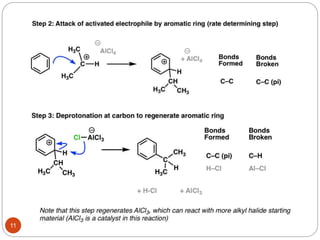
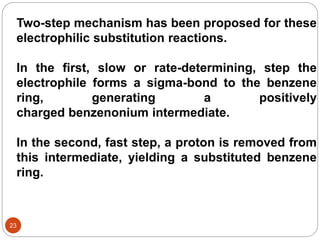
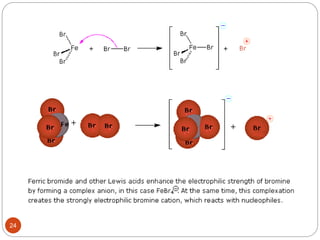
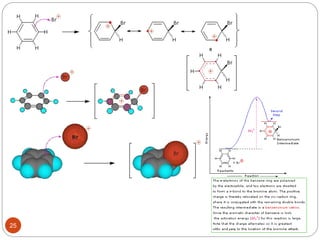
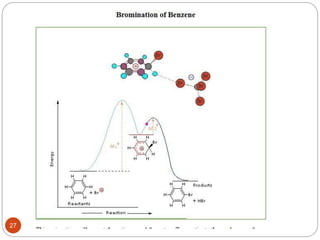
Two-step mechanism has been proposed for these
electrophilic substitution reactions.
In the first, slow or rate-determining, step the
electrophile forms a sigma-bond to the benzene
ring, generating a positively
charged benzenonium intermediate.
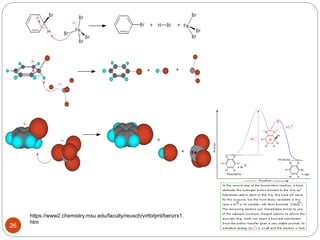
In the second, fast step, a proton is removed from
this intermediate, yielding a substituted benzene
ring.
23
24
25
https://www2.chemistry.msu.edu/faculty/reusch/virttxtjml/benzrx1.
htm
26
27

UNIT I-PART-7.pptx