Chemical
B onding
Part 3:
Covalent Bonds,
Chemical Formulas, Structural Diagrams
6. Covalent Bonding
QuickTime™ and a
decompressor
are needed to see this picture.
B ond with me
 A chemical bond forms when atoms transfer or
share electrons.
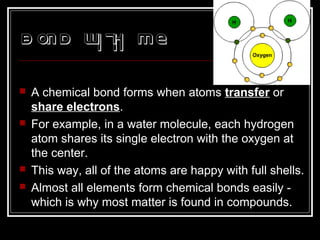
 For example, in a water molecule, each hydrogen
atom shares its single electron with the oxygen at
the center.
 This way, all of the atoms are happy with full shells.
 Almost all elements form chemical bonds easily -
which is why most matter is found in compounds.
Types of bonds
 There are a couple different types of bonds.
1. Ionic Bond
2. Covalent Bond
3. Metallic Bond
 Now, we are going to talk about
covalent bonds.
7. Covalent Bonding
QuickTime™ and a
decompressor
are needed to see this picture.
Cooperating Covalents
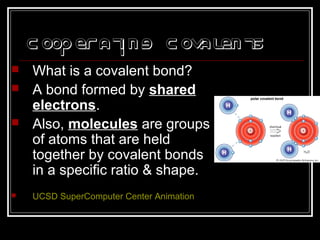
 What is a covalent bond?
 A bond formed by shared
electrons.
 Also, molecules are groups
of atoms that are held
together by covalent bonds
in a specific ratio & shape.
 UCSD SuperComputer Center Animation
Covalent B onds
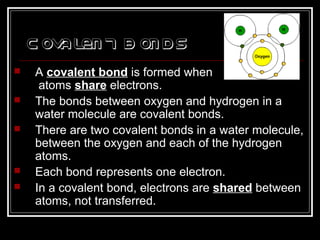
 A covalent bond is formed when
atoms share electrons.
 The bonds between oxygen and hydrogen in a
water molecule are covalent bonds.
 There are two covalent bonds in a water molecule,
between the oxygen and each of the hydrogen
atoms.
 Each bond represents one electron.
 In a covalent bond, electrons are shared between
atoms, not transferred.
8. Special information about
Hydrogen bonding
QuickTime™ and a
decompressor
are needed to see this picture.
“M ” is for
M olecule
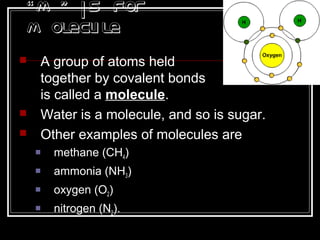
 A group of atoms held
together by covalent bonds
is called a molecule.
 Water is a molecule, and so is sugar.
 Other examples of molecules are
 methane (CH4)
 ammonia (NH3)
 oxygen (O2)
 nitrogen (N2).
Fancy B onding
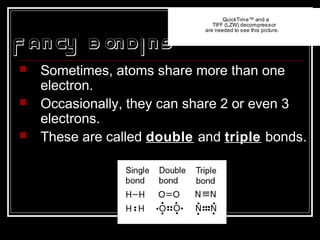
 Sometimes, atoms share more than one
electron.
 Occasionally, they can share 2 or even 3
electrons.
 These are called double and triple bonds.
QuickTime™ and a
TIFF (LZW) decompressor
are needed to see this picture.
Chemical Formulas
 Molecules are represented by a chemical
formula.
 The chemical formula tells you the exact
number of each kind of atom in the molecule.
 For example, the chemical formula for water is
H2O.
 The subscript 2 indicates there are two
hydrogen atoms in the molecule.
 The chemical formula also tells you that water
always contains twice as many hydrogen atoms
as oxygen atoms.
QuickTime™ and a
TIFF (LZW) decompressor
are needed to see this picture.
Chemical Formula Take 2
 Water is a simple molecule, so the formula is
pretty easy.
 Let’s look at a more complex molecule.
 Baking soda, or sodium bicarbonate, is NaHCO3.
 That means it has:
 1 Sodium (Na)
 1 Hydrogen (H)
 1 Carbon (C)
 3 Oxygen (O)
Y ou Try it!
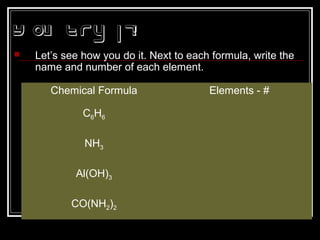
 Let’s see how you do it. Next to each formula, write the
name and number of each element.
Chemical Formula Elements - #
C6H6
NH3
Al(OH)3
CO(NH2)2
Y ou Try it!
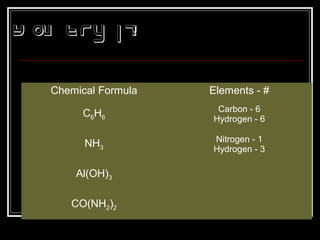
Chemical Formula Elements - #
C6H6
Carbon - 6
Hydrogen - 6
NH3
Al(OH)3
CO(NH2)2
Y ou Try it!
Chemical Formula Elements - #
C6H6
Carbon - 6
Hydrogen - 6
NH3
Nitrogen - 1
Hydrogen - 3
Al(OH)3
CO(NH2)2
Y ou Try it!
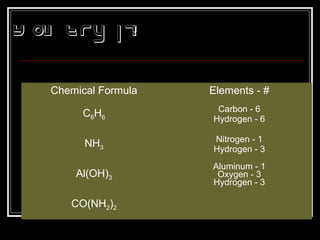
Chemical Formula Elements - #
C6H6
Carbon - 6
Hydrogen - 6
NH3
Nitrogen - 1
Hydrogen - 3
Al(OH)3
Aluminum - 1
Oxygen - 3
Hydrogen - 3
CO(NH2)2
Y ou Try it!
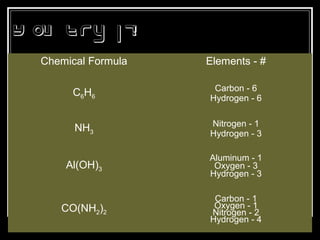
Chemical Formula Elements - #
C6H6
Carbon - 6
Hydrogen - 6
NH3
Nitrogen - 1
Hydrogen - 3
Al(OH)3
Aluminum - 1
Oxygen - 3
Hydrogen - 3
CO(NH2)2
Carbon - 1
Oxygen - 1
Nitrogen - 2
Hydrogen - 4
S tructural D iagram
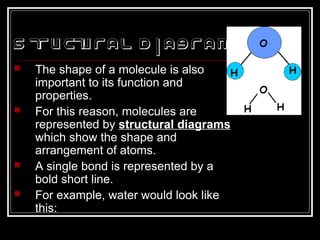
 The shape of a molecule is also
important to its function and
properties.
 For this reason, molecules are
represented by structural diagrams
which show the shape and
arrangement of atoms.
 A single bond is represented by a
bold short line.
 For example, water would look like
this:
S tructural D iagram -
take 2
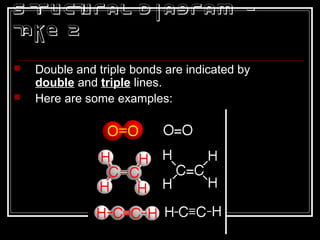
 Double and triple bonds are indicated by
double and triple lines.
 Here are some examples:
S tructural D iagram -
take 3
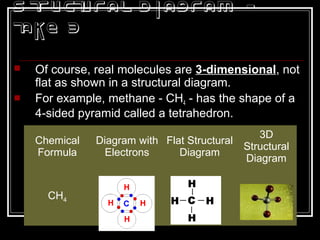
 Of course, real molecules are 3-dimensional, not
flat as shown in a structural diagram.
 For example, methane - CH4 - has the shape of a
4-sided pyramid called a tetrahedron.
Chemical
Formula
Diagram with
Electrons
Flat Structural
Diagram
3D
Structural
Diagram
CH4
Y ou Try it!
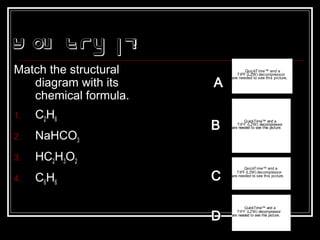
Match the structural
diagram with its
chemical formula.
1. C2H6
2. NaHCO3
3. HC2H3O2
4. C6H6
QuickTime™ and a
TIFF (LZW) decompressor
are needed to see this picture.
QuickTime™ and a
TIFF (LZW) decompressor
are needed to see this picture.
QuickTime™ and a
TIFF (LZW) decompressor
are needed to see this picture.
QuickTime™ and a
TIFF (LZW) decompressor
are needed to see this picture.
CC
BB
AA
DD
Y ou Try it!
Match the structural
diagram with its
chemical formula.
1. C2H6 - D
2. NaHCO3 - A
3. HC2H3O2 - C
4. C6H6 - B
QuickTime™ and a
TIFF (LZW) decompressor
are needed to see this picture.
QuickTime™ and a
TIFF (LZW) decompressor
are needed to see this picture.
QuickTime™ and a
TIFF (LZW) decompressor
are needed to see this picture.
QuickTime™ and a
TIFF (LZW) decompressor
are needed to see this picture.
CC
BB
AA
DD
L ewis D ot M olecules
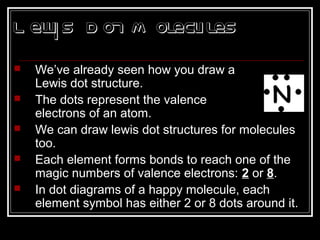
 We’ve already seen how you draw a
Lewis dot structure.
 The dots represent the valence
electrons of an atom.
 We can draw lewis dot structures for molecules
too.
 Each element forms bonds to reach one of the
magic numbers of valence electrons: 2 or 8.
 In dot diagrams of a happy molecule, each
element symbol has either 2 or 8 dots around it.
L ewis D ot M olecule -
Example
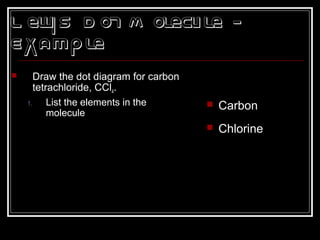
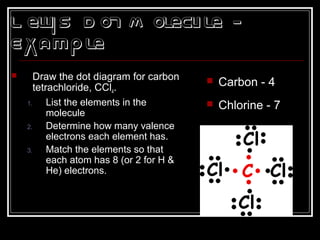
 Draw the dot diagram for carbon
tetrachloride, CCl4.
1. List the elements in the
molecule
 Carbon
 Chlorine
L ewis D ot M olecule -
Example
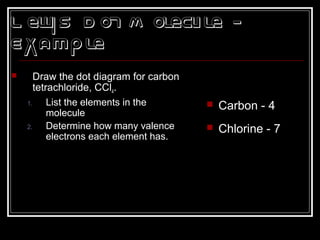
 Draw the dot diagram for carbon
tetrachloride, CCl4.
1. List the elements in the
molecule
2. Determine how many valence
electrons each element has.
 Carbon - 4
 Chlorine - 7
L ewis D ot M olecule -
Example
 Draw the dot diagram for carbon
tetrachloride, CCl4.
1. List the elements in the
molecule
2. Determine how many valence
electrons each element has.
3. Match the elements so that
each atom has 8 (or 2 for H &
He) electrons.
 Carbon - 4
 Chlorine - 7
L ewis D ot M olecule -
Example
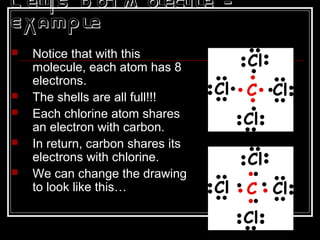
 Notice that with this
molecule, each atom has 8
electrons.
 The shells are all full!!!
 Each chlorine atom shares
an electron with carbon.
 In return, carbon shares its
electrons with chlorine.
 We can change the drawing
to look like this…
L ewis D ot M olecule -
Example
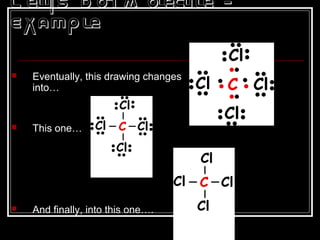
 Eventually, this drawing changes
into…
 This one…
 And finally, into this one….
9. Time for a little music!
QuickTime™ and a
decompressor
are needed to see this picture.
Y ou Try it!
 Now, time for you to draw dot diagrams of
molecules!!
 And count some atoms!

Chemical bonding

  • 1.
    Chemical B onding Part 3: CovalentBonds, Chemical Formulas, Structural Diagrams
  • 2.
    6. Covalent Bonding QuickTime™and a decompressor are needed to see this picture.
  • 3.
    B ond withme  A chemical bond forms when atoms transfer or share electrons.  For example, in a water molecule, each hydrogen atom shares its single electron with the oxygen at the center.  This way, all of the atoms are happy with full shells.  Almost all elements form chemical bonds easily - which is why most matter is found in compounds.
  • 4.
    Types of bonds There are a couple different types of bonds. 1. Ionic Bond 2. Covalent Bond 3. Metallic Bond  Now, we are going to talk about covalent bonds.
  • 5.
    7. Covalent Bonding QuickTime™and a decompressor are needed to see this picture.
  • 6.
    Cooperating Covalents  Whatis a covalent bond?  A bond formed by shared electrons.  Also, molecules are groups of atoms that are held together by covalent bonds in a specific ratio & shape.  UCSD SuperComputer Center Animation
  • 7.
    Covalent B onds A covalent bond is formed when atoms share electrons.  The bonds between oxygen and hydrogen in a water molecule are covalent bonds.  There are two covalent bonds in a water molecule, between the oxygen and each of the hydrogen atoms.  Each bond represents one electron.  In a covalent bond, electrons are shared between atoms, not transferred.
  • 8.
    8. Special informationabout Hydrogen bonding QuickTime™ and a decompressor are needed to see this picture.
  • 9.
    “M ” isfor M olecule  A group of atoms held together by covalent bonds is called a molecule.  Water is a molecule, and so is sugar.  Other examples of molecules are  methane (CH4)  ammonia (NH3)  oxygen (O2)  nitrogen (N2).
  • 10.
    Fancy B onding Sometimes, atoms share more than one electron.  Occasionally, they can share 2 or even 3 electrons.  These are called double and triple bonds. QuickTime™ and a TIFF (LZW) decompressor are needed to see this picture.
  • 11.
    Chemical Formulas  Moleculesare represented by a chemical formula.  The chemical formula tells you the exact number of each kind of atom in the molecule.  For example, the chemical formula for water is H2O.  The subscript 2 indicates there are two hydrogen atoms in the molecule.  The chemical formula also tells you that water always contains twice as many hydrogen atoms as oxygen atoms. QuickTime™ and a TIFF (LZW) decompressor are needed to see this picture.
  • 12.
    Chemical Formula Take2  Water is a simple molecule, so the formula is pretty easy.  Let’s look at a more complex molecule.  Baking soda, or sodium bicarbonate, is NaHCO3.  That means it has:  1 Sodium (Na)  1 Hydrogen (H)  1 Carbon (C)  3 Oxygen (O)
  • 13.
    Y ou Tryit!  Let’s see how you do it. Next to each formula, write the name and number of each element. Chemical Formula Elements - # C6H6 NH3 Al(OH)3 CO(NH2)2
  • 14.
    Y ou Tryit! Chemical Formula Elements - # C6H6 Carbon - 6 Hydrogen - 6 NH3 Al(OH)3 CO(NH2)2
  • 15.
    Y ou Tryit! Chemical Formula Elements - # C6H6 Carbon - 6 Hydrogen - 6 NH3 Nitrogen - 1 Hydrogen - 3 Al(OH)3 CO(NH2)2
  • 16.
    Y ou Tryit! Chemical Formula Elements - # C6H6 Carbon - 6 Hydrogen - 6 NH3 Nitrogen - 1 Hydrogen - 3 Al(OH)3 Aluminum - 1 Oxygen - 3 Hydrogen - 3 CO(NH2)2
  • 17.
    Y ou Tryit! Chemical Formula Elements - # C6H6 Carbon - 6 Hydrogen - 6 NH3 Nitrogen - 1 Hydrogen - 3 Al(OH)3 Aluminum - 1 Oxygen - 3 Hydrogen - 3 CO(NH2)2 Carbon - 1 Oxygen - 1 Nitrogen - 2 Hydrogen - 4
  • 18.
    S tructural Diagram  The shape of a molecule is also important to its function and properties.  For this reason, molecules are represented by structural diagrams which show the shape and arrangement of atoms.  A single bond is represented by a bold short line.  For example, water would look like this:
  • 19.
    S tructural Diagram - take 2  Double and triple bonds are indicated by double and triple lines.  Here are some examples:
  • 20.
    S tructural Diagram - take 3  Of course, real molecules are 3-dimensional, not flat as shown in a structural diagram.  For example, methane - CH4 - has the shape of a 4-sided pyramid called a tetrahedron. Chemical Formula Diagram with Electrons Flat Structural Diagram 3D Structural Diagram CH4
  • 21.
    Y ou Tryit! Match the structural diagram with its chemical formula. 1. C2H6 2. NaHCO3 3. HC2H3O2 4. C6H6 QuickTime™ and a TIFF (LZW) decompressor are needed to see this picture. QuickTime™ and a TIFF (LZW) decompressor are needed to see this picture. QuickTime™ and a TIFF (LZW) decompressor are needed to see this picture. QuickTime™ and a TIFF (LZW) decompressor are needed to see this picture. CC BB AA DD
  • 22.
    Y ou Tryit! Match the structural diagram with its chemical formula. 1. C2H6 - D 2. NaHCO3 - A 3. HC2H3O2 - C 4. C6H6 - B QuickTime™ and a TIFF (LZW) decompressor are needed to see this picture. QuickTime™ and a TIFF (LZW) decompressor are needed to see this picture. QuickTime™ and a TIFF (LZW) decompressor are needed to see this picture. QuickTime™ and a TIFF (LZW) decompressor are needed to see this picture. CC BB AA DD
  • 23.
    L ewis Dot M olecules  We’ve already seen how you draw a Lewis dot structure.  The dots represent the valence electrons of an atom.  We can draw lewis dot structures for molecules too.  Each element forms bonds to reach one of the magic numbers of valence electrons: 2 or 8.  In dot diagrams of a happy molecule, each element symbol has either 2 or 8 dots around it.
  • 24.
    L ewis Dot M olecule - Example  Draw the dot diagram for carbon tetrachloride, CCl4. 1. List the elements in the molecule  Carbon  Chlorine
  • 25.
    L ewis Dot M olecule - Example  Draw the dot diagram for carbon tetrachloride, CCl4. 1. List the elements in the molecule 2. Determine how many valence electrons each element has.  Carbon - 4  Chlorine - 7
  • 26.
    L ewis Dot M olecule - Example  Draw the dot diagram for carbon tetrachloride, CCl4. 1. List the elements in the molecule 2. Determine how many valence electrons each element has. 3. Match the elements so that each atom has 8 (or 2 for H & He) electrons.  Carbon - 4  Chlorine - 7
  • 27.
    L ewis Dot M olecule - Example  Notice that with this molecule, each atom has 8 electrons.  The shells are all full!!!  Each chlorine atom shares an electron with carbon.  In return, carbon shares its electrons with chlorine.  We can change the drawing to look like this…
  • 28.
    L ewis Dot M olecule - Example  Eventually, this drawing changes into…  This one…  And finally, into this one….
  • 29.
    9. Time fora little music! QuickTime™ and a decompressor are needed to see this picture.
  • 30.
    Y ou Tryit!  Now, time for you to draw dot diagrams of molecules!!  And count some atoms!