Atomic Structure
Derek Murphy
HISTORY OF THE ATOM
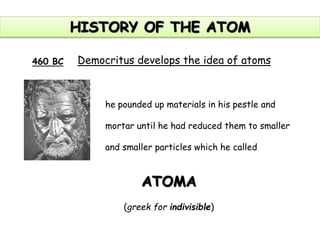
460 BC Democritus develops the idea of atoms
he pounded up materials in his pestle and
mortar until he had reduced them to smaller
and smaller particles which he called
ATOMA
(greek for indivisible)
HISTORY OF THE ATOM
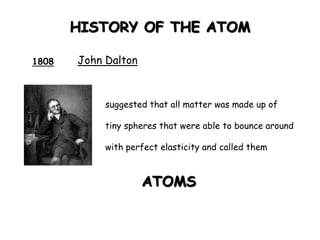
1808 John Dalton
suggested that all matter was made up of
tiny spheres that were able to bounce around
with perfect elasticity and called them
ATOMS
Dalton’s Atomic Theory (1808)
1. Elements are composed of extremely small
particles called atoms. All atoms of a given
element are identical. The atoms of one element
are different from the atoms of all other elements.
2. Compounds are composed of atoms of more
than one element. The relative number of atoms
of each element in a given compound is always
the same. Law of Multiple Proportions
3. Chemical reactions only involve the rearrangement
of atoms. Atoms are not created or destroyed in
chemical reactions. Law of Conservation of Mass
2.1
2
2.1
8 X2Y16 X 8 Y+
2.1
History of the Atom
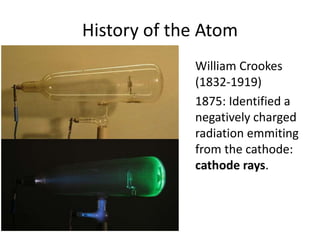
William Crookes
(1832-1919)
1875: Identified a
negatively charged
radiation emmiting
from the cathode:
cathode rays.
HISTORY OF THE ATOM
1898 Joseph John Thompson
Demonstrated that cathode rays are
negatively charged particles
ELECTRON
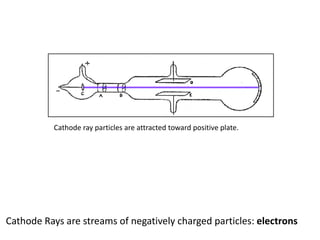
Cathode Rays are streams of negatively charged particles: electrons
Cathode ray particles are attracted toward positive plate.
Ratio of Charge to Mass
Next, Thompson measured how much electrons are deflected by a magnetic
field and compared this with the electric deflection.
He found that the mass to charge ratio was over a thousand times lower than
that of a hydrogen ion (H+), suggesting either that the particles were very light
and/or very highly charged.
charge of electron
mass of electron
= 1.76 x 10¹¹ coulombs per kg
Units for quantity of charge
Robert Millikan’s Oil Drop Experiment
Determined charge on the electron: 1.6 x 10⁻¹⁹ coulomb
charge of electron
mass of electron
= 1.76 x 10¹¹ coulombs per kg
Mass of electron = 9.1 x 10⁻³¹ kgCalculate Mass of electron
http://www.youtube.com/watch?v=XMfYHag7Liw
HISTORY OF THE ATOM
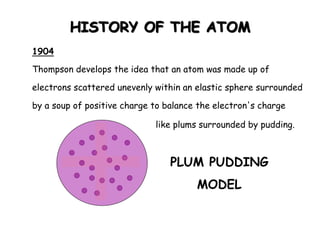
Thompson develops the idea that an atom was made up of
electrons scattered unevenly within an elastic sphere surrounded
by a soup of positive charge to balance the electron's charge
1904
like plums surrounded by pudding.
PLUM PUDDING
MODEL
HISTORY OF THE ATOM
1910 Ernest Rutherford
oversaw Geiger and Marsden carrying out his
famous experiment.
they fired Helium nuclei at a piece of gold foil
which was only a few atoms thick.
they found that although most of them
passed through. About 1 in 10,000 hit
something
Atoms’ positive charge is concentrated in a nucleus 2.2
The Rutherford experiment
“It was about as credible as if you had fired a 15-inch [artillery] shell
at a piece of paper and it came back and hit you.” -- Rutherford
Expected Result based on
Thompson Model of Atom.
Model to explain observed
results.
Nucleus of Atom containing positively charged proton(s)
The only way to account for the observations was to conclude that all of the
positive charge and most of the mass of the atom are concentrated in a very small
region. Rutherford called this tiny atomic core the nucleus.
Positive charge, mass = 1.673 x 10⁻²⁴ g (1800 x electron)
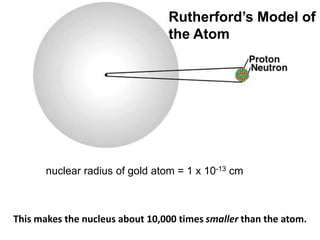
nuclear radius of gold atom = 1 x 10-13 cm
Rutherford’s Model of
the Atom
This makes the nucleus about 10,000 times smaller than the atom.
Chadwick’s Experiment (1932)
Detected non-charged particle with enough
mass to displace proton --- Neutron!
+ive
-ive
No charge, mass = 1.679 x 10⁻²⁴ g
Subatomic Particles
• Protons and neutrons make up the nucleus, providing
most of the atom’s mass; the protons provide all of its
positive charge.
• The nuclear radius is approximately 10,000 times
smaller than the radius of the entire atom.
• Negatively charged electrons outside the nucleus
occupy most of the volume of the atom, but contribute
very little mass.
• A neutral atom has no net electrical charge because
the number of electrons outside the nucleus equals the
number of protons inside the nucleus.
Properties of Subatomic Particles
Relative Charge Relative Mass Location
Proton +1 1 Nucleus
Neutron 0 1 Nucleus
Electron -1 1/1838 Outside Nucleus

Chem1 lecture1-2-atomic-structure (1)

  • 1.
  • 2.
    HISTORY OF THEATOM 460 BC Democritus develops the idea of atoms he pounded up materials in his pestle and mortar until he had reduced them to smaller and smaller particles which he called ATOMA (greek for indivisible)
  • 3.
    HISTORY OF THEATOM 1808 John Dalton suggested that all matter was made up of tiny spheres that were able to bounce around with perfect elasticity and called them ATOMS
  • 4.
    Dalton’s Atomic Theory(1808) 1. Elements are composed of extremely small particles called atoms. All atoms of a given element are identical. The atoms of one element are different from the atoms of all other elements. 2. Compounds are composed of atoms of more than one element. The relative number of atoms of each element in a given compound is always the same. Law of Multiple Proportions 3. Chemical reactions only involve the rearrangement of atoms. Atoms are not created or destroyed in chemical reactions. Law of Conservation of Mass 2.1
  • 5.
  • 6.
    8 X2Y16 X8 Y+ 2.1
  • 7.
    History of theAtom William Crookes (1832-1919) 1875: Identified a negatively charged radiation emmiting from the cathode: cathode rays.
  • 8.
    HISTORY OF THEATOM 1898 Joseph John Thompson Demonstrated that cathode rays are negatively charged particles ELECTRON
  • 9.
    Cathode Rays arestreams of negatively charged particles: electrons Cathode ray particles are attracted toward positive plate.
  • 10.
    Ratio of Chargeto Mass Next, Thompson measured how much electrons are deflected by a magnetic field and compared this with the electric deflection. He found that the mass to charge ratio was over a thousand times lower than that of a hydrogen ion (H+), suggesting either that the particles were very light and/or very highly charged. charge of electron mass of electron = 1.76 x 10¹¹ coulombs per kg Units for quantity of charge
  • 12.
    Robert Millikan’s OilDrop Experiment Determined charge on the electron: 1.6 x 10⁻¹⁹ coulomb charge of electron mass of electron = 1.76 x 10¹¹ coulombs per kg Mass of electron = 9.1 x 10⁻³¹ kgCalculate Mass of electron
  • 13.
  • 14.
    HISTORY OF THEATOM Thompson develops the idea that an atom was made up of electrons scattered unevenly within an elastic sphere surrounded by a soup of positive charge to balance the electron's charge 1904 like plums surrounded by pudding. PLUM PUDDING MODEL
  • 15.
    HISTORY OF THEATOM 1910 Ernest Rutherford oversaw Geiger and Marsden carrying out his famous experiment. they fired Helium nuclei at a piece of gold foil which was only a few atoms thick. they found that although most of them passed through. About 1 in 10,000 hit something
  • 16.
    Atoms’ positive chargeis concentrated in a nucleus 2.2 The Rutherford experiment “It was about as credible as if you had fired a 15-inch [artillery] shell at a piece of paper and it came back and hit you.” -- Rutherford
  • 17.
    Expected Result basedon Thompson Model of Atom. Model to explain observed results. Nucleus of Atom containing positively charged proton(s) The only way to account for the observations was to conclude that all of the positive charge and most of the mass of the atom are concentrated in a very small region. Rutherford called this tiny atomic core the nucleus. Positive charge, mass = 1.673 x 10⁻²⁴ g (1800 x electron)
  • 18.
    nuclear radius ofgold atom = 1 x 10-13 cm Rutherford’s Model of the Atom This makes the nucleus about 10,000 times smaller than the atom.
  • 19.
    Chadwick’s Experiment (1932) Detectednon-charged particle with enough mass to displace proton --- Neutron! +ive -ive No charge, mass = 1.679 x 10⁻²⁴ g
  • 20.
    Subatomic Particles • Protonsand neutrons make up the nucleus, providing most of the atom’s mass; the protons provide all of its positive charge. • The nuclear radius is approximately 10,000 times smaller than the radius of the entire atom. • Negatively charged electrons outside the nucleus occupy most of the volume of the atom, but contribute very little mass. • A neutral atom has no net electrical charge because the number of electrons outside the nucleus equals the number of protons inside the nucleus.
  • 21.
    Properties of SubatomicParticles Relative Charge Relative Mass Location Proton +1 1 Nucleus Neutron 0 1 Nucleus Electron -1 1/1838 Outside Nucleus