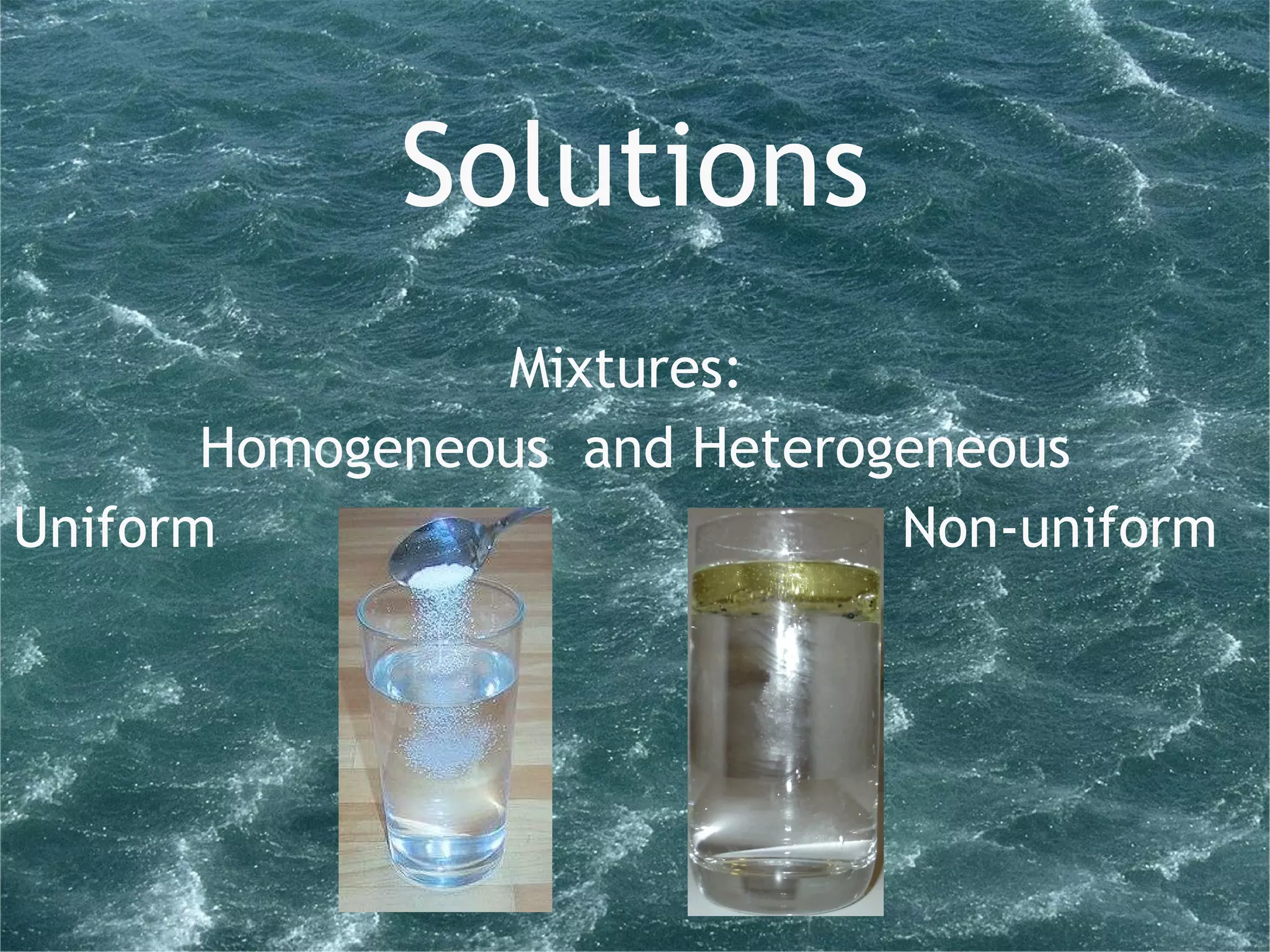
Solutions Mixtures:  Homogeneous  and Heterogeneous Uniform Non-uniform
Solutions Concentrated or Dilute Units of concentration: Ppm/ppb  vs. Molarity
Concentration Parts per million (ppm) mass of solute ppm  = mass of solution  x 100%
Concentration Molarity  =  moles/Liter
Molarity Vinegar  What is the molarity if 3.78 g of CH 3 CO 2 H are dissolved in 100 mL?
Molarity Vinegar  What is the molarity if 3.78 g of CH 3 CO 2 H are dissolved in 100 mL? 1 mole 3.78 g  x  60 g  =  0.063 moles Molarity  =  0.063 moles/0.1 L  =  0.63 M
Effects of Solutes Adding a dissolved substance to a solvent:
Effects of Solutes Adding a dissolved substance to a solvent: Less  solvent molecules evaporate at the regular boiling point: Higher  boiling point
Boiling Point Elevation Adding salt to cooking pasta Makes the pasta cook faster
Effect of Solutes Added solute makes it harder for the solvent to freeze  So a  lower  freezing point occurs
Ice Cream! Milkfat +  +dissolved sugar   + Air  + flavor
Solubility Like dissolves Like Miscible Oil + Water =  immiscible
Surfactants Surface – active Agent Polar/ non-polar go-between
Solubility & Temperature Solubility increases with temperature
Saturation When the maximum amount of solute is dissolved in a solution
Henry’s Law The solubility of a gas in a solution  increases  as the partial pressure of the gas on the surface of the solution increases.
Henry’s Law Carbonated Drinks: What happens when you open the bottle?
Molarity & Stoichiometry Recall Displacement Reactions: Cu  +  2 AgNO 3   --->  2 Ag  + Cu(NO 3 ) 2 How much 0.5 M Silver Nitrate solution is needed to react with  0.317 g Cu metal?
Molarity & Stoichiometry Cu  +  2 AgNO 3   --->  2 Ag  + Cu(NO 3 ) 2 0.317 g Cu  x 1 mole/63.45 g  =  0.05 moles Cu   2 moles AgNO 3 0.05 moles Cu  x  1 mole Cu  = 0.1 mole AgNO 3 0.1 moles AgNO 3  x 1 Liter/0.5 moles = 0.05 L   = 50 mL
Chemical Equilibrium Balance point when the forward and reverse reaction rates are equal Photochromatic lenses
Reversible Reactions Forward Reaction 2 NO 2   ----->  N 2 O 4 Reverse Reaction N 2 O 4   ----->  2 NO 2
Reversible Reactions Forward Reaction 2 NO 2   ----->  N 2 O 4 Reverse Reaction N 2 O 4   ----->  2 NO 2 2 NO 2   N 2 O 4
Chemical Equilibrium Balance point where the rate of the forward reaction equals the rate of the reverse reaction  Concentrations of products and reactants remain unchanged
Equilibrium Constant A  +  B  C  +  D  [C] [D] K eq   =  [A] [B] if K eq  > 1  mostly products (C & D) if K eq  < 1  mostly reactants  (A & B) if K eq  = 1  Equal amounts of reactants, products
Equilibrium Constants Balance the equation Leave out any solids or liquids (s), (l) Raise the substance’s concentration to the power equal to its coefficient
Equilibrium Constant COCl 2 (g)  CO(g)  + Cl 2 (g)  K eq  =  ?
Equilibrium Constant COCl 2 (g)  CO(g)  + Cl 2 (g)    [CO][Cl 2 ] K eq  =  [COCl 2 ] If  [CO] = [Cl 2 ] = 0.0178 and [COCl 2 ] = 0.007, K eq  = ???
Equilibrium Constant COCl 2 (g)  CO(g)  + Cl 2 (g)    [CO][Cl 2 ] K eq  =  [COCl 2 ] If  [CO] = [Cl 2 ] = 0.0178 and [COCl 2 ] = 0.007, K eq  =  0.045
Equilibrium Constants N 2(g)  +  O 2(g) 2 NO (g)  [NO] 2 K eq  =  [N 2 ][O 2 ]
Equilibrium Constants H 2   +  I 2   2 HI [HI] 2 K eq   = [H 2 ][I 2 ] At 25°C, [H 2 ] = [I 2 ] = 0.05 M, [HI] = 0.389M   [HI] 2  (0.389)2 K eq   = [H 2 ][I 2 ]  = (0.05)(0.05)  =  60.3
Equilibrium Constants H 2   +  I 2   2 HI [HI] 2 K eq   = [H 2 ][I 2 ] At 0°C, [H 2 ] = [I 2 ] = 0.0057 M, [HI] = 0.0127M   [HI] 2  (0.0127) 2 K eq   = [H 2 ][I 2 ]  = (0.0057)(0.0057)  =  4.96
Solubility Product K sp AgCl (s)   Ag + (aq)  +  Cl – (aq)  K sp  =  [Ag + ][Cl - ]
Tooth Enamel Hydroxyapatite Ca 5 (PO 4 ) 3 OH Fluorine treatment H 2 SiF 6 Ca 5 (PO 4 ) 3 F
Solubility Product How much Hg 2+  ion would be found in a pond where cinnabar was located? HgS  Hg 2+   +  S 2-  K sp   =  1 x 10 -53
Solubility Product How much Hg 2+  ion would be found in a pond where cinnabar was located? HgS  Hg 2+   +  S 2-  K sp   =  1 x 10 -53   = [Hg 2+ ][S 2-  ]  ([Hg 2+ ] = [S 2-] )
Solubility Product How much Hg 2+  ion would be found in a pond where cinnabar was located? HgS  Hg 2+   +  S 2-  K sp   =  1 x 10 -53   = [Hg 2+ ][S 2-  ]  ([Hg 2+ ] = [S 2-] )   [Hg 2+ ] = 3.16 x 10 -27
Solubility Product K sp
Equilibrium Stresses LeChatelier’s Principle: If a change occurs to a system at equilibrium, the system will react to reduce the stress Concentration Pressure  Temperature
LeChatelier’s Principle Changes in Concentration (adding or removing reactant or product) CO  +  H 2   CH 3 OH To increase CH 3 OH:  Add  CO or  H 2 OR   remove  CH 3 OH
LeChatelier’s Principle Changes in Pressure 2 NO 2(g)  N 2 O 4(g)
LeChatelier’s Principle Changes in Pressure 2 NO 2(g)  N 2 O 4(g) 2 moles of gas 1 mole of gas Increasing Pressure:  Shifts equiibrium to N 2 O 4  side Decreasing Pressure:  Shifts equilibrium to NO 2  side (Remember if volume decreases, pressure increases)
LeChatelier’s Principle Changes in Temperature Exothermic reactions Heat is a product Endothermic Reactions Heat is a reactant
LeChatelier’s Principle Changes in Temperature Exothermic  reaction C 2 H4  +  H 2   C 2 H 6   + heat Adding  heat is like  adding product  so raising the temperature shifts the equilibrium toward C 2 H 4  and H 2
LeChatelier’s Principle Endothermic Reactions H 2   +  F 2   + heat  2 HF  Raising temperature = adding heat   = adding reactant  Equilibrium shifts to form more HF

Chem unit8

  • 1.
    Solutions Mixtures: Homogeneous and Heterogeneous Uniform Non-uniform
  • 2.
    Solutions Concentrated orDilute Units of concentration: Ppm/ppb vs. Molarity
  • 3.
    Concentration Parts permillion (ppm) mass of solute ppm = mass of solution x 100%
  • 4.
  • 5.
    Molarity Vinegar What is the molarity if 3.78 g of CH 3 CO 2 H are dissolved in 100 mL?
  • 6.
    Molarity Vinegar What is the molarity if 3.78 g of CH 3 CO 2 H are dissolved in 100 mL? 1 mole 3.78 g x 60 g = 0.063 moles Molarity = 0.063 moles/0.1 L = 0.63 M
  • 7.
    Effects of SolutesAdding a dissolved substance to a solvent:
  • 8.
    Effects of SolutesAdding a dissolved substance to a solvent: Less solvent molecules evaporate at the regular boiling point: Higher boiling point
  • 9.
    Boiling Point ElevationAdding salt to cooking pasta Makes the pasta cook faster
  • 10.
    Effect of SolutesAdded solute makes it harder for the solvent to freeze So a lower freezing point occurs
  • 11.
    Ice Cream! Milkfat+ +dissolved sugar + Air + flavor
  • 12.
    Solubility Like dissolvesLike Miscible Oil + Water = immiscible
  • 13.
    Surfactants Surface –active Agent Polar/ non-polar go-between
  • 14.
    Solubility & TemperatureSolubility increases with temperature
  • 15.
    Saturation When themaximum amount of solute is dissolved in a solution
  • 16.
    Henry’s Law Thesolubility of a gas in a solution increases as the partial pressure of the gas on the surface of the solution increases.
  • 17.
    Henry’s Law CarbonatedDrinks: What happens when you open the bottle?
  • 18.
    Molarity & StoichiometryRecall Displacement Reactions: Cu + 2 AgNO 3 ---> 2 Ag + Cu(NO 3 ) 2 How much 0.5 M Silver Nitrate solution is needed to react with 0.317 g Cu metal?
  • 19.
    Molarity & StoichiometryCu + 2 AgNO 3 ---> 2 Ag + Cu(NO 3 ) 2 0.317 g Cu x 1 mole/63.45 g = 0.05 moles Cu 2 moles AgNO 3 0.05 moles Cu x 1 mole Cu = 0.1 mole AgNO 3 0.1 moles AgNO 3 x 1 Liter/0.5 moles = 0.05 L = 50 mL
  • 20.
    Chemical Equilibrium Balancepoint when the forward and reverse reaction rates are equal Photochromatic lenses
  • 21.
    Reversible Reactions ForwardReaction 2 NO 2 -----> N 2 O 4 Reverse Reaction N 2 O 4 -----> 2 NO 2
  • 22.
    Reversible Reactions ForwardReaction 2 NO 2 -----> N 2 O 4 Reverse Reaction N 2 O 4 -----> 2 NO 2 2 NO 2 N 2 O 4
  • 23.
    Chemical Equilibrium Balancepoint where the rate of the forward reaction equals the rate of the reverse reaction Concentrations of products and reactants remain unchanged
  • 24.
    Equilibrium Constant A + B C + D [C] [D] K eq = [A] [B] if K eq > 1 mostly products (C & D) if K eq < 1 mostly reactants (A & B) if K eq = 1 Equal amounts of reactants, products
  • 25.
    Equilibrium Constants Balancethe equation Leave out any solids or liquids (s), (l) Raise the substance’s concentration to the power equal to its coefficient
  • 26.
    Equilibrium Constant COCl2 (g) CO(g) + Cl 2 (g) K eq = ?
  • 27.
    Equilibrium Constant COCl2 (g) CO(g) + Cl 2 (g) [CO][Cl 2 ] K eq = [COCl 2 ] If [CO] = [Cl 2 ] = 0.0178 and [COCl 2 ] = 0.007, K eq = ???
  • 28.
    Equilibrium Constant COCl2 (g) CO(g) + Cl 2 (g) [CO][Cl 2 ] K eq = [COCl 2 ] If [CO] = [Cl 2 ] = 0.0178 and [COCl 2 ] = 0.007, K eq = 0.045
  • 29.
    Equilibrium Constants N2(g) + O 2(g) 2 NO (g) [NO] 2 K eq = [N 2 ][O 2 ]
  • 30.
    Equilibrium Constants H2 + I 2 2 HI [HI] 2 K eq = [H 2 ][I 2 ] At 25°C, [H 2 ] = [I 2 ] = 0.05 M, [HI] = 0.389M [HI] 2 (0.389)2 K eq = [H 2 ][I 2 ] = (0.05)(0.05) = 60.3
  • 31.
    Equilibrium Constants H2 + I 2 2 HI [HI] 2 K eq = [H 2 ][I 2 ] At 0°C, [H 2 ] = [I 2 ] = 0.0057 M, [HI] = 0.0127M [HI] 2 (0.0127) 2 K eq = [H 2 ][I 2 ] = (0.0057)(0.0057) = 4.96
  • 32.
    Solubility Product Ksp AgCl (s) Ag + (aq) + Cl – (aq) K sp = [Ag + ][Cl - ]
  • 33.
    Tooth Enamel HydroxyapatiteCa 5 (PO 4 ) 3 OH Fluorine treatment H 2 SiF 6 Ca 5 (PO 4 ) 3 F
  • 34.
    Solubility Product Howmuch Hg 2+ ion would be found in a pond where cinnabar was located? HgS Hg 2+ + S 2- K sp = 1 x 10 -53
  • 35.
    Solubility Product Howmuch Hg 2+ ion would be found in a pond where cinnabar was located? HgS Hg 2+ + S 2- K sp = 1 x 10 -53 = [Hg 2+ ][S 2- ] ([Hg 2+ ] = [S 2-] )
  • 36.
    Solubility Product Howmuch Hg 2+ ion would be found in a pond where cinnabar was located? HgS Hg 2+ + S 2- K sp = 1 x 10 -53 = [Hg 2+ ][S 2- ] ([Hg 2+ ] = [S 2-] ) [Hg 2+ ] = 3.16 x 10 -27
  • 37.
  • 38.
    Equilibrium Stresses LeChatelier’sPrinciple: If a change occurs to a system at equilibrium, the system will react to reduce the stress Concentration Pressure Temperature
  • 39.
    LeChatelier’s Principle Changesin Concentration (adding or removing reactant or product) CO + H 2 CH 3 OH To increase CH 3 OH: Add CO or H 2 OR remove CH 3 OH
  • 40.
    LeChatelier’s Principle Changesin Pressure 2 NO 2(g) N 2 O 4(g)
  • 41.
    LeChatelier’s Principle Changesin Pressure 2 NO 2(g) N 2 O 4(g) 2 moles of gas 1 mole of gas Increasing Pressure: Shifts equiibrium to N 2 O 4 side Decreasing Pressure: Shifts equilibrium to NO 2 side (Remember if volume decreases, pressure increases)
  • 42.
    LeChatelier’s Principle Changesin Temperature Exothermic reactions Heat is a product Endothermic Reactions Heat is a reactant
  • 43.
    LeChatelier’s Principle Changesin Temperature Exothermic reaction C 2 H4 + H 2 C 2 H 6 + heat Adding heat is like adding product so raising the temperature shifts the equilibrium toward C 2 H 4 and H 2
  • 44.
    LeChatelier’s Principle EndothermicReactions H 2 + F 2 + heat 2 HF Raising temperature = adding heat = adding reactant Equilibrium shifts to form more HF

Editor's Notes

  • #39 Storekeepers restocking shelves when products are purchased.