Lecture 4: Hess’s Law


Reading: Zumdahl 9.5

Outline:
  Definition of Hess’ Law
  Using Hess’ Law (examples)
Q: What is Hess’s Law ?
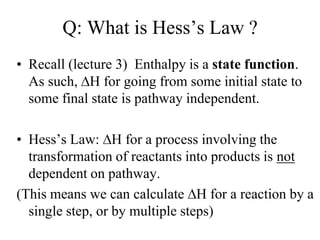
• Recall (lecture 3) Enthalpy is a state function.
  As such, H for going from some initial state to
  some final state is pathway independent.

• Hess’s Law: H for a process involving the
  transformation of reactants into products is not
  dependent on pathway.
(This means we can calculate H for a reaction by a
  single step, or by multiple steps)
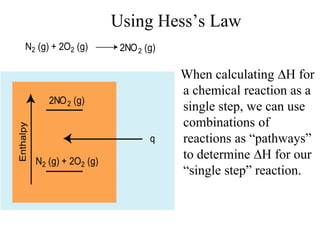
Using Hess’s Law
N2 (g) + 2O2 (g)      2NO 2 (g)

                                  When calculating H for
                                  a chemical reaction as a
      2NO 2 (g)
                                  single step, we can use
                                  combinations of
                             q    reactions as “pathways”
  N2 (g) + 2O2 (g)
                                  to determine H for our
                                  “single step” reaction.
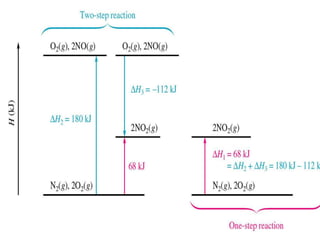
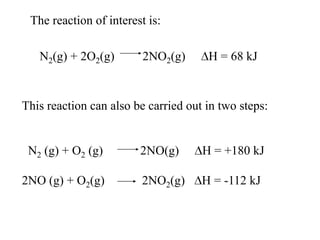
The reaction of interest is:

   N2(g) + 2O2(g)        2NO2(g)      H = 68 kJ


This reaction can also be carried out in two steps:


 N2 (g) + O2 (g)        2NO(g)       H = +180 kJ

2NO (g) + O2(g)         2NO2(g)      H = -112 kJ
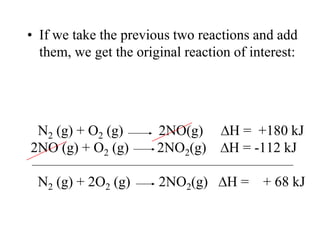
• If we take the previous two reactions and add
  them, we get the original reaction of interest:


 N2 (g) + O2 (g)       2NO(g)       H = +180 kJ
2NO (g) + O2 (g)       2NO2(g)      H = -112 kJ

 N2 (g) + 2O2 (g)      2NO2(g)      H = + 68 kJ
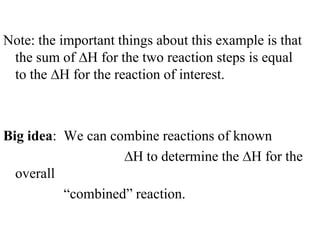
Note: the important things about this example is that
 the sum of H for the two reaction steps is equal
 to the H for the reaction of interest.


Big idea: We can combine reactions of known
                    H to determine the H for the
  overall
          “combined” reaction.
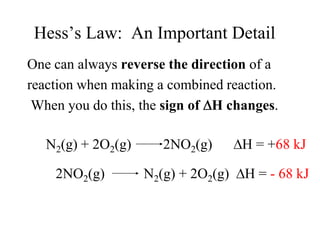
Hess’s Law: An Important Detail
One can always reverse the direction of a
reaction when making a combined reaction.
 When you do this, the sign of H changes.

   N2(g) + 2O2(g)      2NO2(g)       H = +68 kJ

    2NO2(g)         N2(g) + 2O2(g)   H = - 68 kJ
One more detail:
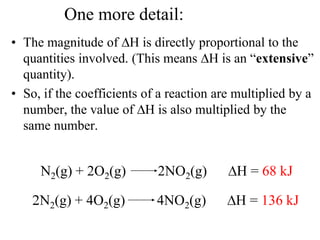
• The magnitude of H is directly proportional to the
  quantities involved. (This means H is an “extensive”
  quantity).
• So, if the coefficients of a reaction are multiplied by a
  number, the value of H is also multiplied by the
  same number.


     N2(g) + 2O2(g)         2NO2(g)         H = 68 kJ

     N2(g) + 4O2(g)         4NO2(g)        H = 136 kJ
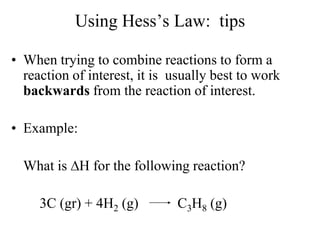
Using Hess’s Law: tips

• When trying to combine reactions to form a
  reaction of interest, it is usually best to work
  backwards from the reaction of interest.

• Example:

  What is H for the following reaction?

     3C (gr) + 4H2 (g)        C3H8 (g)
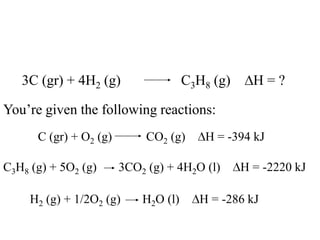
3C (gr) + 4H2 (g)                  C3H8 (g)     H=?

You’re given the following reactions:
      C (gr) + O2 (g)        CO2 (g)     H = -394 kJ

C3H8 (g) + 5O2 (g)      3CO2 (g) + 4H2O (l)      H = -2220 kJ

     H2 (g) + 1/2O2 (g)     H2O (l)     H = -286 kJ
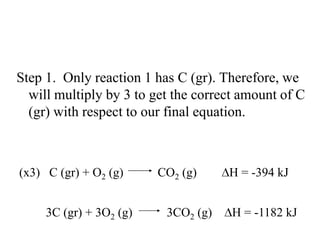
Step 1. Only reaction 1 has C (gr). Therefore, we
  will multiply by 3 to get the correct amount of C
  (gr) with respect to our final equation.


(x3) C (gr) + O2 (g)     CO2 (g)     H = -394 kJ


     3C (gr) + 3O2 (g)    3CO2 (g)    H = -1182 kJ
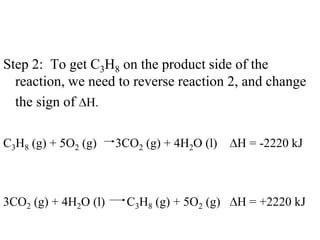
Step 2: To get C3H8 on the product side of the
  reaction, we need to reverse reaction 2, and change
  the sign of H.

C3H8 (g) + 5O2 (g)    3CO2 (g) + 4H2O (l)    H = -2220 kJ


3CO2 (g) + 4H2O (l)     C3H8 (g) + 5O2 (g)   H = +2220 kJ
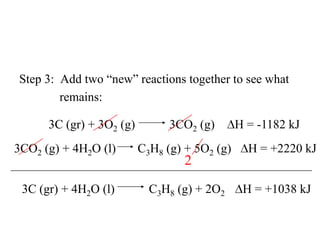
Step 3: Add two “new” reactions together to see what
        remains:

      3C (gr) + 3O2 (g)         3CO2 (g)       H = -1182 kJ
3CO2 (g) + 4H2O (l)       C3H8 (g) + 5O2 (g)     H = +2220 kJ
                                   2
 3C (gr) + 4H2O (l)         C3H8 (g) + 2O2      H = +1038 kJ
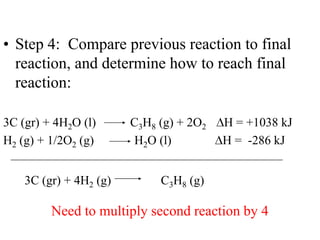
• Step 4: Compare previous reaction to final
  reaction, and determine how to reach final
  reaction:

3C (gr) + 4H2O (l)      C3H8 (g) + 2O2   H = +1038 kJ
H2 (g) + 1/2O2 (g)       H2O (l)         H = -286 kJ


    3C (gr) + 4H2 (g)        C3H8 (g)

         Need to multiply second reaction by 4
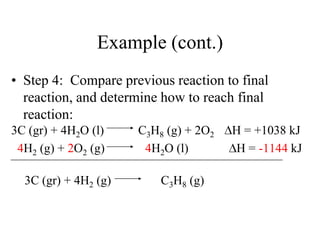
Example (cont.)
• Step 4: Compare previous reaction to final
  reaction, and determine how to reach final
  reaction:
3C (gr) + 4H2O (l)    C3H8 (g) + 2O2   H = +1038 kJ
 4H2 (g) + 2O2 (g)     4H2O (l)        H = -1144 kJ

  3C (gr) + 4H2 (g)       C3H8 (g)
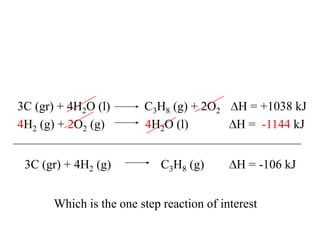
3C (gr) + 4H2O (l)       C3H8 (g) + 2O2     H = +1038 kJ
4H2 (g) + 2O2 (g)        4H2O (l)           H = -1144 kJ


 3C (gr) + 4H2 (g)           C3H8 (g)       H = -106 kJ


       Which is the one step reaction of interest
Another Example:

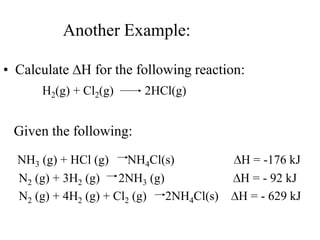
• Calculate H for the following reaction:
      H2(g) + Cl2(g)      2HCl(g)


 Given the following:
  NH3 (g) + HCl (g)     NH4Cl(s)           H = -176 kJ
  N2 (g) + 3H2 (g)    2NH3 (g)             H = - 92 kJ
  N2 (g) + 4H2 (g) + Cl2 (g)   2NH4Cl(s)   H = - 629 kJ
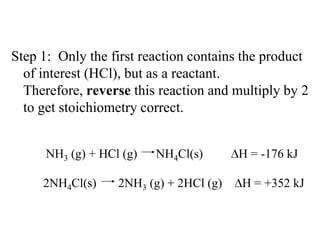
Step 1: Only the first reaction contains the product
  of interest (HCl), but as a reactant.
  Therefore, reverse this reaction and multiply by 2
  to get stoichiometry correct.


      NH3 (g) + HCl (g)   NH4Cl(s)       H = -176 kJ

     2NH4Cl(s)     2NH3 (g) + 2HCl (g)   H = +352 kJ
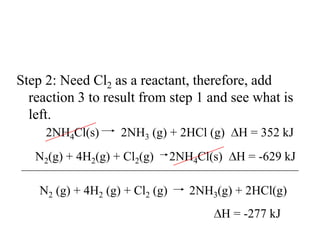
Step 2: Need Cl2 as a reactant, therefore, add
  reaction 3 to result from step 1 and see what is
  left.
     2NH4Cl(s)      2NH3 (g) + 2HCl (g)      H = 352 kJ
   N2(g) + 4H2(g) + Cl2(g)       2NH4Cl(s)   H = -629 kJ

    N2 (g) + 4H2 (g) + Cl2 (g)      2NH3(g) + 2HCl(g)
                                         H = -277 kJ
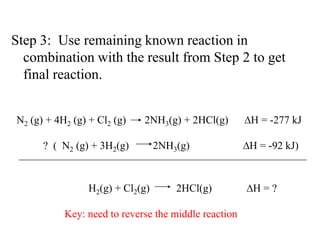
Step 3: Use remaining known reaction in
  combination with the result from Step 2 to get
  final reaction.


N2 (g) + 4H2 (g) + Cl2 (g)   2NH3(g) + 2HCl(g)        H = -277 kJ

      ? ( N2 (g) + 3H2(g)         2NH3(g)             H = -92 kJ)


                 H2(g) + Cl2(g)       2HCl(g)         H=?

           Key: need to reverse the middle reaction
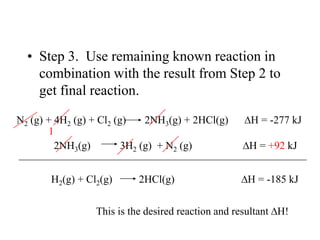
• Step 3. Use remaining known reaction in
    combination with the result from Step 2 to
    get final reaction.

N2 (g) + 4H2 (g) + Cl2 (g)    2NH3(g) + 2HCl(g)      H = -277 kJ
       1
         2NH3(g)         3H2 (g) + N2 (g)           H = +92 kJ


       H2(g) + Cl2(g)      2HCl(g)                  H = -185 kJ


                 This is the desired reaction and resultant H!

Kimia lecture

  • 1.
    Lecture 4: Hess’sLaw Reading: Zumdahl 9.5 Outline: Definition of Hess’ Law Using Hess’ Law (examples)
  • 2.
    Q: What isHess’s Law ? • Recall (lecture 3) Enthalpy is a state function. As such, H for going from some initial state to some final state is pathway independent. • Hess’s Law: H for a process involving the transformation of reactants into products is not dependent on pathway. (This means we can calculate H for a reaction by a single step, or by multiple steps)
  • 4.
    Using Hess’s Law N2(g) + 2O2 (g) 2NO 2 (g) When calculating H for a chemical reaction as a 2NO 2 (g) single step, we can use combinations of q reactions as “pathways” N2 (g) + 2O2 (g) to determine H for our “single step” reaction.
  • 5.
    The reaction ofinterest is: N2(g) + 2O2(g) 2NO2(g) H = 68 kJ This reaction can also be carried out in two steps: N2 (g) + O2 (g) 2NO(g) H = +180 kJ 2NO (g) + O2(g) 2NO2(g) H = -112 kJ
  • 6.
    • If wetake the previous two reactions and add them, we get the original reaction of interest: N2 (g) + O2 (g) 2NO(g) H = +180 kJ 2NO (g) + O2 (g) 2NO2(g) H = -112 kJ N2 (g) + 2O2 (g) 2NO2(g) H = + 68 kJ
  • 7.
    Note: the importantthings about this example is that the sum of H for the two reaction steps is equal to the H for the reaction of interest. Big idea: We can combine reactions of known H to determine the H for the overall “combined” reaction.
  • 8.
    Hess’s Law: AnImportant Detail One can always reverse the direction of a reaction when making a combined reaction. When you do this, the sign of H changes. N2(g) + 2O2(g) 2NO2(g) H = +68 kJ 2NO2(g) N2(g) + 2O2(g) H = - 68 kJ
  • 9.
    One more detail: •The magnitude of H is directly proportional to the quantities involved. (This means H is an “extensive” quantity). • So, if the coefficients of a reaction are multiplied by a number, the value of H is also multiplied by the same number. N2(g) + 2O2(g) 2NO2(g) H = 68 kJ N2(g) + 4O2(g) 4NO2(g) H = 136 kJ
  • 10.
    Using Hess’s Law:tips • When trying to combine reactions to form a reaction of interest, it is usually best to work backwards from the reaction of interest. • Example: What is H for the following reaction? 3C (gr) + 4H2 (g) C3H8 (g)
  • 11.
    3C (gr) +4H2 (g) C3H8 (g) H=? You’re given the following reactions: C (gr) + O2 (g) CO2 (g) H = -394 kJ C3H8 (g) + 5O2 (g) 3CO2 (g) + 4H2O (l) H = -2220 kJ H2 (g) + 1/2O2 (g) H2O (l) H = -286 kJ
  • 12.
    Step 1. Onlyreaction 1 has C (gr). Therefore, we will multiply by 3 to get the correct amount of C (gr) with respect to our final equation. (x3) C (gr) + O2 (g) CO2 (g) H = -394 kJ 3C (gr) + 3O2 (g) 3CO2 (g) H = -1182 kJ
  • 13.
    Step 2: Toget C3H8 on the product side of the reaction, we need to reverse reaction 2, and change the sign of H. C3H8 (g) + 5O2 (g) 3CO2 (g) + 4H2O (l) H = -2220 kJ 3CO2 (g) + 4H2O (l) C3H8 (g) + 5O2 (g) H = +2220 kJ
  • 14.
    Step 3: Addtwo “new” reactions together to see what remains: 3C (gr) + 3O2 (g) 3CO2 (g) H = -1182 kJ 3CO2 (g) + 4H2O (l) C3H8 (g) + 5O2 (g) H = +2220 kJ 2 3C (gr) + 4H2O (l) C3H8 (g) + 2O2 H = +1038 kJ
  • 15.
    • Step 4:Compare previous reaction to final reaction, and determine how to reach final reaction: 3C (gr) + 4H2O (l) C3H8 (g) + 2O2 H = +1038 kJ H2 (g) + 1/2O2 (g) H2O (l) H = -286 kJ 3C (gr) + 4H2 (g) C3H8 (g) Need to multiply second reaction by 4
  • 16.
    Example (cont.) • Step4: Compare previous reaction to final reaction, and determine how to reach final reaction: 3C (gr) + 4H2O (l) C3H8 (g) + 2O2 H = +1038 kJ 4H2 (g) + 2O2 (g) 4H2O (l) H = -1144 kJ 3C (gr) + 4H2 (g) C3H8 (g)
  • 17.
    3C (gr) +4H2O (l) C3H8 (g) + 2O2 H = +1038 kJ 4H2 (g) + 2O2 (g) 4H2O (l) H = -1144 kJ 3C (gr) + 4H2 (g) C3H8 (g) H = -106 kJ Which is the one step reaction of interest
  • 18.
    Another Example: • CalculateH for the following reaction: H2(g) + Cl2(g) 2HCl(g) Given the following: NH3 (g) + HCl (g) NH4Cl(s) H = -176 kJ N2 (g) + 3H2 (g) 2NH3 (g) H = - 92 kJ N2 (g) + 4H2 (g) + Cl2 (g) 2NH4Cl(s) H = - 629 kJ
  • 19.
    Step 1: Onlythe first reaction contains the product of interest (HCl), but as a reactant. Therefore, reverse this reaction and multiply by 2 to get stoichiometry correct. NH3 (g) + HCl (g) NH4Cl(s) H = -176 kJ 2NH4Cl(s) 2NH3 (g) + 2HCl (g) H = +352 kJ
  • 20.
    Step 2: NeedCl2 as a reactant, therefore, add reaction 3 to result from step 1 and see what is left. 2NH4Cl(s) 2NH3 (g) + 2HCl (g) H = 352 kJ N2(g) + 4H2(g) + Cl2(g) 2NH4Cl(s) H = -629 kJ N2 (g) + 4H2 (g) + Cl2 (g) 2NH3(g) + 2HCl(g) H = -277 kJ
  • 21.
    Step 3: Useremaining known reaction in combination with the result from Step 2 to get final reaction. N2 (g) + 4H2 (g) + Cl2 (g) 2NH3(g) + 2HCl(g) H = -277 kJ ? ( N2 (g) + 3H2(g) 2NH3(g) H = -92 kJ) H2(g) + Cl2(g) 2HCl(g) H=? Key: need to reverse the middle reaction
  • 22.
    • Step 3.Use remaining known reaction in combination with the result from Step 2 to get final reaction. N2 (g) + 4H2 (g) + Cl2 (g) 2NH3(g) + 2HCl(g) H = -277 kJ 1 2NH3(g) 3H2 (g) + N2 (g) H = +92 kJ H2(g) + Cl2(g) 2HCl(g) H = -185 kJ This is the desired reaction and resultant H!