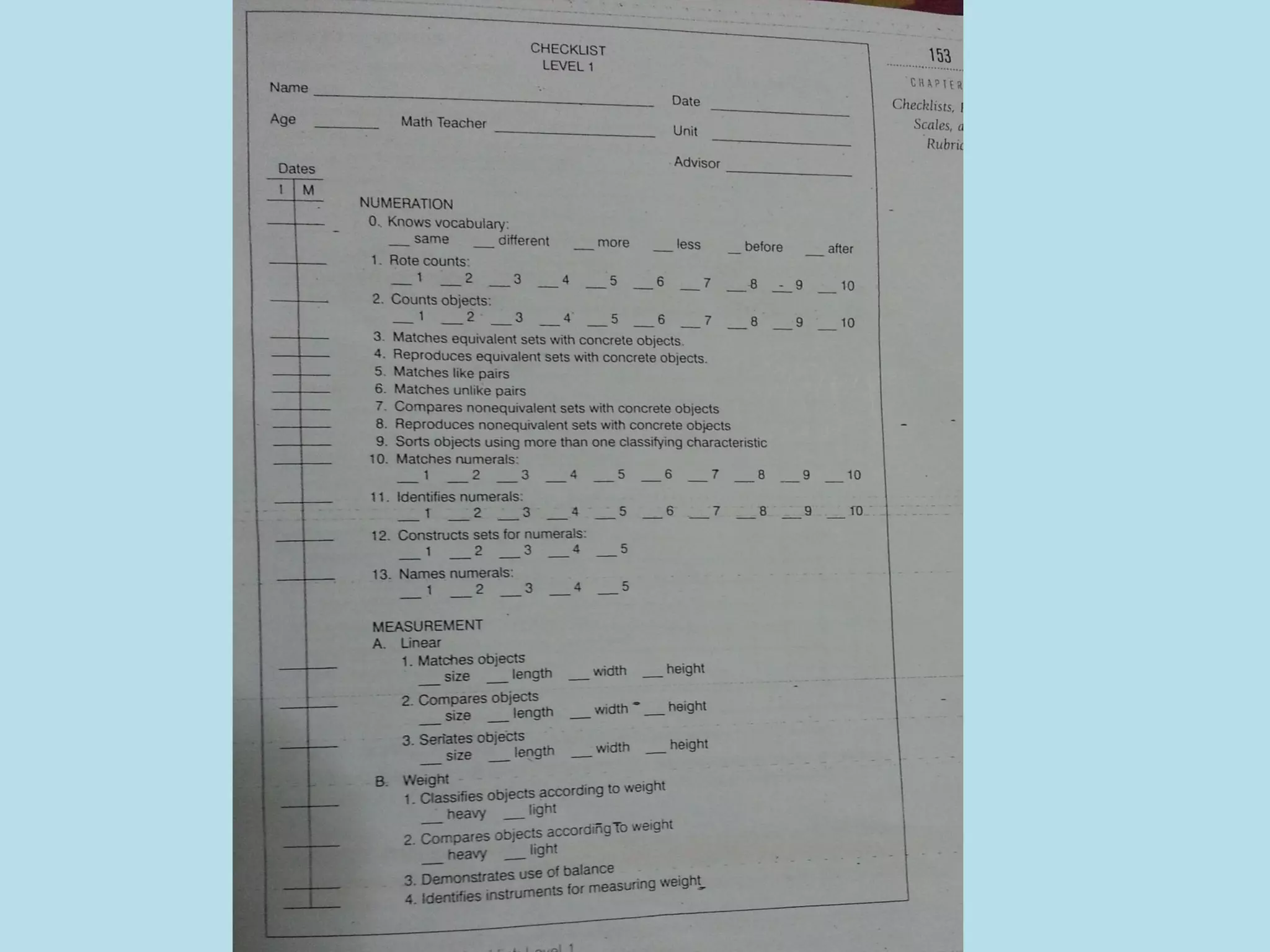
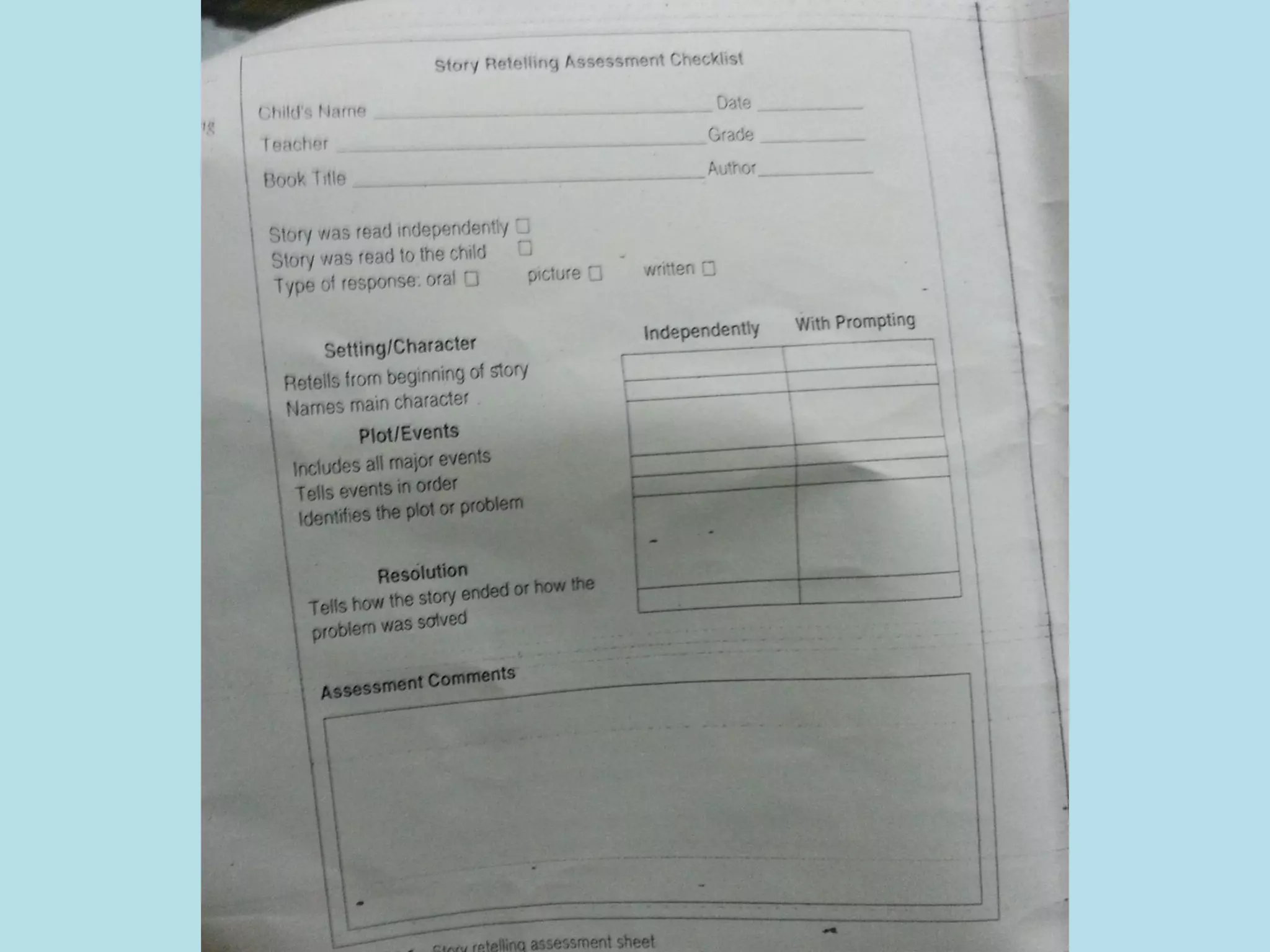
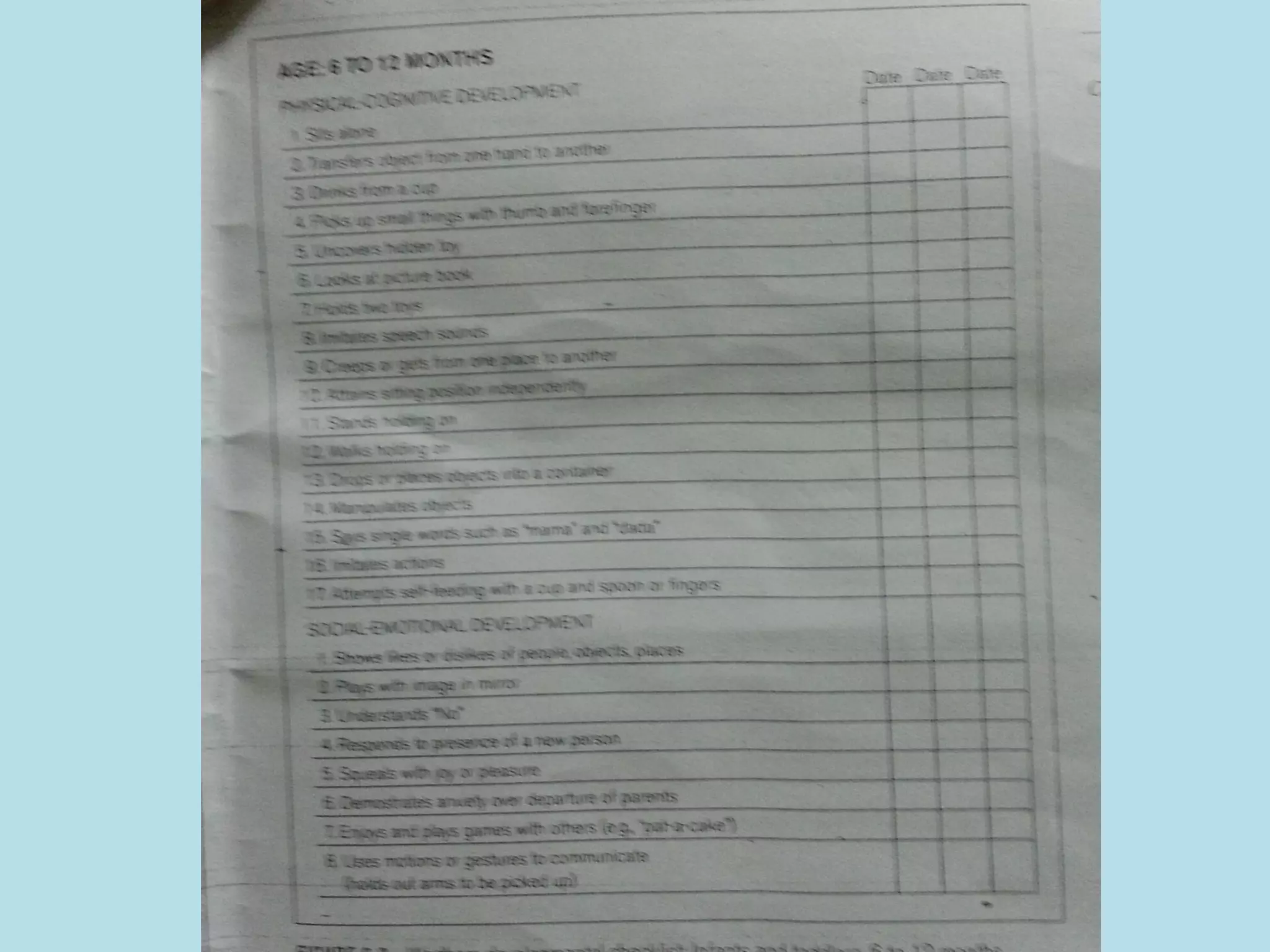
Checklists,
Rating Scales
and Rubrics
Checklists
are made from a collection of
learning objectives or
indicators of development
Checklists
P
U
R
P
O
S
E
S
Checklists
P
U
R
P
O
S
E
S
U
S
E
S
Checklists
P
U
R
P
O
S
E
S
U
S
E
S
D
E
S
I
G
N
E
D
Checklists
P
U
R
P
O
S
E
S
U
S
E
S
S
T
E
P
S
D
E
S
I
G
N
E
D
Purposes
To understand development
To serve as a framework for
curriculum development
To assess learning and
development
Purposes
To understand development:
All developmental
checklists are organized to
describe different areas of
growth including social,
motor and cognitive
development.
Purposes
To serve as a framework for
curriculum development:
• Follows the experiences and
opportunities that young children
should have in the early childhood years
• Have guides for learning activities that
will be appropriate for their children
Purposes
To assess learning and
development:
Teachers who use developmental
checklists to assess, evaluate and
record children’s progress may
eventually realize that they
have better understanding of
each child in the class.
Uses
Infants, Toddlers, and
Preschool Children
School-Age Children
Assess Children with
Delays in Development
Uses
Infants, Toddlers and Preschool
Children
• Uses developmental checklists which is
organized into categories of development:
Physical, Cognitive and Social
• Provides important clues to the kinds of
experiences he or she needs and can enjoy.
• Screen children who enter preschool
programs or select children for programs
Uses
School-Age Children
• Fewer developmental characteristics are
recorded and cognitive or academic
objectives become more important.
• More differentiated in areas of learning
• May appear on report cards as the format
for reporting the child’s achievement to
parents.
Uses
Assess Children with Delays in
Development
• Can be part of an integrated assessment
system that has multiple purposes including
continuous assessment of developmental
progress.
• Used with a family portfolio,
developmental guidelines and checklists
and summary of the child’s progress.
How Checklists are
Designed and Used
Evaluating and
Assessing with
Checklists
Evaluation can be
accomplished :
Through observation
During ongoing learning
activities
Through specific assessment
tasks
Through Observation
Children in early childhood
programs are active
learners thus their progress
is best assessed by watching
their behaviors rather than
using a test
During Ongoing
Learning Activities
The teacher can have
children demonstrate their
performance on a
particular skill as a part of
the lesson being conducted.
Through Specific
Assessment Tasks
The teacher determines a
number of objectives that
can be evaluated at one
time and devises tasks or
activities to conduct with a
child or a small group of
children.
Steps in Checklist
Design
Identification of the Skills to be
Included
Separate Listing of Target
Behaviors
Sequential Organization of the
Checklist
Record Keeping
Identification of the Skills to be
Included
The teacher studies
each checklist category
and determines the
specific objectives or
skills to be included
Separate Listing of Target
Behaviors
If a series of behaviors or
items are included in an
objective, the target
behaviors should be listed
separately so that they can
be recorded separately
(Irwin & Bushnell, 1980).
Separate Listing of Target
Behaviors
Identifies: Yes No
Penny
Nickel
Dime
Quarter
Sequential Organization of the
Checklist
Checklist items should
be arranged in order
of difficulty or
complexity
Record Keeping
It must have a method of
recording the status of the
items
Yes/No or Mastery/Nonmastery
Date
Checklists rating scales Rubrics for Preschool

Checklists rating scales Rubrics for Preschool