Observation vs. Inference
What is an observation? A. When you observe, you become aware of something using one of your senses. Your five senses are  smell, taste, sight, touch, and sound.  I an observation you simply describe something as it appears.  An observation is a statement describing a fact.
Observation In the space below, record 5 observations about your science classroom. 1. 2. 3. 4. 5.
Quantitative Observation Quantitative observation: (quantity)  How many.  Will always have a number. Based on exact measurement. Examples: The room is 8 meters across. Sarah is 141-cm tall. Sam weighs 450 Newtons
Qualitative Observation B. Sometimes scientists must make very careful observations. Often their senses are not good enough. There are some things that cannot be observed using just your senses. (Examples: radiation, sound waves, planets, cells, etc.)
Can you think of ways that scientists have solved this problem? How can scientists extend their senses? Microscopes, Telescopes, satellites, etc.
What is an inference? A. When you infer, you make a mental judgment based on observations. Inferences cannot be directly observed. They require thought. For example, if you get up in the morning, look up at the sky and observe dark clouds, observe the air is cool and humid, and observe puddles on the ground, you might infer that it has recently rained. Note: you did not  see  rain; you  decided  that it rained based on your observations.  An inference is a statement based on your interpretation of the facts.
List 3 inferences about the classroom 1. 2. 3.
Examples Observations That plant is extremely wilted. The car stopped running The Sox are leading there division Inferences That plant is extremely wilted due to a lack of water. The car stooped running because it was out of gas. The sox are leading there division because they are playing well right now.
More examples
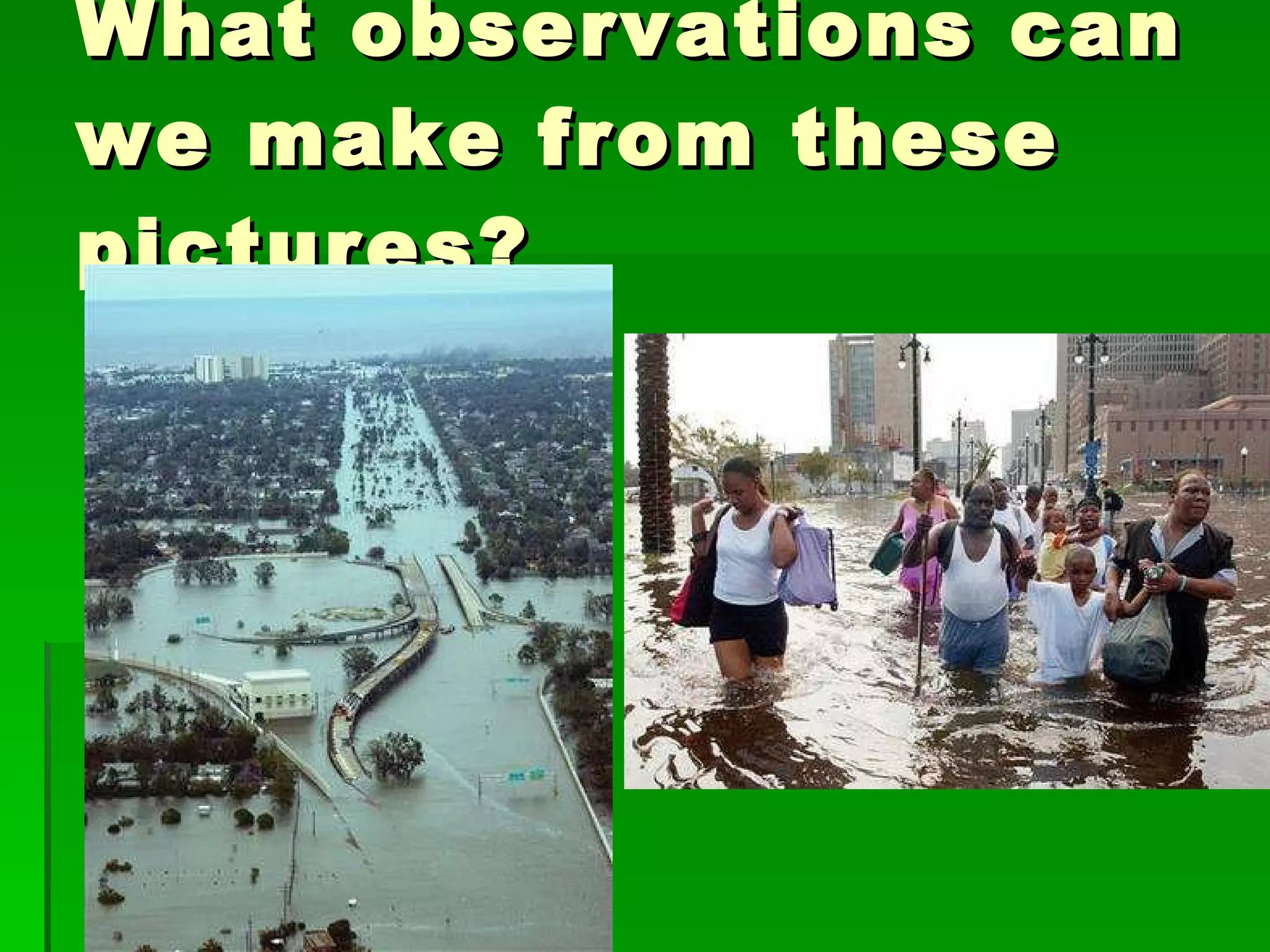
What observations can we make from these pictures?

Observation And Inferences Powerpoint

  • 1.
  • 2.
    What is anobservation? A. When you observe, you become aware of something using one of your senses. Your five senses are smell, taste, sight, touch, and sound. I an observation you simply describe something as it appears. An observation is a statement describing a fact.
  • 3.
    Observation In thespace below, record 5 observations about your science classroom. 1. 2. 3. 4. 5.
  • 4.
    Quantitative Observation Quantitativeobservation: (quantity) How many. Will always have a number. Based on exact measurement. Examples: The room is 8 meters across. Sarah is 141-cm tall. Sam weighs 450 Newtons
  • 5.
    Qualitative Observation B.Sometimes scientists must make very careful observations. Often their senses are not good enough. There are some things that cannot be observed using just your senses. (Examples: radiation, sound waves, planets, cells, etc.)
  • 6.
    Can you thinkof ways that scientists have solved this problem? How can scientists extend their senses? Microscopes, Telescopes, satellites, etc.
  • 7.
    What is aninference? A. When you infer, you make a mental judgment based on observations. Inferences cannot be directly observed. They require thought. For example, if you get up in the morning, look up at the sky and observe dark clouds, observe the air is cool and humid, and observe puddles on the ground, you might infer that it has recently rained. Note: you did not see rain; you decided that it rained based on your observations. An inference is a statement based on your interpretation of the facts.
  • 8.
    List 3 inferencesabout the classroom 1. 2. 3.
  • 9.
    Examples Observations Thatplant is extremely wilted. The car stopped running The Sox are leading there division Inferences That plant is extremely wilted due to a lack of water. The car stooped running because it was out of gas. The sox are leading there division because they are playing well right now.
  • 10.
  • 11.
    What observations canwe make from these pictures?