Infant/Toddler Curriculum: Planning, Observation and Documentation EDUU 326 Resources from: PITC and WestEd (2009) Lally (2009) Zero to Three California Infant/Toddler Curriculum Draft
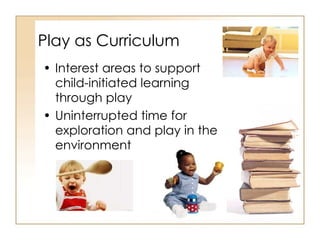
Play as Curriculum Interest areas to support child-initiated learning through play Uninterrupted time for exploration and play in the environment
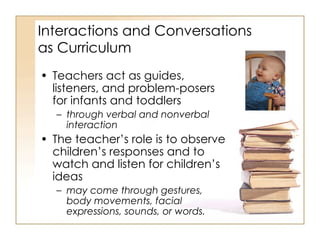
Interactions and Conversations  as Curriculum  Teachers act as guides, listeners, and problem-posers for infants and toddlers  through verbal and nonverbal interaction  The teacher’s role is to observe children’s responses and to watch and listen for children’s ideas may come through gestures, body movements, facial expressions, sounds, or words.
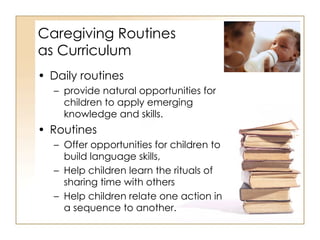
Caregiving Routines as Curriculum Daily routines  provide natural opportunities for children to apply emerging knowledge and skills. Routines  Offer opportunities for children to build language skills,  Help children learn the rituals of sharing time with others Help children relate one action in a sequence to another.
New Approaches in  Infant-Toddler Care Help Infants Form and Prolong Secure Attachments Infant–toddler care is now being structured to support attachments between parents and child, and caregivers and child. Help Infants with Positive Identity Formation Infant care teacher training is now being structured to help teachers understand their role in the child’s development of her first sense of self. Lally, J. Ronald (2009).  The Science and Psychology of Infant–Toddler Care: How an Understanding of Early Learning Has Transformed Child Care.  Zero to Three
New Approaches in  Infant-Toddler Care 3.  Include Family Child-Rearing Practices as Part of Care Infant care teachers structure care to keep the child’s connection to family strong. 4.  Treat Babies Differently at Different Points Along Their Developmental Trajectory Infant care teachers alter their behavior in relation to the transitions infants go through. (Lally, 2009)
New Approaches in  Infant-Toddler Care 5.  Engage in Responsive Practice The infant care teacher should be facilitative, responsive, reflective, and adaptive. 6.  Use a Reflective Curriculum Process Planning is also done to explore ways to help Teachers  (a) get “in tune” with each infant they care for (b) learn from the infant what he needs, thinks, and feels,  (c) find ways to deepen their relationships with the children. (Lally, 2009)
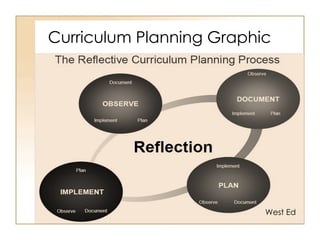
Planning the Infant/Toddler Curriculum Observe, Reflect Document, Reflect Reflect, Discuss,  Plan Implement, Reflect Partner with Families  in Planning   Curriculum CDE CA IT Curriculum Draft
Curriculum Planning Graphic West Ed
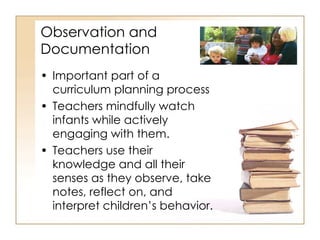
Observation and Documentation Important part of a curriculum planning process Teachers mindfully watch infants while actively engaging with them. Teachers use their knowledge and all their senses as they observe, take notes, reflect on, and interpret children’s behavior.
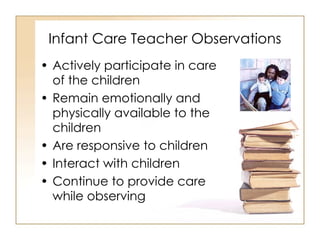
Infant Care Teacher Observations Actively participate in care of the children Remain emotionally and physically available to the children  Are responsive to children  Interact with children Continue to provide care while observing
Watch, Ask, and Adapt PITC’s “Watch, Ask, and Adapt” process  Work hand in hand with curriculum planning that includes observation, documentation, and assessment.  Infant/toddler care teachers  observe to be responsive  build relationships with infants  deepen their understanding of children’s development and learning discover ways to support children’s development and learning
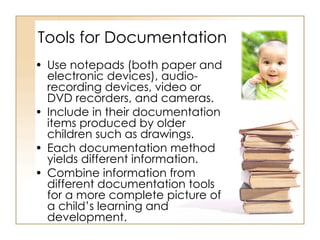
Tools for Documentation Use notepads (both paper and electronic devices), audio-recording devices, video or DVD recorders, and cameras.  Include in their documentation items produced by older children such as drawings. Each documentation method yields different information. Combine information from different documentation tools for a more complete picture of a child’s learning and development.
Planning Based on Observation, Documentation, and Assessment Helps teachers plan for the next steps in the child’s learning.  Informs curriculum plans since teachers are able to predict what each child is likely to focus on over the next days or weeks. Information from assessment results pertinent to the child’s developmental level in different areas may inform a plan. Plans can be brief and flexible - not written in stone.  ‘ The general principle of responsiveness to the child’s moment-to-moment interests and needs applies to this part of the curriculum planning process

Infant toddler curriculum

  • 1.
    Infant/Toddler Curriculum: Planning,Observation and Documentation EDUU 326 Resources from: PITC and WestEd (2009) Lally (2009) Zero to Three California Infant/Toddler Curriculum Draft
  • 2.
    Play as CurriculumInterest areas to support child-initiated learning through play Uninterrupted time for exploration and play in the environment
  • 3.
    Interactions and Conversations as Curriculum Teachers act as guides, listeners, and problem-posers for infants and toddlers through verbal and nonverbal interaction The teacher’s role is to observe children’s responses and to watch and listen for children’s ideas may come through gestures, body movements, facial expressions, sounds, or words.
  • 4.
    Caregiving Routines asCurriculum Daily routines provide natural opportunities for children to apply emerging knowledge and skills. Routines Offer opportunities for children to build language skills, Help children learn the rituals of sharing time with others Help children relate one action in a sequence to another.
  • 5.
    New Approaches in Infant-Toddler Care Help Infants Form and Prolong Secure Attachments Infant–toddler care is now being structured to support attachments between parents and child, and caregivers and child. Help Infants with Positive Identity Formation Infant care teacher training is now being structured to help teachers understand their role in the child’s development of her first sense of self. Lally, J. Ronald (2009). The Science and Psychology of Infant–Toddler Care: How an Understanding of Early Learning Has Transformed Child Care. Zero to Three
  • 6.
    New Approaches in Infant-Toddler Care 3. Include Family Child-Rearing Practices as Part of Care Infant care teachers structure care to keep the child’s connection to family strong. 4. Treat Babies Differently at Different Points Along Their Developmental Trajectory Infant care teachers alter their behavior in relation to the transitions infants go through. (Lally, 2009)
  • 7.
    New Approaches in Infant-Toddler Care 5. Engage in Responsive Practice The infant care teacher should be facilitative, responsive, reflective, and adaptive. 6. Use a Reflective Curriculum Process Planning is also done to explore ways to help Teachers (a) get “in tune” with each infant they care for (b) learn from the infant what he needs, thinks, and feels, (c) find ways to deepen their relationships with the children. (Lally, 2009)
  • 8.
    Planning the Infant/ToddlerCurriculum Observe, Reflect Document, Reflect Reflect, Discuss, Plan Implement, Reflect Partner with Families in Planning Curriculum CDE CA IT Curriculum Draft
  • 9.
  • 10.
    Observation and DocumentationImportant part of a curriculum planning process Teachers mindfully watch infants while actively engaging with them. Teachers use their knowledge and all their senses as they observe, take notes, reflect on, and interpret children’s behavior.
  • 11.
    Infant Care TeacherObservations Actively participate in care of the children Remain emotionally and physically available to the children Are responsive to children Interact with children Continue to provide care while observing
  • 12.
    Watch, Ask, andAdapt PITC’s “Watch, Ask, and Adapt” process Work hand in hand with curriculum planning that includes observation, documentation, and assessment. Infant/toddler care teachers observe to be responsive build relationships with infants deepen their understanding of children’s development and learning discover ways to support children’s development and learning
  • 13.
    Tools for DocumentationUse notepads (both paper and electronic devices), audio-recording devices, video or DVD recorders, and cameras. Include in their documentation items produced by older children such as drawings. Each documentation method yields different information. Combine information from different documentation tools for a more complete picture of a child’s learning and development.
  • 14.
    Planning Based onObservation, Documentation, and Assessment Helps teachers plan for the next steps in the child’s learning. Informs curriculum plans since teachers are able to predict what each child is likely to focus on over the next days or weeks. Information from assessment results pertinent to the child’s developmental level in different areas may inform a plan. Plans can be brief and flexible - not written in stone. ‘ The general principle of responsiveness to the child’s moment-to-moment interests and needs applies to this part of the curriculum planning process