Communication Strategy Development Questioning our needs and assumptions
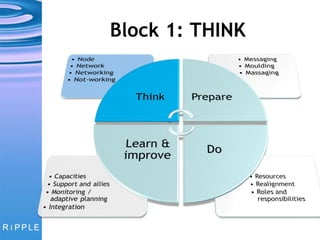
Overview Four blocks of communication questions relating to  four essential actions , i.e.: Think Prepare Do Improve
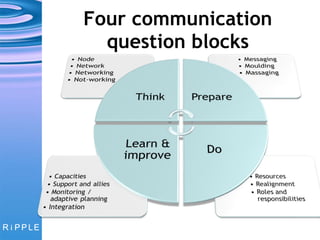
Four communication question blocks
Four communication question blocks These questions are: Indicative Interactive Iterative Integrative Anything starting with I and ending with  ive ?
THINK! Photo credits: Gutter
Block 1: THINK
THINK: Node The  node  is YOU / your organisation What is your vision? What is your mission? What are you doing? Why? What kind of institution are you / What is your scale?  Organisation? Programme? Network? Project? Event?
THINK: Network The  network  represents the institutions around you Who are your target audiences?  Primary / secondary? Who should know about your work? Who do you need to engage with to address your issues / objectives?  Who are you trying to affect / influence?
THINK: Networking The  networking vision  is your overall plan re: your audiences How can communication activities help you achieve your objective? Do you want to push information, pull information, share-learn-engage? What should your audiences do with your work?
THINK: Networking ( 2 ) The  networking vision  is your overall plan re: your audiences What are you trying to achieve with each audience? What would be your communication goals?
THINK: Not-working Sometimes you need communication to get rid of constraints. What is  not working  for you? What communication-related challenges are you facing? What is the  main  issue you are dealing with, where communication can help?
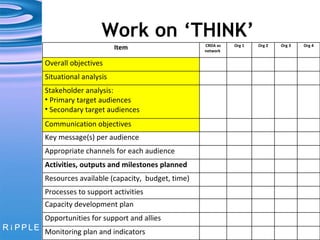
Work on ‘THINK’ Fill out the ‘THINK’ part of the matrix: For each question use a card See if you can organise the cards and link them together Fill out the matrix (see next slide) Check your work with neighbouring tables? Note down your content questions Note down your process issues
Work on ‘THINK’ Item CRDA as network  Org 1 Org 2 Org 3 Org 4 Overall objectives Situational analysis Stakeholder analysis:  Primary target audiences Secondary target audiences Communication objectives Key message(s) per audience Appropriate channels for each audience Activities, outputs and milestones planned Resources available (capacity,  budget, time) Processes to support activities Capacity development plan Opportunities for support and allies Monitoring plan and indicators
PREPARE! Photo credits: Fotoos van Robin
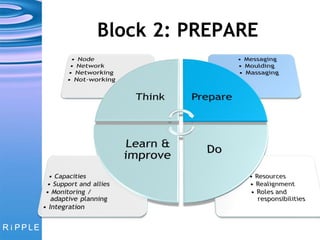
Block 2: PREPARE
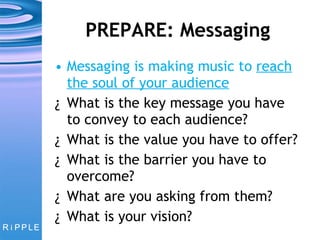
PREPARE: Messaging Messaging is making music to  reach the soul of your audience What is the key message you have to convey to each audience? What is the value you have to offer? What is the barrier you have to overcome? What are you asking from them? What is your vision?
PREPARE: Moulding Moulding is about  adapting/refining  to the preferences of your audience What channel should you use to reach each audience?  What products / services / outputs do you plan to produce? What is the difference between activities, channels and outputs?
PREPARE: Massaging Massaging is  integrating  your communication with your other work and ensuring it’s adding sense Why do you want a separate communication strategy (document)? What is the form ( structure ) of your strategy?  What do you need to ensure the strategy reinforces, rather than hinders your approach?
Work on ‘PREPARE’ Fill out the ‘PREPARE’ part of the matrix: For each question use a card See if you can organise the cards and link them together Fill out the matrix (see next slide) Check your work with neighbouring tables? Note down your content questions Note down your process issues
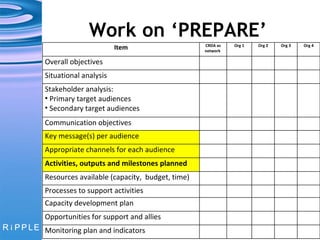
Work on ‘PREPARE’ Item CRDA as network  Org 1 Org 2 Org 3 Org 4 Overall objectives Situational analysis Stakeholder analysis:  Primary target audiences Secondary target audiences Communication objectives Key message(s) per audience Appropriate channels for each audience Activities, outputs and milestones planned Resources available (capacity,  budget, time) Processes to support activities Capacity development plan Opportunities for support and allies Monitoring plan and indicators
(just)  DO  (it) ! Photo credits: Mark E. Dyer
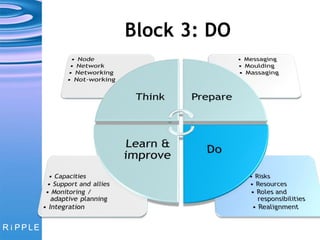
Block 3: DO
DO: Risks Long preparation, short war!  Risk assessment  is sound management What risks are you bearing? What threats are you facing? How likely / influential are they? What are key element of quality that you need to keep in mind to make your communications credible?
DO: Resources Your resources determine the  realism/robustness  of your plans What budget do you have (how much)? How much do you need? What capacity (skills + time) do you have to carry out your activities? What can you do yourself and what needs (external) support?
DO: Roles and responsibilities The key to a solid implementation:  who does what  (clearly)? Who (internally) needs to be involved in the communication strategy development? Who will carry out what activity?
DO: Realignment Integration  again! Make sure your comms efforts tie in with the rest What is your implementation plan?  What activities?  What outputs / outcomes?  What milestones? What processes (workflow) should you design to support development of outputs/ products?
Work on ‘DO’ Fill out the ‘DO’ part of the matrix: For each question use a card See if you can organise the cards and link them together Fill out the matrix (see next slide) Check your work with neighbouring tables? Note down your content questions Note down your process issues
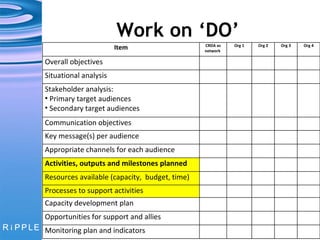
Work on ‘DO’ Item CRDA as network  Org 1 Org 2 Org 3 Org 4 Overall objectives Situational analysis Stakeholder analysis:  Primary target audiences Secondary target audiences Communication objectives Key message(s) per audience Appropriate channels for each audience Activities, outputs and milestones planned Resources available (capacity,  budget, time) Processes to support activities Capacity development plan Opportunities for support and allies Monitoring plan and indicators
IMPROVE! Photo credits: Steve Sawyer
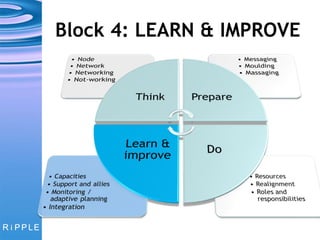
Block 4: LEARN & IMPROVE
LEARN & IMPROVE: Capacities Activities  depend on people . Think and care about them: empower What could have been improved?  Where did you lack skills / capacities? What capacity development activities can you plan?
LEARN & IMPROVE: Support & allies Out there,  someone or something can help you : be curious! Who (ind/org/netw) can you involve to work on your plans?  What events and movements can you use to piggyback on? What resources are available to implement your plans?
LEARN & IMPROVE:  Monitoring & adaptive planning The best plan is just not good enough! What matters is to  monitor and improve over time What would you consider measures / statements of success? How are you planning (methods) to monitor your expected success?  How will your monitoring link back to improved planning?
LEARN & IMPROVE: Integration And again:  unite and rise ! How to integrate your communication activities in day-to-day practices? What activities do you need to cut out (or sub-contract) because they drive you away from your core ‘business’?
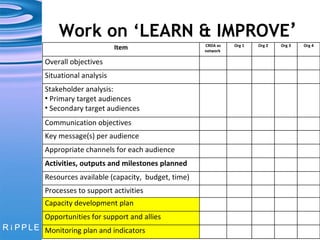
Work on ‘LEARN & IMPROVE’ Fill out the ‘LEARN & IMPROVE’ part of the matrix: For each question use a card See if you can organise the cards and link them together Fill out the matrix (see next slide) Check your work with neighbouring tables? Note down your content questions Note down your process issues
Work on ‘LEARN & IMPROVE ’ Item CRDA as network  Org 1 Org 2 Org 3 Org 4 Overall objectives Situational analysis Stakeholder analysis:  Primary target audiences Secondary target audiences Communication objectives Key message(s) per audience Appropriate channels for each audience Activities, outputs and milestones planned Resources available (capacity,  budget, time) Processes to support activities Capacity development plan Opportunities for support and allies Monitoring plan and indicators
What structure for your communication strategy? Overall objectives : Good to add clearly (at beginning) Situational analysis : To integrate in a summarised assessment? Stakeholder analysis : Rather mention primary / secondary audiences? Perhaps mention influence of some. Comms objectives : Should be clearly mentioned and restated in the executive summary. Key messages : For you to decide. If clear enough, add them? Otherwise include them at a more general level. Appropriate channels : No need to show a table but useful to clearly state how (through what channels [and outputs]) you will reach each target audience Activities / outputs /  milestones : Key! Put a table? Organise it per target audience? Milestones if you have an operational plan (GANTT chart?)
What structure for your communication strategy? Resources available : No need to include it as is but also possible (budget mentioned). Human resources and timeframe should be mentioned however. Support processes : If you include it, mention it in a summarised way. It’s more useful for you. Capacity development plan : Best not to mention it? Opportunities for support / allies : Add it as part of your audiences? In your assessment of the context? In a risk and opportunity part? Monitoring plan / indicators : Should be mentioned. To develop to the degree of detail that you like. Other elements : Principles? Risks? Images/ graphs/ pictures? Annual operational plan? Budget? Proofs of your results? Process to develop strategy? References?  What to put in the body / what in the appendixes?
Activities, channels, outputs? Activities:  What you will do . Organise workshops; Write publications etc. Channels:  Where you will circulate information . Electronic: World Wide Web, email, discussion group... Face-to-face: Workshop, training, event, discussion, theatre... Print: publications, graphic display etc. Other media: TV, radio. Outputs:  What you will transmit  through channels. Website, electronic newsletter, e-conference, facilitated discussion on discussion group. Workshop reports, training course, video of theatre play Briefing notes, working papers, specific posters

Checklist Communication Strategy Development

  • 1.
    Communication Strategy DevelopmentQuestioning our needs and assumptions
  • 2.
    Overview Four blocksof communication questions relating to four essential actions , i.e.: Think Prepare Do Improve
  • 3.
  • 4.
    Four communication questionblocks These questions are: Indicative Interactive Iterative Integrative Anything starting with I and ending with ive ?
  • 5.
  • 6.
  • 7.
    THINK: Node The node is YOU / your organisation What is your vision? What is your mission? What are you doing? Why? What kind of institution are you / What is your scale? Organisation? Programme? Network? Project? Event?
  • 8.
    THINK: Network The network represents the institutions around you Who are your target audiences? Primary / secondary? Who should know about your work? Who do you need to engage with to address your issues / objectives? Who are you trying to affect / influence?
  • 9.
    THINK: Networking The networking vision is your overall plan re: your audiences How can communication activities help you achieve your objective? Do you want to push information, pull information, share-learn-engage? What should your audiences do with your work?
  • 10.
    THINK: Networking (2 ) The networking vision is your overall plan re: your audiences What are you trying to achieve with each audience? What would be your communication goals?
  • 11.
    THINK: Not-working Sometimesyou need communication to get rid of constraints. What is not working for you? What communication-related challenges are you facing? What is the main issue you are dealing with, where communication can help?
  • 12.
    Work on ‘THINK’Fill out the ‘THINK’ part of the matrix: For each question use a card See if you can organise the cards and link them together Fill out the matrix (see next slide) Check your work with neighbouring tables? Note down your content questions Note down your process issues
  • 13.
    Work on ‘THINK’Item CRDA as network Org 1 Org 2 Org 3 Org 4 Overall objectives Situational analysis Stakeholder analysis: Primary target audiences Secondary target audiences Communication objectives Key message(s) per audience Appropriate channels for each audience Activities, outputs and milestones planned Resources available (capacity, budget, time) Processes to support activities Capacity development plan Opportunities for support and allies Monitoring plan and indicators
  • 14.
    PREPARE! Photo credits:Fotoos van Robin
  • 15.
  • 16.
    PREPARE: Messaging Messagingis making music to reach the soul of your audience What is the key message you have to convey to each audience? What is the value you have to offer? What is the barrier you have to overcome? What are you asking from them? What is your vision?
  • 17.
    PREPARE: Moulding Mouldingis about adapting/refining to the preferences of your audience What channel should you use to reach each audience? What products / services / outputs do you plan to produce? What is the difference between activities, channels and outputs?
  • 18.
    PREPARE: Massaging Massagingis integrating your communication with your other work and ensuring it’s adding sense Why do you want a separate communication strategy (document)? What is the form ( structure ) of your strategy? What do you need to ensure the strategy reinforces, rather than hinders your approach?
  • 19.
    Work on ‘PREPARE’Fill out the ‘PREPARE’ part of the matrix: For each question use a card See if you can organise the cards and link them together Fill out the matrix (see next slide) Check your work with neighbouring tables? Note down your content questions Note down your process issues
  • 20.
    Work on ‘PREPARE’Item CRDA as network Org 1 Org 2 Org 3 Org 4 Overall objectives Situational analysis Stakeholder analysis: Primary target audiences Secondary target audiences Communication objectives Key message(s) per audience Appropriate channels for each audience Activities, outputs and milestones planned Resources available (capacity, budget, time) Processes to support activities Capacity development plan Opportunities for support and allies Monitoring plan and indicators
  • 21.
    (just) DO (it) ! Photo credits: Mark E. Dyer
  • 22.
  • 23.
    DO: Risks Longpreparation, short war! Risk assessment is sound management What risks are you bearing? What threats are you facing? How likely / influential are they? What are key element of quality that you need to keep in mind to make your communications credible?
  • 24.
    DO: Resources Yourresources determine the realism/robustness of your plans What budget do you have (how much)? How much do you need? What capacity (skills + time) do you have to carry out your activities? What can you do yourself and what needs (external) support?
  • 25.
    DO: Resources Yourresources determine the realism/robustness of your plans What budget do you have (how much)? How much do you need? What capacity (skills + time) do you have to carry out your activities? What can you do yourself and what needs (external) support?
  • 26.
    DO: Roles andresponsibilities The key to a solid implementation: who does what (clearly)? Who (internally) needs to be involved in the communication strategy development? Who will carry out what activity?
  • 27.
    DO: Realignment Integration again! Make sure your comms efforts tie in with the rest What is your implementation plan? What activities? What outputs / outcomes? What milestones? What processes (workflow) should you design to support development of outputs/ products?
  • 28.
    Work on ‘DO’Fill out the ‘DO’ part of the matrix: For each question use a card See if you can organise the cards and link them together Fill out the matrix (see next slide) Check your work with neighbouring tables? Note down your content questions Note down your process issues
  • 29.
    Work on ‘DO’Item CRDA as network Org 1 Org 2 Org 3 Org 4 Overall objectives Situational analysis Stakeholder analysis: Primary target audiences Secondary target audiences Communication objectives Key message(s) per audience Appropriate channels for each audience Activities, outputs and milestones planned Resources available (capacity, budget, time) Processes to support activities Capacity development plan Opportunities for support and allies Monitoring plan and indicators
  • 30.
  • 31.
    Block 4: LEARN& IMPROVE
  • 32.
    LEARN & IMPROVE:Capacities Activities depend on people . Think and care about them: empower What could have been improved? Where did you lack skills / capacities? What capacity development activities can you plan?
  • 33.
    LEARN & IMPROVE:Support & allies Out there, someone or something can help you : be curious! Who (ind/org/netw) can you involve to work on your plans? What events and movements can you use to piggyback on? What resources are available to implement your plans?
  • 34.
    LEARN & IMPROVE: Monitoring & adaptive planning The best plan is just not good enough! What matters is to monitor and improve over time What would you consider measures / statements of success? How are you planning (methods) to monitor your expected success? How will your monitoring link back to improved planning?
  • 35.
    LEARN & IMPROVE:Integration And again: unite and rise ! How to integrate your communication activities in day-to-day practices? What activities do you need to cut out (or sub-contract) because they drive you away from your core ‘business’?
  • 36.
    Work on ‘LEARN& IMPROVE’ Fill out the ‘LEARN & IMPROVE’ part of the matrix: For each question use a card See if you can organise the cards and link them together Fill out the matrix (see next slide) Check your work with neighbouring tables? Note down your content questions Note down your process issues
  • 37.
    Work on ‘LEARN& IMPROVE ’ Item CRDA as network Org 1 Org 2 Org 3 Org 4 Overall objectives Situational analysis Stakeholder analysis: Primary target audiences Secondary target audiences Communication objectives Key message(s) per audience Appropriate channels for each audience Activities, outputs and milestones planned Resources available (capacity, budget, time) Processes to support activities Capacity development plan Opportunities for support and allies Monitoring plan and indicators
  • 38.
    What structure foryour communication strategy? Overall objectives : Good to add clearly (at beginning) Situational analysis : To integrate in a summarised assessment? Stakeholder analysis : Rather mention primary / secondary audiences? Perhaps mention influence of some. Comms objectives : Should be clearly mentioned and restated in the executive summary. Key messages : For you to decide. If clear enough, add them? Otherwise include them at a more general level. Appropriate channels : No need to show a table but useful to clearly state how (through what channels [and outputs]) you will reach each target audience Activities / outputs / milestones : Key! Put a table? Organise it per target audience? Milestones if you have an operational plan (GANTT chart?)
  • 39.
    What structure foryour communication strategy? Resources available : No need to include it as is but also possible (budget mentioned). Human resources and timeframe should be mentioned however. Support processes : If you include it, mention it in a summarised way. It’s more useful for you. Capacity development plan : Best not to mention it? Opportunities for support / allies : Add it as part of your audiences? In your assessment of the context? In a risk and opportunity part? Monitoring plan / indicators : Should be mentioned. To develop to the degree of detail that you like. Other elements : Principles? Risks? Images/ graphs/ pictures? Annual operational plan? Budget? Proofs of your results? Process to develop strategy? References? What to put in the body / what in the appendixes?
  • 40.
    Activities, channels, outputs?Activities: What you will do . Organise workshops; Write publications etc. Channels: Where you will circulate information . Electronic: World Wide Web, email, discussion group... Face-to-face: Workshop, training, event, discussion, theatre... Print: publications, graphic display etc. Other media: TV, radio. Outputs: What you will transmit through channels. Website, electronic newsletter, e-conference, facilitated discussion on discussion group. Workshop reports, training course, video of theatre play Briefing notes, working papers, specific posters