The PR challenge for Associations Getting maximum bang for minimum bucks What every Executive Director should know
Who are we? Four Winds Communications specialises in comms. services for Associations We provide: Strategic comms. planning Media management/training Lobbying/advocacy Membership comms. services All tailored specifically for the unique needs of Associations
Membership organisations Hundreds of associations Think of an industry – there’ll be an association e.g.  NZ Sheep Breeders Association The Funeral Directors Association of New Zealand NZ Continence Association NZ Poultry Association NZ Hang Gliding and Paragliding Association NZ Tourism Industry Association
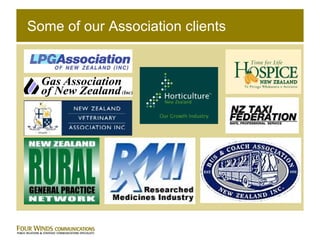
Some of our Association clients
New Zealand Veterinary Association 1780 members Members include vets in rural and urban practices, government service, universities, technical & research institutes, pharmaceutical companies & other related industries & students. 80% + membership of all registered veterinarians Microchipping was big issue Advocates on NZ’s biosecurity + codes of practices for urban vets
Taxi Federation Represents an industry of over 3000 members Taxi organisations, limousine services, and shuttle services from co-operatives with 700 plus taxis to single unit operators Stamp out the cowboys (restrict industry entry) Access to bus lanes Compliance and relationships with city authorities
GANZ Six big members + further 45 associate members Represents organisations in gas sector involved in transporting and trading gas  Interests from major pipeline coys to appliance sellers/installers Advocating for fuel switching in energy policy + range of technical regulatory issues relating to pricing
What makes advocacy  organisations  different? Diverse internal audiences Significant size disparities in membership numbers Not-for-profit Must meet a range of different comms. expectations
Membership organisations: A communications challenge Membership organisations have unique comms. challenges Not as well resourced as corporates Small budgets But wide range of comms. issues Resources & budgets split across many fronts Must deliver perceived value for money But the biggest challenge is …
Keeping the membership happy Massive differences in the business focus/interests of members Often differences in business acumen Differences in business imperatives Different hot/cold buttons Massive differences in the comms. tools they’ll use/respond to, or think are warranted They’re not always easily reachable
Members versus staff/shareholders Members more active/demanding/vocal Members demand service/profile They expect their Association to protect their regulatory environment They want quality ongoing comms. (it’s usually a KPI) They want to be fully consulted They want everything yesterday!
Keeping the bosses happy Controlled by board or council Often has conflicting views/agendas Can be captured by dominant personality, or hindered by lack of consensus  Part-time decision-makers Making comms. decisions when not experienced
A broad comms. focus Broad business and stakeholder focus = broad comms. focus Mix of strategic and operational comms activities Real need to demonstrate value for investment Very easy to measure effectiveness of comms.
Comms. techniques Strategic Audit and analysis, planning, counsel, training crisis/issues management Public relations Media management, stakeholder relations, public information campaigns, marketing comms. Govt. relations Lobbying/advocacy, submissions, ‘intelligence’, policy analysis Membership comms. Publications/writing, website management, information sharing, professional development initiatives, event management
Most useful internal comms. tools Newsletter/magazine Short, pithy, Trans-Tasman style, issues and outcome-focused Txt on key issues to selected members Email briefs (where appropriate) Members’ intranet Using sector leaders/influencers as networkers to membership Phone calls to smaller members every so often
Getting bang for buck - externally Operate smarter Be selective – especially relationship management, lobbying, media Use leverage Set realistic expectations
Getting bang for buck - internally Understand members’ needs Consistent and frequent Make the conference count Nothing wrong with low tech.
Measuring effectiveness Done by survey Members actively complain/leave Direct impact on management Direct impact on income Executive Director reports progress monthly to Council/Board Budgets and progress assessed against KPIs
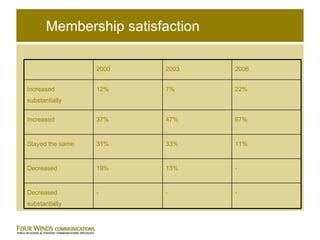
Membership satisfaction - - - Decreased substantially - 13% 19% Decreased 11% 33% 31% Stayed the same 67% 47% 37% Increased 22% 7% 12% Increased substantially 2006 2003 2000
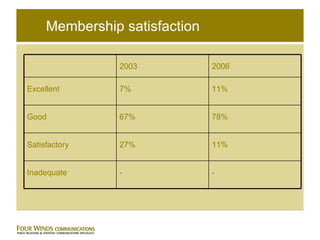
Membership satisfaction - - Inadequate 11% 27% Satisfactory 78% 67% Good 11% 7% Excellent 2006 2003
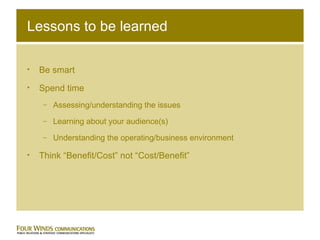
Lessons to be learned Be smart Spend time Assessing/understanding the issues Learning about your audience(s) Understanding the operating/business environment Think “Benefit/Cost” not “Cost/Benefit”
How what you don't know you don't know can ruin an otherwise great staff comms. plan OR When visions and missions miss the point
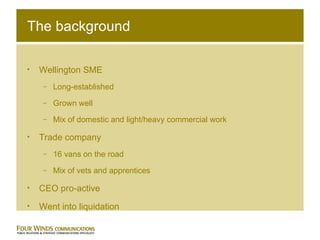
The background Wellington SME Long-established Grown well Mix of domestic and light/heavy commercial work Trade company 16 vans on the road Mix of vets and apprentices CEO pro-active Went into liquidation
The issue Company was not making money Growth had stopped Repeat business hard to come by Overheads higher Staff were ‘aware of the situation’
The plan Company operated internal comms plan Had company mission Had company vision Had structured staff briefings Had little news sheet CEO managed by walkabout
Our role External marketing Profile-raising Business development Engage/brief staff
What we did Interviewed all staff Developed collateral material Agreed target markets Established ‘time and motion’ study
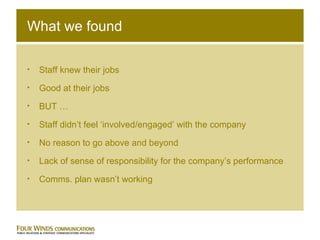
What we found Staff knew their jobs Good at their jobs BUT … Staff didn’t feel ‘involved/engaged’ with the company No reason to go above and beyond Lack of sense of responsibility for the company’s performance Comms. plan wasn’t working
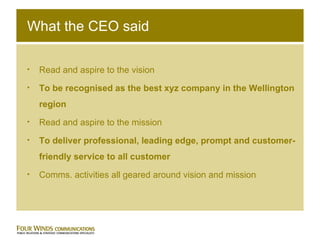
What the CEO said Read and aspire to the vision To be recognised as the best xyz company in the Wellington region Read and aspire to the mission To deliver professional, leading edge, prompt and customer-friendly service to all customer Comms. activities all geared around vision and mission
What the CEO didn’t know Neither the vision nor the mission meant anything personal to staff.
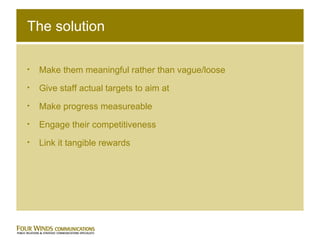
The solution Make them meaningful rather than vague/loose Give staff actual targets to aim at Make progress measureable Engage their competitiveness Link it tangible rewards
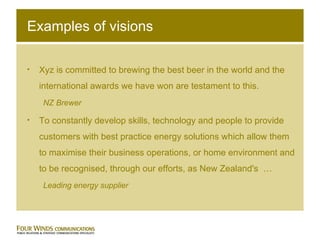
Examples of visions Xyz is committed to brewing the best beer in the world and the international awards we have won are testament to this.   NZ Brewer To constantly develop skills, technology and people to provide customers with best practice energy solutions which allow them to maximise their business operations, or home environment and to be recognised, through our efforts, as New Zealand's  … Leading energy supplier
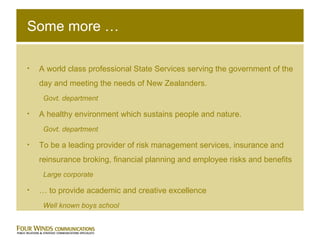
Some more … A world class professional State Services serving the government of the day and meeting the needs of New Zealanders. Govt. department A healthy environment which sustains people and nature.  Govt. department To be a leading provider of risk management services, insurance and reinsurance broking, financial planning and employee risks and benefits  Large corporate …  to provide academic and creative excellence Well known boys school
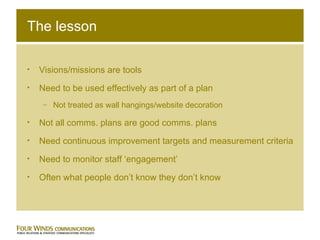
The lesson Visions/missions are tools Need to be used effectively as part of a plan Not treated as wall hangings/website decoration Not all comms. plans are good comms. plans Need continuous improvement targets and measurement criteria Need to monitor staff ‘engagement’ Often what people don’t know they don’t know
Thank you Daniel Paul Four Winds Communications Limited (04) 499-0873 (021) 400-993

Internal Comms Presentation

  • 1.
    The PR challengefor Associations Getting maximum bang for minimum bucks What every Executive Director should know
  • 2.
    Who are we?Four Winds Communications specialises in comms. services for Associations We provide: Strategic comms. planning Media management/training Lobbying/advocacy Membership comms. services All tailored specifically for the unique needs of Associations
  • 3.
    Membership organisations Hundredsof associations Think of an industry – there’ll be an association e.g. NZ Sheep Breeders Association The Funeral Directors Association of New Zealand NZ Continence Association NZ Poultry Association NZ Hang Gliding and Paragliding Association NZ Tourism Industry Association
  • 4.
    Some of ourAssociation clients
  • 5.
    New Zealand VeterinaryAssociation 1780 members Members include vets in rural and urban practices, government service, universities, technical & research institutes, pharmaceutical companies & other related industries & students. 80% + membership of all registered veterinarians Microchipping was big issue Advocates on NZ’s biosecurity + codes of practices for urban vets
  • 6.
    Taxi Federation Representsan industry of over 3000 members Taxi organisations, limousine services, and shuttle services from co-operatives with 700 plus taxis to single unit operators Stamp out the cowboys (restrict industry entry) Access to bus lanes Compliance and relationships with city authorities
  • 7.
    GANZ Six bigmembers + further 45 associate members Represents organisations in gas sector involved in transporting and trading gas Interests from major pipeline coys to appliance sellers/installers Advocating for fuel switching in energy policy + range of technical regulatory issues relating to pricing
  • 8.
    What makes advocacy organisations different? Diverse internal audiences Significant size disparities in membership numbers Not-for-profit Must meet a range of different comms. expectations
  • 9.
    Membership organisations: Acommunications challenge Membership organisations have unique comms. challenges Not as well resourced as corporates Small budgets But wide range of comms. issues Resources & budgets split across many fronts Must deliver perceived value for money But the biggest challenge is …
  • 10.
    Keeping the membershiphappy Massive differences in the business focus/interests of members Often differences in business acumen Differences in business imperatives Different hot/cold buttons Massive differences in the comms. tools they’ll use/respond to, or think are warranted They’re not always easily reachable
  • 11.
    Members versus staff/shareholdersMembers more active/demanding/vocal Members demand service/profile They expect their Association to protect their regulatory environment They want quality ongoing comms. (it’s usually a KPI) They want to be fully consulted They want everything yesterday!
  • 12.
    Keeping the bosseshappy Controlled by board or council Often has conflicting views/agendas Can be captured by dominant personality, or hindered by lack of consensus Part-time decision-makers Making comms. decisions when not experienced
  • 13.
    A broad comms.focus Broad business and stakeholder focus = broad comms. focus Mix of strategic and operational comms activities Real need to demonstrate value for investment Very easy to measure effectiveness of comms.
  • 14.
    Comms. techniques StrategicAudit and analysis, planning, counsel, training crisis/issues management Public relations Media management, stakeholder relations, public information campaigns, marketing comms. Govt. relations Lobbying/advocacy, submissions, ‘intelligence’, policy analysis Membership comms. Publications/writing, website management, information sharing, professional development initiatives, event management
  • 15.
    Most useful internalcomms. tools Newsletter/magazine Short, pithy, Trans-Tasman style, issues and outcome-focused Txt on key issues to selected members Email briefs (where appropriate) Members’ intranet Using sector leaders/influencers as networkers to membership Phone calls to smaller members every so often
  • 16.
    Getting bang forbuck - externally Operate smarter Be selective – especially relationship management, lobbying, media Use leverage Set realistic expectations
  • 17.
    Getting bang forbuck - internally Understand members’ needs Consistent and frequent Make the conference count Nothing wrong with low tech.
  • 18.
    Measuring effectiveness Doneby survey Members actively complain/leave Direct impact on management Direct impact on income Executive Director reports progress monthly to Council/Board Budgets and progress assessed against KPIs
  • 19.
    Membership satisfaction -- - Decreased substantially - 13% 19% Decreased 11% 33% 31% Stayed the same 67% 47% 37% Increased 22% 7% 12% Increased substantially 2006 2003 2000
  • 20.
    Membership satisfaction -- Inadequate 11% 27% Satisfactory 78% 67% Good 11% 7% Excellent 2006 2003
  • 21.
    Lessons to belearned Be smart Spend time Assessing/understanding the issues Learning about your audience(s) Understanding the operating/business environment Think “Benefit/Cost” not “Cost/Benefit”
  • 22.
    How what youdon't know you don't know can ruin an otherwise great staff comms. plan OR When visions and missions miss the point
  • 23.
    The background WellingtonSME Long-established Grown well Mix of domestic and light/heavy commercial work Trade company 16 vans on the road Mix of vets and apprentices CEO pro-active Went into liquidation
  • 24.
    The issue Companywas not making money Growth had stopped Repeat business hard to come by Overheads higher Staff were ‘aware of the situation’
  • 25.
    The plan Companyoperated internal comms plan Had company mission Had company vision Had structured staff briefings Had little news sheet CEO managed by walkabout
  • 26.
    Our role Externalmarketing Profile-raising Business development Engage/brief staff
  • 27.
    What we didInterviewed all staff Developed collateral material Agreed target markets Established ‘time and motion’ study
  • 28.
    What we foundStaff knew their jobs Good at their jobs BUT … Staff didn’t feel ‘involved/engaged’ with the company No reason to go above and beyond Lack of sense of responsibility for the company’s performance Comms. plan wasn’t working
  • 29.
    What the CEOsaid Read and aspire to the vision To be recognised as the best xyz company in the Wellington region Read and aspire to the mission To deliver professional, leading edge, prompt and customer-friendly service to all customer Comms. activities all geared around vision and mission
  • 30.
    What the CEOdidn’t know Neither the vision nor the mission meant anything personal to staff.
  • 31.
    The solution Makethem meaningful rather than vague/loose Give staff actual targets to aim at Make progress measureable Engage their competitiveness Link it tangible rewards
  • 32.
    Examples of visionsXyz is committed to brewing the best beer in the world and the international awards we have won are testament to this. NZ Brewer To constantly develop skills, technology and people to provide customers with best practice energy solutions which allow them to maximise their business operations, or home environment and to be recognised, through our efforts, as New Zealand's … Leading energy supplier
  • 33.
    Some more …A world class professional State Services serving the government of the day and meeting the needs of New Zealanders. Govt. department A healthy environment which sustains people and nature. Govt. department To be a leading provider of risk management services, insurance and reinsurance broking, financial planning and employee risks and benefits Large corporate … to provide academic and creative excellence Well known boys school
  • 34.
    The lesson Visions/missionsare tools Need to be used effectively as part of a plan Not treated as wall hangings/website decoration Not all comms. plans are good comms. plans Need continuous improvement targets and measurement criteria Need to monitor staff ‘engagement’ Often what people don’t know they don’t know
  • 35.
    Thank you DanielPaul Four Winds Communications Limited (04) 499-0873 (021) 400-993