Caroline Stockmann Save the Children International The Communicating Information Officer
Agenda Save the Children International changing role of the CIO? marketing and communications developing your own communications strategy tips and tricks


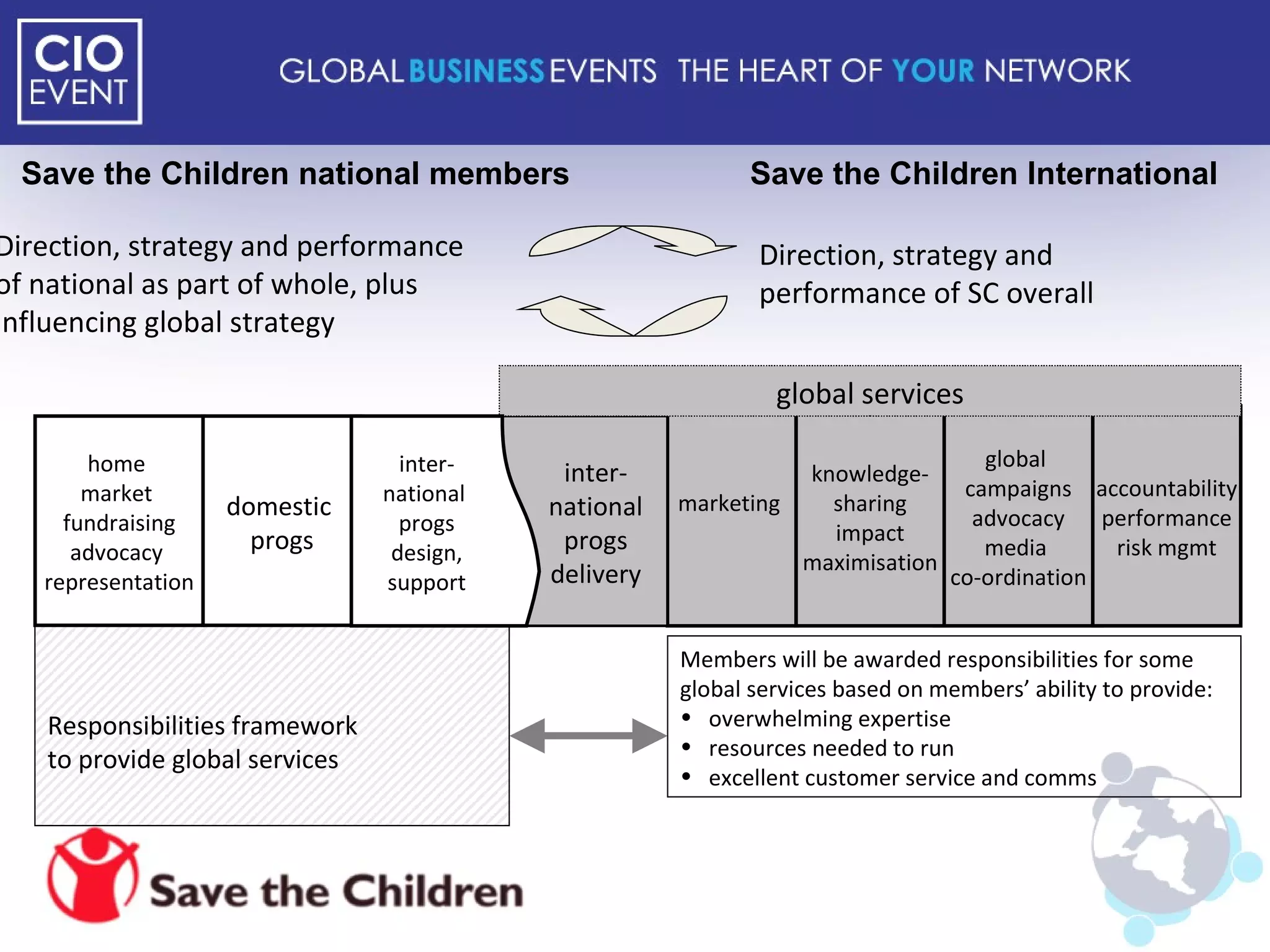
Responsibilities framework to provide global services home  market  fundraising advocacy  representation domestic  progs Save the Children national members Save the Children International global  campaigns advocacy media  co-ordination knowledge- sharing impact maximisation marketing  Direction, strategy and performance  of national as part of whole, plus  influencing global strategy Direction, strategy and  performance of SC overall Members will be awarded responsibilities for some global services based on members’ ability to provide: overwhelming expertise resources needed to run excellent customer service and comms accountability performance risk mgmt inter- national progs delivery global services inter- national  progs design, support
IT at Save the Children International all the usual stuff focus on difficult geographies future focus on knowledge management desire to be best-in-class, not just within the INGO world reliance on pro bono and low bono partnerships to get there
Changing Role of the CIO? In our fast-moving, demanding business world, where there is no shortage of talent and education (and the highest unemployment rate in years…), a CIO needs to have the following skills, actually to survive: technical business acumen leadership skills ‘ people’ skills …  and excellent  communication  skills. Miss that last one, and how can others ‘get’ the rest?  (And is this really that new?....)
Marketing & Communication If you cannot communicate well, and if you cannot market yourself and your ideas, you will not be successful as a CIO. A question for you: Do you: communicate well with senior leadership? communicate well with your team/subordinates?  Peers? Often it is one or the other, but the best CIOs can cover off all bases.
Definition of communication: the giving or  exchanging  of information, signals, or messages as by talk, gestures or writing a  passage  or way of getting from one place to another the  art  of expressing ideas close, sympathetic  relationship … Definition of ‘communicative’: talkative… giving  information  readily
The Challenge not all those attracted to the profession are extroverts, i.e. getting their energy from others often we are communicating with more than one person – and they all have different needs/ways of hearing the subject matter can be found ‘dry’ by others, and it is tempting to overplay the detail IT is a service function, and therefore will often be on the receiving end of criticism/feedback/challenge – and success can be measured in how well these are dealt with
Developing Your Own Communications Strategy know your strengths and your weaknesses exploit your strengths, but also work on the weaknesses and specifically develop a strategy to focus on what you might not ‘naturally’ tend towards (eg ‘introvert’  ->  more personable, strategically influential; ‘extrovert’  ->  more content-focussed) use all the tools at hand, personal and applicable to your own strategy remain ‘authentic’ - this has still to be you, or there will be no trust
Tips & Tricks know yourself (360 feedback, observer), know your boss, and know your audience, by: Belbin Myers Briggs  visual/kinetic/aural tendencies functional ‘styles’ gender left brain/right brain body (left/right position; gestures, etc) ……  and by listening…….
Tips & Tricks (2) practice makes perfect don’t give up – it is a continuing journey be authentic, but ‘use different muscles’ the customer is always right play baseball adjust your pace of ‘reaction’ – up or down fill your ‘gaps’ with others with group communication, say things differently
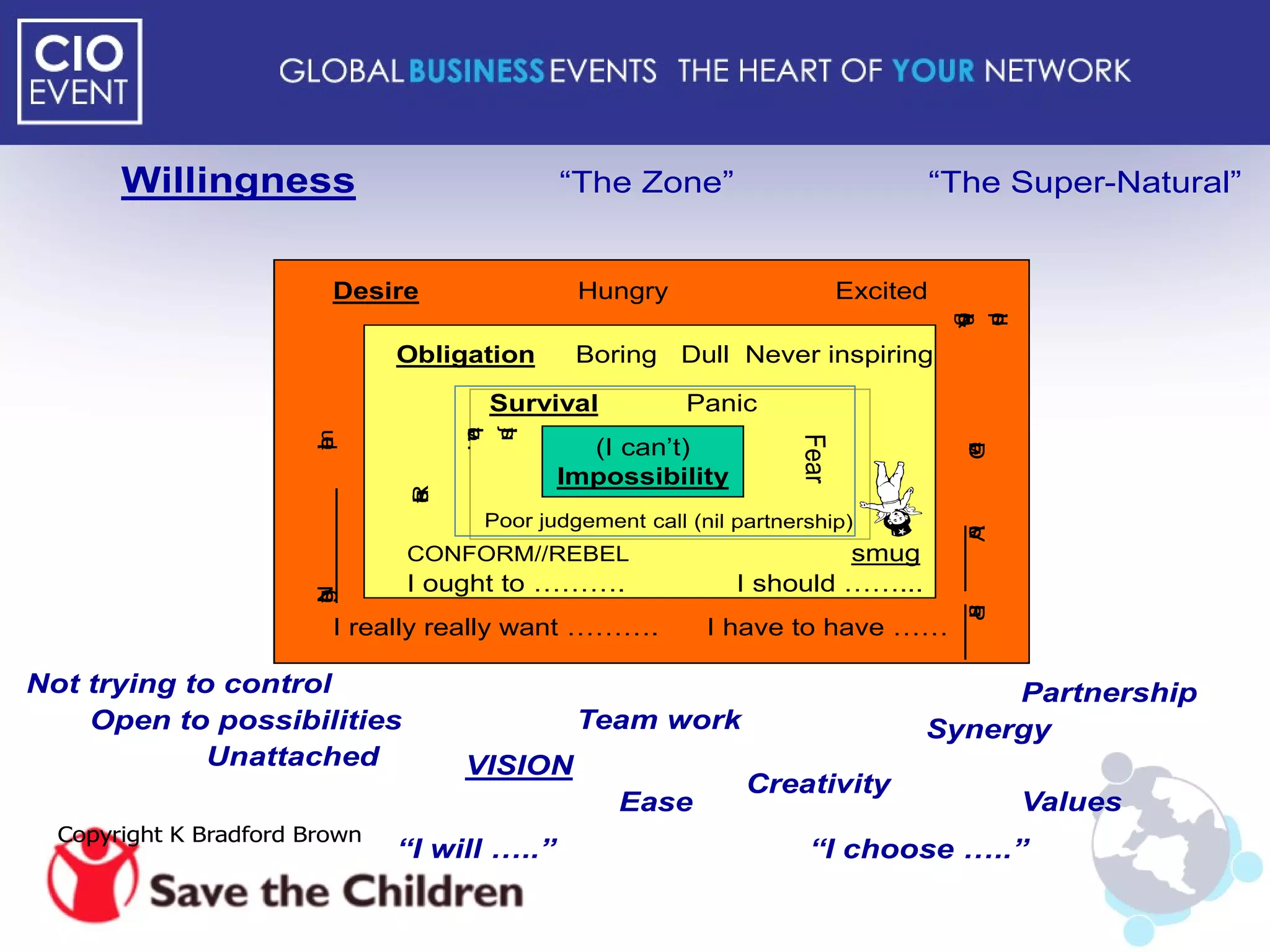
Tips & Tricks (3) may sound simple, and  is  – so why don’t we do it? may just be continuous improvement plan (treat like a project)! get yourself in ‘the zone’, as that is where you will perform best and be open to others…..
 
In conclusion: It is important to develop a plan or strategy, and treat this like a project. This will ensure you take it seriously, identify opportunities to ‘practice’, and allow monitoring and follow-up, to be sure to reach your goal. Steps include: 1. Set yourself a plan 2. Identify key meetings/occasions of potential influence 3. Research different styles, as well as your own 4. Get trusted feedback arranged 5. Try out different approaches, whilst still being yourself 6. Take time to think about your audience, and how they like to receive information  7. Work on your presentation skills.  If you take the time to think about how to communicate effectively, you will see results/become more ‘marketable’…..
Thank you!!

The Communicating Information Officer

  • 1.
    Caroline Stockmann Savethe Children International The Communicating Information Officer
  • 2.
    Agenda Save theChildren International changing role of the CIO? marketing and communications developing your own communications strategy tips and tricks
  • 3.
  • 4.
  • 5.
  • 6.
  • 7.
  • 8.
  • 9.
  • 10.
    Responsibilities framework toprovide global services home market fundraising advocacy representation domestic progs Save the Children national members Save the Children International global campaigns advocacy media co-ordination knowledge- sharing impact maximisation marketing Direction, strategy and performance of national as part of whole, plus influencing global strategy Direction, strategy and performance of SC overall Members will be awarded responsibilities for some global services based on members’ ability to provide: overwhelming expertise resources needed to run excellent customer service and comms accountability performance risk mgmt inter- national progs delivery global services inter- national progs design, support
  • 11.
    IT at Savethe Children International all the usual stuff focus on difficult geographies future focus on knowledge management desire to be best-in-class, not just within the INGO world reliance on pro bono and low bono partnerships to get there
  • 12.
    Changing Role ofthe CIO? In our fast-moving, demanding business world, where there is no shortage of talent and education (and the highest unemployment rate in years…), a CIO needs to have the following skills, actually to survive: technical business acumen leadership skills ‘ people’ skills … and excellent communication skills. Miss that last one, and how can others ‘get’ the rest? (And is this really that new?....)
  • 13.
    Marketing & CommunicationIf you cannot communicate well, and if you cannot market yourself and your ideas, you will not be successful as a CIO. A question for you: Do you: communicate well with senior leadership? communicate well with your team/subordinates? Peers? Often it is one or the other, but the best CIOs can cover off all bases.
  • 14.
    Definition of communication:the giving or exchanging of information, signals, or messages as by talk, gestures or writing a passage or way of getting from one place to another the art of expressing ideas close, sympathetic relationship … Definition of ‘communicative’: talkative… giving information readily
  • 15.
    The Challenge notall those attracted to the profession are extroverts, i.e. getting their energy from others often we are communicating with more than one person – and they all have different needs/ways of hearing the subject matter can be found ‘dry’ by others, and it is tempting to overplay the detail IT is a service function, and therefore will often be on the receiving end of criticism/feedback/challenge – and success can be measured in how well these are dealt with
  • 16.
    Developing Your OwnCommunications Strategy know your strengths and your weaknesses exploit your strengths, but also work on the weaknesses and specifically develop a strategy to focus on what you might not ‘naturally’ tend towards (eg ‘introvert’ -> more personable, strategically influential; ‘extrovert’ -> more content-focussed) use all the tools at hand, personal and applicable to your own strategy remain ‘authentic’ - this has still to be you, or there will be no trust
  • 17.
    Tips & Tricksknow yourself (360 feedback, observer), know your boss, and know your audience, by: Belbin Myers Briggs visual/kinetic/aural tendencies functional ‘styles’ gender left brain/right brain body (left/right position; gestures, etc) …… and by listening…….
  • 18.
    Tips & Tricks(2) practice makes perfect don’t give up – it is a continuing journey be authentic, but ‘use different muscles’ the customer is always right play baseball adjust your pace of ‘reaction’ – up or down fill your ‘gaps’ with others with group communication, say things differently
  • 19.
    Tips & Tricks(3) may sound simple, and is – so why don’t we do it? may just be continuous improvement plan (treat like a project)! get yourself in ‘the zone’, as that is where you will perform best and be open to others…..
  • 20.
  • 21.
    In conclusion: Itis important to develop a plan or strategy, and treat this like a project. This will ensure you take it seriously, identify opportunities to ‘practice’, and allow monitoring and follow-up, to be sure to reach your goal. Steps include: 1. Set yourself a plan 2. Identify key meetings/occasions of potential influence 3. Research different styles, as well as your own 4. Get trusted feedback arranged 5. Try out different approaches, whilst still being yourself 6. Take time to think about your audience, and how they like to receive information 7. Work on your presentation skills. If you take the time to think about how to communicate effectively, you will see results/become more ‘marketable’…..
  • 22.