It’s Really that Simple

The Essential Nonprofit
 Communications Plan


                March 15, 2012

                Martha Wells
                Susie Bowie
“The single biggest problem
 in communication is the illusion
     that it has taken place.”
        George Bernard Shaw


Let’s look at a plan.
What we’re covering today

  •   What’s a brand?
  •   Your audiences
  •   Message development
  •   Goals vs. strategies
  •   Tools & tactics
         -Media relations 101
         -Self-generated communication 101
         -Successful partnerships
  •   Evaluation
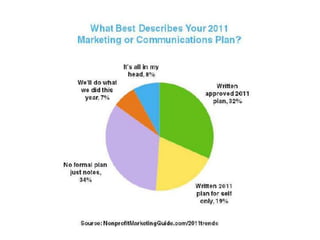
How do you feel
 about plans?
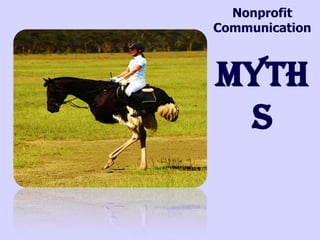
Nonprofit
Communication


Myth
 s
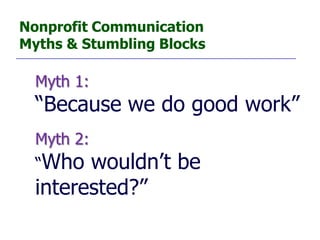
Nonprofit Communication
Myths & Stumbling Blocks

  Myth 1:
  “Because we do good work”
  Myth 2:
  “Who  wouldn’t be
  interested?”
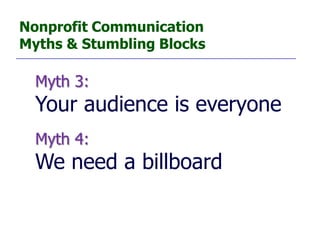
Nonprofit Communication
Myths & Stumbling Blocks

  Myth 3:
  Your audience is everyone
  Myth 4:
  We need a billboard
What is a brand?
  • What’s your nonprofit’s personality?
  • What’s your position relative to
    competition?
  • What brand characteristics are
    delivered well and not so well?
What’s in a
communication
plan?
The communications plan

  • Situation Analysis
  • SWOT
  • Goals, Strategies, Tactics & Tactics
  • Who’s responsible
  • When it’s going to be done
The communications plan
does NOT include

  • Common sense
  • Policies
  • Internal processes (management)
PR & Marketing Basics

  • Earned media
  • Paid media
  • Self-generated communications
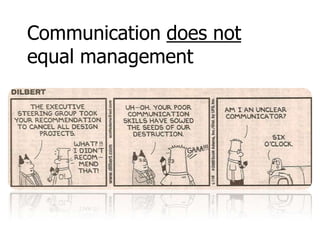
Communication does not
equal management
Your
Audiences
• Who are you talking to?

• What do you want
  them to know about you?

• What do you want them to do?


Emotion – Information - Motivation
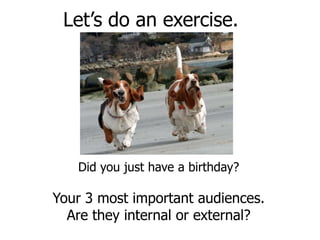
Let’s do an exercise.


   Did you just have a birthday?

Your 3 most important audiences.
  Are they internal or external?
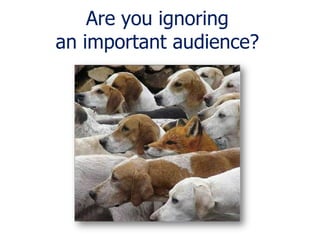
Are you ignoring
an important audience?
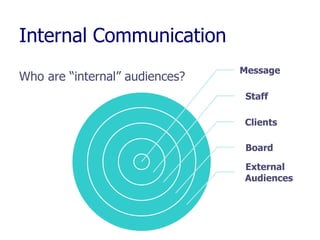
Internal Communication
                                Message
Who are “internal” audiences?
                                 Staff

                                Clients

                                 Board

                                External
                                Audiences
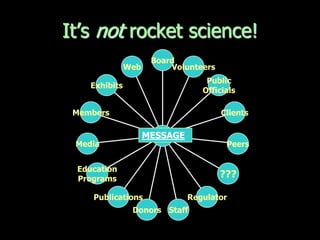
It’s not rocket science!
                      Board
               Web        Volunteers
                                   Public
    Exhibits
                                  Officials

 Members                               Clients

                     MESSAGE
 Media                                  Peers


 Education
 Programs
                                       ???

     Publications              Regulator
                Donors Staff
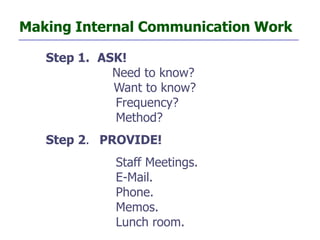
Making Internal Communication Work

   Step 1. ASK!
             Need to know?
             Want to know?
             Frequency?
             Method?
   Step 2. PROVIDE!
             Staff Meetings.
             E-Mail.
             Phone.
             Memos.
             Lunch room.
Board Members are Ambassadors

 •   Frequent & informal communication
 • Formal presentations through
   Speaker’s Bureau
 • Joining staff for donor meetings
 • Sitting at tables at YOUR events
 • Representing your organization at
   community events
Message
Development
A few good
message tests…

1. Is it personal?

2. Are you conveying uniqueness?

3. Is there a call to action?

4. Does it add value?
Where can people turn when they are desperate for
help with their housing situation? Our team at the
One Stop Center provides friendly, caring,
compassionate assistance to people that come for
help with a wide variety of issues. No one chooses
to be homeless - it is not something young children
aspire to. But when it happens to you or a loved
one, we are here to provide basic services and help
people move on a path to improve their situation,
and ultimately, to independence if possible.
Charis, age 12, was 20 pounds overweight and very
unhappy about it. Each day, she would endure teasing and
ridicule at the hands of her schoolmates. She tried dieting
but never seemed to have any luck. At times, she even
contemplated suicide. One day, a counselor at the Boys &
Girls Club gently suggested that Charis try the Triple Play
program. … After 4 months in the Triple Play program,
Charis was at her normal body weight and feeling very, very
good about herself. Her newfound love of fitness has even
led her to try out for the track team at school!
Stroke is the leading cause of adult disability
and can happen at any age. It’s the 4th
cause of death nationwide. More women die
of stroke every year than of breast cancer.
Approximately 2,800 strokes happen in
Sarasota and Manatee counties annually.
With over 8,000 baby boomers turning 65
every day for the next 19 years, that number
will significantly rise!
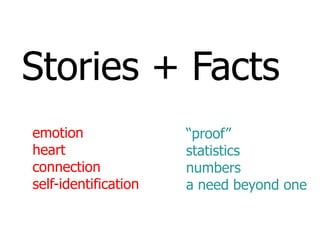
Stories + Facts
emotion               “proof”
heart                 statistics
connection            numbers
self-identification   a need beyond one
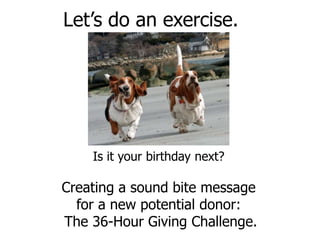
Let’s do an exercise.


    Is it your birthday next?

Creating a sound bite message
  for a new potential donor:
The 36-Hour Giving Challenge.
Goals vs.
Strategies
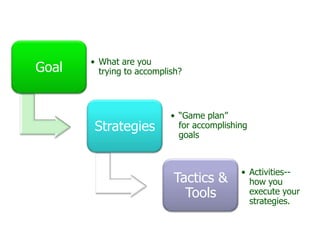
• What are you
Goal     trying to accomplish?


                           • “Game plan”
        Strategies           for accomplishing
                             goals


                                            • Activities--
                           Tactics &          how you
                             Tools            execute your
                                              strategies.
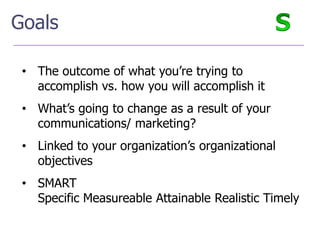
Goals

 • The outcome of what you’re trying to
   accomplish vs. how you will accomplish it
 • What’s going to change as a result of your
   communications/ marketing?
 • Linked to your organization’s organizational
   objectives
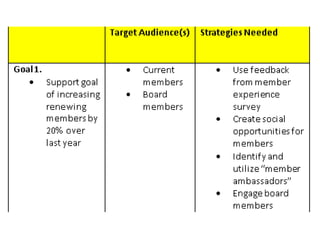
 • SMART
   Specific Measureable Attainable Realistic Timely
Strategies

 • Big picture approaches to meet your goal,
   supported by tactics and tools.
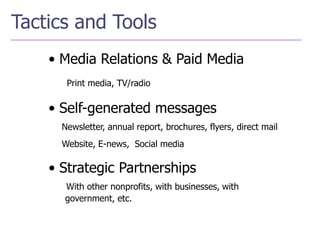
Tactics and Tools
    • Media Relations & Paid Media
       Print media, TV/radio

    • Self-generated messages
      Newsletter, annual report, brochures, flyers, direct mail
      Website, E-news, Social media

    • Strategic Partnerships
      With other nonprofits, with businesses, with
      government, etc.
Media
Relations
101
Reporters are people who like to…

 • Be approached as individuals, not as a “blast”.
 • Receive information in certain ways.
 • Know you are considerate of their time.
 • Be called back. Now.
 • Be thanked.


     You have a job to do. They have a job to do.
         Are you helping them do their job?
Know what is news.
Know what is not news.

• Know the beats and how your story relate.
• Calendar items are NOT news!
• Is your pitch interesting to anyone outside of
  your organization?

  TIP: Relate it to a national or local issue that’s
  big right now?
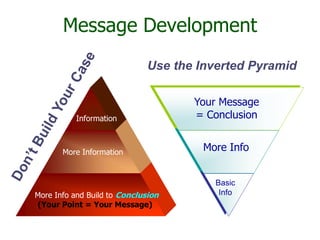
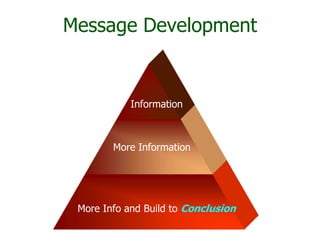
Message Development


            Information


        More Information


 More Info and Build to Conclusion
Message Development
                              Use the Inverted Pyramid

                                     Your Message
           Information               = Conclusion


       More Information               More Info


                                        Basic
More Info and Build to Conclusion        Info
(Your Point = Your Message)
Self-Generated
Communications
101
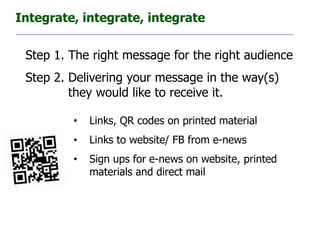
Integrate, integrate, integrate


 Step 1. The right message for the right audience
 Step 2. Delivering your message in the way(s)
         they would like to receive it.

         •   Links, QR codes on printed material
         •   Links to website/ FB from e-news
         •   Sign ups for e-news on website, printed
             materials and direct mail
Oneness in look


  “By the time you’re getting sick of
  your logo, your audience is just
  starting to associate it with you.”
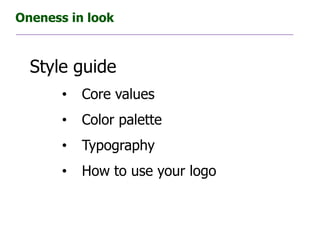
Oneness in look


  Style guide
       •   Core values
       •   Color palette
       •   Typography
       •   How to use your logo
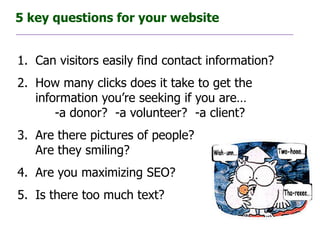
5 key questions for your website


1. Can visitors easily find contact information?
2. How many clicks does it take to get the
   information you’re seeking if you are…
       -a donor? -a volunteer? -a client?
3. Are there pictures of people?
   Are they smiling?
4. Are you maximizing SEO?
5. Is there too much text?
Quick guide to effective e-newsletters

 The subject line
 • “Our Newsletter: Volume XVI” Really?
 • Make me want to open it


 The content
 • Short articles, clickable to your website.
 • Use the “does anyone care?” test
 • Doesn’t have to be all original
 • Ask what people want!
Quick guide to effective e-newsletters

 The look
 • Easy to click through
 • Pictures
 • Two-column


 The frequency
 • Twice a month is enough
Fundamental Principles of Social Media


 • Add value.
 • Have a personality.
 • If you’re pitching for a need, make
   it timely, relevant and urgent.
 • Use your networks.
 • Same principles of audience,
   goals and strategy apply.
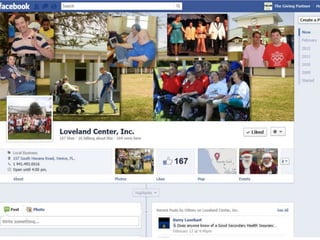
The new Facebook timeline
• Large cover photo taking up much of the
  vertical space of the top screen.

• Can highlight a key post at the top of your
  timeline for up to 7 days (call to action)

• People can see what their friends
  are saying about your org.

                                  Thanks, Nancy Schwartz!
Engagement vs. Numbers


  What’s more important
   How many fans, or the quality
   of your interactions with them?
Leveraging partnerships
for communication reach
  • Develop a clear partnership agreement
     -Who takes the lead
     -Single point of contact
     -What items does everyone have input on

  • Reaching “alignment”

  • Joint press releases

  • Be careful of “sharing” distribution lists.
Crisis
Communications
What you need to know
about a crisis
 • It can happen to any organization.

 • One spokesperson.

 • “No comment” or “off the record” will come
   back to get you.

 • The truth always wins.
   Make sure they hear it from you.
 • People assume what they don’t hear directly.
Evaluating
Your
Efforts
The 3 Key Questions of Evaluation


1. Did our messengers know the
  message?

2. Did our messages reach our audiences
  with minimal ambiguity?

3. Did you accomplish your goal?
Qualitative vs. Quantitative

      Quantitative:
      •   Google analytics (website)
      •   Click-thrus & opens (e-newsletter)
      •   Readership (print publications)
      •   Facebook insights


      Qualitative:
      • Surveys (formal, informal)
      • Action based
That’s it.
Any questions?

Essential Nonprofit Communications Plan

  • 1.
    It’s Really thatSimple The Essential Nonprofit Communications Plan March 15, 2012 Martha Wells Susie Bowie
  • 2.
    “The single biggestproblem in communication is the illusion that it has taken place.” George Bernard Shaw Let’s look at a plan.
  • 3.
    What we’re coveringtoday • What’s a brand? • Your audiences • Message development • Goals vs. strategies • Tools & tactics -Media relations 101 -Self-generated communication 101 -Successful partnerships • Evaluation
  • 4.
    How do youfeel about plans?
  • 6.
  • 7.
    Nonprofit Communication Myths &Stumbling Blocks Myth 1: “Because we do good work” Myth 2: “Who wouldn’t be interested?”
  • 8.
    Nonprofit Communication Myths &Stumbling Blocks Myth 3: Your audience is everyone Myth 4: We need a billboard
  • 9.
    What is abrand? • What’s your nonprofit’s personality? • What’s your position relative to competition? • What brand characteristics are delivered well and not so well?
  • 10.
  • 11.
    The communications plan • Situation Analysis • SWOT • Goals, Strategies, Tactics & Tactics • Who’s responsible • When it’s going to be done
  • 12.
    The communications plan doesNOT include • Common sense • Policies • Internal processes (management)
  • 13.
    PR & MarketingBasics • Earned media • Paid media • Self-generated communications
  • 14.
  • 15.
  • 16.
    • Who areyou talking to? • What do you want them to know about you? • What do you want them to do? Emotion – Information - Motivation
  • 17.
    Let’s do anexercise. Did you just have a birthday? Your 3 most important audiences. Are they internal or external?
  • 18.
    Are you ignoring animportant audience?
  • 19.
    Internal Communication Message Who are “internal” audiences? Staff Clients Board External Audiences
  • 20.
    It’s not rocketscience! Board Web Volunteers Public Exhibits Officials Members Clients MESSAGE Media Peers Education Programs ??? Publications Regulator Donors Staff
  • 21.
    Making Internal CommunicationWork Step 1. ASK! Need to know? Want to know? Frequency? Method? Step 2. PROVIDE! Staff Meetings. E-Mail. Phone. Memos. Lunch room.
  • 22.
    Board Members areAmbassadors • Frequent & informal communication • Formal presentations through Speaker’s Bureau • Joining staff for donor meetings • Sitting at tables at YOUR events • Representing your organization at community events
  • 23.
  • 24.
    A few good messagetests… 1. Is it personal? 2. Are you conveying uniqueness? 3. Is there a call to action? 4. Does it add value?
  • 25.
    Where can peopleturn when they are desperate for help with their housing situation? Our team at the One Stop Center provides friendly, caring, compassionate assistance to people that come for help with a wide variety of issues. No one chooses to be homeless - it is not something young children aspire to. But when it happens to you or a loved one, we are here to provide basic services and help people move on a path to improve their situation, and ultimately, to independence if possible.
  • 26.
    Charis, age 12,was 20 pounds overweight and very unhappy about it. Each day, she would endure teasing and ridicule at the hands of her schoolmates. She tried dieting but never seemed to have any luck. At times, she even contemplated suicide. One day, a counselor at the Boys & Girls Club gently suggested that Charis try the Triple Play program. … After 4 months in the Triple Play program, Charis was at her normal body weight and feeling very, very good about herself. Her newfound love of fitness has even led her to try out for the track team at school!
  • 27.
    Stroke is theleading cause of adult disability and can happen at any age. It’s the 4th cause of death nationwide. More women die of stroke every year than of breast cancer. Approximately 2,800 strokes happen in Sarasota and Manatee counties annually. With over 8,000 baby boomers turning 65 every day for the next 19 years, that number will significantly rise!
  • 28.
    Stories + Facts emotion “proof” heart statistics connection numbers self-identification a need beyond one
  • 29.
    Let’s do anexercise. Is it your birthday next? Creating a sound bite message for a new potential donor: The 36-Hour Giving Challenge.
  • 30.
  • 31.
    • What areyou Goal trying to accomplish? • “Game plan” Strategies for accomplishing goals • Activities-- Tactics & how you Tools execute your strategies.
  • 32.
    Goals • Theoutcome of what you’re trying to accomplish vs. how you will accomplish it • What’s going to change as a result of your communications/ marketing? • Linked to your organization’s organizational objectives • SMART Specific Measureable Attainable Realistic Timely
  • 33.
    Strategies • Bigpicture approaches to meet your goal, supported by tactics and tools.
  • 35.
    Tactics and Tools • Media Relations & Paid Media Print media, TV/radio • Self-generated messages Newsletter, annual report, brochures, flyers, direct mail Website, E-news, Social media • Strategic Partnerships With other nonprofits, with businesses, with government, etc.
  • 36.
  • 37.
    Reporters are peoplewho like to… • Be approached as individuals, not as a “blast”. • Receive information in certain ways. • Know you are considerate of their time. • Be called back. Now. • Be thanked. You have a job to do. They have a job to do. Are you helping them do their job?
  • 38.
    Know what isnews. Know what is not news. • Know the beats and how your story relate. • Calendar items are NOT news! • Is your pitch interesting to anyone outside of your organization? TIP: Relate it to a national or local issue that’s big right now?
  • 39.
    Message Development Information More Information More Info and Build to Conclusion
  • 40.
    Message Development Use the Inverted Pyramid Your Message Information = Conclusion More Information More Info Basic More Info and Build to Conclusion Info (Your Point = Your Message)
  • 41.
  • 42.
    Integrate, integrate, integrate Step 1. The right message for the right audience Step 2. Delivering your message in the way(s) they would like to receive it. • Links, QR codes on printed material • Links to website/ FB from e-news • Sign ups for e-news on website, printed materials and direct mail
  • 43.
    Oneness in look “By the time you’re getting sick of your logo, your audience is just starting to associate it with you.”
  • 44.
    Oneness in look Style guide • Core values • Color palette • Typography • How to use your logo
  • 46.
    5 key questionsfor your website 1. Can visitors easily find contact information? 2. How many clicks does it take to get the information you’re seeking if you are… -a donor? -a volunteer? -a client? 3. Are there pictures of people? Are they smiling? 4. Are you maximizing SEO? 5. Is there too much text?
  • 48.
    Quick guide toeffective e-newsletters The subject line • “Our Newsletter: Volume XVI” Really? • Make me want to open it The content • Short articles, clickable to your website. • Use the “does anyone care?” test • Doesn’t have to be all original • Ask what people want!
  • 49.
    Quick guide toeffective e-newsletters The look • Easy to click through • Pictures • Two-column The frequency • Twice a month is enough
  • 50.
    Fundamental Principles ofSocial Media • Add value. • Have a personality. • If you’re pitching for a need, make it timely, relevant and urgent. • Use your networks. • Same principles of audience, goals and strategy apply.
  • 51.
    The new Facebooktimeline • Large cover photo taking up much of the vertical space of the top screen. • Can highlight a key post at the top of your timeline for up to 7 days (call to action) • People can see what their friends are saying about your org. Thanks, Nancy Schwartz!
  • 53.
    Engagement vs. Numbers What’s more important How many fans, or the quality of your interactions with them?
  • 54.
    Leveraging partnerships for communicationreach • Develop a clear partnership agreement -Who takes the lead -Single point of contact -What items does everyone have input on • Reaching “alignment” • Joint press releases • Be careful of “sharing” distribution lists.
  • 55.
  • 56.
    What you needto know about a crisis • It can happen to any organization. • One spokesperson. • “No comment” or “off the record” will come back to get you. • The truth always wins. Make sure they hear it from you. • People assume what they don’t hear directly.
  • 57.
  • 58.
    The 3 KeyQuestions of Evaluation 1. Did our messengers know the message? 2. Did our messages reach our audiences with minimal ambiguity? 3. Did you accomplish your goal?
  • 59.
    Qualitative vs. Quantitative Quantitative: • Google analytics (website) • Click-thrus & opens (e-newsletter) • Readership (print publications) • Facebook insights Qualitative: • Surveys (formal, informal) • Action based
  • 60.