CSE 461: Error Detection and
Correction
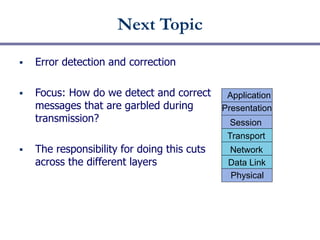
Next Topic
 Error detection and correction
 Focus: How do we detect and correct
messages that are garbled during
transmission?
 The responsibility for doing this cuts
across the different layers
Physical
Data Link
Network
Transport
Session
Presentation
Application
Errors and Redundancy
 Noise can flip some of the bits we receive
 We must be able to detect when this occurs!
 Who needs to detect it? (links/routers, OSs, or
apps?)
 Basic approach: add redundant data
 Error detection codes allow errors to be recognized
 Error correction codes allow errors to be repaired too
Motivating Example
 A simple error detection scheme:
 Just send two copies. Differences imply errors.
 Question: Can we do any better?
 With less overhead
 Catch more kinds of errors
 Answer: Yes – stronger protection with fewer bits
 But we can’t catch all inadvertent errors, nor malicious ones
 We will look at basic block codes
 K bits in, N bits out is a (N,K) code
 Simple, memoryless mapping
Detection vs. Correction
 Two strategies to correct errors:
 Detect and retransmit, or Automatic Repeat reQuest.
(ARQ)
 Error correcting codes, or Forward Error Correction
(FEC)
 Retransmissions typically at higher levels (Network+).
Why?
 Question: Which should we choose?
Retransmissions vs. FEC
 The better option depends on the kind of errors and the
cost of recovery
 Example: Message with 1000 bits, Prob(bit error) 0.001
 Case 1: random errors
 Case 2: bursts of 1000 errors
 Case 3: real-time application (teleconference)
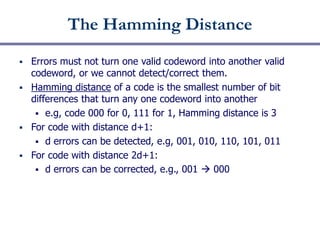
The Hamming Distance
 Errors must not turn one valid codeword into another valid
codeword, or we cannot detect/correct them.
 Hamming distance of a code is the smallest number of bit
differences that turn any one codeword into another
 e.g, code 000 for 0, 111 for 1, Hamming distance is 3
 For code with distance d+1:
 d errors can be detected, e.g, 001, 010, 110, 101, 011
 For code with distance 2d+1:
 d errors can be corrected, e.g., 001  000
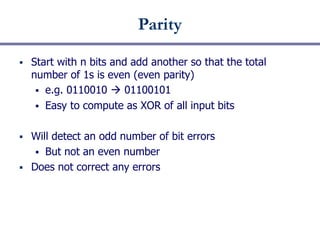
Parity
 Start with n bits and add another so that the total
number of 1s is even (even parity)
 e.g. 0110010  01100101
 Easy to compute as XOR of all input bits
 Will detect an odd number of bit errors
 But not an even number
 Does not correct any errors
2D Parity
 Add parity row/column to array of
bits
 How many simultaneous bit errors
can it detect?
 Which errors can it correct?
0101001 1
1101001 0
1011110 1
0001110 1
0110100 1
1011111 0
1111011 0
Checksums
 Used in Internet protocols (IP, ICMP, TCP, UDP)
 Basic Idea: Add up the data and send it along with sum
 Algorithm:
 checksum is the 1s complement of the 1s
complement sum of the data interpreted 16 bits at a
time (for 16-bit TCP/UDP checksum)
 1s complement: flip all bits to make number negative
 Consequence: adding requires carryout to be added
back
CRCs (Cyclic Redundancy Check)
 Stronger protection than checksums
 Used widely in practice, e.g., Ethernet CRC-32
 Implemented in hardware (XORs and shifts)
 Algorithm: Given n bits of data, generate a k bit check
sequence that gives a combined n + k bits that are
divisible by a chosen divisor C(x)
 Based on mathematics of finite fields
 “numbers” correspond to polynomials, use modulo
arithmetic
 e.g, interpret 10011010 as x7 + x4 + x3 + x1
How is C(x) Chosen?
 Mathematical properties:
 All 1-bit errors if non-zero xk and x0 terms
 All 2-bit errors if C(x) has a factor with at least three
terms
 Any odd number of errors if C(x) has (x + 1) as a
factor
 Any burst error < k bits
 There are standardized polynomials of different degree
that are known to catch many errors
 Ethernet CRC-32:
100000100110000010001110110110111
Reed-Solomon / BCH Codes
 Developed to protect data on magnetic disks
 Used for CDs and cable modems too
 Property: 2t redundant bits can correct <= t errors
 Mathematics somewhat more involved …
Key Concepts
 Redundant bits are added to messages to protect
against transmission errors.
 Two recovery strategies are retransmissions (ARQ) and
error correcting codes (FEC)
 The Hamming distance tells us how much error can
safely be tolerated.

lect5.ppt

  • 1.
    CSE 461: ErrorDetection and Correction
  • 2.
    Next Topic  Errordetection and correction  Focus: How do we detect and correct messages that are garbled during transmission?  The responsibility for doing this cuts across the different layers Physical Data Link Network Transport Session Presentation Application
  • 3.
    Errors and Redundancy Noise can flip some of the bits we receive  We must be able to detect when this occurs!  Who needs to detect it? (links/routers, OSs, or apps?)  Basic approach: add redundant data  Error detection codes allow errors to be recognized  Error correction codes allow errors to be repaired too
  • 4.
    Motivating Example  Asimple error detection scheme:  Just send two copies. Differences imply errors.  Question: Can we do any better?  With less overhead  Catch more kinds of errors  Answer: Yes – stronger protection with fewer bits  But we can’t catch all inadvertent errors, nor malicious ones  We will look at basic block codes  K bits in, N bits out is a (N,K) code  Simple, memoryless mapping
  • 5.
    Detection vs. Correction Two strategies to correct errors:  Detect and retransmit, or Automatic Repeat reQuest. (ARQ)  Error correcting codes, or Forward Error Correction (FEC)  Retransmissions typically at higher levels (Network+). Why?  Question: Which should we choose?
  • 6.
    Retransmissions vs. FEC The better option depends on the kind of errors and the cost of recovery  Example: Message with 1000 bits, Prob(bit error) 0.001  Case 1: random errors  Case 2: bursts of 1000 errors  Case 3: real-time application (teleconference)
  • 7.
    The Hamming Distance Errors must not turn one valid codeword into another valid codeword, or we cannot detect/correct them.  Hamming distance of a code is the smallest number of bit differences that turn any one codeword into another  e.g, code 000 for 0, 111 for 1, Hamming distance is 3  For code with distance d+1:  d errors can be detected, e.g, 001, 010, 110, 101, 011  For code with distance 2d+1:  d errors can be corrected, e.g., 001  000
  • 8.
    Parity  Start withn bits and add another so that the total number of 1s is even (even parity)  e.g. 0110010  01100101  Easy to compute as XOR of all input bits  Will detect an odd number of bit errors  But not an even number  Does not correct any errors
  • 9.
    2D Parity  Addparity row/column to array of bits  How many simultaneous bit errors can it detect?  Which errors can it correct? 0101001 1 1101001 0 1011110 1 0001110 1 0110100 1 1011111 0 1111011 0
  • 10.
    Checksums  Used inInternet protocols (IP, ICMP, TCP, UDP)  Basic Idea: Add up the data and send it along with sum  Algorithm:  checksum is the 1s complement of the 1s complement sum of the data interpreted 16 bits at a time (for 16-bit TCP/UDP checksum)  1s complement: flip all bits to make number negative  Consequence: adding requires carryout to be added back
  • 11.
    CRCs (Cyclic RedundancyCheck)  Stronger protection than checksums  Used widely in practice, e.g., Ethernet CRC-32  Implemented in hardware (XORs and shifts)  Algorithm: Given n bits of data, generate a k bit check sequence that gives a combined n + k bits that are divisible by a chosen divisor C(x)  Based on mathematics of finite fields  “numbers” correspond to polynomials, use modulo arithmetic  e.g, interpret 10011010 as x7 + x4 + x3 + x1
  • 12.
    How is C(x)Chosen?  Mathematical properties:  All 1-bit errors if non-zero xk and x0 terms  All 2-bit errors if C(x) has a factor with at least three terms  Any odd number of errors if C(x) has (x + 1) as a factor  Any burst error < k bits  There are standardized polynomials of different degree that are known to catch many errors  Ethernet CRC-32: 100000100110000010001110110110111
  • 13.
    Reed-Solomon / BCHCodes  Developed to protect data on magnetic disks  Used for CDs and cable modems too  Property: 2t redundant bits can correct <= t errors  Mathematics somewhat more involved …
  • 14.
    Key Concepts  Redundantbits are added to messages to protect against transmission errors.  Two recovery strategies are retransmissions (ARQ) and error correcting codes (FEC)  The Hamming distance tells us how much error can safely be tolerated.