PRESENTED BY:
 ADWITIYA BISWAS
 ANKIT PRASAD
 PRIYANKA
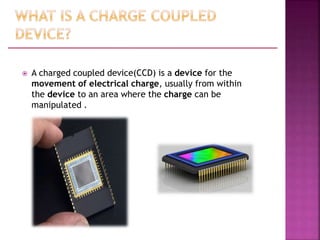
 A charged coupled device(CCD) is a device for the
movement of electrical charge, usually from within
the device to an area where the charge can be
manipulated .
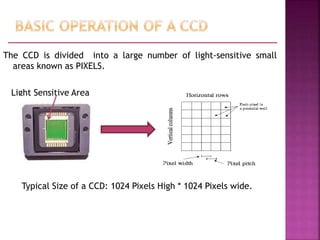
The CCD is divided into a large number of light-sensitive small
areas known as PIXELS.
Light Sensitive Area
Typical Size of a CCD: 1024 Pixels High * 1024 Pixels wide.
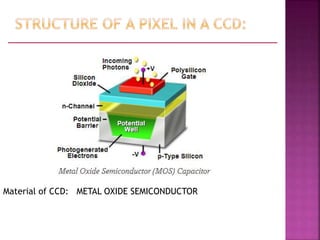
Material of CCD: METAL OXIDE SEMICONDUCTOR
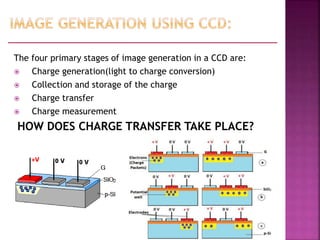
The four primary stages of image generation in a CCD are:
 Charge generation(light to charge conversion)
 Collection and storage of the charge
 Charge transfer
 Charge measurement
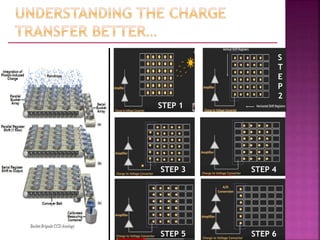
HOW DOES CHARGE TRANSFER TAKE PLACE?
STEP 1
STEP 3
STEP 5
STEP 4
STEP 6
S
T
E
P
2
The final process on the CCD is the reading of each pixel so
that the size of the associated charge cloud can be measured.
At the end of the readout register is an amplifier which
measure the value of each charge cloud and converts it into a
voltage, a typical conversion factor being around 5-10µV per
electron with "typical" full well values being about 100,000
electrons or so.
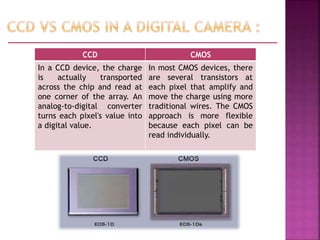
CCD CMOS
In a CCD device, the charge
is actually transported
across the chip and read at
one corner of the array. An
analog-to-digital converter
turns each pixel's value into
a digital value.
In most CMOS devices, there
are several transistors at
each pixel that amplify and
move the charge using more
traditional wires. The CMOS
approach is more flexible
because each pixel can be
read individually.
THE COMMON TYPES OF CCD ARE:
 Interline transfer device
 Full frame transfer device
 Intensified charged coupled device
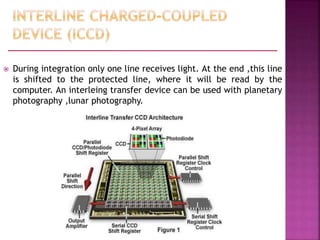
 During integration only one line receives light. At the end ,this line
is shifted to the protected line, where it will be read by the
computer. An interleing transfer device can be used with planetary
photography ,lunar photography.
 Full Frame CCDs are inherently progressive scan. They capture
a full frame in a single shutter (integration) period. They differ
from Interline Transfer CCDs because they do not have a pixel
storage area next to the active pixel. They in fact have no
pixel storage area.
 The benefit of Full Frame sensors is that they have 100% Fill
Factor and since they require half as much pixel area as Frame
Transfer sensors they are less expensive.
 The disadvantage of Full Frame sensors is that it takes a
relatively long time to clock the pixels out of the shift register
and so the effective Readout Time is long. Full Frame sensors
are always used with a mechanical shutter or strobe light.
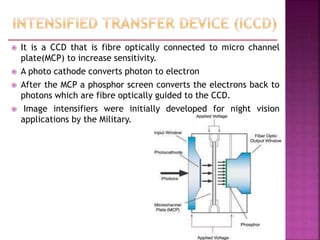
 It is a CCD that is fibre optically connected to micro channel
plate(MCP) to increase sensitivity.
 A photo cathode converts photon to electron
 After the MCP a phosphor screen converts the electrons back to
photons which are fibre optically guided to the CCD.
 Image intensifiers were initially developed for night vision
applications by the Military.
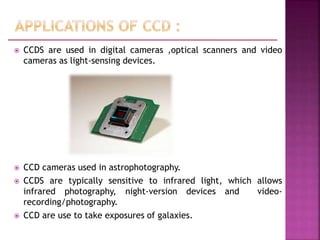
 CCDS are used in digital cameras ,optical scanners and video
cameras as light-sensing devices.
 CCD cameras used in astrophotography.
 CCDS are typically sensitive to infrared light, which allows
infrared photography, night-version devices and video-
recording/photography.
 CCD are use to take exposures of galaxies.
 CCD sensors are more susceptible to vertical smear from
bright light sources when the sensor is overloaded; high-
end frame transfer CCDs in turn do not suffer from this
problem.
 CCD cameras are designed for specific use, and knowing
what you’ll be asking of it will help you make your
purchasing decision. CCD cameras are manufactured with
c-mount or t-mounts and are also equipped with an
adaptor to connect to a computer for ease in displaying
the images
 CCD sensors consume much much more power.
 HD video-less pixel rates.
 CCDS are expensive as they require special manufacturing.
 CCD sensors are rigid and can irritate the oral tissue and
cause pain.
 The receptors is reused indefinitely-cross infection.
 CCD sensors may be wired/wireless-mastering the use
requires some effort and learning period.
THANK YOU

Charged Coupled Device

  • 1.
    PRESENTED BY:  ADWITIYABISWAS  ANKIT PRASAD  PRIYANKA
  • 2.
     A chargedcoupled device(CCD) is a device for the movement of electrical charge, usually from within the device to an area where the charge can be manipulated .
  • 3.
    The CCD isdivided into a large number of light-sensitive small areas known as PIXELS. Light Sensitive Area Typical Size of a CCD: 1024 Pixels High * 1024 Pixels wide.
  • 4.
    Material of CCD:METAL OXIDE SEMICONDUCTOR
  • 5.
    The four primarystages of image generation in a CCD are:  Charge generation(light to charge conversion)  Collection and storage of the charge  Charge transfer  Charge measurement HOW DOES CHARGE TRANSFER TAKE PLACE?
  • 6.
    STEP 1 STEP 3 STEP5 STEP 4 STEP 6 S T E P 2
  • 7.
    The final processon the CCD is the reading of each pixel so that the size of the associated charge cloud can be measured. At the end of the readout register is an amplifier which measure the value of each charge cloud and converts it into a voltage, a typical conversion factor being around 5-10µV per electron with "typical" full well values being about 100,000 electrons or so.
  • 8.
    CCD CMOS In aCCD device, the charge is actually transported across the chip and read at one corner of the array. An analog-to-digital converter turns each pixel's value into a digital value. In most CMOS devices, there are several transistors at each pixel that amplify and move the charge using more traditional wires. The CMOS approach is more flexible because each pixel can be read individually.
  • 9.
    THE COMMON TYPESOF CCD ARE:  Interline transfer device  Full frame transfer device  Intensified charged coupled device
  • 10.
     During integrationonly one line receives light. At the end ,this line is shifted to the protected line, where it will be read by the computer. An interleing transfer device can be used with planetary photography ,lunar photography.
  • 11.
     Full FrameCCDs are inherently progressive scan. They capture a full frame in a single shutter (integration) period. They differ from Interline Transfer CCDs because they do not have a pixel storage area next to the active pixel. They in fact have no pixel storage area.  The benefit of Full Frame sensors is that they have 100% Fill Factor and since they require half as much pixel area as Frame Transfer sensors they are less expensive.  The disadvantage of Full Frame sensors is that it takes a relatively long time to clock the pixels out of the shift register and so the effective Readout Time is long. Full Frame sensors are always used with a mechanical shutter or strobe light.
  • 13.
     It isa CCD that is fibre optically connected to micro channel plate(MCP) to increase sensitivity.  A photo cathode converts photon to electron  After the MCP a phosphor screen converts the electrons back to photons which are fibre optically guided to the CCD.  Image intensifiers were initially developed for night vision applications by the Military.
  • 14.
     CCDS areused in digital cameras ,optical scanners and video cameras as light-sensing devices.  CCD cameras used in astrophotography.  CCDS are typically sensitive to infrared light, which allows infrared photography, night-version devices and video- recording/photography.  CCD are use to take exposures of galaxies.
  • 16.
     CCD sensorsare more susceptible to vertical smear from bright light sources when the sensor is overloaded; high- end frame transfer CCDs in turn do not suffer from this problem.  CCD cameras are designed for specific use, and knowing what you’ll be asking of it will help you make your purchasing decision. CCD cameras are manufactured with c-mount or t-mounts and are also equipped with an adaptor to connect to a computer for ease in displaying the images
  • 17.
     CCD sensorsconsume much much more power.  HD video-less pixel rates.  CCDS are expensive as they require special manufacturing.  CCD sensors are rigid and can irritate the oral tissue and cause pain.  The receptors is reused indefinitely-cross infection.  CCD sensors may be wired/wireless-mastering the use requires some effort and learning period.
  • 18.