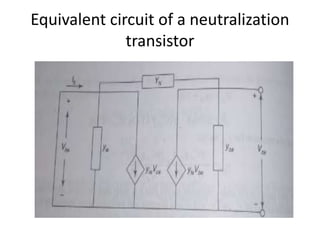
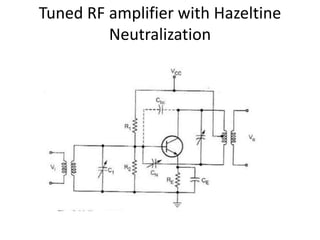
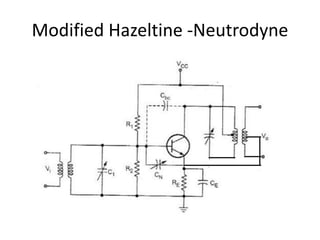
Neutralization is a technique used to cancel feedback in bipolar junction transistors (BJTs) and field-effect transistors (FETs) that can cause instability over certain frequency ranges. This is done by introducing an additional feedback signal of equal amplitude but opposite phase to cancel the original feedback. In a neutralized transistor circuit, a negative capacitor is typically used to introduce this additional feedback signal. The Hazeltine neutralization method uses a variable capacitor connected from the bottom of an RF amplifier coil to the transistor base to neutralize the feedback from the collector-base capacitance. A modified version called Neutrodyne neutralization connects the capacitor to the secondary coil of the next stage for improved stability and insensitivity to supply voltage variations.