Digital Photography 2863

   Test on Chapters 1 and 2
         Spring 2013
1. What does the aperture do?

A. It controls how much light reaches the
   sensor.
B. It controls how long the shutter is open.
C. It controls the depth of field.
D. It controls the speed of the film.
E. Both A and C.
F. Both B and D.
2. What does the acronym
    “SLR” stand for?
3. Name at least one advantage of using
an SLR instead of another type of
camera.
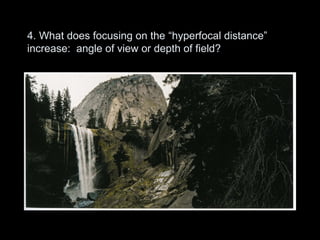
4. What does focusing on the “hyperfocal distance”
increase: angle of view or depth of field?
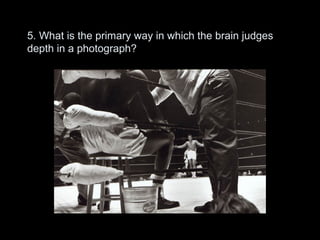
5. What is the primary way in which the brain judges
depth in a photograph?
6. When using shutter priority mode, you set the
_______ and the camera sets the appropriate
_________.
7. An aperture of f/2.8 lets in:

      a. twice as much light
      b. half as much light

as an aperture of f/4.
8. The combination of shutter speed
and aperture is called the ________.
9. The focal length of a lens affects the
photograph in what two ways?

a. Amount of light and angle of view
b. Angle of view and magnification
c. Depth of field and magnification
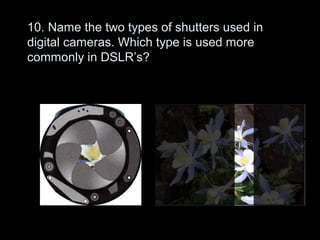
10. Name the two types of shutters used in
digital cameras. Which type is used more
commonly in DSLR’s?
11. What is a “normal lens?”
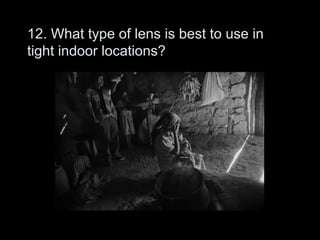
12. What type of lens is best to use in
tight indoor locations?
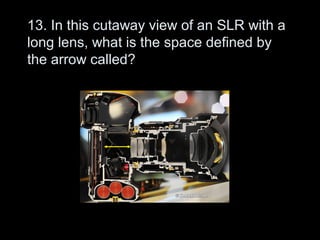
13. In this cutaway view of an SLR with a
long lens, what is the space defined by
the arrow called?
14. True or False:
A normal lens for a full
frame or 35 mm camera is
about 50mm.
15. Name at least one
advantage of a normal
lens.
16. True or False:
A long lens provides
relatively little depth of
field.
17. Which of the following lenses
   works best when taking portraits?


a. Medium-long lens
b. Wide angle lens
c. Long lens
d. Telephoto lens
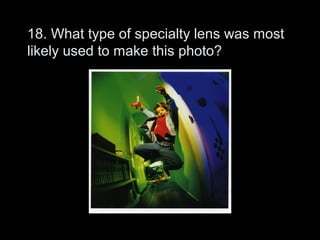
18. What type of specialty lens was most
likely used to make this photo?
19. What is the “plane of critical focus?”
20. Name at least one thing a
polarizing filter can do.
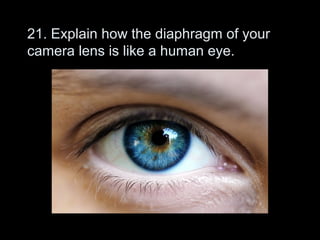
21. Explain how the diaphragm of your
camera lens is like a human eye.
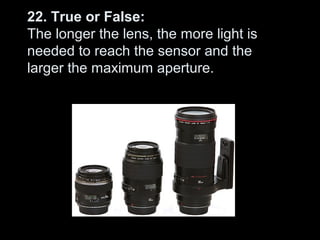
22. True or False:
The longer the lens, the more light is
needed to reach the sensor and the
larger the maximum aperture.
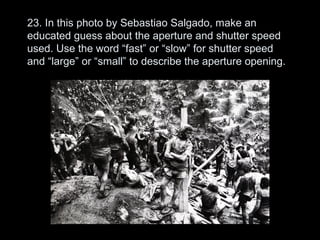
23. In this photo by Sebastiao Salgado, make an
educated guess about the aperture and shutter speed
used. Use the word “fast” or “slow” for shutter speed
and “large” or “small” to describe the aperture opening.
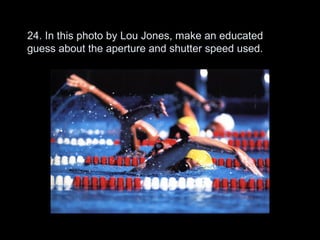
24. In this photo by Lou Jones, make an educated
guess about the aperture and shutter speed used.
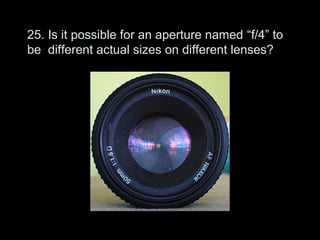
25. Is it possible for an aperture named “f/4” to
be different actual sizes on different lenses?
26. What method is most effective in
   changing the perspective in a
   photograph?


a. Changing the focal length of the lens
b. Changing the lens to distance of the
   closest subject
c. Changing the angle of view
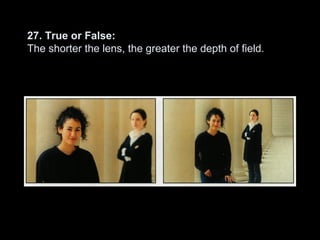
27. True or False:
The shorter the lens, the greater the depth of field.
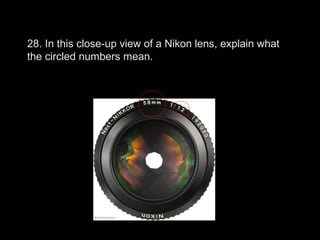
28. In this close-up view of a Nikon lens, explain what
the circled numbers mean.
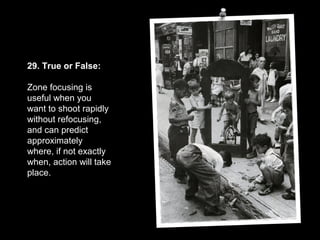
29. True or False:

Zone focusing is
useful when you
want to shoot rapidly
without refocusing,
and can predict
approximately
where, if not exactly
when, action will take
place.
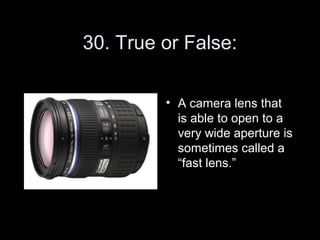
30. True or False:

         • A camera lens that
           is able to open to a
           very wide aperture is
           sometimes called a
           “fast lens.”
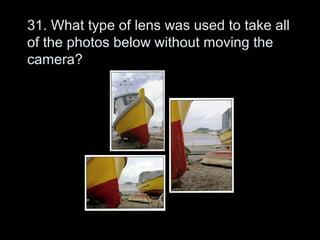
31. What type of lens was used to take all
of the photos below without moving the
camera?
32. True or False:
The “plane of critical focus”
usually falls about 1/3 of the
way back from the front of
the depth of field.
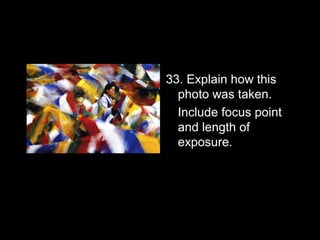
33. Explain how this
  photo was taken.
  Include focus point
  and length of
  exposure.
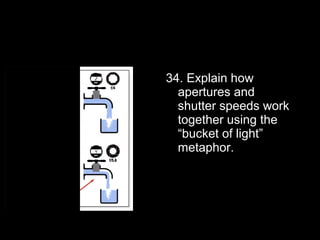
34. Explain how
  apertures and
  shutter speeds work
  together using the
  “bucket of light”
  metaphor.
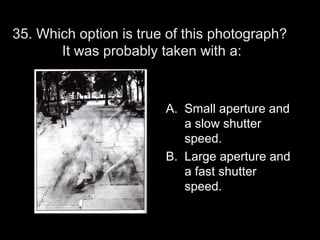
35. Which option is true of this photograph?
       It was probably taken with a:


                        A. Small aperture and
                           a slow shutter
                           speed.
                        B. Large aperture and
                           a fast shutter
                           speed.
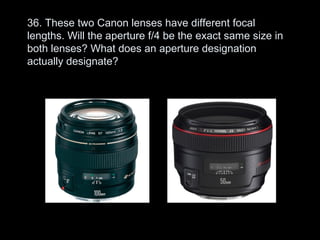
36. These two Canon lenses have different focal
lengths. Will the aperture f/4 be the exact same size in
both lenses? What does an aperture designation
actually designate?
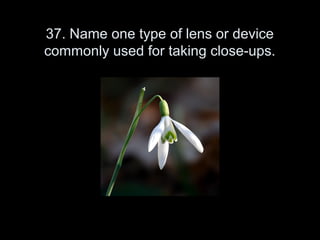
37. Name one type of lens or device
commonly used for taking close-ups.
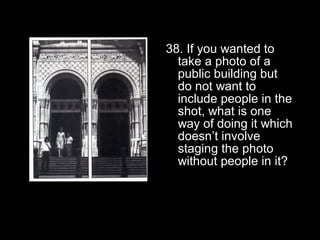
38. If you wanted to
  take a photo of a
  public building but
  do not want to
  include people in the
  shot, what is one
  way of doing it which
  doesn’t involve
  staging the photo
  without people in it?
39. What changes perspective: changing
the focal length or changing the lens-to-
subject distance?
40. True or False:


• A small aperture has a shallow depth of
  field and a large aperture has a deep
  depth of field.
41. An f/32 aperture has what
        size opening?


          A. Large
          B. Small
          C. Medium
42. A lens is called “fast”
            because:
A. It takes very little time to focus.
B. The wide aperture allows for faster
   shutter speeds.
C. It can capture a greater depth of field
   in a longer period of time.
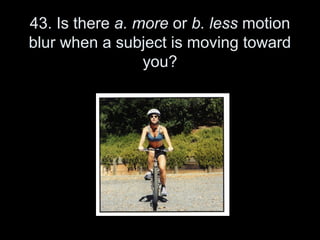
43. Is there a. more or b. less motion
blur when a subject is moving toward
                 you?
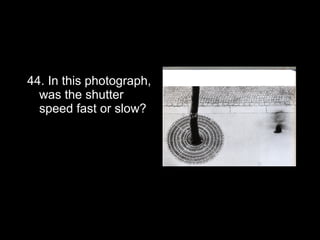
44. In this photograph,
  was the shutter
  speed fast or slow?
45. “Depth of field” means:
A. How many pixels your sensor
   captures.
B. How much of the shot is in focus.
C. How much of a landscape appears in
   your shot.
D. How much of a view is seen in your
   viewfinder.
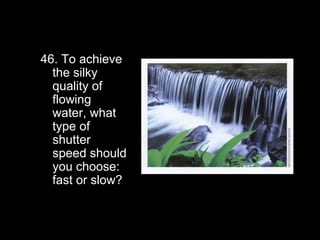
46. To achieve
  the silky
  quality of
  flowing
  water, what
  type of
  shutter
  speed should
  you choose:
  fast or slow?
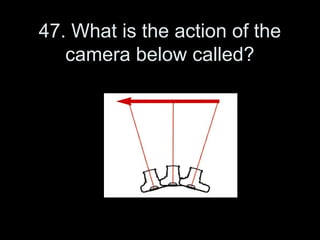
47. What is the action of the
   camera below called?
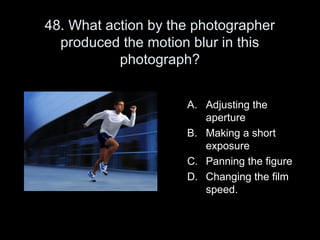
48. What action by the photographer
  produced the motion blur in this
           photograph?


                     A. Adjusting the
                        aperture
                     B. Making a short
                        exposure
                     C. Panning the figure
                     D. Changing the film
                        speed.
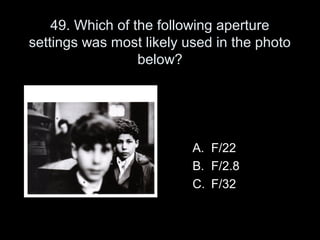
49. Which of the following aperture
settings was most likely used in the photo
                  below?


                          A. F/22
                          B. F/2.8
                          C. F/32
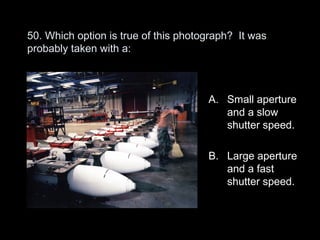
50. Which option is true of this photograph? It was
probably taken with a:


                                      A. Small aperture
                                         and a slow
                                         shutter speed.

                                      B. Large aperture
                                         and a fast
                                         shutter speed.
Extra Credit

        Section 1
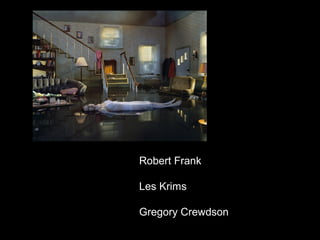
Identify the photographer whose
          work is shown:
            1 pt. each
Lee Friedlander

Annie Leibovitz

Gregory Crewdson
Jan Groover

William Christenberry

Paul Berger
James Welling

Jerry Uelsmann

Andreas Gursky
Robert Frank

Les Krims

Gregory Crewdson
William Klein

John Pfahl

Richard Avedon
Extra Credit

        Section 2
Identify the photographer whose
          work is shown:
            1 pt. each

Chapters 1 & 2 test

  • 1.
    Digital Photography 2863 Test on Chapters 1 and 2 Spring 2013
  • 2.
    1. What doesthe aperture do? A. It controls how much light reaches the sensor. B. It controls how long the shutter is open. C. It controls the depth of field. D. It controls the speed of the film. E. Both A and C. F. Both B and D.
  • 3.
    2. What doesthe acronym “SLR” stand for?
  • 4.
    3. Name atleast one advantage of using an SLR instead of another type of camera.
  • 5.
    4. What doesfocusing on the “hyperfocal distance” increase: angle of view or depth of field?
  • 6.
    5. What isthe primary way in which the brain judges depth in a photograph?
  • 7.
    6. When usingshutter priority mode, you set the _______ and the camera sets the appropriate _________.
  • 8.
    7. An apertureof f/2.8 lets in: a. twice as much light b. half as much light as an aperture of f/4.
  • 9.
    8. The combinationof shutter speed and aperture is called the ________.
  • 10.
    9. The focallength of a lens affects the photograph in what two ways? a. Amount of light and angle of view b. Angle of view and magnification c. Depth of field and magnification
  • 11.
    10. Name thetwo types of shutters used in digital cameras. Which type is used more commonly in DSLR’s?
  • 12.
    11. What isa “normal lens?”
  • 13.
    12. What typeof lens is best to use in tight indoor locations?
  • 14.
    13. In thiscutaway view of an SLR with a long lens, what is the space defined by the arrow called?
  • 15.
    14. True orFalse: A normal lens for a full frame or 35 mm camera is about 50mm.
  • 16.
    15. Name atleast one advantage of a normal lens.
  • 17.
    16. True orFalse: A long lens provides relatively little depth of field.
  • 18.
    17. Which ofthe following lenses works best when taking portraits? a. Medium-long lens b. Wide angle lens c. Long lens d. Telephoto lens
  • 19.
    18. What typeof specialty lens was most likely used to make this photo?
  • 20.
    19. What isthe “plane of critical focus?”
  • 21.
    20. Name atleast one thing a polarizing filter can do.
  • 22.
    21. Explain howthe diaphragm of your camera lens is like a human eye.
  • 23.
    22. True orFalse: The longer the lens, the more light is needed to reach the sensor and the larger the maximum aperture.
  • 24.
    23. In thisphoto by Sebastiao Salgado, make an educated guess about the aperture and shutter speed used. Use the word “fast” or “slow” for shutter speed and “large” or “small” to describe the aperture opening.
  • 25.
    24. In thisphoto by Lou Jones, make an educated guess about the aperture and shutter speed used.
  • 26.
    25. Is itpossible for an aperture named “f/4” to be different actual sizes on different lenses?
  • 27.
    26. What methodis most effective in changing the perspective in a photograph? a. Changing the focal length of the lens b. Changing the lens to distance of the closest subject c. Changing the angle of view
  • 28.
    27. True orFalse: The shorter the lens, the greater the depth of field.
  • 29.
    28. In thisclose-up view of a Nikon lens, explain what the circled numbers mean.
  • 30.
    29. True orFalse: Zone focusing is useful when you want to shoot rapidly without refocusing, and can predict approximately where, if not exactly when, action will take place.
  • 31.
    30. True orFalse: • A camera lens that is able to open to a very wide aperture is sometimes called a “fast lens.”
  • 32.
    31. What typeof lens was used to take all of the photos below without moving the camera?
  • 33.
    32. True orFalse: The “plane of critical focus” usually falls about 1/3 of the way back from the front of the depth of field.
  • 34.
    33. Explain howthis photo was taken. Include focus point and length of exposure.
  • 35.
    34. Explain how apertures and shutter speeds work together using the “bucket of light” metaphor.
  • 36.
    35. Which optionis true of this photograph? It was probably taken with a: A. Small aperture and a slow shutter speed. B. Large aperture and a fast shutter speed.
  • 37.
    36. These twoCanon lenses have different focal lengths. Will the aperture f/4 be the exact same size in both lenses? What does an aperture designation actually designate?
  • 38.
    37. Name onetype of lens or device commonly used for taking close-ups.
  • 39.
    38. If youwanted to take a photo of a public building but do not want to include people in the shot, what is one way of doing it which doesn’t involve staging the photo without people in it?
  • 40.
    39. What changesperspective: changing the focal length or changing the lens-to- subject distance?
  • 41.
    40. True orFalse: • A small aperture has a shallow depth of field and a large aperture has a deep depth of field.
  • 42.
    41. An f/32aperture has what size opening? A. Large B. Small C. Medium
  • 43.
    42. A lensis called “fast” because: A. It takes very little time to focus. B. The wide aperture allows for faster shutter speeds. C. It can capture a greater depth of field in a longer period of time.
  • 44.
    43. Is therea. more or b. less motion blur when a subject is moving toward you?
  • 45.
    44. In thisphotograph, was the shutter speed fast or slow?
  • 46.
    45. “Depth offield” means: A. How many pixels your sensor captures. B. How much of the shot is in focus. C. How much of a landscape appears in your shot. D. How much of a view is seen in your viewfinder.
  • 47.
    46. To achieve the silky quality of flowing water, what type of shutter speed should you choose: fast or slow?
  • 48.
    47. What isthe action of the camera below called?
  • 49.
    48. What actionby the photographer produced the motion blur in this photograph? A. Adjusting the aperture B. Making a short exposure C. Panning the figure D. Changing the film speed.
  • 50.
    49. Which ofthe following aperture settings was most likely used in the photo below? A. F/22 B. F/2.8 C. F/32
  • 51.
    50. Which optionis true of this photograph? It was probably taken with a: A. Small aperture and a slow shutter speed. B. Large aperture and a fast shutter speed.
  • 52.
    Extra Credit Section 1 Identify the photographer whose work is shown: 1 pt. each
  • 53.
  • 54.
  • 55.
  • 56.
  • 57.
  • 58.
    Extra Credit Section 2 Identify the photographer whose work is shown: 1 pt. each