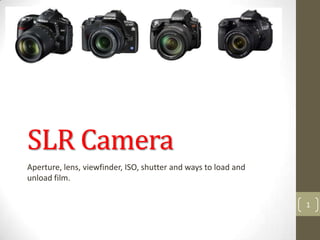
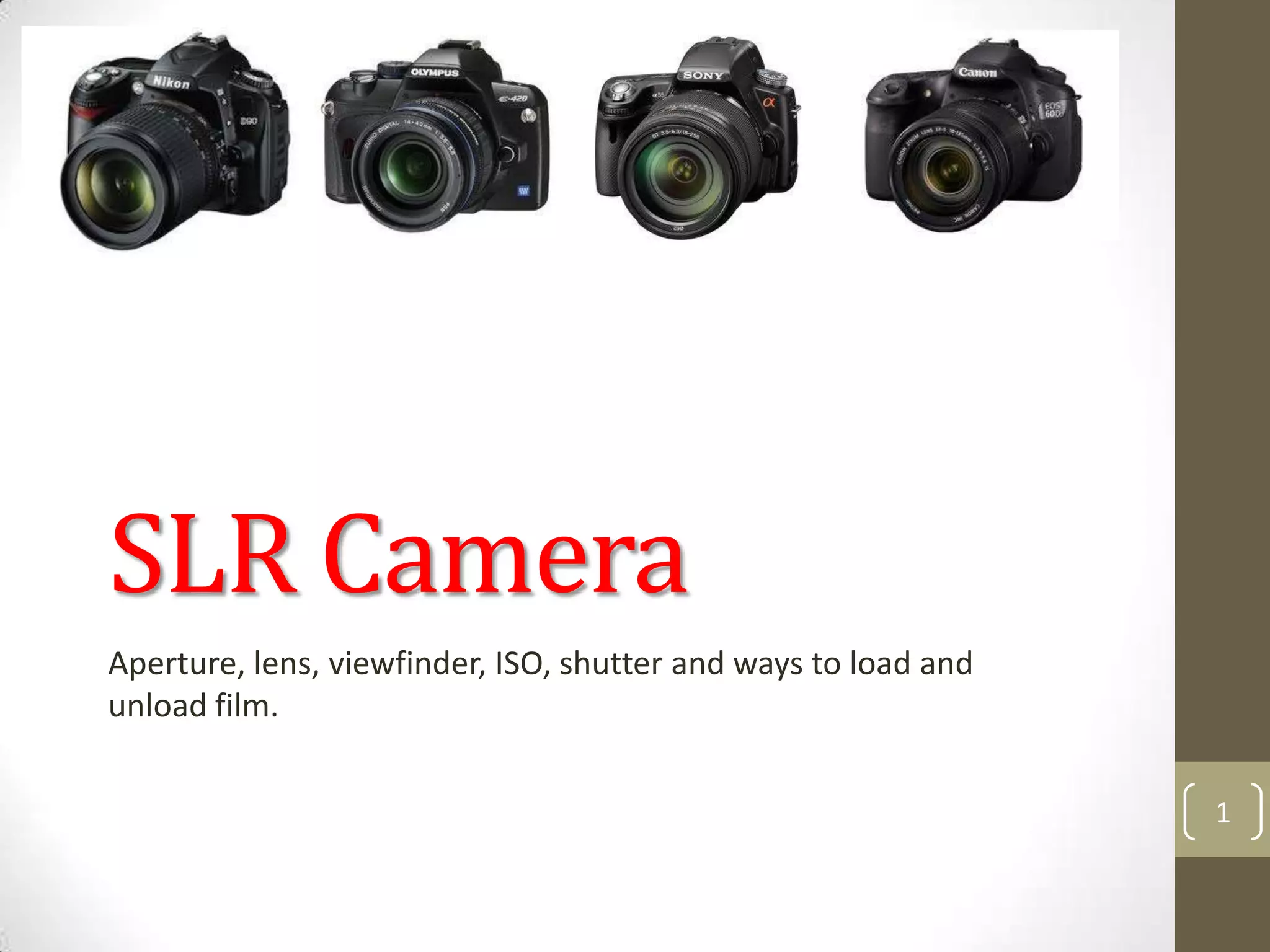
SLR Camera
Aperture, lens, viewfinder, ISO, shutter and ways to load and
unload film.

                                                                1
Aperture
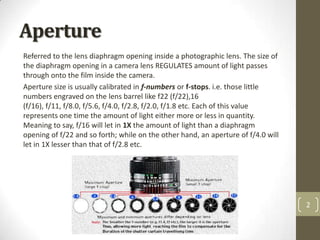
Referred to the lens diaphragm opening inside a photographic lens. The size of
the diaphragm opening in a camera lens REGULATES amount of light passes
through onto the film inside the camera.
Aperture size is usually calibrated in f-numbers or f-stops. i.e. those little
numbers engraved on the lens barrel like f22 (f/22),16
(f/16), f/11, f/8.0, f/5.6, f/4.0, f/2.8, f/2.0, f/1.8 etc. Each of this value
represents one time the amount of light either more or less in quantity.
Meaning to say, f/16 will let in 1X the amount of light than a diaphragm
opening of f/22 and so forth; while on the other hand, an aperture of f/4.0 will
let in 1X lesser than that of f/2.8 etc.


                                                                                   2
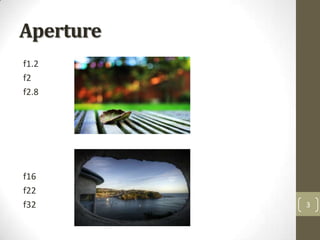
Aperture
f1.2
f2
f2.8


f16
f22
f32        3
Lens
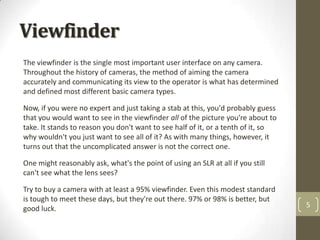
LENS ELEMENTS & IMAGE QUALITY
• All but the simplest cameras contain lenses which are actually
  comprised of several "lens elements." Each of these elements
  directs the path of light rays to recreate the image as accurately as
  possible on the digital sensor. The goal is to minimize
  aberrations, while still utilizing the fewest and least expensive
  elements.


                                                                          4
Viewfinder
The viewfinder is the single most important user interface on any camera.
Throughout the history of cameras, the method of aiming the camera
accurately and communicating its view to the operator is what has determined
and defined most different basic camera types.

Now, if you were no expert and just taking a stab at this, you'd probably guess
that you would want to see in the viewfinder all of the picture you're about to
take. It stands to reason you don't want to see half of it, or a tenth of it, so
why wouldn't you just want to see all of it? As with many things, however, it
turns out that the uncomplicated answer is not the correct one.

One might reasonably ask, what's the point of using an SLR at all if you still
can't see what the lens sees?

Try to buy a camera with at least a 95% viewfinder. Even this modest standard
is tough to meet these days, but they're out there. 97% or 98% is better, but
good luck.                                                                         5
Viewfinder
The manufacturers would just as soon keep you in the dark about the
differences between good and bad viewfinders. But you can't shoot well if you
can't see what you're shooting, or if your camera is only giving you an
approximate idea what you'll get on film. Know your viewfinder!

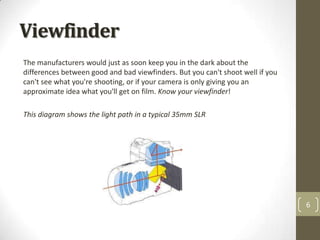
This diagram shows the light path in a typical 35mm SLR


                                                                                6
Viewfinder
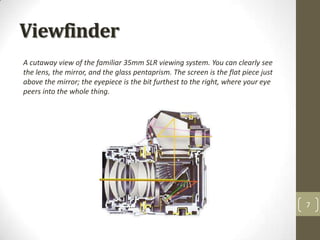
A cutaway view of the familiar 35mm SLR viewing system. You can clearly see
the lens, the mirror, and the glass pentaprism. The screen is the flat piece just
above the mirror; the eyepiece is the bit furthest to the right, where your eye
peers into the whole thing.


                                                                                    7
ISO
• In traditional (film) photography ISO (or ASA) was the indication of how
  sensitive a film was to light. It was measured in numbers (you’ve probably
  seen them on films – 100, 200, 400, 800 etc.). The lower the number the
  lower the sensitivity of the film and the finer the grain in the shots you’re
  taking.

• In Digital Photography ISO measures the sensitivity of the image sensor. The
  same principles apply as in film photography – the lower the number the
  less sensitive your camera is to light and the finer the grain. Higher ISO
  settings are generally used in darker situations to get faster shutter speeds
  (for example an indoor sports event when you want to freeze the action in
  lower light) – however the cost is noisier shots. I’ll illustrate this below with
  two enlargements of shots that I just took – the one on the left is taken at
  100 ISO and the one of the right at 3200 ISO (click to enlarge to see the full
  effect).

ISO (International Organization for Standardization)                                  8
Shutter
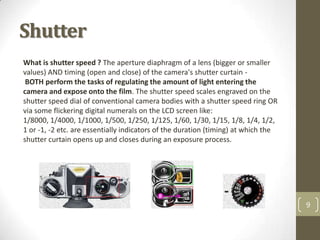
What is shutter speed ? The aperture diaphragm of a lens (bigger or smaller
values) AND timing (open and close) of the camera's shutter curtain -
 BOTH perform the tasks of regulating the amount of light entering the
camera and expose onto the film. The shutter speed scales engraved on the
shutter speed dial of conventional camera bodies with a shutter speed ring OR
via some flickering digital numerals on the LCD screen like:
1/8000, 1/4000, 1/1000, 1/500, 1/250, 1/125, 1/60, 1/30, 1/15, 1/8, 1/4, 1/2,
1 or -1, -2 etc. are essentially indicators of the duration (timing) at which the
shutter curtain opens up and closes during an exposure process.


                                                                                    9
Shutter
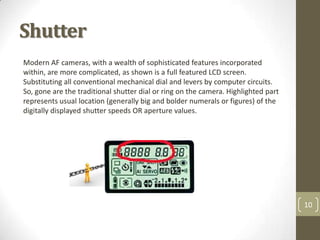
Modern AF cameras, with a wealth of sophisticated features incorporated
within, are more complicated, as shown is a full featured LCD screen.
Substituting all conventional mechanical dial and levers by computer circuits.
So, gone are the traditional shutter dial or ring on the camera. Highlighted part
represents usual location (generally big and bolder numerals or figures) of the
digitally displayed shutter speeds OR aperture values.


                                                                                    10
Film


       11

SLR Cameras

  • 1.
    SLR Camera Aperture, lens,viewfinder, ISO, shutter and ways to load and unload film. 1
  • 2.
    Aperture Referred to thelens diaphragm opening inside a photographic lens. The size of the diaphragm opening in a camera lens REGULATES amount of light passes through onto the film inside the camera. Aperture size is usually calibrated in f-numbers or f-stops. i.e. those little numbers engraved on the lens barrel like f22 (f/22),16 (f/16), f/11, f/8.0, f/5.6, f/4.0, f/2.8, f/2.0, f/1.8 etc. Each of this value represents one time the amount of light either more or less in quantity. Meaning to say, f/16 will let in 1X the amount of light than a diaphragm opening of f/22 and so forth; while on the other hand, an aperture of f/4.0 will let in 1X lesser than that of f/2.8 etc. 2
  • 3.
  • 4.
    Lens LENS ELEMENTS &IMAGE QUALITY • All but the simplest cameras contain lenses which are actually comprised of several "lens elements." Each of these elements directs the path of light rays to recreate the image as accurately as possible on the digital sensor. The goal is to minimize aberrations, while still utilizing the fewest and least expensive elements. 4
  • 5.
    Viewfinder The viewfinder isthe single most important user interface on any camera. Throughout the history of cameras, the method of aiming the camera accurately and communicating its view to the operator is what has determined and defined most different basic camera types. Now, if you were no expert and just taking a stab at this, you'd probably guess that you would want to see in the viewfinder all of the picture you're about to take. It stands to reason you don't want to see half of it, or a tenth of it, so why wouldn't you just want to see all of it? As with many things, however, it turns out that the uncomplicated answer is not the correct one. One might reasonably ask, what's the point of using an SLR at all if you still can't see what the lens sees? Try to buy a camera with at least a 95% viewfinder. Even this modest standard is tough to meet these days, but they're out there. 97% or 98% is better, but good luck. 5
  • 6.
    Viewfinder The manufacturers wouldjust as soon keep you in the dark about the differences between good and bad viewfinders. But you can't shoot well if you can't see what you're shooting, or if your camera is only giving you an approximate idea what you'll get on film. Know your viewfinder! This diagram shows the light path in a typical 35mm SLR 6
  • 7.
    Viewfinder A cutaway viewof the familiar 35mm SLR viewing system. You can clearly see the lens, the mirror, and the glass pentaprism. The screen is the flat piece just above the mirror; the eyepiece is the bit furthest to the right, where your eye peers into the whole thing. 7
  • 8.
    ISO • In traditional(film) photography ISO (or ASA) was the indication of how sensitive a film was to light. It was measured in numbers (you’ve probably seen them on films – 100, 200, 400, 800 etc.). The lower the number the lower the sensitivity of the film and the finer the grain in the shots you’re taking. • In Digital Photography ISO measures the sensitivity of the image sensor. The same principles apply as in film photography – the lower the number the less sensitive your camera is to light and the finer the grain. Higher ISO settings are generally used in darker situations to get faster shutter speeds (for example an indoor sports event when you want to freeze the action in lower light) – however the cost is noisier shots. I’ll illustrate this below with two enlargements of shots that I just took – the one on the left is taken at 100 ISO and the one of the right at 3200 ISO (click to enlarge to see the full effect). ISO (International Organization for Standardization) 8
  • 9.
    Shutter What is shutterspeed ? The aperture diaphragm of a lens (bigger or smaller values) AND timing (open and close) of the camera's shutter curtain - BOTH perform the tasks of regulating the amount of light entering the camera and expose onto the film. The shutter speed scales engraved on the shutter speed dial of conventional camera bodies with a shutter speed ring OR via some flickering digital numerals on the LCD screen like: 1/8000, 1/4000, 1/1000, 1/500, 1/250, 1/125, 1/60, 1/30, 1/15, 1/8, 1/4, 1/2, 1 or -1, -2 etc. are essentially indicators of the duration (timing) at which the shutter curtain opens up and closes during an exposure process. 9
  • 10.
    Shutter Modern AF cameras,with a wealth of sophisticated features incorporated within, are more complicated, as shown is a full featured LCD screen. Substituting all conventional mechanical dial and levers by computer circuits. So, gone are the traditional shutter dial or ring on the camera. Highlighted part represents usual location (generally big and bolder numerals or figures) of the digitally displayed shutter speeds OR aperture values. 10
  • 11.