APERTURE, EXPOSURE
AND DEPTH OF FIELD
The Eye
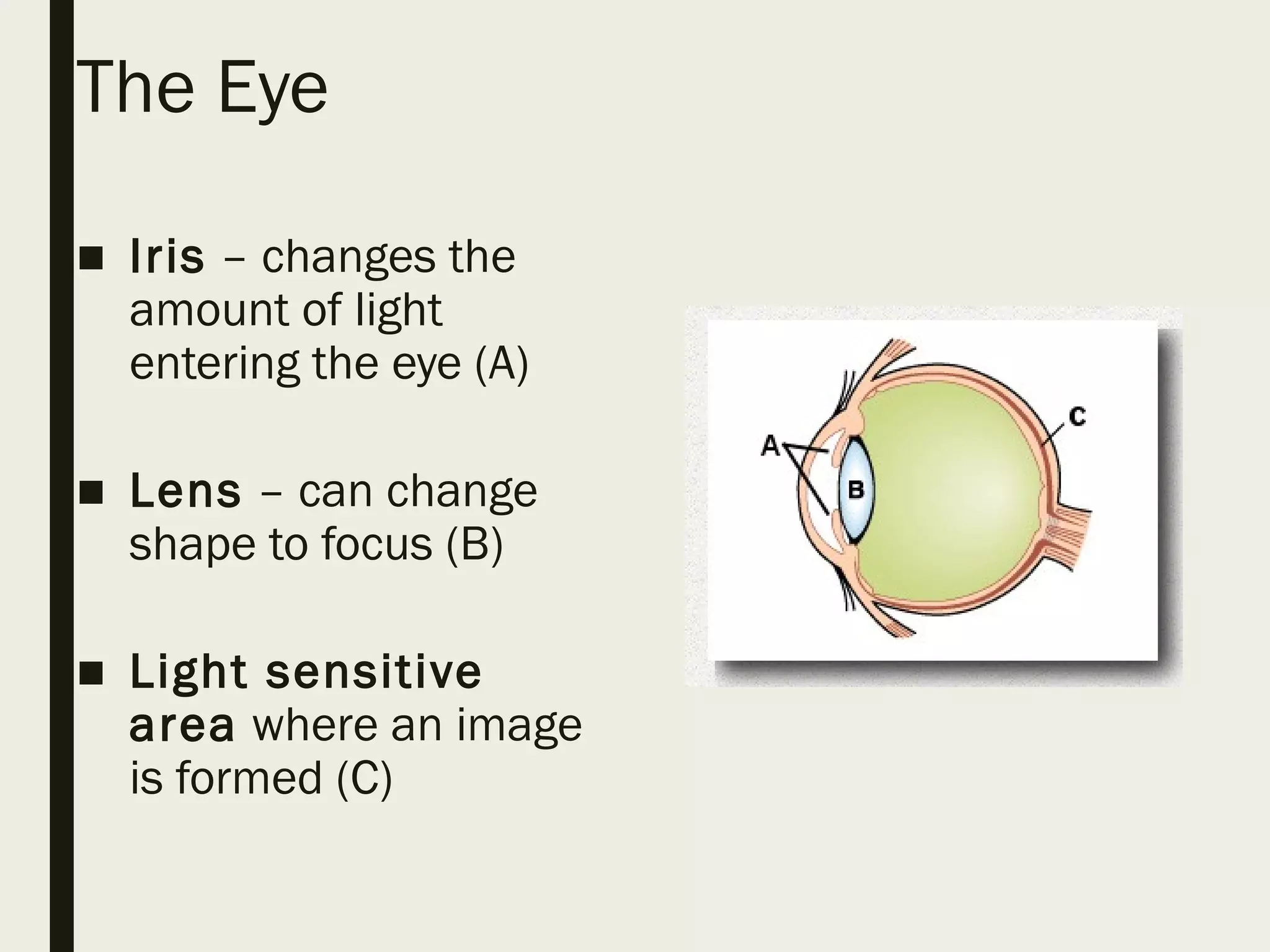
■ Iris – changes the
amount of light
entering the eye (A)
■ Lens – can change
shape to focus (B)
■ Light sensitive
area where an image
is formed (C)
The Camera
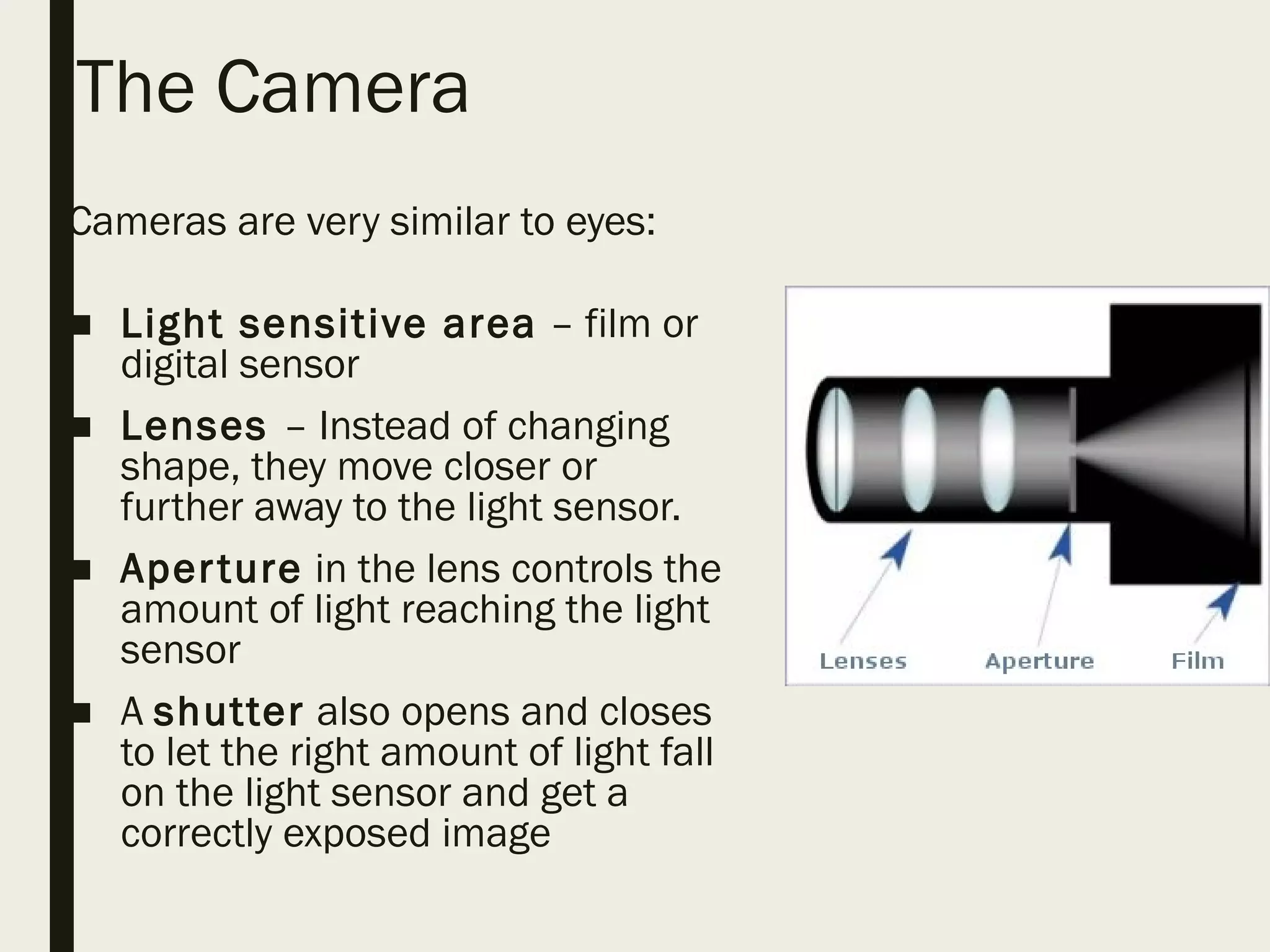
Cameras are very similar to eyes:
■ Light sensitive area – film or
digital sensor
■ Lenses – Instead of changing
shape, they move closer or
further away to the light sensor.
■ Aperture in the lens controls the
amount of light reaching the light
sensor
■ A shutter also opens and closes
to let the right amount of light fall
on the light sensor and get a
correctly exposed image
Types of Lenses for 35mm cameras
■ Removable – for SLR
cameras
■ Fixed – on compact
cameras
■ “Prime” Lens
(Fixed focal length)
■ Zoom – most common
(Range of focal lengths)
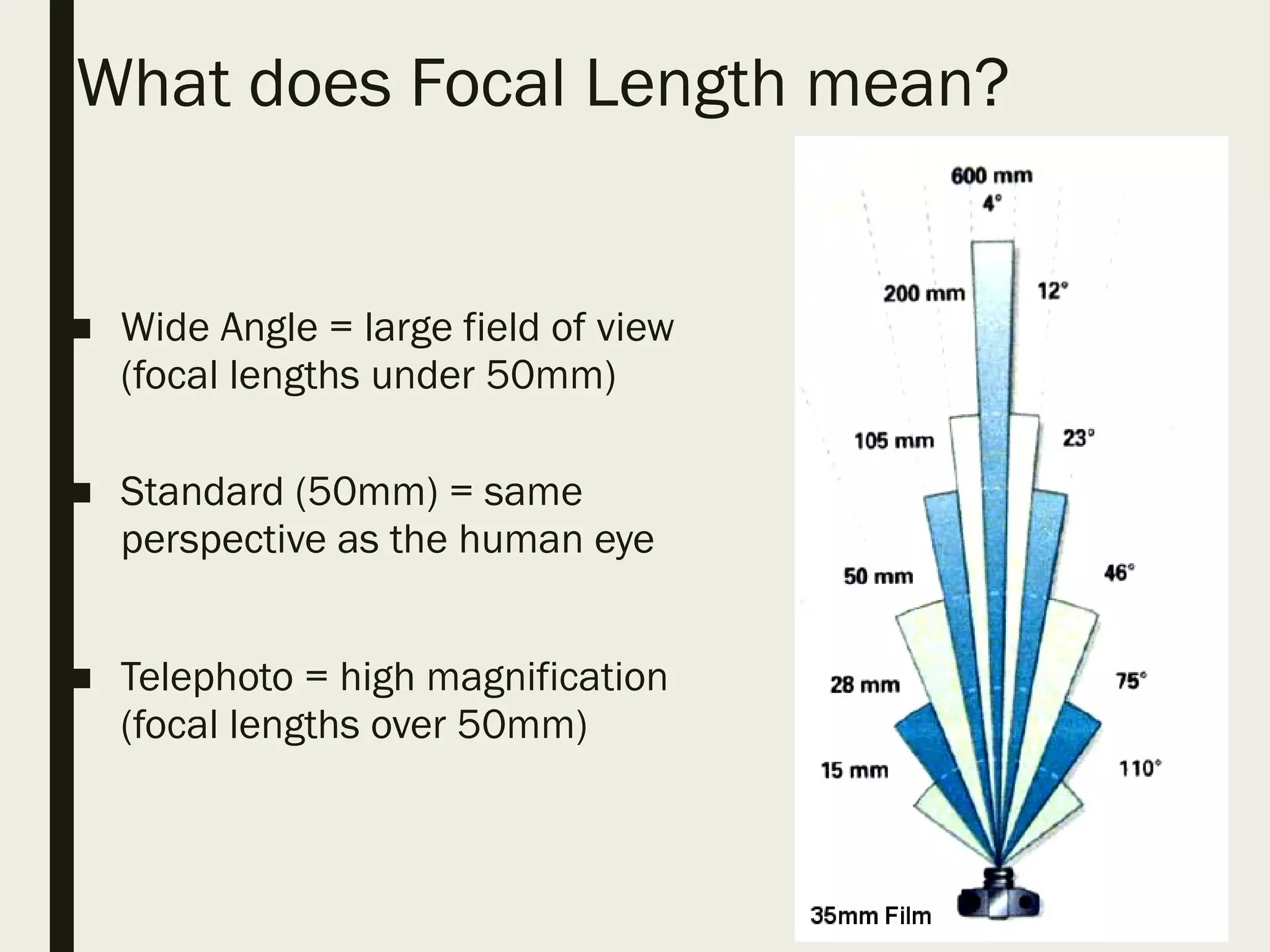
What does Focal Length mean?
■ Wide Angle = large field of view
(focal lengths under 50mm)
■ Standard (50mm) = same
perspective as the human eye
■ Telephoto = high magnification
(focal lengths over 50mm)
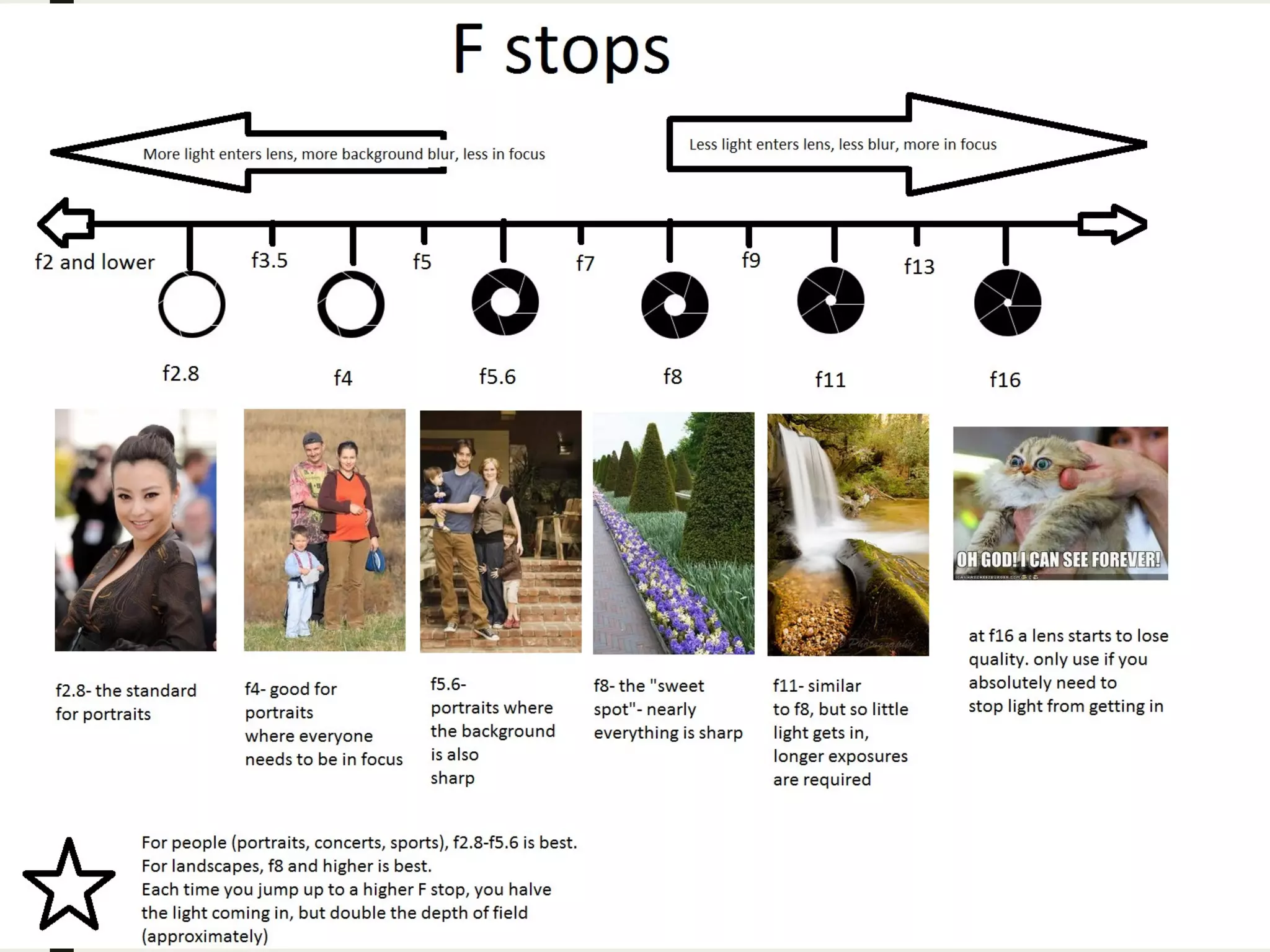
Aperture
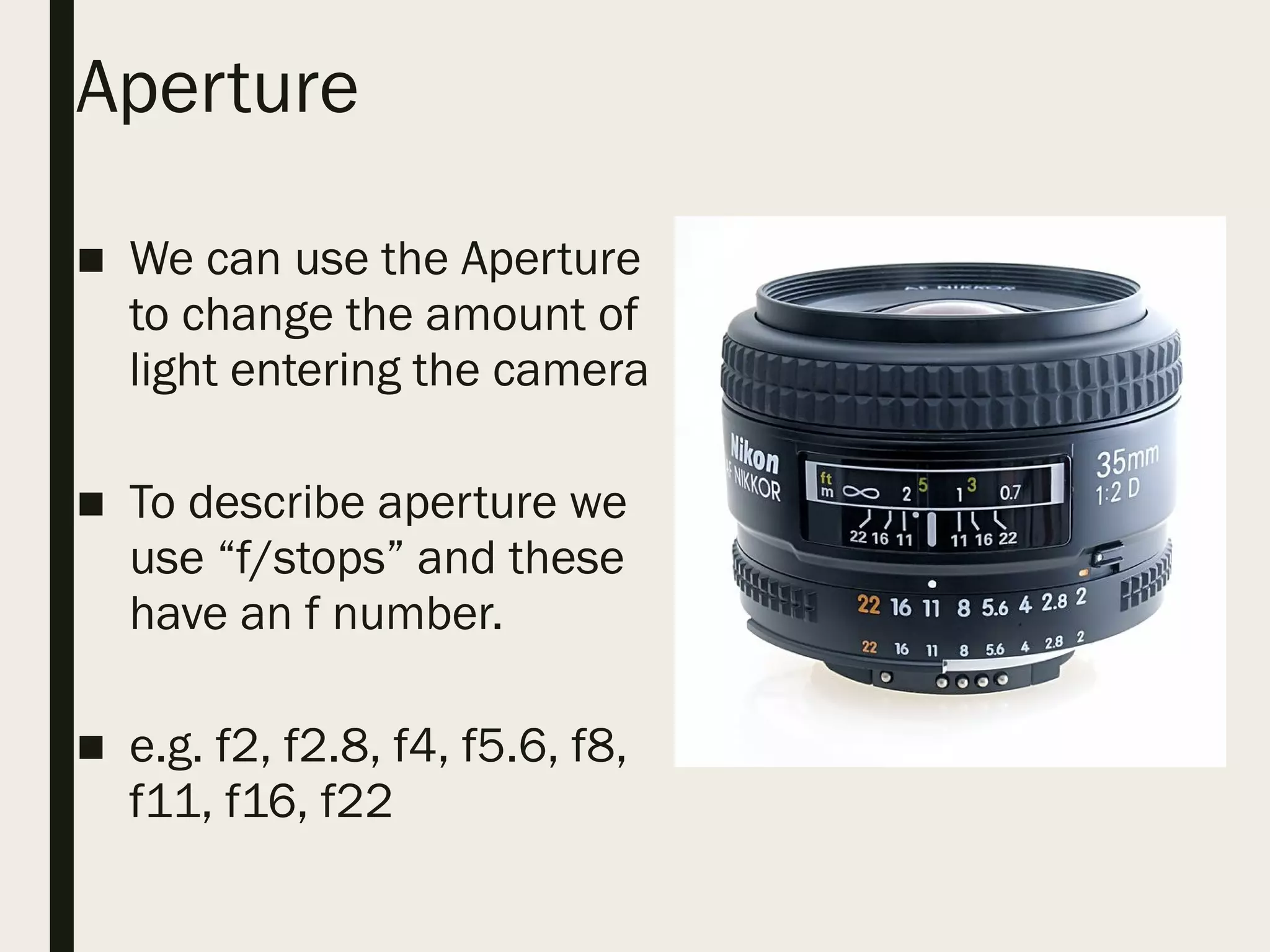
■ We can use the Aperture
to change the amount of
light entering the camera
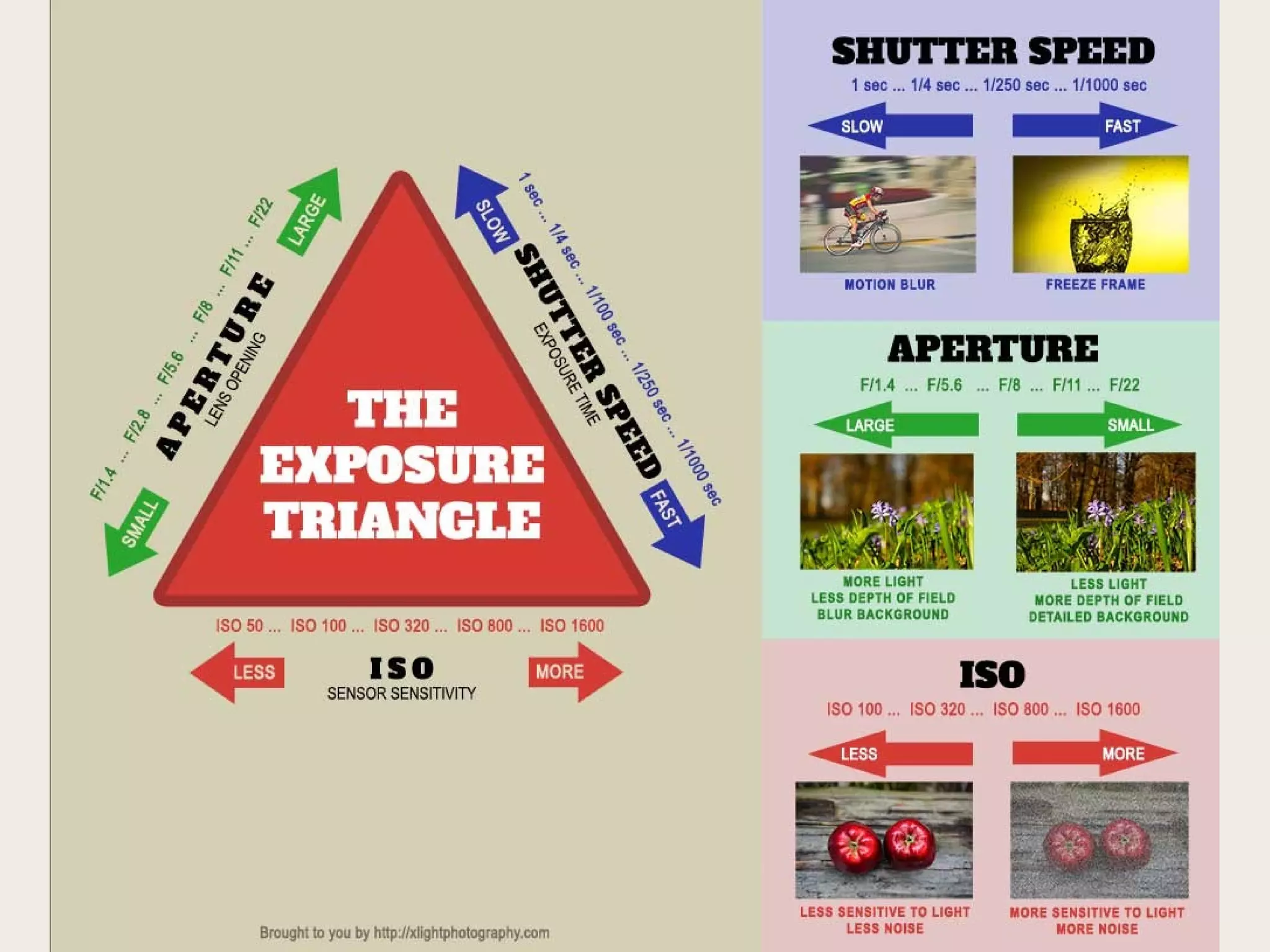
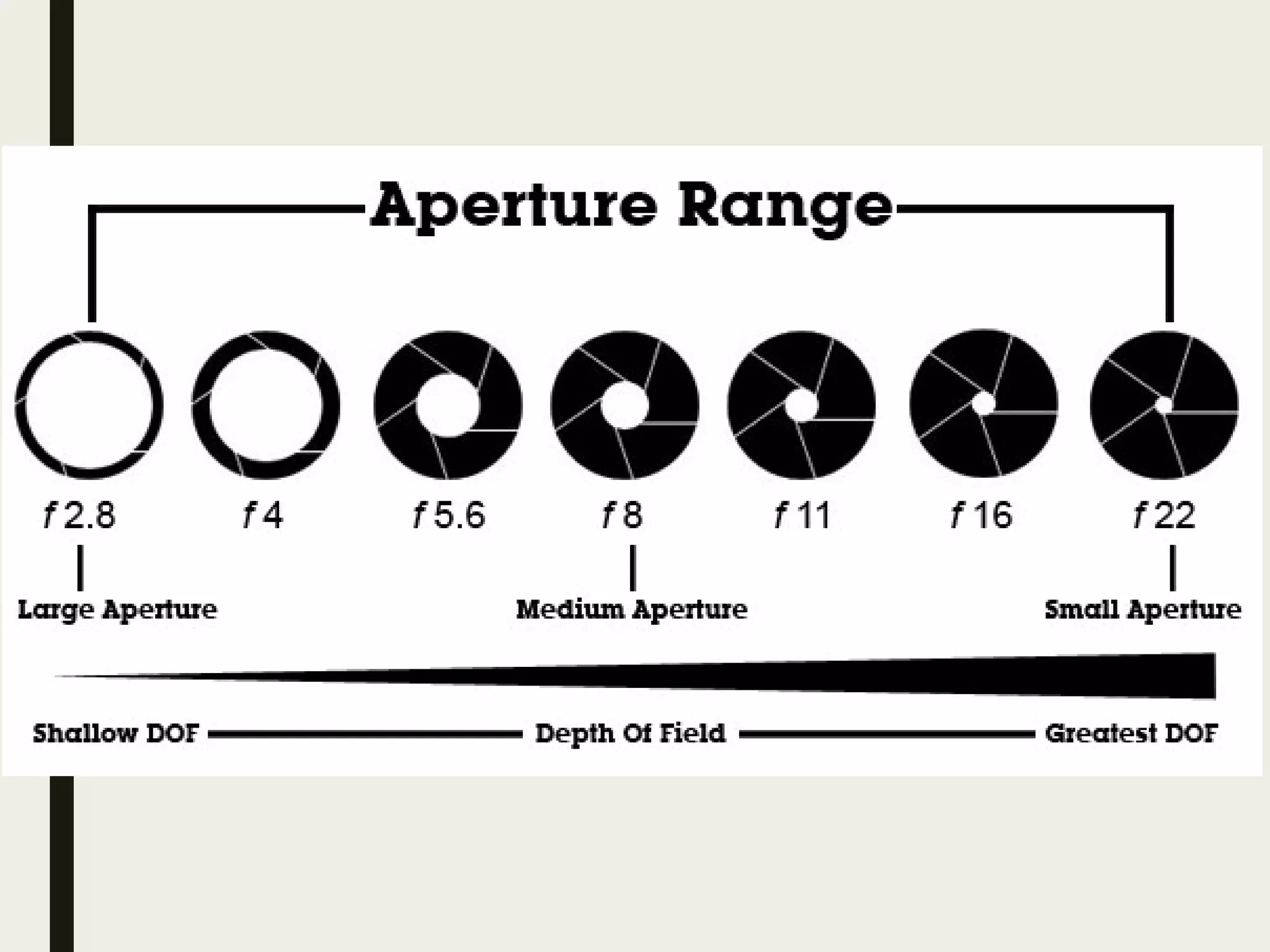
■ To describe aperture we
use “f/stops” and these
have an f number.
■ e.g. f2, f2.8, f4, f5.6, f8,
f11, f16, f22
Aperture
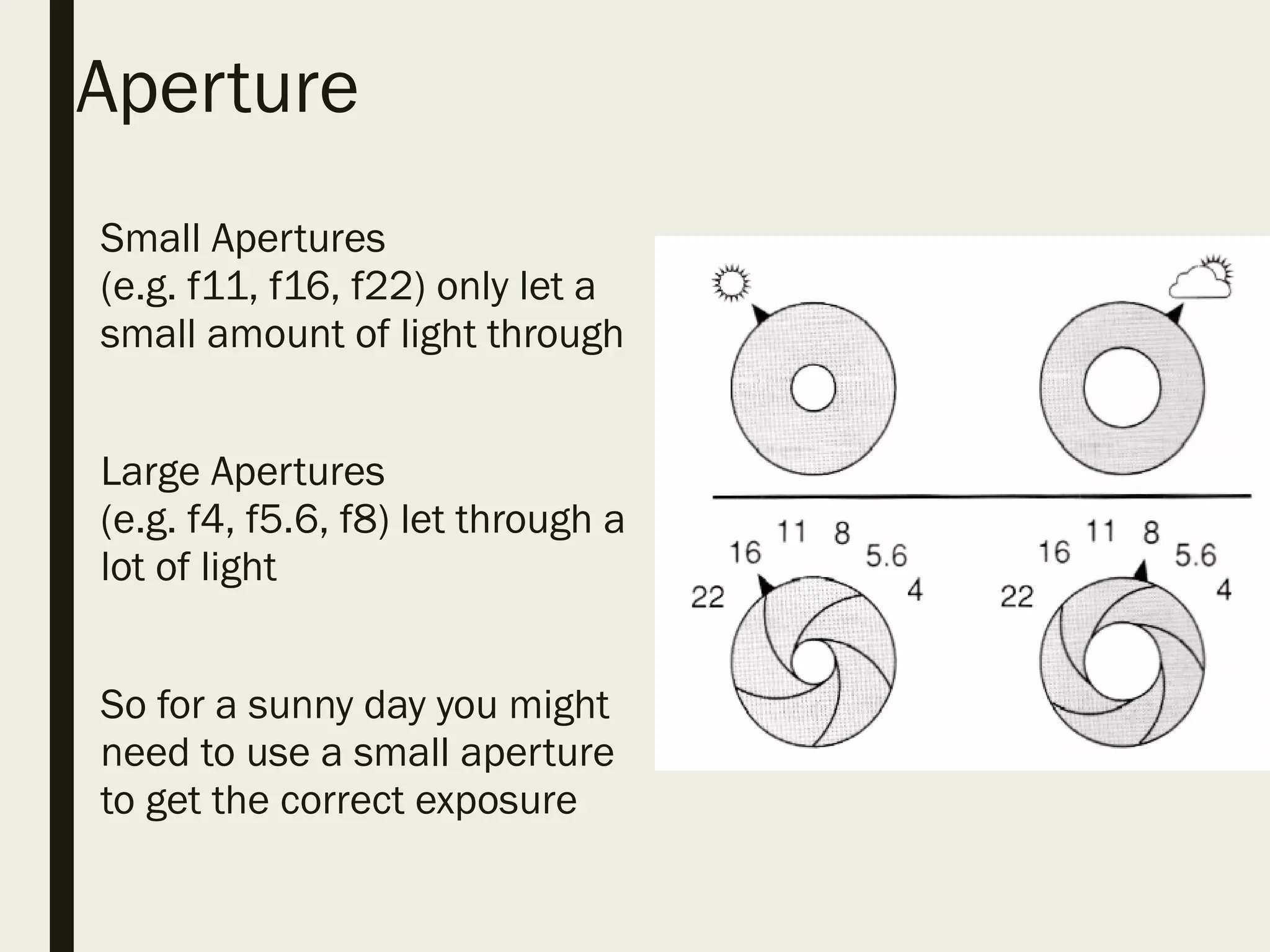
■ Small Apertures
(e.g. f11, f16, f22) only let a
small amount of light through
■ Large Apertures
(e.g. f4, f5.6, f8) let through a
lot of light
■ So for a sunny day you might
need to use a small aperture
to get the correct exposure
Aperture
■ Each change of f/stop either halves or
doubles amount of light entering the
camera
■ The largest f/stop on a lens is called the maximum
aperture. The maximum lens aperture is important
because it indicates the largest amount of light that
the lens will transmit
■ A smaller maximum aperture f number (= a larger
aperture) = a brighter lens = generally more
expensive
Depth of Field
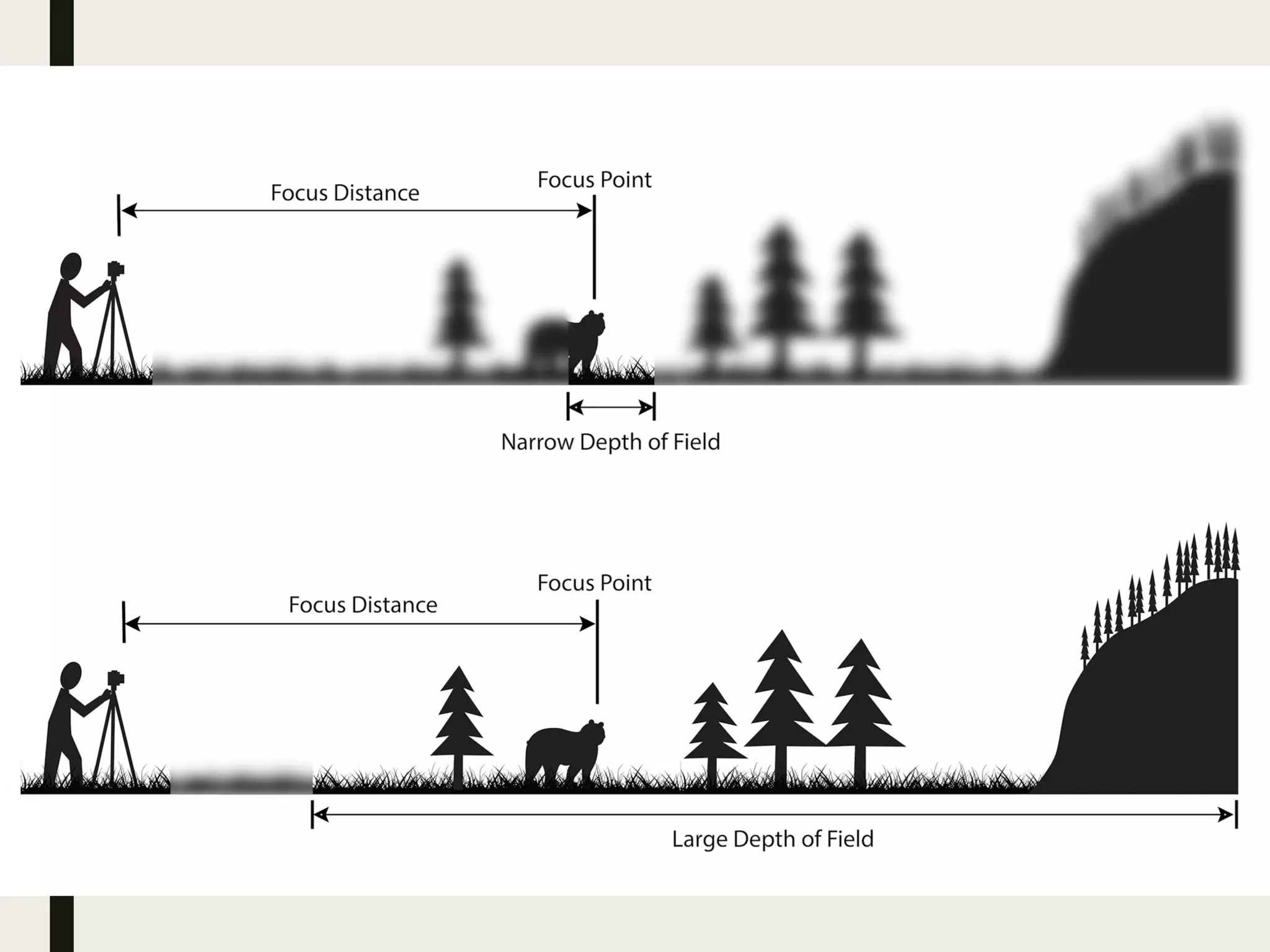
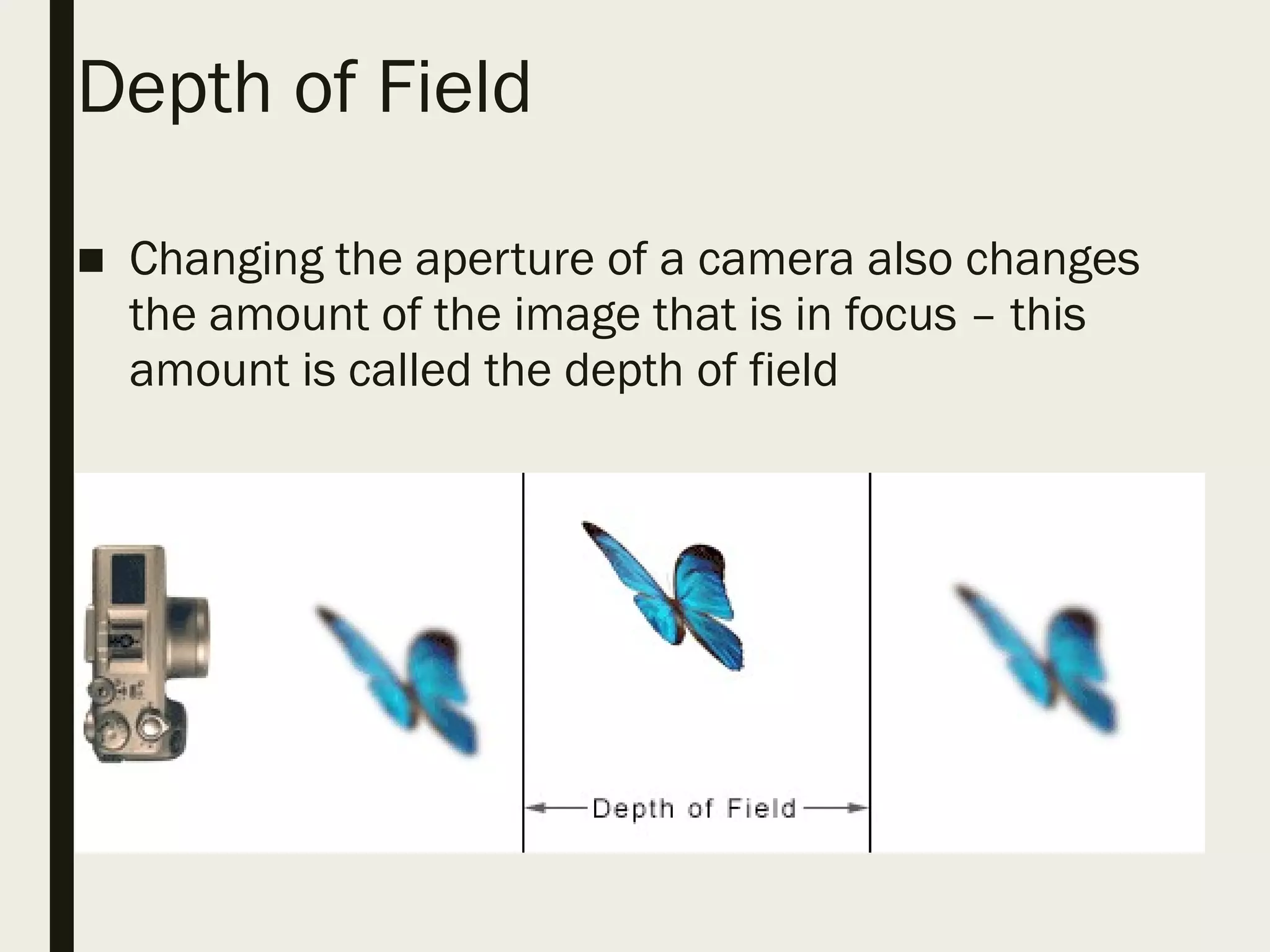
■ Changing the aperture of a camera also changes
the amount of the image that is in focus – this
amount is called the depth of field
Circles of Confusion
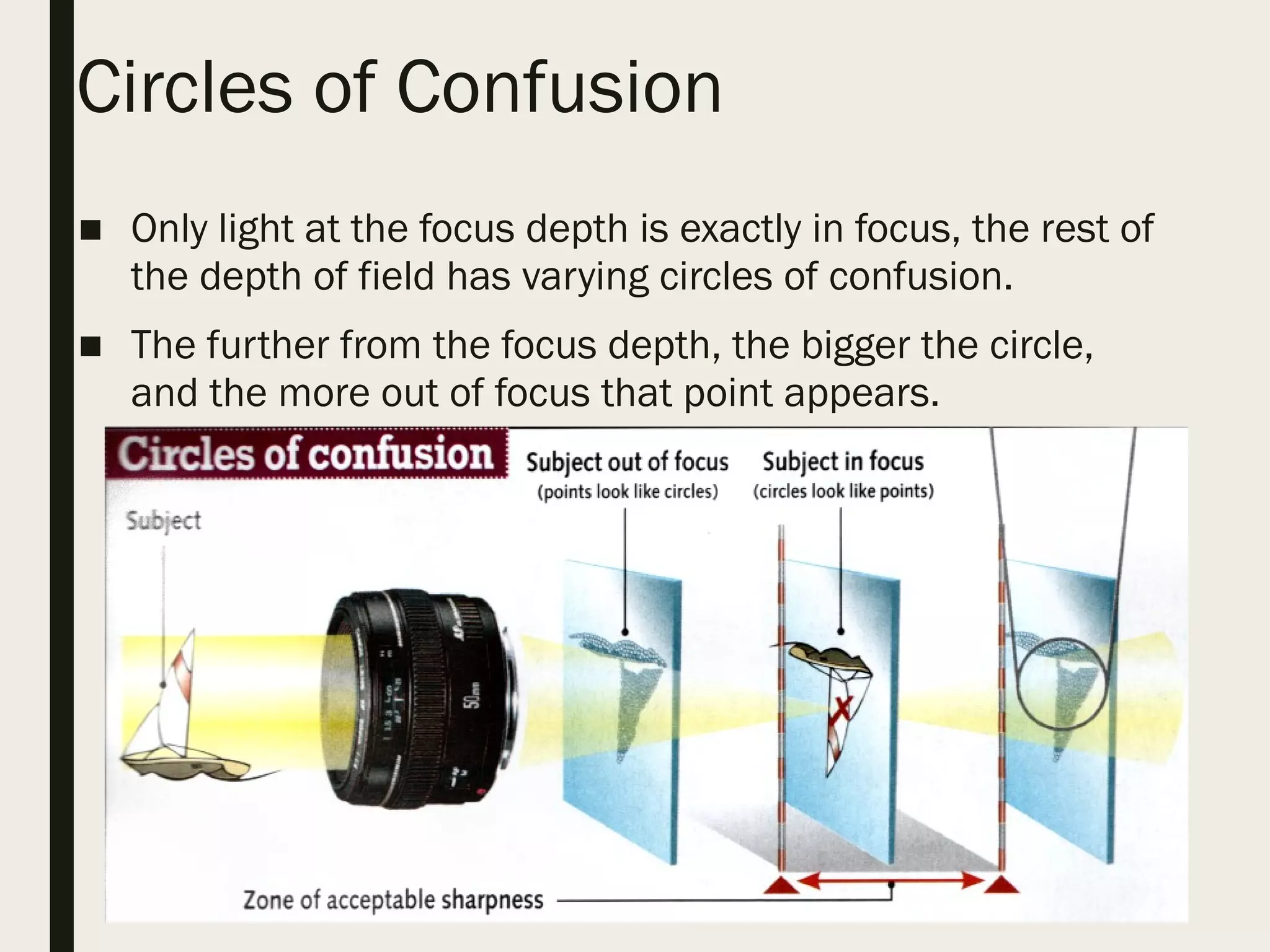
■ Only light at the focus depth is exactly in focus, the rest of
the depth of field has varying circles of confusion.
■ The further from the focus depth, the bigger the circle,
and the more out of focus that point appears.
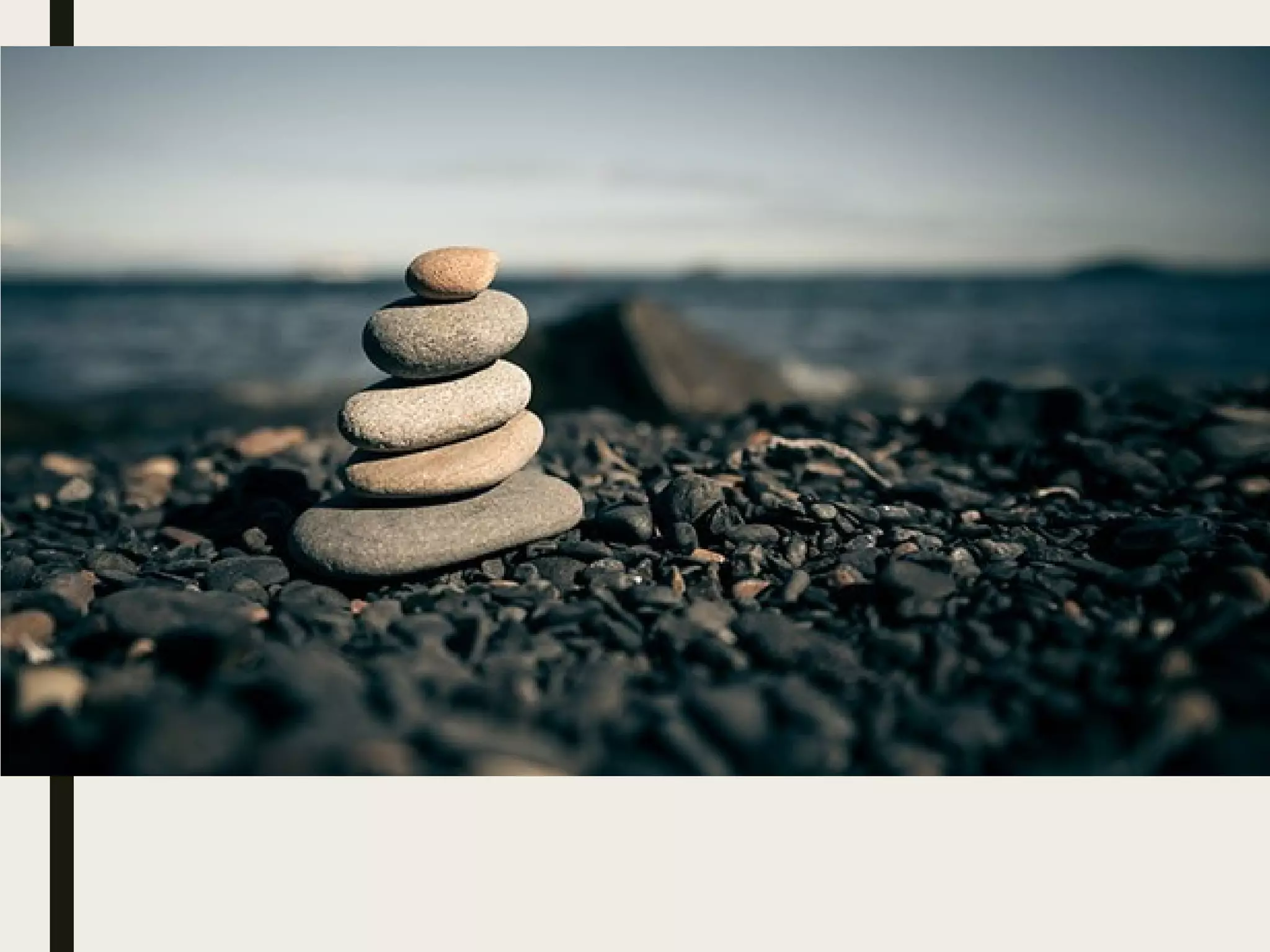
Depth of Field
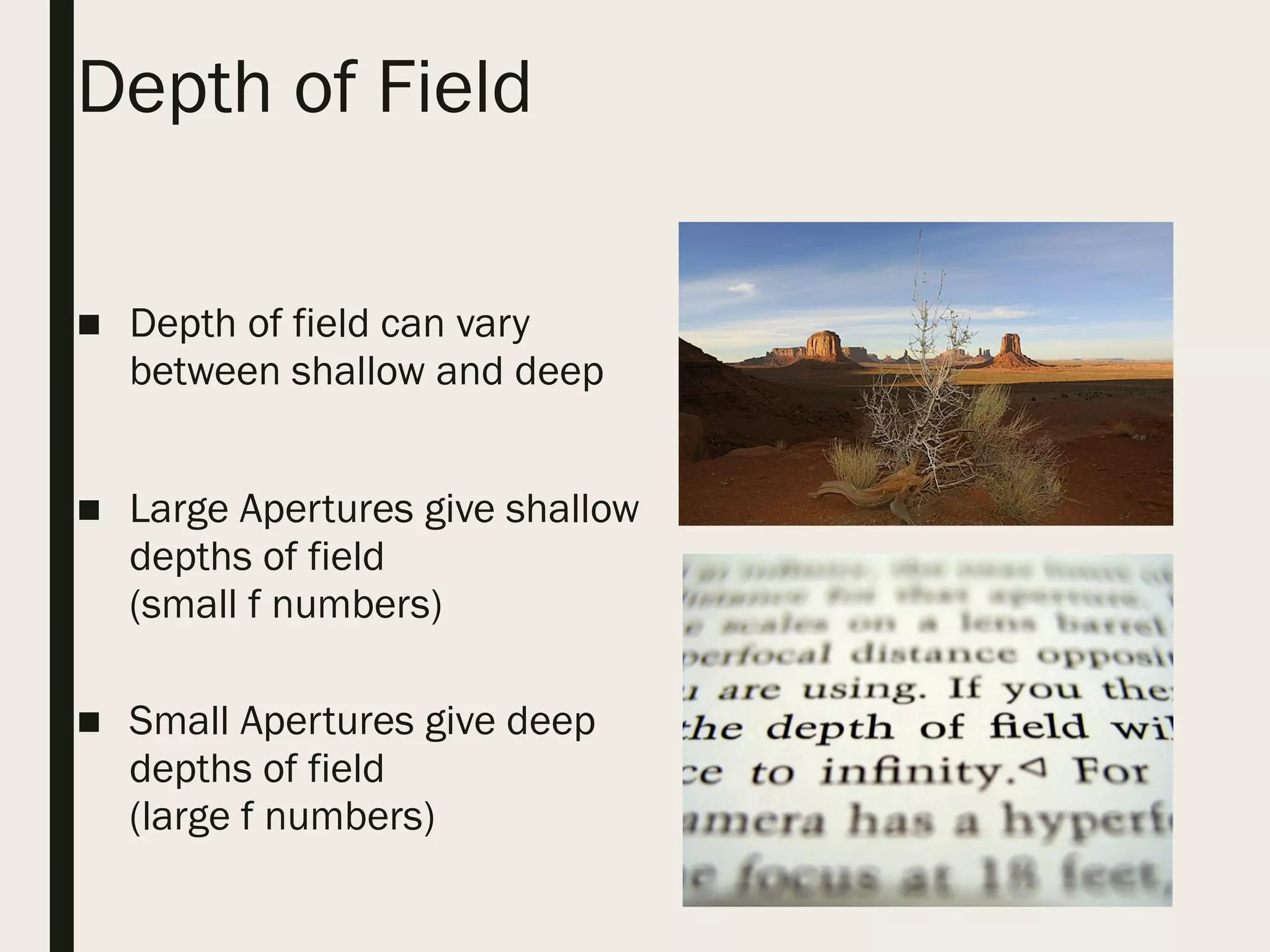
■ Depth of field can vary
between shallow and deep
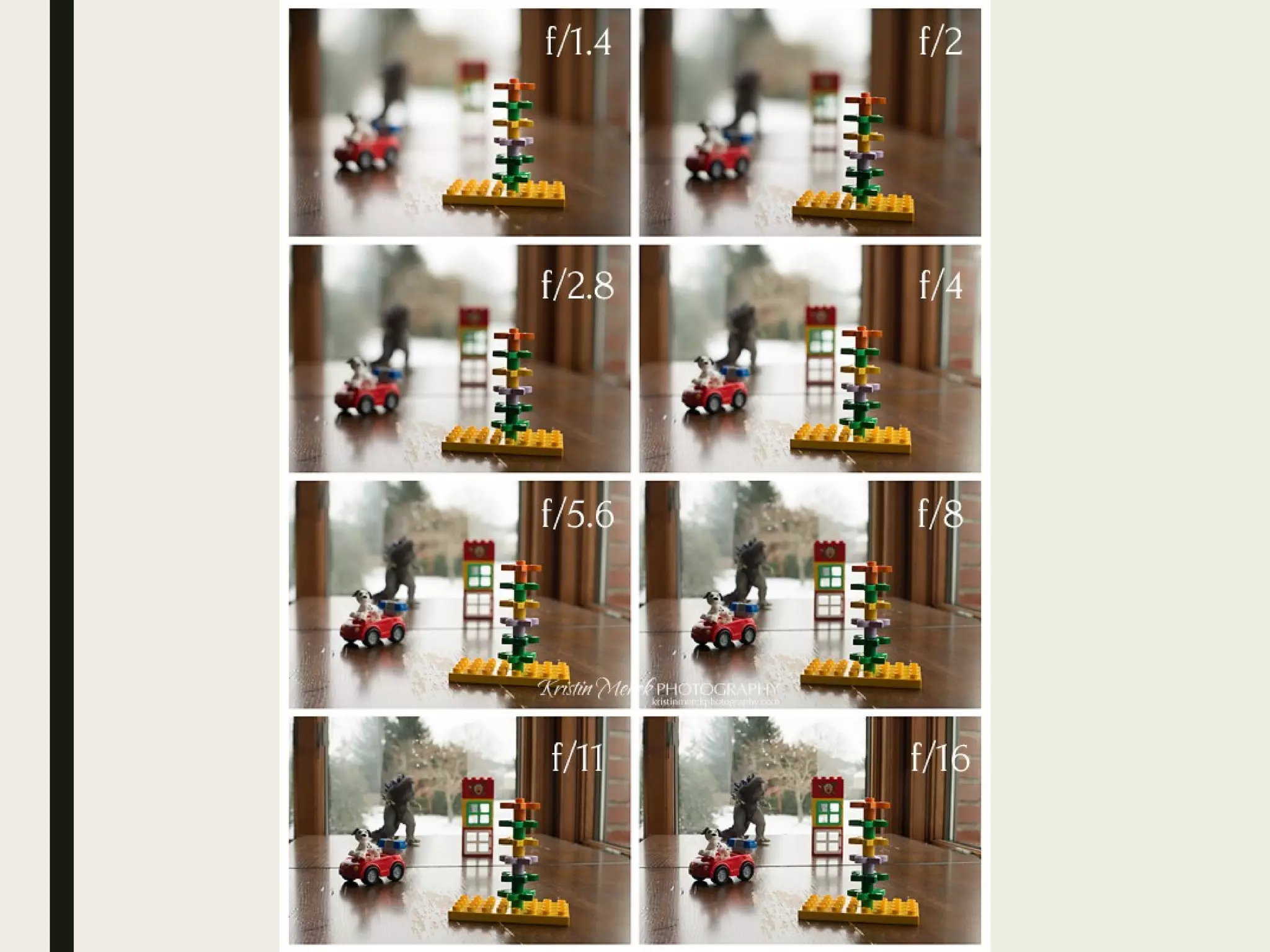
■ Large Apertures give shallow
depths of field
(small f numbers)
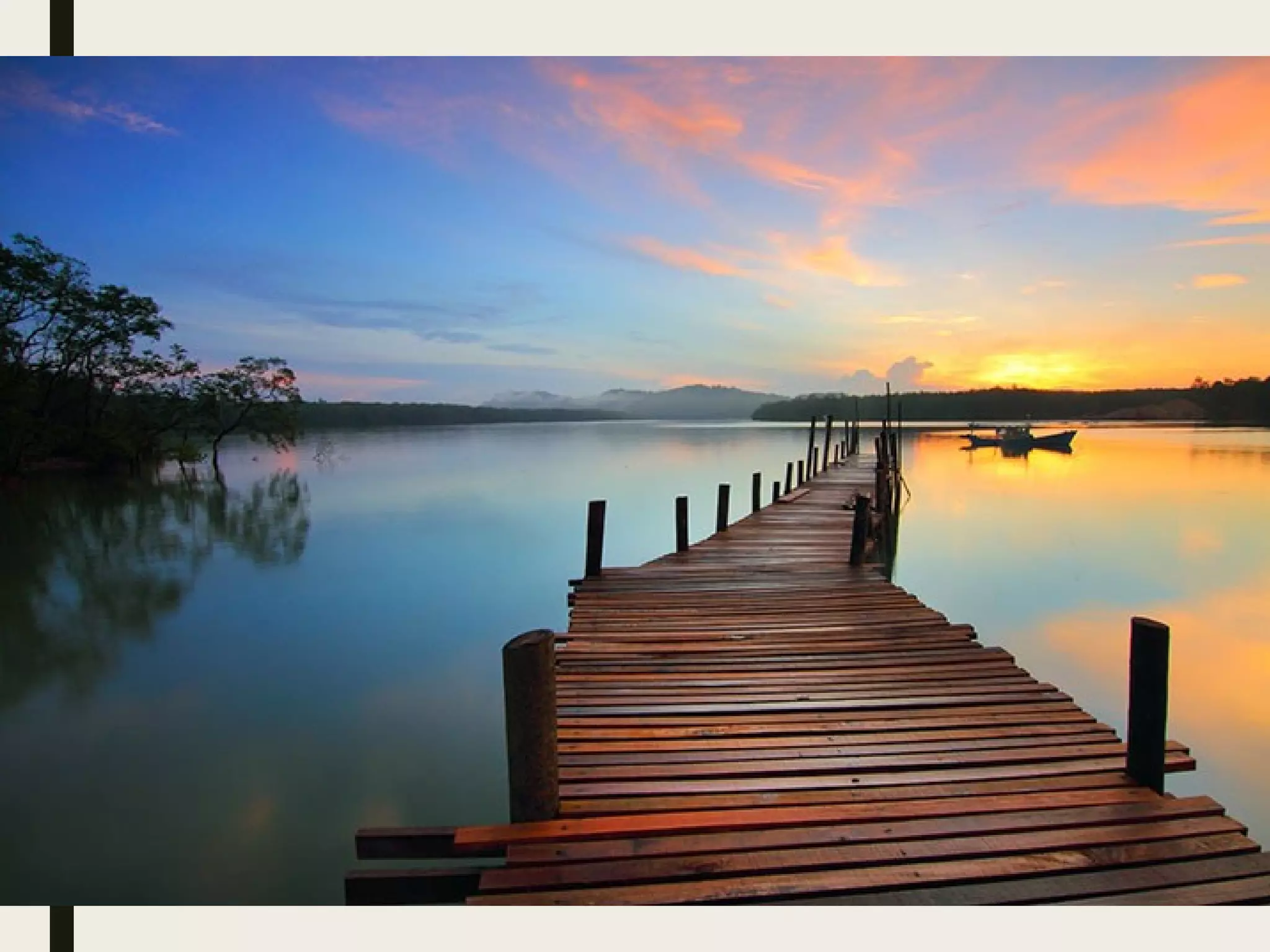
■ Small Apertures give deep
depths of field
(large f numbers)
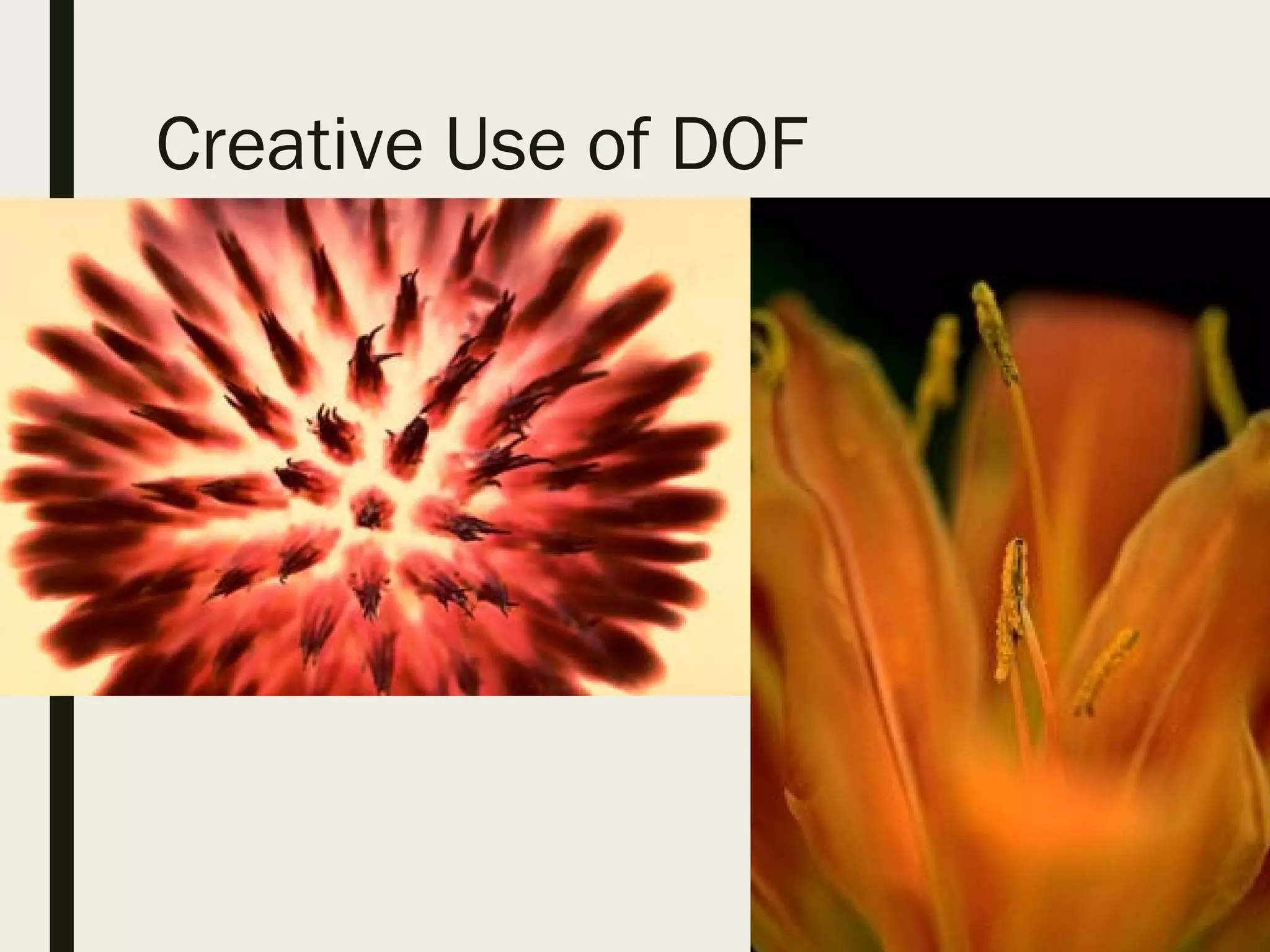
Creative Use of DOF
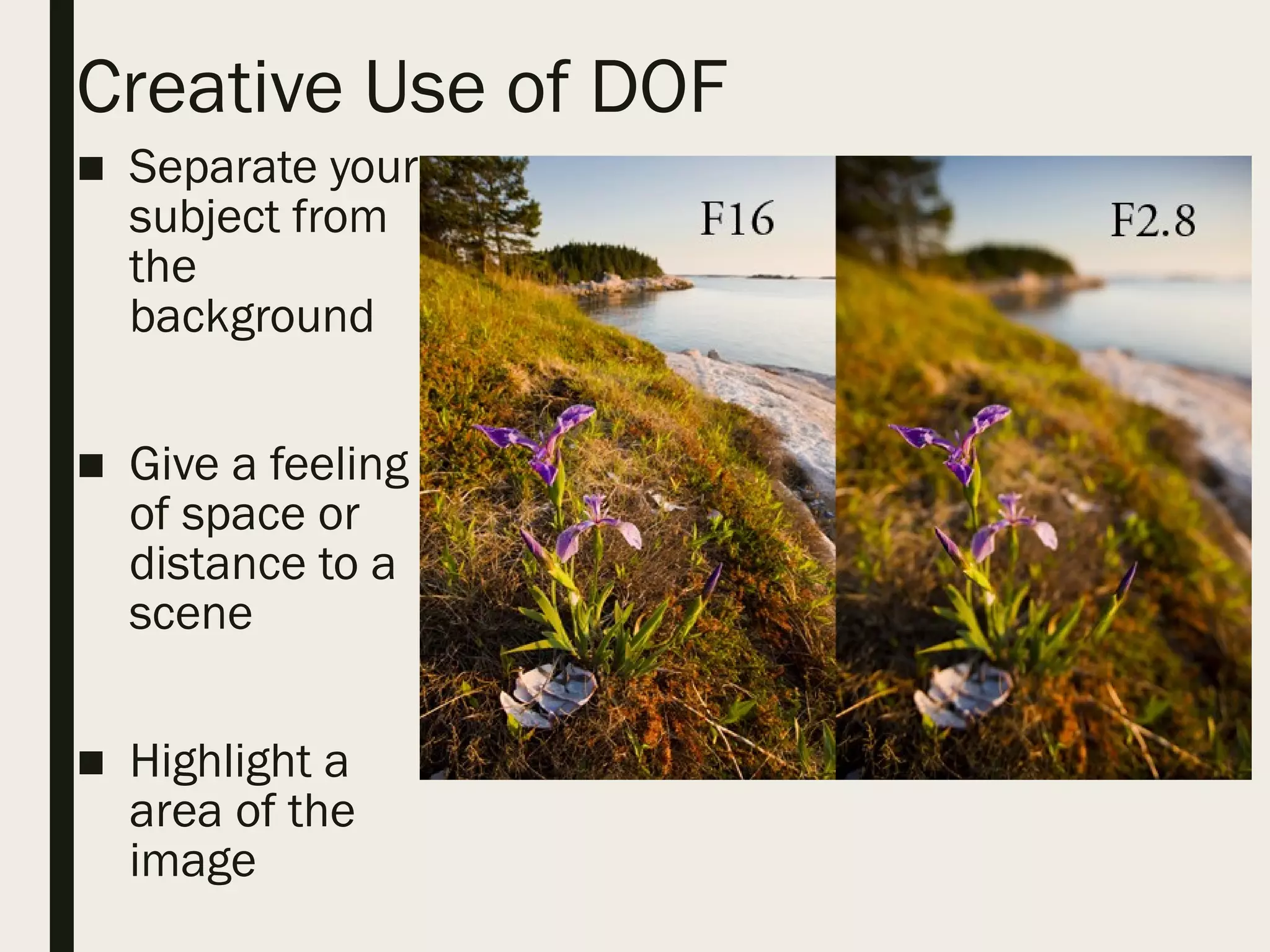
■ Separate your
subject from
the
background
■ Give a feeling
of space or
distance to a
scene
■ Highlight a
area of the
image
Creative Use of DOF
Exposure / Shutter Speed
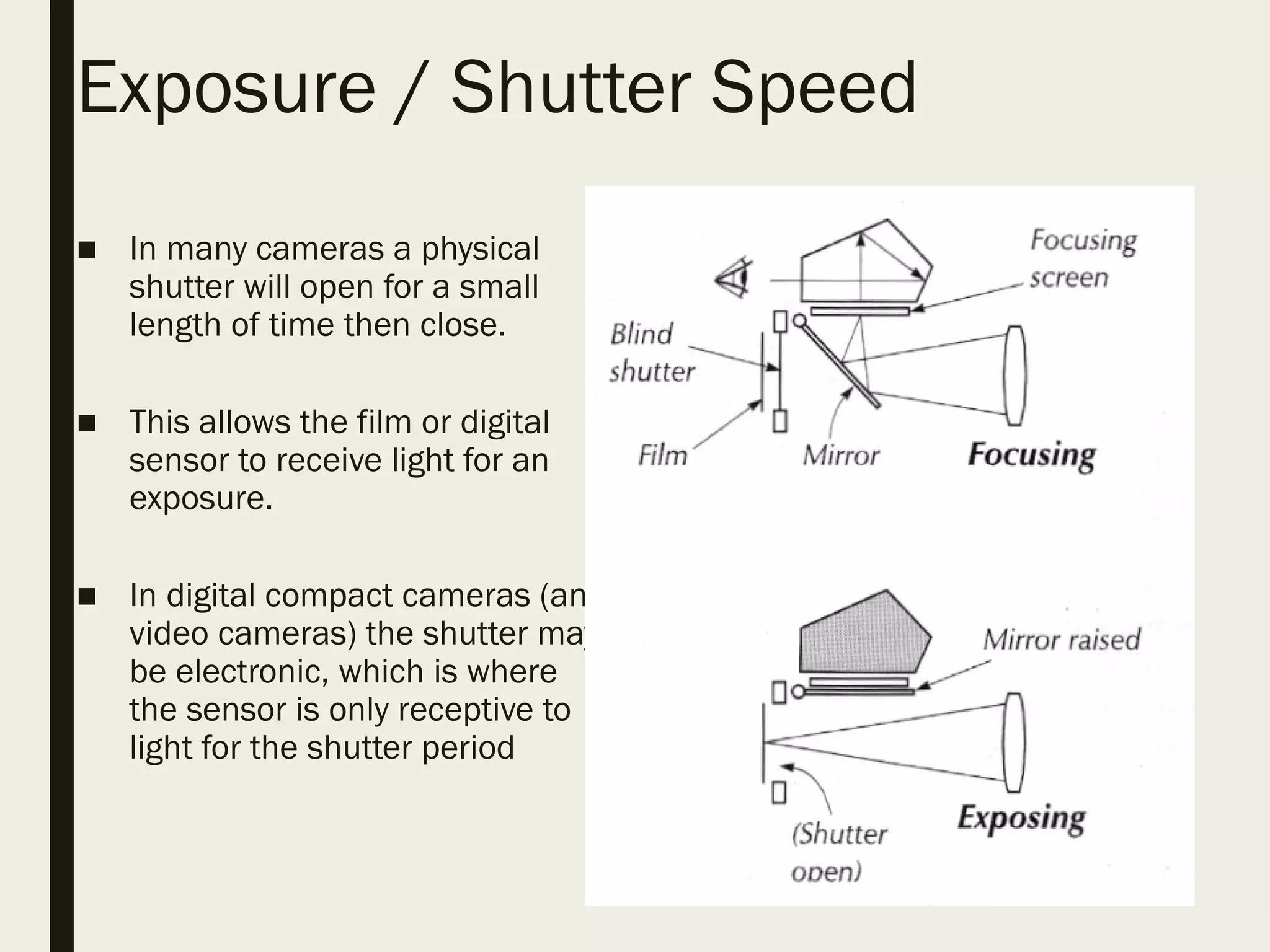
■ In many cameras a physical
shutter will open for a small
length of time then close.
■ This allows the film or digital
sensor to receive light for an
exposure.
■ In digital compact cameras (and
video cameras) the shutter may
be electronic, which is where
the sensor is only receptive to
light for the shutter period
Exposure / Shutter Speed
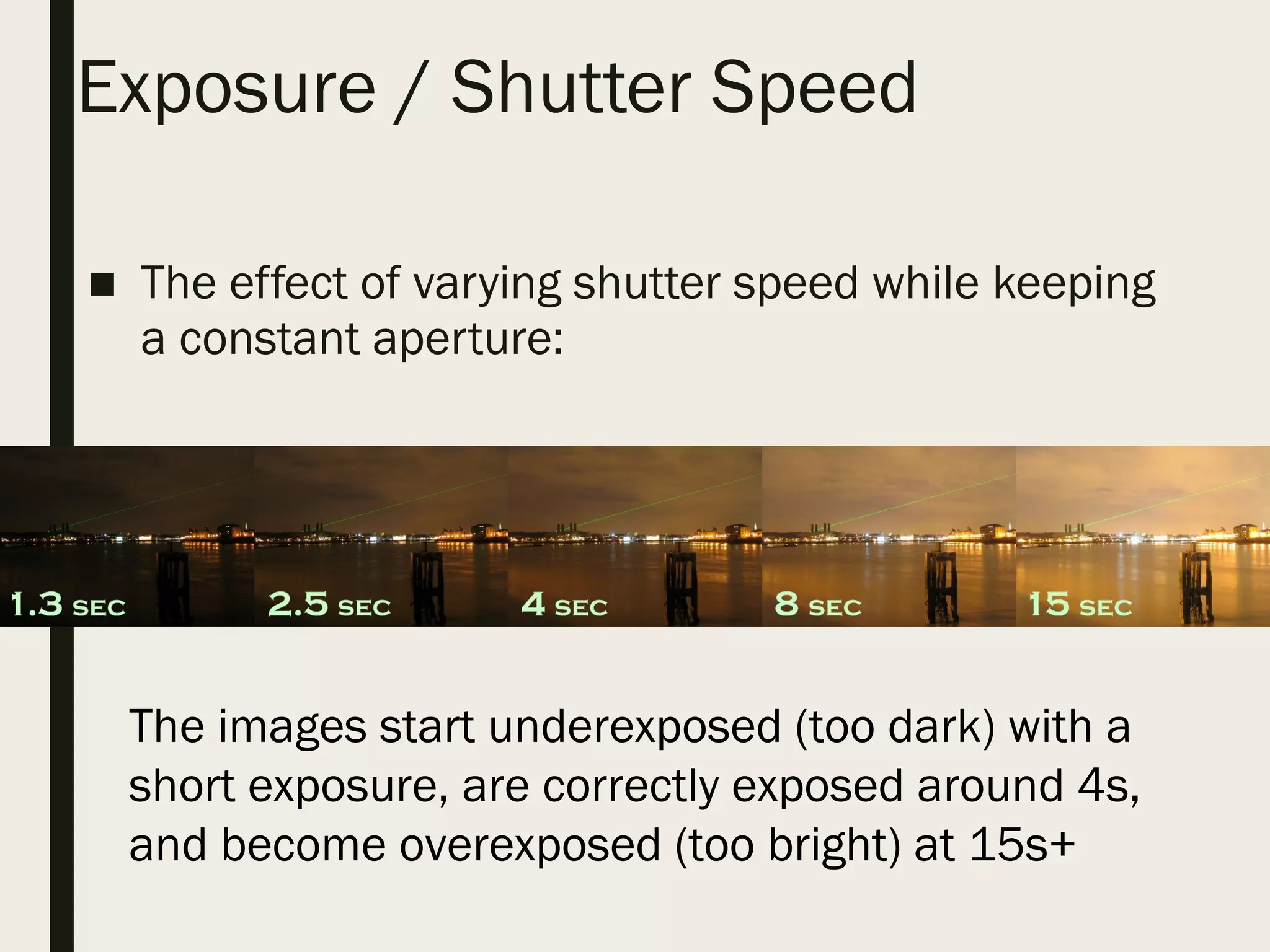
■ The effect of varying shutter speed while keeping
a constant aperture:
The images start underexposed (too dark) with a
short exposure, are correctly exposed around 4s,
and become overexposed (too bright) at 15s+
Exposure / Shutter Speed
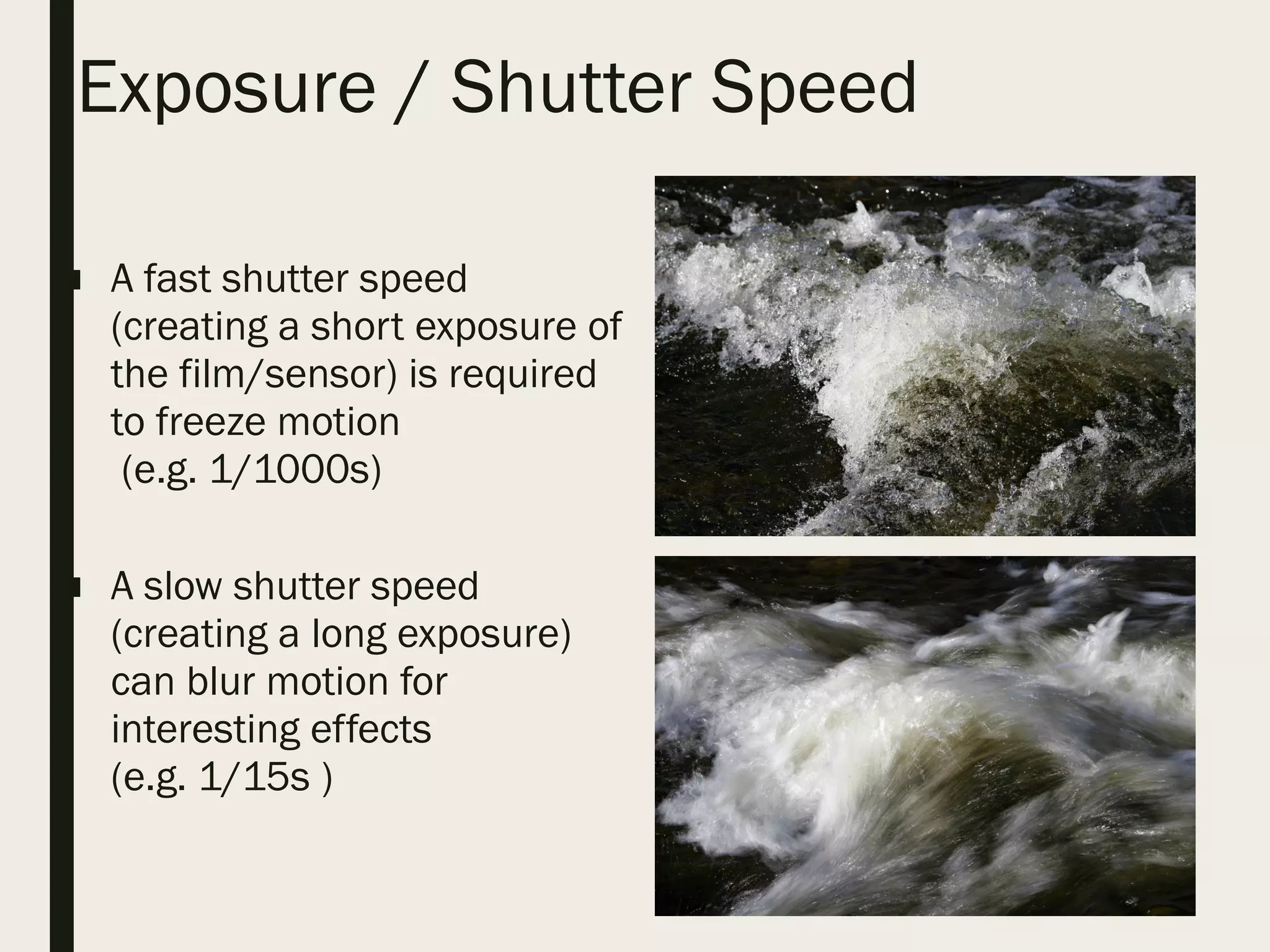
■ A fast shutter speed
(creating a short exposure of
the film/sensor) is required
to freeze motion
(e.g. 1/1000s)
■ A slow shutter speed
(creating a long exposure)
can blur motion for
interesting effects
(e.g. 1/15s )
Shutter Speed
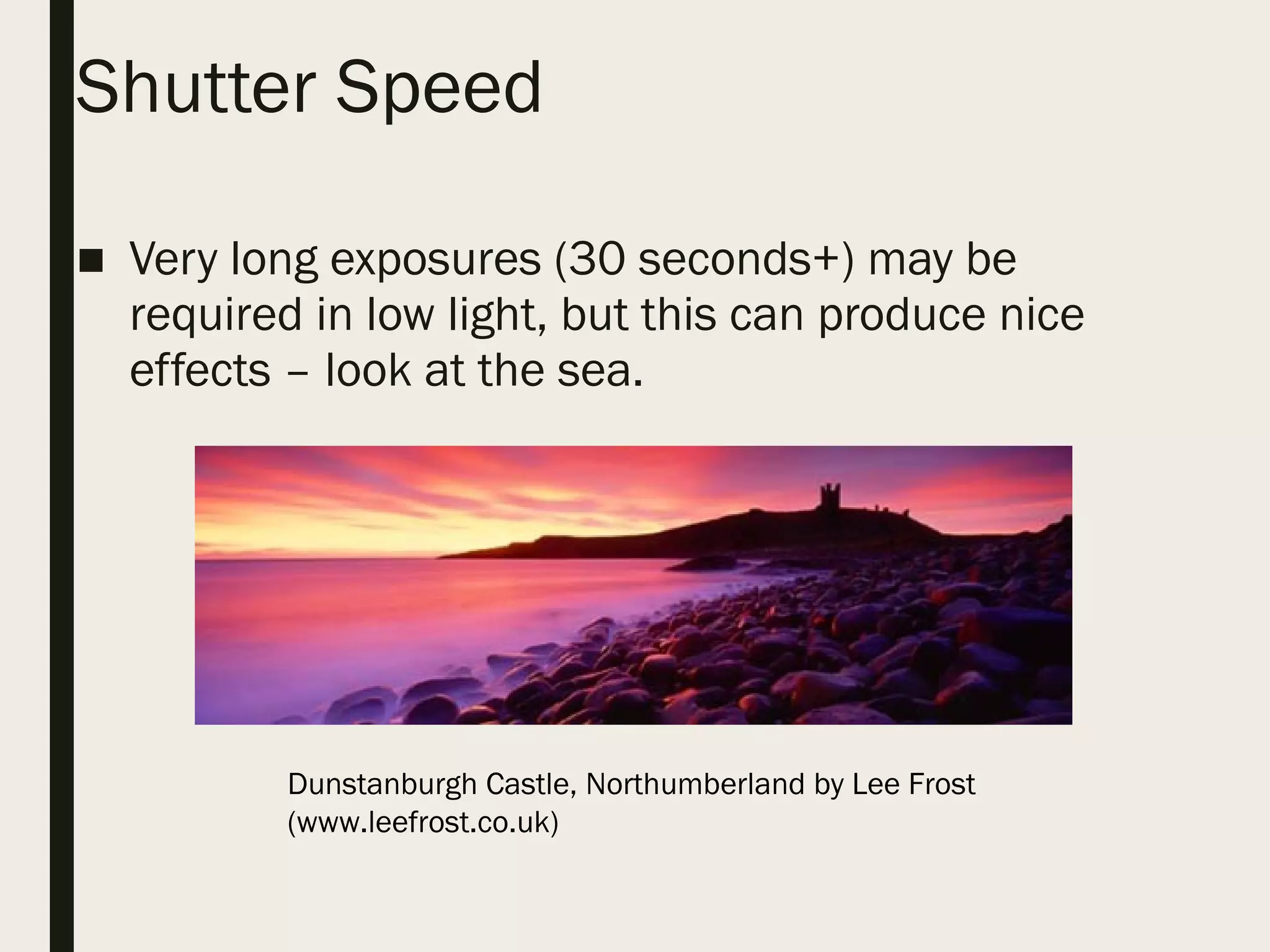
■ Very long exposures (30 seconds+) may be
required in low light, but this can produce nice
effects – look at the sea.
Dunstanburgh Castle, Northumberland by Lee Frost
(www.leefrost.co.uk)
Reciprocity
■ Changing the shutter speed by +/-1 increment
changes the exposure value by 1 stop
(e.g. 1/30s to 1/60s )
■ Changing the aperture by +/- 1 increment also
changes the exposure value by 1 stop
(e.g. f11 to f8 )
■ As these changes are equivalent, it means that
there are a number of combinations that will
give a correct exposure.
■ e.g. 1/30s @ f11 = 1/60s @ f8 = 1/125s @
f5.6...
Now the test!
■ Under or over
exposure?
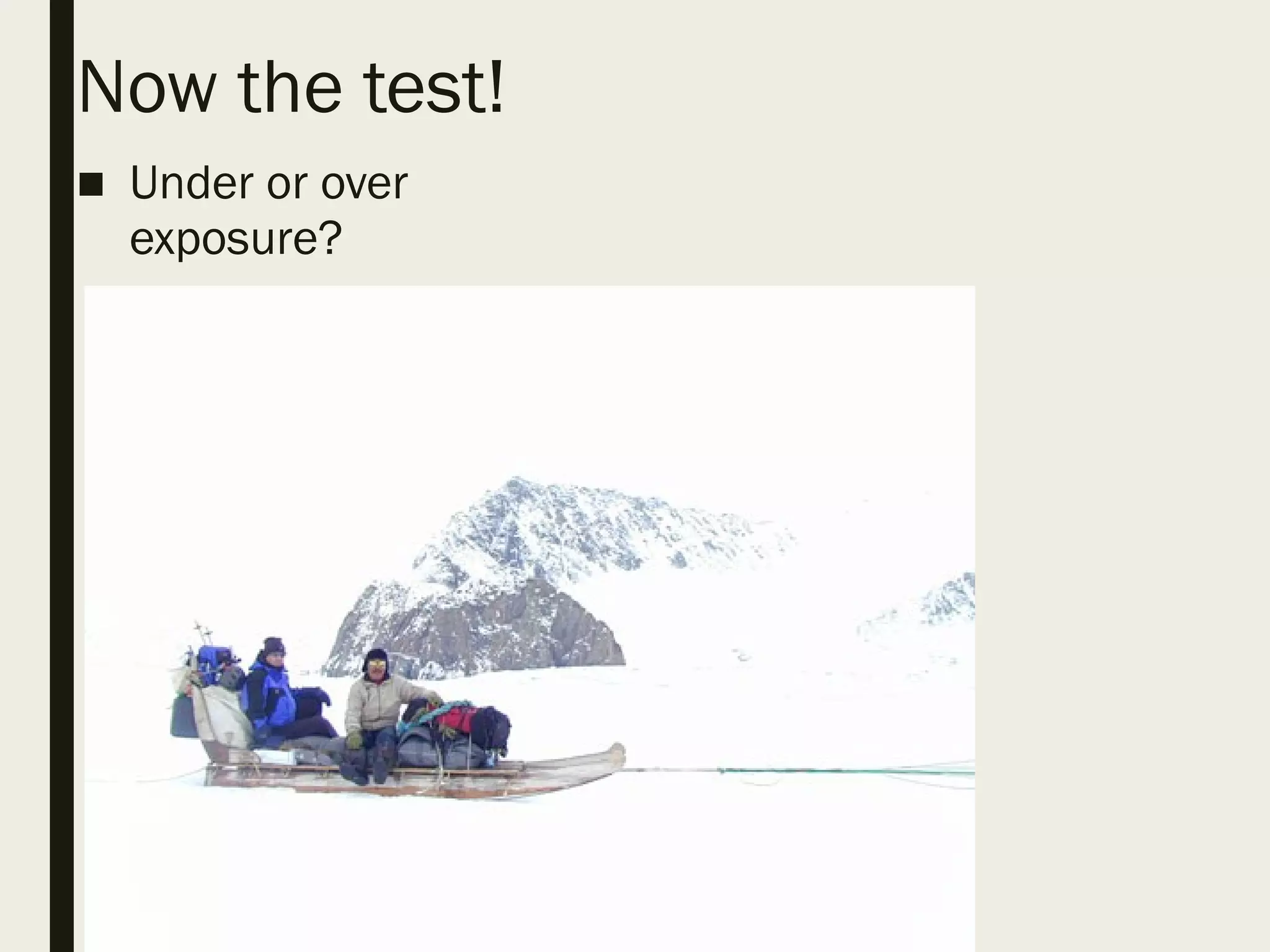
Now the test!
■ Which is the largest aperture?
Now the test!
■ Under, or over
exposed?
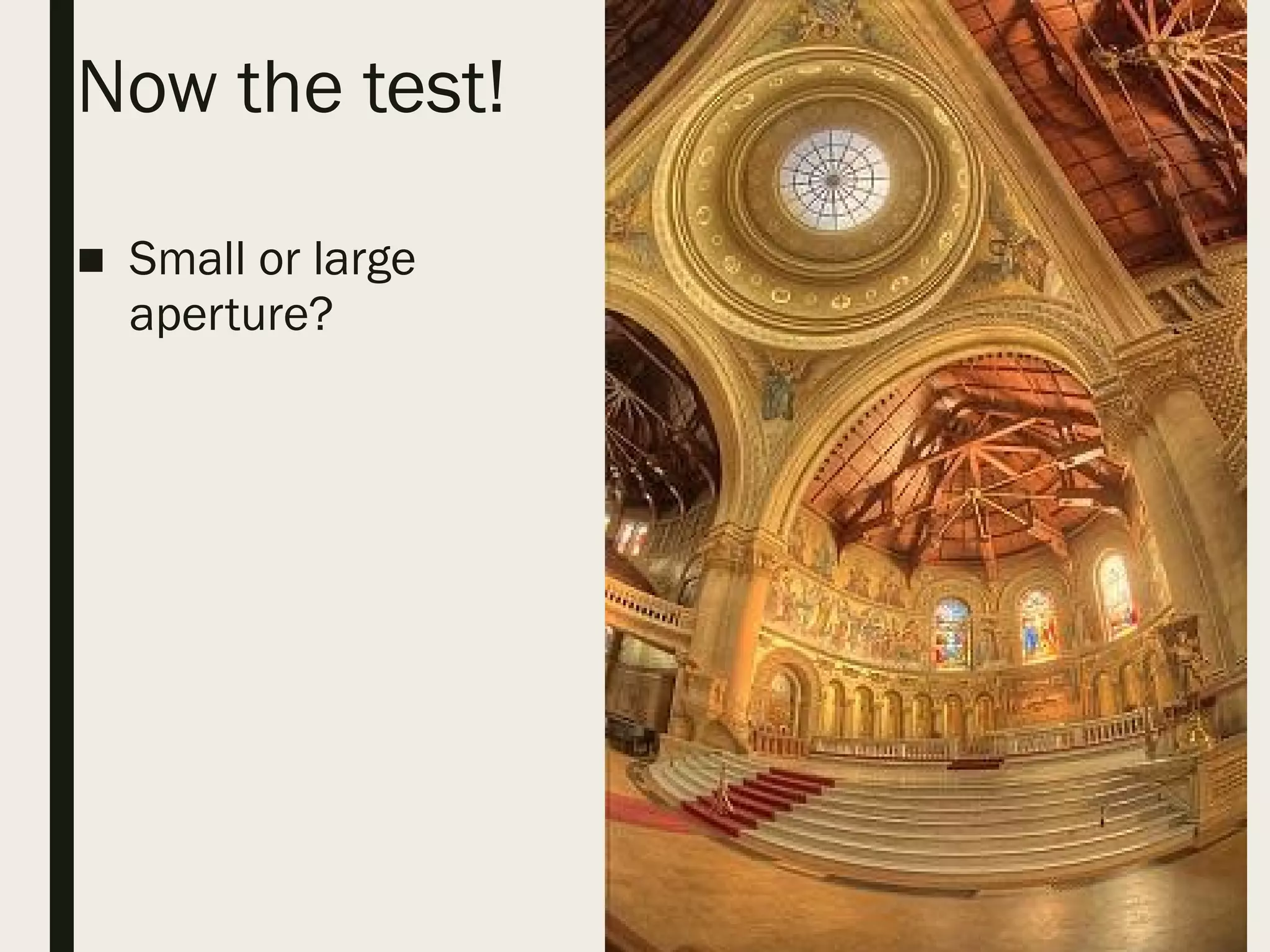
Now the test!
■ Small or large
aperture?

Aperture, exposure and depth of field

  • 1.
  • 4.
    The Eye ■ Iris– changes the amount of light entering the eye (A) ■ Lens – can change shape to focus (B) ■ Light sensitive area where an image is formed (C)
  • 5.
    The Camera Cameras arevery similar to eyes: ■ Light sensitive area – film or digital sensor ■ Lenses – Instead of changing shape, they move closer or further away to the light sensor. ■ Aperture in the lens controls the amount of light reaching the light sensor ■ A shutter also opens and closes to let the right amount of light fall on the light sensor and get a correctly exposed image
  • 6.
    Types of Lensesfor 35mm cameras ■ Removable – for SLR cameras ■ Fixed – on compact cameras ■ “Prime” Lens (Fixed focal length) ■ Zoom – most common (Range of focal lengths)
  • 7.
    What does FocalLength mean? ■ Wide Angle = large field of view (focal lengths under 50mm) ■ Standard (50mm) = same perspective as the human eye ■ Telephoto = high magnification (focal lengths over 50mm)
  • 9.
    Aperture ■ We canuse the Aperture to change the amount of light entering the camera ■ To describe aperture we use “f/stops” and these have an f number. ■ e.g. f2, f2.8, f4, f5.6, f8, f11, f16, f22
  • 10.
    Aperture ■ Small Apertures (e.g.f11, f16, f22) only let a small amount of light through ■ Large Apertures (e.g. f4, f5.6, f8) let through a lot of light ■ So for a sunny day you might need to use a small aperture to get the correct exposure
  • 12.
    Aperture ■ Each changeof f/stop either halves or doubles amount of light entering the camera ■ The largest f/stop on a lens is called the maximum aperture. The maximum lens aperture is important because it indicates the largest amount of light that the lens will transmit ■ A smaller maximum aperture f number (= a larger aperture) = a brighter lens = generally more expensive
  • 13.
    Depth of Field ■Changing the aperture of a camera also changes the amount of the image that is in focus – this amount is called the depth of field
  • 14.
    Circles of Confusion ■Only light at the focus depth is exactly in focus, the rest of the depth of field has varying circles of confusion. ■ The further from the focus depth, the bigger the circle, and the more out of focus that point appears.
  • 15.
    Depth of Field ■Depth of field can vary between shallow and deep ■ Large Apertures give shallow depths of field (small f numbers) ■ Small Apertures give deep depths of field (large f numbers)
  • 16.
    Creative Use ofDOF ■ Separate your subject from the background ■ Give a feeling of space or distance to a scene ■ Highlight a area of the image
  • 19.
  • 22.
    Exposure / ShutterSpeed ■ In many cameras a physical shutter will open for a small length of time then close. ■ This allows the film or digital sensor to receive light for an exposure. ■ In digital compact cameras (and video cameras) the shutter may be electronic, which is where the sensor is only receptive to light for the shutter period
  • 23.
    Exposure / ShutterSpeed ■ The effect of varying shutter speed while keeping a constant aperture: The images start underexposed (too dark) with a short exposure, are correctly exposed around 4s, and become overexposed (too bright) at 15s+
  • 24.
    Exposure / ShutterSpeed ■ A fast shutter speed (creating a short exposure of the film/sensor) is required to freeze motion (e.g. 1/1000s) ■ A slow shutter speed (creating a long exposure) can blur motion for interesting effects (e.g. 1/15s )
  • 25.
    Shutter Speed ■ Verylong exposures (30 seconds+) may be required in low light, but this can produce nice effects – look at the sea. Dunstanburgh Castle, Northumberland by Lee Frost (www.leefrost.co.uk)
  • 26.
    Reciprocity ■ Changing theshutter speed by +/-1 increment changes the exposure value by 1 stop (e.g. 1/30s to 1/60s ) ■ Changing the aperture by +/- 1 increment also changes the exposure value by 1 stop (e.g. f11 to f8 ) ■ As these changes are equivalent, it means that there are a number of combinations that will give a correct exposure. ■ e.g. 1/30s @ f11 = 1/60s @ f8 = 1/125s @ f5.6...
  • 27.
    Now the test! ■Under or over exposure?
  • 28.
    Now the test! ■Which is the largest aperture?
  • 29.
    Now the test! ■Under, or over exposed?
  • 30.
    Now the test! ■Small or large aperture?

Editor's Notes

  • #7 Look at your lens / camera – who has a prime lens? Who has a zoom?
  • #13 What is the maximum aperture on your lens? Who has less than f2.8? f2.8? f3.5? – half stop F4? Over f4? Larger maximum apertures mean you can shoot in lower lighting conditions.