Executive function in everyday life
 implications for young cochlear
          implant users
    Beer, J., Kronenberger, W. G., Pisoni, D. B..
  (2011). Cochlear Implants International, 12, s89–
                       s91.
Introduction
• Deafness and degraded auditory experience
  may affect not only speech and language
  skills, but also other neurocognitive functions
  (Pisoni et al., 2010).
  – EX: 1. STM and WM capacity.
         2. Slowing processing speeds for rehearsal
            and retrieving verbal information.
Introduction
• Executive function (Gioia et al., 2001).:
  –   organization
  –   planning
  –   working memory
  –   inhibition
  –   Flexibility
  –   involved in the control of thought
  –   Action
  –   emotion
Introduction
• General agreement among cognitive
  psychologists and neuroscientists that several
  different aspects of EF play important roles in
  – language perception.
  – production via top-down feedback.
  – control of processing activities in a wide range of
    behavioral tasks (Pisoni et al., 2010).
Introduction
• Two objects:
  – identify areas of EF vulnerability in children with
    CI’s using a behavior rating scale completed by
    parents
  – determine if these areas of vulnerability are
    associated with conventional speech and
    language outcomes
Methods
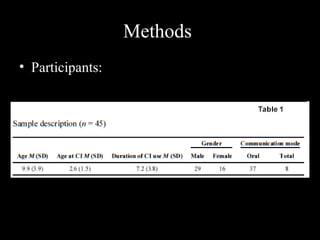
• Participants:
Methods
• Materials (EF):
  – Behavior Rating Inventory of Executive Function
    (BRIEF™)
     •   inhibitory control
     •   shifting behavior
     •   emotional control
     •   initiating tasks and ideas
     •   working memory
     •    planning and organizing
     •   organization of materials
     •    monitoring
Methods
• Materials (EF):
  – Behavior Rating Inventory of Executive Function
    (BRIEF™)
     • Behavioral Regulation Index
     • Metacognitive Index
     • Global Executive Composite
Methods
• Materials:
  – Speech and language General language ability
     • Clinical Evaluation of Language Fundamentals fourth
       edition (CELF-4)
  – Vocabulary
     • Peabody Picture Vocabulary Test (PPVT-4)
  – Open-set word recognition :
     • Lexical Neighborhood Test (LNT)(easy or hard word)
  – Open-set sentence recognition :
     • Hearing in Noise Test for Children (HINT-C)(words quiet
       or words noise(+5 dB))
Results
Results
Discussion
•   The results of this study indicate that children
    with CIs have difficulty in some EF
    domains,based on parent report.
    –   inhibit
    –   working mwmory scales
    –   behavioral regulation index
Discussion
•   Deficits in working memory may become a
    problem when the task at hand carries with it a
    high cognitive load such as hearing in noise,
    perceiving spoken sentences, and formulating
    sentences based on a picture.
    –   general language (CELF-4)
    –   speech perception in noise (HINT-C in noise)
Discussion
• A period of early auditory deprivation may
  result in differences in the development of
  domain general neurocognitive processes that
  impact domain-specific areas such as language
  and speech perception.

Executive function in everyday life implications for young cochlear implant users

  • 1.
    Executive function ineveryday life implications for young cochlear implant users Beer, J., Kronenberger, W. G., Pisoni, D. B.. (2011). Cochlear Implants International, 12, s89– s91.
  • 2.
    Introduction • Deafness anddegraded auditory experience may affect not only speech and language skills, but also other neurocognitive functions (Pisoni et al., 2010). – EX: 1. STM and WM capacity. 2. Slowing processing speeds for rehearsal and retrieving verbal information.
  • 3.
    Introduction • Executive function(Gioia et al., 2001).: – organization – planning – working memory – inhibition – Flexibility – involved in the control of thought – Action – emotion
  • 4.
    Introduction • General agreementamong cognitive psychologists and neuroscientists that several different aspects of EF play important roles in – language perception. – production via top-down feedback. – control of processing activities in a wide range of behavioral tasks (Pisoni et al., 2010).
  • 5.
    Introduction • Two objects: – identify areas of EF vulnerability in children with CI’s using a behavior rating scale completed by parents – determine if these areas of vulnerability are associated with conventional speech and language outcomes
  • 6.
  • 7.
    Methods • Materials (EF): – Behavior Rating Inventory of Executive Function (BRIEF™) • inhibitory control • shifting behavior • emotional control • initiating tasks and ideas • working memory • planning and organizing • organization of materials • monitoring
  • 8.
    Methods • Materials (EF): – Behavior Rating Inventory of Executive Function (BRIEF™) • Behavioral Regulation Index • Metacognitive Index • Global Executive Composite
  • 9.
    Methods • Materials: – Speech and language General language ability • Clinical Evaluation of Language Fundamentals fourth edition (CELF-4) – Vocabulary • Peabody Picture Vocabulary Test (PPVT-4) – Open-set word recognition : • Lexical Neighborhood Test (LNT)(easy or hard word) – Open-set sentence recognition : • Hearing in Noise Test for Children (HINT-C)(words quiet or words noise(+5 dB))
  • 10.
  • 11.
  • 12.
    Discussion • The results of this study indicate that children with CIs have difficulty in some EF domains,based on parent report. – inhibit – working mwmory scales – behavioral regulation index
  • 13.
    Discussion • Deficits in working memory may become a problem when the task at hand carries with it a high cognitive load such as hearing in noise, perceiving spoken sentences, and formulating sentences based on a picture. – general language (CELF-4) – speech perception in noise (HINT-C in noise)
  • 14.
    Discussion • A periodof early auditory deprivation may result in differences in the development of domain general neurocognitive processes that impact domain-specific areas such as language and speech perception.