Chapter 16 Building the Data Mining Environment
The Ideal Customer-Centric Organization Customer is king (not pauper) For B2C (business to consumer) - Combination of point-of-sale transaction data and loyalty cards For B2B (business to business) – traditional approaches (purchase orders, sales orders, etc.), Electronic Data Interchange (EDI) of same, Enterprise Resource Planning (ERP) software with intranet access for business partners Customer interactions are recorded, remembered, utilized (action) Corporate culture focused on rewards for how customers are treated
The Ideal Data Mining Environment A corporate culture that appreciates the value of information Committed (human and $ capital investment) to consolidate customer data from disparate data sources (ECTL – extract, clean, transform, load) which is challenging and time consuming A corporate culture committed to being a Learning Organization which values progress and steady improvement
The Ideal Data Mining Environment Recognize the importance of data analysis and its results are shared across the organization Marketing Sales Operational system designers (IT or vendor software) Willing to make data readily available for analysis even if it means some re-design of software
Reality (where “rubber meets the road”) The ideal environments, organizations, and corporate culture rarely exist all in one organization!!! Don’t be shocked…it’s hard work!!!
Building a Customer-Centric Organization Biggest challenge to this is establishing a  single view  of the customer shared across the entire enterprise Reverse of this is also a challenge – creating a  single view  of our own company to the customer Consistency is needed for both the above
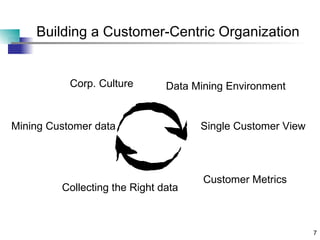
Building a Customer-Centric Organization Corp. Culture Data Mining Environment Single Customer View Customer Metrics Collecting the Right data Mining Customer data
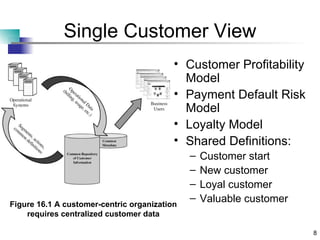
Single Customer View Customer Profitability Model Payment Default Risk Model Loyalty Model Shared Definitions: Customer start New customer Loyal customer Valuable customer Figure 16.1 A customer-centric organization requires centralized customer data
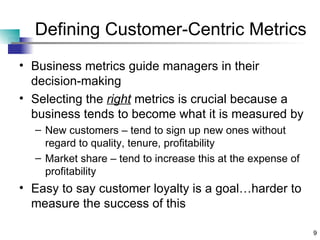
Defining Customer-Centric Metrics Business metrics guide managers in their decision-making Selecting the  right  metrics is crucial because a business tends to become what it is measured by New customers – tend to sign up new ones without regard to quality, tenure, profitability Market share – tend to increase this at the expense of profitability Easy to say customer loyalty is a goal…harder to measure the success of this
Collecting the Right Data Data collection should map back to defined customer metrics Customer metrics often stated as questions in need of answers: How many times/year does customer contact our Customer Support (phone, web, etc.)? What is payment status of customers (current, 30, 60, 90 days, etc.)? Thousands of other questions
DM Environment & Mining Data Data Mining group (team) is needed DM Infrastructure to support is needed
Data Mining Group Possible locations for such a group include Part of I.T. Outside organization – outsource this activity Part of marketing, finance, customer relationship management Interdisciplinary group across functional departments (e.g., marketing, finance, IT, etc.) Each of the above have advantages and disadvantages
Data Mining Staff Characteristics Database skills (SQL) Data ECTL  (extraction, cleaning, transformation, loading)  skills Hands-on with Data Mining software such as PolyAnalyst, SAS, SPSS, Salford Systems, Clementine, etc.) Statistics Machine learning skills Industry knowledge Data visualization skills Interviewing and requirements gathering skills Presentation, writing, and communication skills Cannot all be DM Rookies!
Data Mining Infrastructure Ability to access data from many sources & consolidate Ability to score customers based on existing models Ability to manage lots of models over time Ability to manage lots of model scores over time Ability to track model score changes over time Ability to reconstruct a customer “signature” on demand Ability to publish scores, rules, and other data mining results
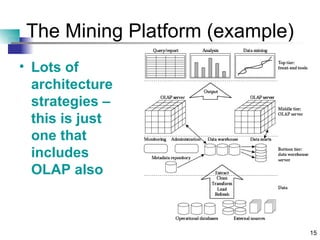
The Mining Platform (example) Lots of architecture strategies – this is just one that includes OLAP also
Data Mining Software Review “Questions to Ask” Side Bar in book on page 533 (2 nd  edition)
End of Chapter 16

Chapter16

  • 1.
    Chapter 16 Buildingthe Data Mining Environment
  • 2.
    The Ideal Customer-CentricOrganization Customer is king (not pauper) For B2C (business to consumer) - Combination of point-of-sale transaction data and loyalty cards For B2B (business to business) – traditional approaches (purchase orders, sales orders, etc.), Electronic Data Interchange (EDI) of same, Enterprise Resource Planning (ERP) software with intranet access for business partners Customer interactions are recorded, remembered, utilized (action) Corporate culture focused on rewards for how customers are treated
  • 3.
    The Ideal DataMining Environment A corporate culture that appreciates the value of information Committed (human and $ capital investment) to consolidate customer data from disparate data sources (ECTL – extract, clean, transform, load) which is challenging and time consuming A corporate culture committed to being a Learning Organization which values progress and steady improvement
  • 4.
    The Ideal DataMining Environment Recognize the importance of data analysis and its results are shared across the organization Marketing Sales Operational system designers (IT or vendor software) Willing to make data readily available for analysis even if it means some re-design of software
  • 5.
    Reality (where “rubbermeets the road”) The ideal environments, organizations, and corporate culture rarely exist all in one organization!!! Don’t be shocked…it’s hard work!!!
  • 6.
    Building a Customer-CentricOrganization Biggest challenge to this is establishing a single view of the customer shared across the entire enterprise Reverse of this is also a challenge – creating a single view of our own company to the customer Consistency is needed for both the above
  • 7.
    Building a Customer-CentricOrganization Corp. Culture Data Mining Environment Single Customer View Customer Metrics Collecting the Right data Mining Customer data
  • 8.
    Single Customer ViewCustomer Profitability Model Payment Default Risk Model Loyalty Model Shared Definitions: Customer start New customer Loyal customer Valuable customer Figure 16.1 A customer-centric organization requires centralized customer data
  • 9.
    Defining Customer-Centric MetricsBusiness metrics guide managers in their decision-making Selecting the right metrics is crucial because a business tends to become what it is measured by New customers – tend to sign up new ones without regard to quality, tenure, profitability Market share – tend to increase this at the expense of profitability Easy to say customer loyalty is a goal…harder to measure the success of this
  • 10.
    Collecting the RightData Data collection should map back to defined customer metrics Customer metrics often stated as questions in need of answers: How many times/year does customer contact our Customer Support (phone, web, etc.)? What is payment status of customers (current, 30, 60, 90 days, etc.)? Thousands of other questions
  • 11.
    DM Environment &Mining Data Data Mining group (team) is needed DM Infrastructure to support is needed
  • 12.
    Data Mining GroupPossible locations for such a group include Part of I.T. Outside organization – outsource this activity Part of marketing, finance, customer relationship management Interdisciplinary group across functional departments (e.g., marketing, finance, IT, etc.) Each of the above have advantages and disadvantages
  • 13.
    Data Mining StaffCharacteristics Database skills (SQL) Data ECTL (extraction, cleaning, transformation, loading) skills Hands-on with Data Mining software such as PolyAnalyst, SAS, SPSS, Salford Systems, Clementine, etc.) Statistics Machine learning skills Industry knowledge Data visualization skills Interviewing and requirements gathering skills Presentation, writing, and communication skills Cannot all be DM Rookies!
  • 14.
    Data Mining InfrastructureAbility to access data from many sources & consolidate Ability to score customers based on existing models Ability to manage lots of models over time Ability to manage lots of model scores over time Ability to track model score changes over time Ability to reconstruct a customer “signature” on demand Ability to publish scores, rules, and other data mining results
  • 15.
    The Mining Platform(example) Lots of architecture strategies – this is just one that includes OLAP also
  • 16.
    Data Mining SoftwareReview “Questions to Ask” Side Bar in book on page 533 (2 nd edition)
  • 17.