Customer Relationship Management (CRM) by Abhishek Tatachar
Highlights Evolution of CRM What is CRM CRM Phases Integrated Architecture How does Data Mining help CRM Leading CRM Vendors Limits Conclusion
Evolution Initially, there were  Door-to-Door  sales forces to approach the customers. Then,   Mass marketing  replaced the intimacy of a direct sales force. Later,   Targeted marketing  evolved. Use of direct mail and telemarketing. Latest is  Customer Relationship Management (CRM),  the next step in Evolution. A concept supported by latest technologies.
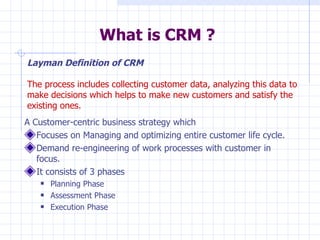
What is CRM ? A Customer-centric business strategy which Focuses on Managing and optimizing entire customer life cycle. Demand re-engineering of work processes with customer in focus. It consists of 3 phases Planning Phase Assessment Phase Execution Phase Layman Definition of CRM The process includes   collecting customer data, analyzing this data to make decisions which helps to make new customers and satisfy the existing ones.
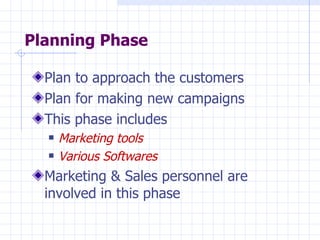
Planning Phase Plan to approach the customers Plan for making new campaigns This phase includes Marketing tools Various Softwares Marketing & Sales personnel are involved in this phase
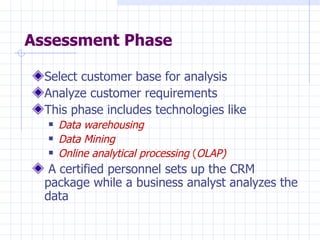
Assessment Phase Select customer base for analysis Analyze customer requirements  This phase includes technologies like Data warehousing Data Mining Online analytical processing   ( OLAP) A certified personnel sets up the CRM package while a business analyst analyzes the data
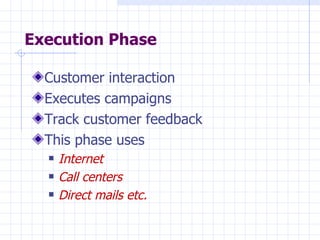
Execution Phase   Customer interaction Executes campaigns Track customer feedback This phase uses Internet Call centers Direct mails etc.
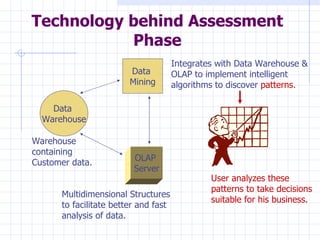
Technology behind Assessment Phase Data  Mining Data  Warehouse OLAP  Server Warehouse containing Customer data. Multidimensional Structures to facilitate better and fast analysis of data. Integrates with Data Warehouse &  OLAP to implement intelligent algorithms to discover  patterns . User analyzes these patterns to take decisions suitable for his business.
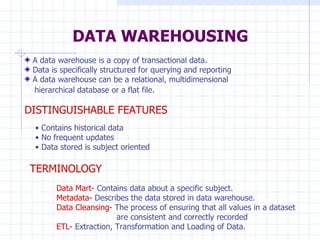
DATA WAREHOUSING A data warehouse is a copy of transactional data. Data is specifically structured for querying and reporting A data warehouse can be a relational, multidimensional  hierarchical database or a flat file.   DISTINGUISHABLE FEATURES Contains historical data No frequent updates Data stored is subject oriented TERMINOLOGY Data Mart-  Contains data about a specific subject. Metadata-  Describes the data stored in data warehouse. Data Cleansing-  The process of ensuring that all values in a dataset  are consistent and correctly recorded ETL-  Extraction, Transformation and Loading of Data.
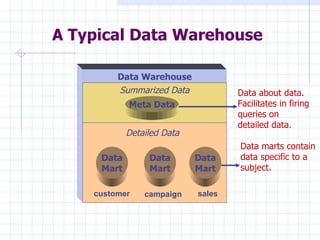
A Typical Data Warehouse Data Warehouse Detailed Data Data Mart Data Mart Data Mart Summarized Data Meta Data Data about data. Facilitates in firing queries on detailed data. Data marts contain data specific to a subject.  customer campaign  sales
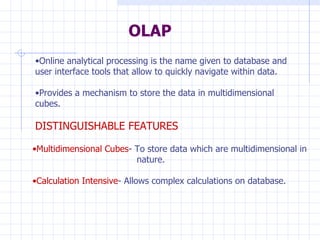
OLAP Online analytical processing is the name given to database and user interface tools that allow to quickly navigate within data. Provides a mechanism to store the data in multidimensional cubes. DISTINGUISHABLE FEATURES Multidimensional Cubes - To store data which are multidimensional in    nature. Calculation Intensive - Allows complex calculations on database.
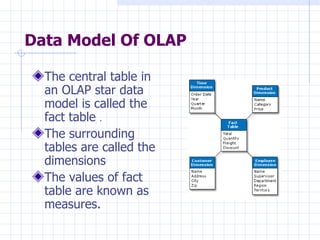
Data Model Of OLAP The central table in an OLAP star data model is called the fact table  . The surrounding tables are called the dimensions  The values of fact table are known as measures.
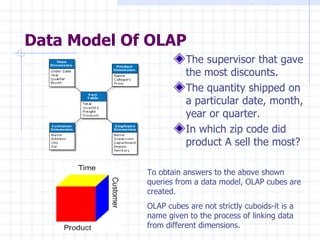
Data Model Of OLAP The supervisor that gave the most discounts.  The quantity shipped on a particular date, month, year or quarter.  In which zip code did product A sell the most?  To obtain answers to the above shown queries from a data model, OLAP cubes are created. OLAP cubes are not strictly cuboids-it is a name given to the process of linking data from different dimensions.
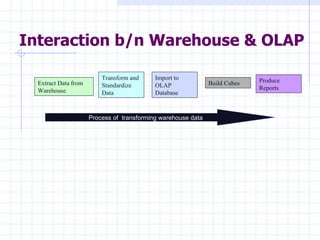
Interaction b/n Warehouse & OLAP Extract Data from Warehouse Transform and Standardize Data Import to OLAP Database Build Cubes Produce Reports Process of  transforming warehouse data
How does Data Mining help CRM CRM systems typically collect a great deal of data  Data Mining is used to search through this information  Identify patterns that can help to predict buyer behavior  Target specific customers with specific offers This area of CRM is referred to as Analytical CRM
With CRM, a business can … Provide better customer service Make call centers more efficient Increase customer revenues Help sales staff close deals faster Simplify marketing and sales processes  Discover new customers
Leading CRM Vendors Siebel mySAP  Oracle  PeopleSoft Vantive Clarify
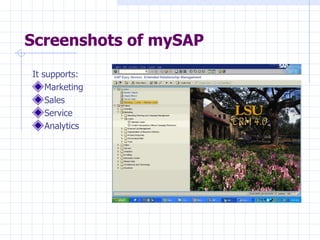
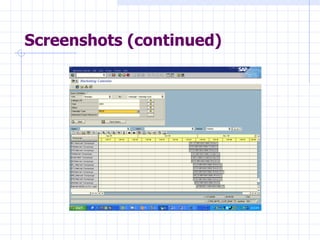
Screenshots of mySAP It supports: Marketing Sales Service Analytics
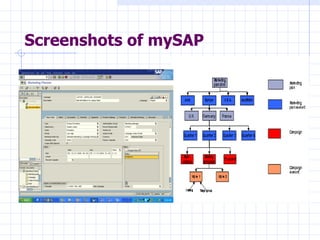
Screenshots of mySAP
Screenshots (continued)
Limits Expensive Hard to implement Time consuming  It requires a lot of management and money
Conclusion CRM is a concept, implemented with the support of various technologies.  Supporting technologies include  Data warehousing, Data Mining, OLAP  etc. A proper Data warehouse should be in place for any CRM initiative. Customer needs should be in focus while implementing CRM.
References CRM by Kristin Anderson & Carol Kerr www.crmguru.com www.dwreview.com sap.com The Rushmore Group, LLC
Thank You

Crm evolution- crm phases

  • 1.
    Customer Relationship Management(CRM) by Abhishek Tatachar
  • 2.
    Highlights Evolution ofCRM What is CRM CRM Phases Integrated Architecture How does Data Mining help CRM Leading CRM Vendors Limits Conclusion
  • 3.
    Evolution Initially, therewere Door-to-Door sales forces to approach the customers. Then, Mass marketing replaced the intimacy of a direct sales force. Later, Targeted marketing evolved. Use of direct mail and telemarketing. Latest is Customer Relationship Management (CRM), the next step in Evolution. A concept supported by latest technologies.
  • 4.
    What is CRM? A Customer-centric business strategy which Focuses on Managing and optimizing entire customer life cycle. Demand re-engineering of work processes with customer in focus. It consists of 3 phases Planning Phase Assessment Phase Execution Phase Layman Definition of CRM The process includes collecting customer data, analyzing this data to make decisions which helps to make new customers and satisfy the existing ones.
  • 5.
    Planning Phase Planto approach the customers Plan for making new campaigns This phase includes Marketing tools Various Softwares Marketing & Sales personnel are involved in this phase
  • 6.
    Assessment Phase Selectcustomer base for analysis Analyze customer requirements This phase includes technologies like Data warehousing Data Mining Online analytical processing ( OLAP) A certified personnel sets up the CRM package while a business analyst analyzes the data
  • 7.
    Execution Phase Customer interaction Executes campaigns Track customer feedback This phase uses Internet Call centers Direct mails etc.
  • 8.
    Technology behind AssessmentPhase Data Mining Data Warehouse OLAP Server Warehouse containing Customer data. Multidimensional Structures to facilitate better and fast analysis of data. Integrates with Data Warehouse & OLAP to implement intelligent algorithms to discover patterns . User analyzes these patterns to take decisions suitable for his business.
  • 9.
    DATA WAREHOUSING Adata warehouse is a copy of transactional data. Data is specifically structured for querying and reporting A data warehouse can be a relational, multidimensional hierarchical database or a flat file. DISTINGUISHABLE FEATURES Contains historical data No frequent updates Data stored is subject oriented TERMINOLOGY Data Mart- Contains data about a specific subject. Metadata- Describes the data stored in data warehouse. Data Cleansing- The process of ensuring that all values in a dataset are consistent and correctly recorded ETL- Extraction, Transformation and Loading of Data.
  • 10.
    A Typical DataWarehouse Data Warehouse Detailed Data Data Mart Data Mart Data Mart Summarized Data Meta Data Data about data. Facilitates in firing queries on detailed data. Data marts contain data specific to a subject. customer campaign sales
  • 11.
    OLAP Online analyticalprocessing is the name given to database and user interface tools that allow to quickly navigate within data. Provides a mechanism to store the data in multidimensional cubes. DISTINGUISHABLE FEATURES Multidimensional Cubes - To store data which are multidimensional in nature. Calculation Intensive - Allows complex calculations on database.
  • 12.
    Data Model OfOLAP The central table in an OLAP star data model is called the fact table . The surrounding tables are called the dimensions The values of fact table are known as measures.
  • 13.
    Data Model OfOLAP The supervisor that gave the most discounts. The quantity shipped on a particular date, month, year or quarter. In which zip code did product A sell the most? To obtain answers to the above shown queries from a data model, OLAP cubes are created. OLAP cubes are not strictly cuboids-it is a name given to the process of linking data from different dimensions.
  • 14.
    Interaction b/n Warehouse& OLAP Extract Data from Warehouse Transform and Standardize Data Import to OLAP Database Build Cubes Produce Reports Process of transforming warehouse data
  • 15.
    How does DataMining help CRM CRM systems typically collect a great deal of data Data Mining is used to search through this information Identify patterns that can help to predict buyer behavior Target specific customers with specific offers This area of CRM is referred to as Analytical CRM
  • 16.
    With CRM, abusiness can … Provide better customer service Make call centers more efficient Increase customer revenues Help sales staff close deals faster Simplify marketing and sales processes Discover new customers
  • 17.
    Leading CRM VendorsSiebel mySAP Oracle PeopleSoft Vantive Clarify
  • 18.
    Screenshots of mySAPIt supports: Marketing Sales Service Analytics
  • 19.
  • 20.
  • 21.
    Limits Expensive Hardto implement Time consuming It requires a lot of management and money
  • 22.
    Conclusion CRM isa concept, implemented with the support of various technologies. Supporting technologies include Data warehousing, Data Mining, OLAP etc. A proper Data warehouse should be in place for any CRM initiative. Customer needs should be in focus while implementing CRM.
  • 23.
    References CRM byKristin Anderson & Carol Kerr www.crmguru.com www.dwreview.com sap.com The Rushmore Group, LLC
  • 24.