


Customer
Relationship
Management at
Manohar Reddy.E
16-093
What is
Capital One Financial Corporation is a bank
holding company specializing in credit cards, home loans, auto loans,
banking and savings products headquartered in McLean, Virginia.
The Company was founded in the year 1988 by
Richard Fairbank and Nigel Morris
History
Late 1980s, Founders had a vision of creating an information-based
company rather than a financial services company when they worked
in the consulting business.
1988, Signet Bank brought Fairbank and Morris concept and the
concept was “Credit cards are not banking, they are information It’s all
about collecting information on millions of people that you’ve never
met, and on the basis of that information, making a series of critical
decisions about lending money to them and hoping they back you.”
Signet Bank used information based strategy
• 1994, Signet’s executive management made decision to float the credit
card business separately where Capital One Financial Corporation
was born in November 1994, with Richard Fairbank as Chairman and
CEO, and Nigel Morris as President and COO.
• 2000, The stock price of the company has increased by 1,000% and
the company has grown at an average annual rate of 40%, excluding
mergers and acquisitions.
• 2001, The company handled more than US$45 billion in loans and
43.8 million customers worldwide, serviced by more than 20,000
employees
What is Credit card?
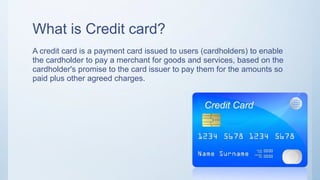
A credit card is a payment card issued to users (cardholders) to enable
the cardholder to pay a merchant for goods and services, based on the
cardholder's promise to the card issuer to pay them for the amounts so
paid plus other agreed charges.
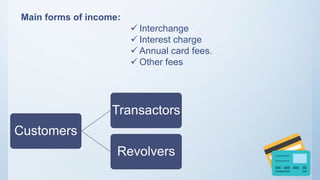
Main forms of income:
 Interchange
 Interest charge
 Annual card fees.
 Other fees
Customers
Transactors
Revolvers
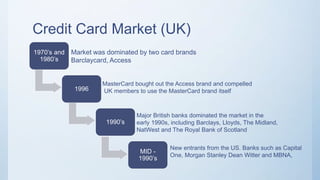
Credit Card Market (UK)
1970’s and
1980’s
Market was dominated by two card brands
Barclaycard, Access
1996
MasterCard bought out the Access brand and compelled
UK members to use the MasterCard brand itself
1990’s
Major British banks dominated the market in the
early 1990s, including Barclays, Lloyds, The Midland,
NatWest and The Royal Bank of Scotland
MID -
1990’s
New entrants from the US. Banks such as Capital
One, Morgan Stanley Dean Witter and MBNA,
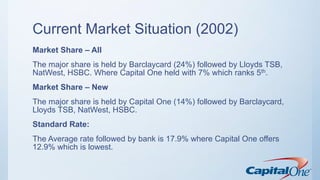
Current Market Situation (2002)
Market Share – All
The major share is held by Barclaycard (24%) followed by Lloyds TSB,
NatWest, HSBC. Where Capital One held with 7% which ranks 5th.
Market Share – New
The major share is held by Capital One (14%) followed by Barclaycard,
Lloyds TSB, NatWest, HSBC.
Standard Rate:
The Average rate followed by bank is 17.9% where Capital One offers
12.9% which is lowest.
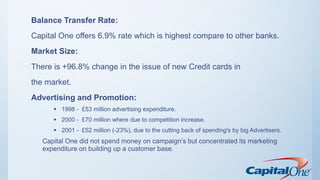
Balance Transfer Rate:
Capital One offers 6.9% rate which is highest compare to other banks.
Market Size:
There is +96.8% change in the issue of new Credit cards in
the market.
Advertising and Promotion:
 1998 - £53 million advertising expenditure.
 2000 - £70 million where due to competition increase.
 2001 - £52 million (-23%), due to the cutting back of spending's by big Advertisers.
Capital One did not spend money on campaign’s but concentrated its marketing
expenditure on building up a customer base.
Business Model
• The business model of Capital One is founded on the simple, that each
customer requires a different product and service benefits from a credit
card provider.
• Each customer carries a specific and unique credit risk and potential
revenue profile, based mainly on their previous credit history it can
analyzed.
Information Based Strategy
• In order to understand the customers, the company uses information
technology to accumulate and manage large amounts of data on its
customers.
• Capital One’s Marketing and Analysis teams develop ideas, design
products and select segments based on the Test and learn strategy
(where it carries out scientific tests to identify differences in potential
customer behavior. )
• All test results are then analyzed and integrated into databases and
can be referenced later to initiate further ideas development and
product design.
Departments
 Marketing and Analysis (M&A)
 Operations
 IT
 Human Resources.
Marketing and Analysis (M&A)
Account acquisition – the activity of attracting customers to Capital
One.
Account management – managing the customer relationship in a
profitable manner if the applicant become as a customer.
Operations: There are over 1,000 people working in Capital One’s call-
center, which handles more than 10,000 calls per day on an incoming
basis
Operations
 Operations Processing
Customer Relations
Sales
 Inbound
 Outbound
 Retention
 New business
Collections
 Payment Assistance
 Recoveries
 Fraud
Information Technology (IT)
• The IT department offers a full-service capability to the business
(Operations and M&A), covering the spectrum of products and
processes through their genesis and complete life cycle.
• IT also provides the tools through which IBS is enabled – including the
query tools, the batch updates, and the summary and transactional
data.
Human Resources
Hiring/Training
 Evaluation
 Compensation
Future Challenges
Building a Deeper Understanding of Customer Needs
Managing Costs
Co-ordinating Channels
THANK YOU

Customer Relationship Management at Capital one

  • 1.
  • 2.
    What is Capital OneFinancial Corporation is a bank holding company specializing in credit cards, home loans, auto loans, banking and savings products headquartered in McLean, Virginia. The Company was founded in the year 1988 by Richard Fairbank and Nigel Morris
  • 3.
    History Late 1980s, Foundershad a vision of creating an information-based company rather than a financial services company when they worked in the consulting business. 1988, Signet Bank brought Fairbank and Morris concept and the concept was “Credit cards are not banking, they are information It’s all about collecting information on millions of people that you’ve never met, and on the basis of that information, making a series of critical decisions about lending money to them and hoping they back you.” Signet Bank used information based strategy
  • 4.
    • 1994, Signet’sexecutive management made decision to float the credit card business separately where Capital One Financial Corporation was born in November 1994, with Richard Fairbank as Chairman and CEO, and Nigel Morris as President and COO. • 2000, The stock price of the company has increased by 1,000% and the company has grown at an average annual rate of 40%, excluding mergers and acquisitions. • 2001, The company handled more than US$45 billion in loans and 43.8 million customers worldwide, serviced by more than 20,000 employees
  • 5.
    What is Creditcard? A credit card is a payment card issued to users (cardholders) to enable the cardholder to pay a merchant for goods and services, based on the cardholder's promise to the card issuer to pay them for the amounts so paid plus other agreed charges.
  • 6.
    Main forms ofincome:  Interchange  Interest charge  Annual card fees.  Other fees Customers Transactors Revolvers
  • 7.
    Credit Card Market(UK) 1970’s and 1980’s Market was dominated by two card brands Barclaycard, Access 1996 MasterCard bought out the Access brand and compelled UK members to use the MasterCard brand itself 1990’s Major British banks dominated the market in the early 1990s, including Barclays, Lloyds, The Midland, NatWest and The Royal Bank of Scotland MID - 1990’s New entrants from the US. Banks such as Capital One, Morgan Stanley Dean Witter and MBNA,
  • 8.
    Current Market Situation(2002) Market Share – All The major share is held by Barclaycard (24%) followed by Lloyds TSB, NatWest, HSBC. Where Capital One held with 7% which ranks 5th. Market Share – New The major share is held by Capital One (14%) followed by Barclaycard, Lloyds TSB, NatWest, HSBC. Standard Rate: The Average rate followed by bank is 17.9% where Capital One offers 12.9% which is lowest.
  • 9.
    Balance Transfer Rate: CapitalOne offers 6.9% rate which is highest compare to other banks. Market Size: There is +96.8% change in the issue of new Credit cards in the market. Advertising and Promotion:  1998 - £53 million advertising expenditure.  2000 - £70 million where due to competition increase.  2001 - £52 million (-23%), due to the cutting back of spending's by big Advertisers. Capital One did not spend money on campaign’s but concentrated its marketing expenditure on building up a customer base.
  • 10.
    Business Model • Thebusiness model of Capital One is founded on the simple, that each customer requires a different product and service benefits from a credit card provider. • Each customer carries a specific and unique credit risk and potential revenue profile, based mainly on their previous credit history it can analyzed.
  • 11.
    Information Based Strategy •In order to understand the customers, the company uses information technology to accumulate and manage large amounts of data on its customers. • Capital One’s Marketing and Analysis teams develop ideas, design products and select segments based on the Test and learn strategy (where it carries out scientific tests to identify differences in potential customer behavior. ) • All test results are then analyzed and integrated into databases and can be referenced later to initiate further ideas development and product design.
  • 12.
    Departments  Marketing andAnalysis (M&A)  Operations  IT  Human Resources.
  • 13.
    Marketing and Analysis(M&A) Account acquisition – the activity of attracting customers to Capital One. Account management – managing the customer relationship in a profitable manner if the applicant become as a customer. Operations: There are over 1,000 people working in Capital One’s call- center, which handles more than 10,000 calls per day on an incoming basis
  • 14.
    Operations  Operations Processing CustomerRelations Sales  Inbound  Outbound  Retention  New business Collections  Payment Assistance  Recoveries  Fraud
  • 15.
    Information Technology (IT) •The IT department offers a full-service capability to the business (Operations and M&A), covering the spectrum of products and processes through their genesis and complete life cycle. • IT also provides the tools through which IBS is enabled – including the query tools, the batch updates, and the summary and transactional data.
  • 16.
  • 17.
    Future Challenges Building aDeeper Understanding of Customer Needs Managing Costs Co-ordinating Channels
  • 18.