Data Mining at UVA New Horizons in Teaching and Learning Conference May 21-24, 2007 Kathy Gerber, ITC Research Computing [email_address]
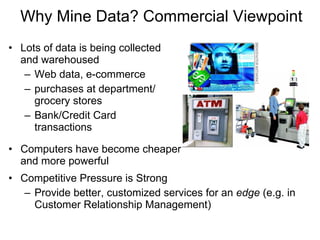
Lots of data is being collected  and warehoused  Web data, e-commerce purchases at department/ grocery stores Bank/Credit Card  transactions Computers have become cheaper  and more powerful Competitive Pressure is Strong  Provide better, customized services for an  edge  (e.g. in Customer Relationship Management) Why Mine Data? Commercial Viewpoint
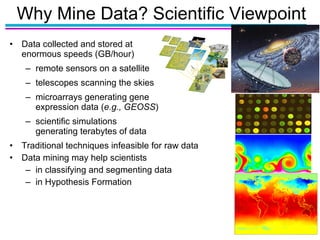
Why Mine Data? Scientific Viewpoint Data collected and stored at  enormous speeds (GB/hour) remote sensors on a satellite telescopes scanning the skies microarrays generating gene  expression data ( e.g., GEOSS ) scientific simulations  generating terabytes of data Traditional techniques infeasible for raw data Data mining may help scientists  in classifying and segmenting data in Hypothesis Formation
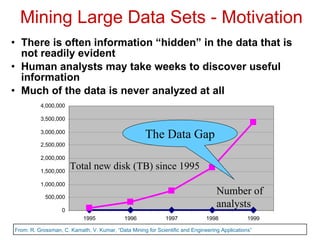
Mining Large Data Sets - Motivation There is often information “hidden” in the data that is  not readily evident Human analysts may take weeks to discover useful information Much of the data is never analyzed at all The Data Gap Total new disk (TB) since 1995 Number of analysts From: R. Grossman, C. Kamath, V. Kumar, “Data Mining for Scientific and Engineering Applications”
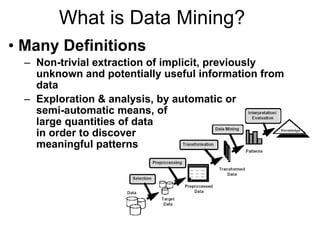
What is Data Mining? Many Definitions Non-trivial extraction of implicit, previously unknown and potentially useful information from data Exploration & analysis, by automatic or  semi-automatic means, of  large quantities of data  in order to discover  meaningful patterns
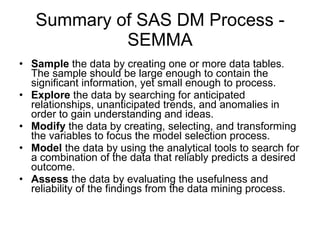
Summary of SAS DM Process - SEMMA Sample  the data by creating one or more data tables. The sample should be large enough to contain the significant information, yet small enough to process. Explore  the data by searching for anticipated relationships, unanticipated trends, and anomalies in order to gain understanding and ideas. Modify  the data by creating, selecting, and transforming the variables to focus the model selection process. Model  the data by using the analytical tools to search for a combination of the data that reliably predicts a desired outcome. Assess  the data by evaluating the usefulness and reliability of the findings from the data mining process.
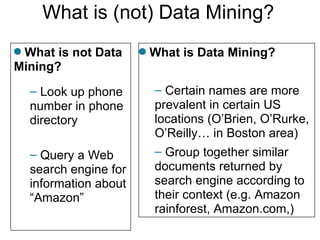
What is (not) Data Mining? What is Data Mining? Certain names are more prevalent in certain US locations (O’Brien, O’Rurke, O’Reilly… in Boston area) Group together similar documents returned by search engine according to their context (e.g. Amazon rainforest, Amazon.com,) What is not Data Mining? Look up phone number in phone directory Query a Web search engine for information about “Amazon”
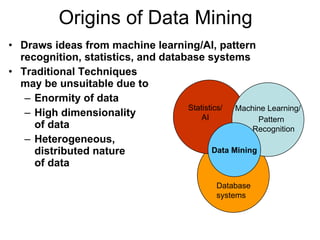
Draws ideas from machine learning/AI, pattern recognition, statistics, and database systems Traditional Techniques may be unsuitable due to  Enormity of data High dimensionality  of data Heterogeneous,  distributed nature  of data Origins of Data Mining Machine Learning/ Pattern   Recognition Statistics/ AI Data Mining Database systems
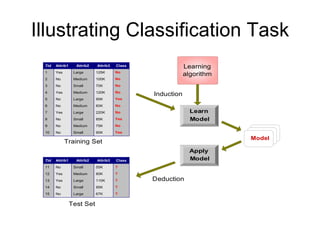
Classification: Definition Given a collection of records ( training set  ) Each record contains a set of  attributes , one of the attributes is the  class . Find a  model   for class attribute as a function of the values of other attributes. Goal:  previously unseen  records should be assigned a class as accurately as possible. A  test set  is used to determine the accuracy of the model. Usually, the given data set is divided into training and test sets, with training set used to build the model and test set used to validate it.
Examples of Classification Task Predicting tumor cells as benign or malignant Classifying credit card transactions  as legitimate or fraudulent Classifying secondary structures of protein  as alpha-helix, beta-sheet, or random  coil Categorizing news stories as finance,  weather, entertainment, sports, etc
Classification Techniques Decision Tree based Methods Rule-based Methods Memory based reasoning Neural Networks Naïve Bayes and Bayesian Belief Networks Support Vector Machines
Illustrating Classification Task
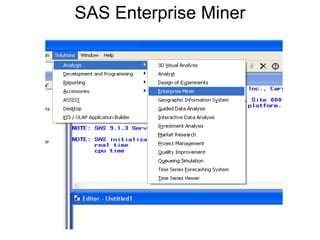
Software Demonstrations SAS Enterprise Miner R Rattle Weka
SAS Enterprise Miner
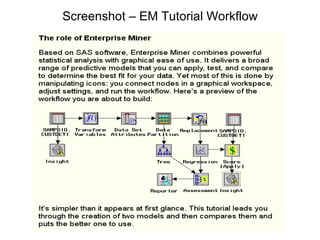
Screenshot – EM Tutorial Workflow
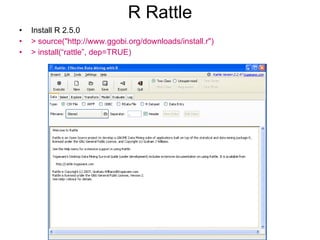
R Rattle Install R 2.5.0    > source("http://www.ggobi.org/downloads/install.r") > install(“rattle”, dep=TRUE)
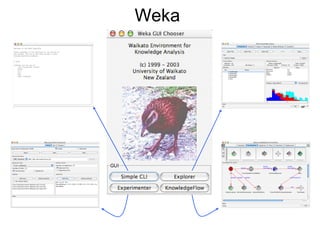
Weka
Slide Credits R. Grossman, C. Kamath, V. Kumar, “Data Mining for Scientific and Engineering  Applications” SAS Enterprise Miner tutorial Frank Eibe, Machine Learning with Weka Tan, Steinbach, Kumar “Introduction to Data Mining”
Versions and References for Software Used Today SAS 9.1.3 EAS with  Enterprise Miner UVA licensed software http://rescomp.virginia.edu R 2.5.0 with  Rattle  (open source) Open source Weka  (open source) Ian Witten, Frank Eibe:  Data Mining: Practical Machine Learning Tools and Techniques  (Second Edition)  Not demonstrated but also see  Insightful Miner  and  Orange

Datamining

  • 1.
    Data Mining atUVA New Horizons in Teaching and Learning Conference May 21-24, 2007 Kathy Gerber, ITC Research Computing [email_address]
  • 2.
    Lots of datais being collected and warehoused Web data, e-commerce purchases at department/ grocery stores Bank/Credit Card transactions Computers have become cheaper and more powerful Competitive Pressure is Strong Provide better, customized services for an edge (e.g. in Customer Relationship Management) Why Mine Data? Commercial Viewpoint
  • 3.
    Why Mine Data?Scientific Viewpoint Data collected and stored at enormous speeds (GB/hour) remote sensors on a satellite telescopes scanning the skies microarrays generating gene expression data ( e.g., GEOSS ) scientific simulations generating terabytes of data Traditional techniques infeasible for raw data Data mining may help scientists in classifying and segmenting data in Hypothesis Formation
  • 4.
    Mining Large DataSets - Motivation There is often information “hidden” in the data that is not readily evident Human analysts may take weeks to discover useful information Much of the data is never analyzed at all The Data Gap Total new disk (TB) since 1995 Number of analysts From: R. Grossman, C. Kamath, V. Kumar, “Data Mining for Scientific and Engineering Applications”
  • 5.
    What is DataMining? Many Definitions Non-trivial extraction of implicit, previously unknown and potentially useful information from data Exploration & analysis, by automatic or semi-automatic means, of large quantities of data in order to discover meaningful patterns
  • 6.
    Summary of SASDM Process - SEMMA Sample the data by creating one or more data tables. The sample should be large enough to contain the significant information, yet small enough to process. Explore the data by searching for anticipated relationships, unanticipated trends, and anomalies in order to gain understanding and ideas. Modify the data by creating, selecting, and transforming the variables to focus the model selection process. Model the data by using the analytical tools to search for a combination of the data that reliably predicts a desired outcome. Assess the data by evaluating the usefulness and reliability of the findings from the data mining process.
  • 7.
    What is (not)Data Mining? What is Data Mining? Certain names are more prevalent in certain US locations (O’Brien, O’Rurke, O’Reilly… in Boston area) Group together similar documents returned by search engine according to their context (e.g. Amazon rainforest, Amazon.com,) What is not Data Mining? Look up phone number in phone directory Query a Web search engine for information about “Amazon”
  • 8.
    Draws ideas frommachine learning/AI, pattern recognition, statistics, and database systems Traditional Techniques may be unsuitable due to Enormity of data High dimensionality of data Heterogeneous, distributed nature of data Origins of Data Mining Machine Learning/ Pattern Recognition Statistics/ AI Data Mining Database systems
  • 9.
    Classification: Definition Givena collection of records ( training set ) Each record contains a set of attributes , one of the attributes is the class . Find a model for class attribute as a function of the values of other attributes. Goal: previously unseen records should be assigned a class as accurately as possible. A test set is used to determine the accuracy of the model. Usually, the given data set is divided into training and test sets, with training set used to build the model and test set used to validate it.
  • 10.
    Examples of ClassificationTask Predicting tumor cells as benign or malignant Classifying credit card transactions as legitimate or fraudulent Classifying secondary structures of protein as alpha-helix, beta-sheet, or random coil Categorizing news stories as finance, weather, entertainment, sports, etc
  • 11.
    Classification Techniques DecisionTree based Methods Rule-based Methods Memory based reasoning Neural Networks Naïve Bayes and Bayesian Belief Networks Support Vector Machines
  • 12.
  • 13.
    Software Demonstrations SASEnterprise Miner R Rattle Weka
  • 14.
  • 15.
    Screenshot – EMTutorial Workflow
  • 16.
    R Rattle InstallR 2.5.0    > source("http://www.ggobi.org/downloads/install.r") > install(“rattle”, dep=TRUE)
  • 17.
  • 18.
    Slide Credits R.Grossman, C. Kamath, V. Kumar, “Data Mining for Scientific and Engineering Applications” SAS Enterprise Miner tutorial Frank Eibe, Machine Learning with Weka Tan, Steinbach, Kumar “Introduction to Data Mining”
  • 19.
    Versions and Referencesfor Software Used Today SAS 9.1.3 EAS with Enterprise Miner UVA licensed software http://rescomp.virginia.edu R 2.5.0 with Rattle (open source) Open source Weka (open source) Ian Witten, Frank Eibe: Data Mining: Practical Machine Learning Tools and Techniques (Second Edition) Not demonstrated but also see Insightful Miner and Orange