
Business intelligence   - a decision support tool for businessSolutions with Style
Business IntelligenceAllows organizations to better understand, analyze, and even predict what’s happening in their company. It helps your organization turn data into useful and meaningful information and then distribute this information to those who need it, when they need it—so they can make timely and better-informed decisions
Need of BIThe practical reality of most organizations is that their data infrastructure is made up by a collection of heterogeneous systems.
Need of BI – case studyEven though the information is available "somewhere" in the different data systems, it is very hard to answer simple questions like this.How much time did sales person A spend on customer C?How much did we sell to customer C?Was customer C happy with the provided service?Did customer C pay his bills?
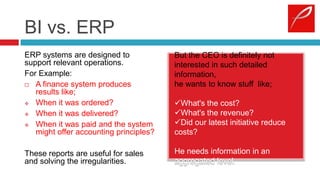
BI vs. ERPERP systems are designed to support relevant operations.For Example: A finance system produces results like;
When it was ordered?
When it was delivered?
When it was paid and the system might offer accounting principles?These reports are useful for sales and solving the irregularities.But the CEO is definitely not interested in such detailed information,he wants to know stuff  like;What's the cost?
What's the revenue?
Did our latest initiative reduce costs?He needs information in an aggregated level.
How BI helpsCustom calculations
Query Wizard Expertise
Layout Comments and Saving
Analytical features like ranking, filtering, sorting, group by etc…

Business Intelligence Precious Microtech

  • 1.
    Business intelligence - a decision support tool for businessSolutions with Style
  • 2.
    Business IntelligenceAllows organizationsto better understand, analyze, and even predict what’s happening in their company. It helps your organization turn data into useful and meaningful information and then distribute this information to those who need it, when they need it—so they can make timely and better-informed decisions
  • 3.
    Need of BIThepractical reality of most organizations is that their data infrastructure is made up by a collection of heterogeneous systems.
  • 4.
    Need of BI– case studyEven though the information is available "somewhere" in the different data systems, it is very hard to answer simple questions like this.How much time did sales person A spend on customer C?How much did we sell to customer C?Was customer C happy with the provided service?Did customer C pay his bills?
  • 5.
    BI vs. ERPERPsystems are designed to support relevant operations.For Example: A finance system produces results like;
  • 6.
    When it wasordered?
  • 7.
    When it wasdelivered?
  • 8.
    When it waspaid and the system might offer accounting principles?These reports are useful for sales and solving the irregularities.But the CEO is definitely not interested in such detailed information,he wants to know stuff like;What's the cost?
  • 9.
  • 10.
    Did our latestinitiative reduce costs?He needs information in an aggregated level.
  • 11.
    How BI helpsCustomcalculations
  • 12.
  • 13.
  • 14.
    Analytical features likeranking, filtering, sorting, group by etc…