Decision Support, Data Warehousing, and OLAP Anindya Datta Director, iXL Center for E-Commerce Georgia Institute of Technology [email_address]
Outline Terminology:  OLAP vs. OLTP Data Warehousing Architecture Technologies Products Research Issues References
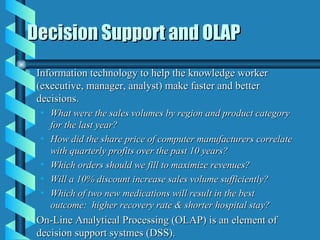
Decision Support and OLAP Information technology to help the knowledge worker (executive, manager, analyst) make faster and better decisions. What were the sales volumes by region and product category for the last year? How did the share price of computer manufacturers correlate with quarterly profits over the past 10 years? Which orders should we fill to maximize revenues? Will a 10% discount increase sales volume sufficiently? Which of two new medications will result in the best outcome:  higher recovery rate & shorter hospital stay? On-Line Analytical Processing (OLAP) is an element of decision support systmes (DSS).
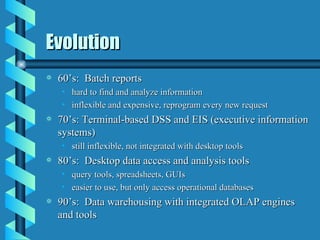
Evolution 60’s:  Batch reports hard to find and analyze information inflexible and expensive, reprogram every new request 70’s: Terminal-based DSS and EIS (executive information systems) still inflexible, not integrated with desktop tools 80’s:  Desktop data access and analysis tools query tools, spreadsheets, GUIs easier to use, but only access operational databases 90’s:  Data warehousing with integrated OLAP engines and tools
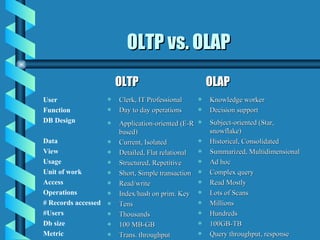
OLTP vs. OLAP Clerk, IT Professional Day to day operations Application-oriented (E-R based) Current, Isolated Detailed, Flat relational Structured, Repetitive Short, Simple transaction Read/write Index/hash on prim. Key Tens Thousands 100 MB-GB Trans. throughput Knowledge worker Decision support Subject-oriented (Star, snowflake) Historical, Consolidated Summarized, Multidimensional Ad hoc Complex query Read Mostly Lots of Scans Millions Hundreds 100GB-TB Query throughput, response User Function DB Design  Data  View Usage Unit of work Access Operations # Records accessed #Users Db size Metric OLTP OLAP
Data Warehouse A decision support database that is maintained separately from the organization’s operational databases. A data warehouse is a  subject-oriented, integrated, time-varying, non-volatile collection of data that is used primarily in organizational decision making
Why Separate Data Warehouse? Performance Op dbs designed & tuned for known txs & workloads. Complex OLAP queries would degrade perf. For op txs. Special data organization, access & implementation methods needed for multidimensional views & queries.  Function Missing data:  Decision support requires historical data, which op dbs do not typically maintain. Data consolidation: Decision support requires consolidation (aggregation, summarization) of data from many heterogeneous sources:  op dbs, external sources.  Data quality:  Different sources typically use inconsistent data representations, codes, and formats which have to be reconciled.
Data Warehousing Market Hardware:  servers, storage, clients Warehouse DBMs Tools Market growing from  $2B in 1995 to $8 B in 1998 (Meta Group) 1.5B today to $6.9B in 1999 (Gartner Group) Systems integration & Consulting Already deployed in many industries:  manufacturing, retail, financial, insurance, transportation, telecom., utilities, healthcare.
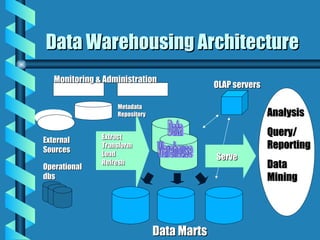
Data Warehousing Architecture Monitoring & Administration Metadata Repository Extract Transform Load Refresh Data Marts External Sources Operational dbs Serve OLAP servers Analysis Query/ Reporting Data Mining Data  Warehouse
Three-Tier Architecture Warehouse database server Almost always a relational DBMS; rarely flat files OLAP servers Relational OLAP (ROLAP):  extended relational DBMS that maps operations on multidimensional data to standard relational operations. Multidimensional OLAP (MOLAP): special purpose server that directly implements multidimensional data and operations. Clients Query and reporting tools. Analysis tools Data mining tools (e.g., trend analysis, prediction)
Data Warehouse vs. Data Marts Enterprise warehouse:  collects all information about subjects (customers, products, sales, assets, personnel) that span the entire organization. Requires extensive business modeling May take years to design and build Data Marts:  Departmental subsets that focus on selected subjects:  Marketing data mart:  customer, products, sales. Faster roll out, but complex integration in the long run. Virtual warehouse:  views over operational dbs Materialize some summary views for efficient query processing Easier to build Requisite excess capcaity on operational db servers
Design & Operational Process Define architecture.  Do capacity planning. Integrate db and OLAP servers, storage and client tools. Design warehouse schema, views. Design physical warehouse organization:  data placement, partitioning, access methods. Connect sources:  gateways, ODBC drivers, wrappers. Design & implement scripts for data extract, load refresh. Define metadata and populate repository. Design & implement end-user applications. Roll out warehouse and applications. Monitor the warehouse.
OLAP for Decision Support Goal of OLAP is to support ad-hoc querying for the business analyst Business analysts are familiar with spreadsheets Extend spreadsheet analysis model to work with warehouse data Large data set Semantically enriched to understand business terms (e.g., time, geography) Combined with reporting features Multidimensional  view of data is the foundation of OLAP
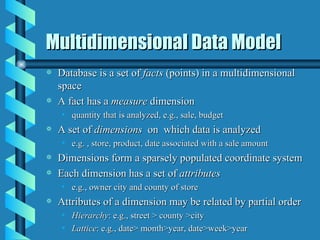
Multidimensional Data Model Database is a set of  facts  (points) in a multidimensional space A fact has a  measure  dimension quantity that is analyzed, e.g., sale, budget A set of  dimensions   on  which data is analyzed e.g. , store, product, date associated with a sale amount Dimensions form a sparsely populated coordinate system Each dimension has a set of  attributes e.g., owner city and county of store Attributes of a dimension may be related by partial order Hierarchy : e.g., street > county >city Lattice : e.g., date> month>year, date>week>year
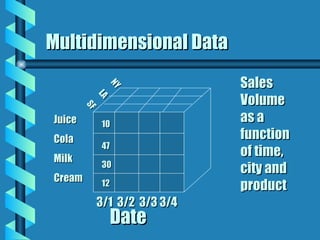
Multidimensional Data 10 47 30 12 Juice Cola Milk  Cream NY LA SF Sales Volume as a function of time, city and product 3/1  3/2  3/3 3/4 Date
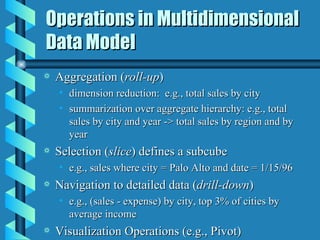
Operations in Multidimensional Data Model Aggregation ( roll-up ) dimension reduction:  e.g., total sales by city summarization over aggregate hierarchy: e.g., total sales by city and year -> total sales by region and by year Selection ( slice ) defines a subcube e.g., sales where city = Palo Alto and date = 1/15/96 Navigation to detailed data ( drill-down ) e.g., (sales - expense) by city, top 3% of cities by average income Visualization Operations (e.g., Pivot)
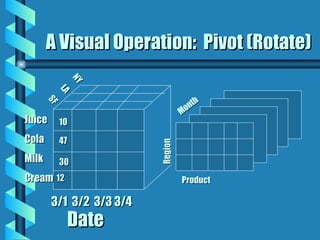
A Visual Operation:  Pivot (Rotate) 10 47 30 12 Juice Cola Milk  Cream NY LA SF 3/1  3/2  3/3 3/4 Date Month Region Product
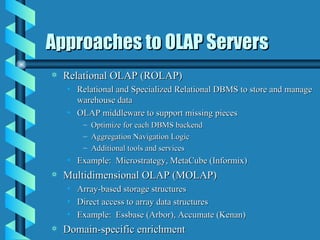
Approaches to OLAP Servers Relational OLAP (ROLAP) Relational and Specialized Relational DBMS to store and manage warehouse data OLAP middleware to support missing pieces Optimize for each DBMS backend Aggregation Navigation Logic Additional tools and services Example:  Microstrategy, MetaCube (Informix) Multidimensional OLAP (MOLAP) Array-based storage structures Direct access to array data structures Example:  Essbase (Arbor), Accumate (Kenan) Domain-specific enrichment
Relational DBMS as Warehouse Server Schema design Specialized scan, indexing and join techniques Handling of aggregate views (querying and materialization) Supporting query language extensions beyond SQL Complex query processing and optimization Data partitioning and parallelism
Warehouse Database Schema ER design techniques not appropriate Design should reflect multidimensional view Star Schema Snowflake Schema Fact Constellation Schema
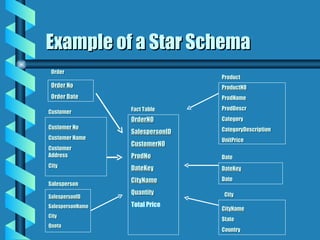
Example of a Star Schema Order No Order Date Customer No Customer Name Customer Address City SalespersonID SalespersonName City Quota OrderNO SalespersonID CustomerNO ProdNo DateKey CityName Quantity Total Price ProductNO ProdName ProdDescr Category CategoryDescription UnitPrice DateKey Date CityName State Country Order Customer Salesperson City Date Product Fact Table
Star Schema A single fact table and a single table for each dimension Every fact points to one tuple in each of the dimensions and has additional attributes Does not capture hierarchies directly Generated keys are used for performance and maintenance reasons Fact constellation: Multiple Fact tables that share many dimension tables Example:  Projected expense and the actual expense may share dimensional tables
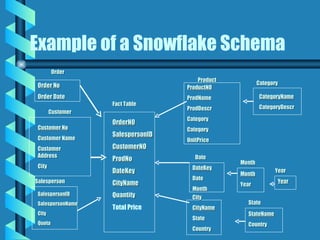
Example of a Snowflake Schema Order No Order Date Customer No Customer Name Customer Address City SalespersonID SalespersonName City Quota OrderNO SalespersonID CustomerNO ProdNo DateKey CityName Quantity Total Price ProductNO ProdName ProdDescr Category Category UnitPrice DateKey Date Month CityName State Country Order Customer Salesperson City Date Product Fact Table CategoryName CategoryDescr Month Year Year StateName Country Category State Month Year
Snowflake Schema Represent dimensional hierarchy directly by normalizing the dimension tables Easy to maintain Saves storage, but is alleged that it reduces effectiveness of browsing (Kimball)
Indexing Techniques Exploiting indexes to reduce scanning of data is of crucial importance Bitmap Indexes Join Indexes Other Issues Text indexing Parallelizing and sequencing of index builds and incremental updates
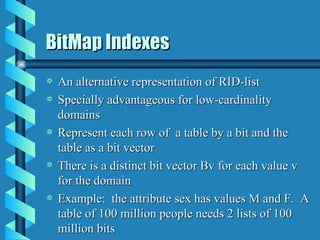
BitMap Indexes An alternative representation of RID-list Specially advantageous for low-cardinality domains Represent each row of  a table by a bit and the table as a bit vector There is a distinct bit vector Bv for each value v for the domain Example:  the attribute sex has values M and F.  A table of 100 million people needs 2 lists of 100 million bits
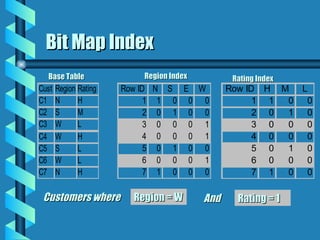
Bit Map Index Base Table Rating Index Region Index Customers where   Region = W Rating = 1 And
BitMap Indexes Comparison, join and aggregation operations are reduced to bit arithmetic with dramatic improvement in processing time Significant reduction in space and I/O (30:1) Adapted for higher cardinality domains as well. Compression (e.g., run-length encoding) exploited Products that support bitmaps:  Model 204, TargetIndex (Redbrick), IQ (Sybase), Oracle 7.3
Issues in Handling of Aggregate Views Important component for ROLAP Servers Representation in the context of star schema Query Expressions Materialized Views Logic for Aggregation Navigation make optimum use of materialized aggregates to answer a query Choice of aggregate views to materialize HP Intelligent Warehouse pioneered some of the techniques
SQL Extensions for Front End Tools Extended Family of Aggregate functions rank (top 10) and N-Tile (“top 30%” of all products) Median, mode….. Reporting Features running total, cumulative totals Results of multiple group by: total sales by month and total sales by product SQL comes in the way of sequential processing and columnar aggregations changes in total sale from 1994 to 1996, aggregated by brand
Query Processing in MOLAP Servers The storage model is an n-dimensional array Front end multidimensional queries map to server capabilities in a straightforward way Direct Addressing abilities A straightforward array representation has good indexing properties but very poor storage utilization when the data is sparse
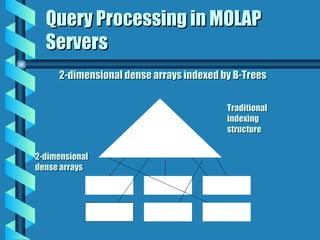
Query Processing in MOLAP Servers 2-dimensional dense arrays indexed by B-Trees Traditional indexing structure 2-dimensional dense arrays
Population & Refreshing the Warehouse Data extraction Data cleaning Data transformation Convert from legacy/host format to warehouse format Load  Sort, summarize, consolidate, compute views, check integrity, build indexes, partition Refresh Propogate updates from sources to the warehouse
Data Cleaning Why? Data warehouse contains data that is analyzed for business decisions More data and multiple sources could mean more errors in the data and harder to trace such errors Results in incorrect analysis Detecting data anomalies and rectifying them early has huge payoffs Important to identify tools that work together well Long Term Solution Change business practices and data entry tools Repository for meta-data
Data Cleaning Techniques Transformation Rules Example:  translate “gender” to “sex” Products:  Warehouse Manger (Prism), Extract (ETI) Uses domain-specific knowledge to do scrubbing Parsing and fuzzy matching Multiple data sources (can designate a preferred source) Products:  Integrity (Vality), Trillum Discover facts that flag unusual patterns (auditing) Some dealer has never received a single complaint Products:  QDB, SBStar, WizRule
Load Issues: huge volumes of data to be loaded small time window (usually at night) when the warehouse can be taken off-line When to build indexes and summary tables allow system administrator to monitor status, cancel suspend, resume load, or change load rate restart after failure with no loss of data integrity Techniques: batch load utility:  sort input records on clustering key and use sequential I/O; build indexes and derived tables sequential loads still too long (~100 days for TB) use parallelism and incremental techniques
Refresh Issues: when to refresh on every update: too expensive, only necessary if OLAP queries need current data  (e.g., up-the-minute stock quotes) periodically (e.g., every 24 hours, every week) or after “significant” events refresh policy set by administrator based on user needs and traffic possibly different policies for different sources how to refresh
Refresh Techniques Full extract from base tables read entire source table or database:  expensive may be the only choice for legacy databases or files. Incremental techniques (related to work on active dbs) detect & propagate changes on base tables:  replication servers (e.g., Sybase, Oracle, IBM Data Propagator) snapshots & triggers (Oracle) transaction shipping (Sybase) Logical correctness computing changes to star tables computing changes to derived and summary tables optimization:  only significant changes transactional correctness:  incremental load
Metadata Repository Administrative metadata source databases and their contents gateway descriptions warehouse schema, view & derived data definitions dimensions, hierarchies pre-defined queries and reports data mart locations and contents data partitions data extraction, cleansing, transformation rules, defaults data refresh and purging rules user profiles, user groups security: user authorization, access control
Metdata Repository .. 2 Business data business terms and definitions ownership of data charging policies operational metadata data lineage:  history of migrated data and sequence of transformations applied currency of data:  active, archived, purged monitoring information:  warehouse usage statistics, error reports, audit trails.
Warehouse Design Tools Creating and managing a warehouse is hard. Development tools defining & editing metadata repository contents (schemas, scripts, rules). Queries and reports Shipping metadata to and from RDBMS catalogue (e.g., Prism Warehouse Manager). Planning & analysis tools impact of schema changes capacity planning refresh performance:  changing refresh rates or time windows
Warehouse Management Tools Monitoring and reporting tools (e.g., HP Intelligent Warehouse Advisor) which partitions, summary tables, columns are used  query execution times for summary tables, types & frequencies of roll downs warehouse usage over time (detect peak periods) Systems and network management tools (e.g., HP OpenView, IBM NetView, Tivoli): traffic, utilization Exception reporting/alerting tools 9e.g., DB2 Event Alerters, Information Advantage InfoAgents & InfoAlert) runaway queries Analysis/Visualization tools:  OLAP on metadata
State of Commercial Practice Products and Vendors [Datamation, May 15, 1996;  R.C. Barquin, H.A. Edelstein:  Planning and Designin gthe Data Warehous.  Prentice Hall.  1997] Connectivity to sources Apertus CA-Ingres Gateway Information Builders EDA/SQL IBM Data Jioner Informix Enterprise Gateway Microsoft ODBC Oracle Open Connect Platinum Infohub SAS Connect Software AG Entire Sybase Enterprise Connect Trinzic InfoHub Data extract, clean, transfomr, refresh CA-Ingres Replicator Carleton Passport Evolutionary Tech Inc. ETI-Extract Harte-Hanks Trillium IBM Data Joiner, Data Propagator Oracle 7 Platinum InfoRefiner, InfroPump Praxis OmniReplicator Prism Warehouse Manager Redbrick TMU SAS Access Software AG  Souorcepoint Sybase Replication Server Trinzic InfoPump
State of Commercial Practice..2 Multidimensional Database Engines Arbor Essbase Comshare Commander OLAP Oracle IRI Express SAS System Warehouse Data Servers CA-Ingres IBM DB2 Information Builders Focus Informix Oracle Praxiz Model 204 Redbrick Software AG ADABAS Sybase MPP Tandem Terdata ROLAP Servers HP Intelligent Warehouse Information Advantage Asxys Informix Metacube MicroStrategy DSS Server
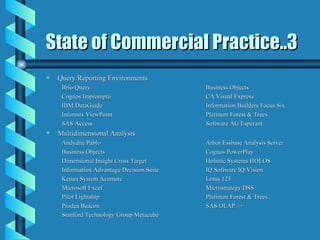
State of Commercial Practice..3 Query/Reporting Environments Brio/Query Business Objects Cognos Impromptu CA Visual Express IBM DataGuide Information Builders Focus Six Informix ViewPoint Platinum Forest & Trees SAS Access Software AG Esperant Multidimensional Analysis Andydne Pablo Arbor Essbase Analysis Server Business Objects Cognos PowerPlay Dimensional Insight Cross Target Holistic Systems HOLOS Information Advantage Decision Suite IQ Software IQ/Vision Kenan System Acumate Lotus 123 Microsoft Excel Microstrategy DSS Pilot Lightship Platinum Forest & Trees Prodea Beacon SAS OLAP ++ Stanford Technology Group Metacube
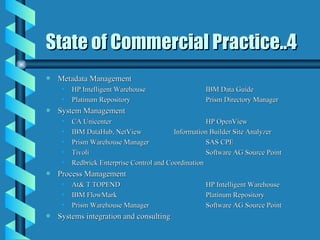
State of Commercial Practice..4 Metadata Management HP Intelligent Warehouse IBM Data Guide Platinum Repository  Prism Directory Manager System Management CA Unicenter HP OpenView IBM DataHub, NetView Information Builder Site Analyzer Prism Warehouse Manager SAS CPE Tivoli Software AG Source Point Redbrick Enterprise Control and Coordination Process Management  At& T TOPEND HP Intelligent Warehouse IBM FlowMark Platinum Repository Prism Warehouse Manager Software AG Source Point Systems integration and consulting
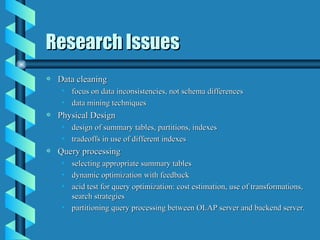
Research Issues Data cleaning focus on data inconsistencies, not schema differences data mining techniques Physical Design design of summary tables, partitions, indexes tradeoffs in use of different indexes Query processing selecting appropriate summary tables dynamic optimization with feedback acid test for query optimization: cost estimation, use of transformations, search strategies partitioning query processing between OLAP server and backend server.
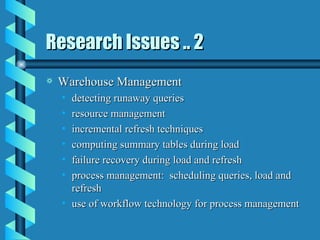
Research Issues .. 2 Warehouse Management detecting runaway queries resource management incremental refresh techniques computing summary tables during load failure recovery during load and refresh process management:  scheduling queries, load and refresh use of workflow technology for process management

Data Warehouse

  • 1.
    Decision Support, DataWarehousing, and OLAP Anindya Datta Director, iXL Center for E-Commerce Georgia Institute of Technology [email_address]
  • 2.
    Outline Terminology: OLAP vs. OLTP Data Warehousing Architecture Technologies Products Research Issues References
  • 3.
    Decision Support andOLAP Information technology to help the knowledge worker (executive, manager, analyst) make faster and better decisions. What were the sales volumes by region and product category for the last year? How did the share price of computer manufacturers correlate with quarterly profits over the past 10 years? Which orders should we fill to maximize revenues? Will a 10% discount increase sales volume sufficiently? Which of two new medications will result in the best outcome: higher recovery rate & shorter hospital stay? On-Line Analytical Processing (OLAP) is an element of decision support systmes (DSS).
  • 4.
    Evolution 60’s: Batch reports hard to find and analyze information inflexible and expensive, reprogram every new request 70’s: Terminal-based DSS and EIS (executive information systems) still inflexible, not integrated with desktop tools 80’s: Desktop data access and analysis tools query tools, spreadsheets, GUIs easier to use, but only access operational databases 90’s: Data warehousing with integrated OLAP engines and tools
  • 5.
    OLTP vs. OLAPClerk, IT Professional Day to day operations Application-oriented (E-R based) Current, Isolated Detailed, Flat relational Structured, Repetitive Short, Simple transaction Read/write Index/hash on prim. Key Tens Thousands 100 MB-GB Trans. throughput Knowledge worker Decision support Subject-oriented (Star, snowflake) Historical, Consolidated Summarized, Multidimensional Ad hoc Complex query Read Mostly Lots of Scans Millions Hundreds 100GB-TB Query throughput, response User Function DB Design Data View Usage Unit of work Access Operations # Records accessed #Users Db size Metric OLTP OLAP
  • 6.
    Data Warehouse Adecision support database that is maintained separately from the organization’s operational databases. A data warehouse is a subject-oriented, integrated, time-varying, non-volatile collection of data that is used primarily in organizational decision making
  • 7.
    Why Separate DataWarehouse? Performance Op dbs designed & tuned for known txs & workloads. Complex OLAP queries would degrade perf. For op txs. Special data organization, access & implementation methods needed for multidimensional views & queries. Function Missing data: Decision support requires historical data, which op dbs do not typically maintain. Data consolidation: Decision support requires consolidation (aggregation, summarization) of data from many heterogeneous sources: op dbs, external sources. Data quality: Different sources typically use inconsistent data representations, codes, and formats which have to be reconciled.
  • 8.
    Data Warehousing MarketHardware: servers, storage, clients Warehouse DBMs Tools Market growing from $2B in 1995 to $8 B in 1998 (Meta Group) 1.5B today to $6.9B in 1999 (Gartner Group) Systems integration & Consulting Already deployed in many industries: manufacturing, retail, financial, insurance, transportation, telecom., utilities, healthcare.
  • 9.
    Data Warehousing ArchitectureMonitoring & Administration Metadata Repository Extract Transform Load Refresh Data Marts External Sources Operational dbs Serve OLAP servers Analysis Query/ Reporting Data Mining Data Warehouse
  • 10.
    Three-Tier Architecture Warehousedatabase server Almost always a relational DBMS; rarely flat files OLAP servers Relational OLAP (ROLAP): extended relational DBMS that maps operations on multidimensional data to standard relational operations. Multidimensional OLAP (MOLAP): special purpose server that directly implements multidimensional data and operations. Clients Query and reporting tools. Analysis tools Data mining tools (e.g., trend analysis, prediction)
  • 11.
    Data Warehouse vs.Data Marts Enterprise warehouse: collects all information about subjects (customers, products, sales, assets, personnel) that span the entire organization. Requires extensive business modeling May take years to design and build Data Marts: Departmental subsets that focus on selected subjects: Marketing data mart: customer, products, sales. Faster roll out, but complex integration in the long run. Virtual warehouse: views over operational dbs Materialize some summary views for efficient query processing Easier to build Requisite excess capcaity on operational db servers
  • 12.
    Design & OperationalProcess Define architecture. Do capacity planning. Integrate db and OLAP servers, storage and client tools. Design warehouse schema, views. Design physical warehouse organization: data placement, partitioning, access methods. Connect sources: gateways, ODBC drivers, wrappers. Design & implement scripts for data extract, load refresh. Define metadata and populate repository. Design & implement end-user applications. Roll out warehouse and applications. Monitor the warehouse.
  • 13.
    OLAP for DecisionSupport Goal of OLAP is to support ad-hoc querying for the business analyst Business analysts are familiar with spreadsheets Extend spreadsheet analysis model to work with warehouse data Large data set Semantically enriched to understand business terms (e.g., time, geography) Combined with reporting features Multidimensional view of data is the foundation of OLAP
  • 14.
    Multidimensional Data ModelDatabase is a set of facts (points) in a multidimensional space A fact has a measure dimension quantity that is analyzed, e.g., sale, budget A set of dimensions on which data is analyzed e.g. , store, product, date associated with a sale amount Dimensions form a sparsely populated coordinate system Each dimension has a set of attributes e.g., owner city and county of store Attributes of a dimension may be related by partial order Hierarchy : e.g., street > county >city Lattice : e.g., date> month>year, date>week>year
  • 15.
    Multidimensional Data 1047 30 12 Juice Cola Milk Cream NY LA SF Sales Volume as a function of time, city and product 3/1 3/2 3/3 3/4 Date
  • 16.
    Operations in MultidimensionalData Model Aggregation ( roll-up ) dimension reduction: e.g., total sales by city summarization over aggregate hierarchy: e.g., total sales by city and year -> total sales by region and by year Selection ( slice ) defines a subcube e.g., sales where city = Palo Alto and date = 1/15/96 Navigation to detailed data ( drill-down ) e.g., (sales - expense) by city, top 3% of cities by average income Visualization Operations (e.g., Pivot)
  • 17.
    A Visual Operation: Pivot (Rotate) 10 47 30 12 Juice Cola Milk Cream NY LA SF 3/1 3/2 3/3 3/4 Date Month Region Product
  • 18.
    Approaches to OLAPServers Relational OLAP (ROLAP) Relational and Specialized Relational DBMS to store and manage warehouse data OLAP middleware to support missing pieces Optimize for each DBMS backend Aggregation Navigation Logic Additional tools and services Example: Microstrategy, MetaCube (Informix) Multidimensional OLAP (MOLAP) Array-based storage structures Direct access to array data structures Example: Essbase (Arbor), Accumate (Kenan) Domain-specific enrichment
  • 19.
    Relational DBMS asWarehouse Server Schema design Specialized scan, indexing and join techniques Handling of aggregate views (querying and materialization) Supporting query language extensions beyond SQL Complex query processing and optimization Data partitioning and parallelism
  • 20.
    Warehouse Database SchemaER design techniques not appropriate Design should reflect multidimensional view Star Schema Snowflake Schema Fact Constellation Schema
  • 21.
    Example of aStar Schema Order No Order Date Customer No Customer Name Customer Address City SalespersonID SalespersonName City Quota OrderNO SalespersonID CustomerNO ProdNo DateKey CityName Quantity Total Price ProductNO ProdName ProdDescr Category CategoryDescription UnitPrice DateKey Date CityName State Country Order Customer Salesperson City Date Product Fact Table
  • 22.
    Star Schema Asingle fact table and a single table for each dimension Every fact points to one tuple in each of the dimensions and has additional attributes Does not capture hierarchies directly Generated keys are used for performance and maintenance reasons Fact constellation: Multiple Fact tables that share many dimension tables Example: Projected expense and the actual expense may share dimensional tables
  • 23.
    Example of aSnowflake Schema Order No Order Date Customer No Customer Name Customer Address City SalespersonID SalespersonName City Quota OrderNO SalespersonID CustomerNO ProdNo DateKey CityName Quantity Total Price ProductNO ProdName ProdDescr Category Category UnitPrice DateKey Date Month CityName State Country Order Customer Salesperson City Date Product Fact Table CategoryName CategoryDescr Month Year Year StateName Country Category State Month Year
  • 24.
    Snowflake Schema Representdimensional hierarchy directly by normalizing the dimension tables Easy to maintain Saves storage, but is alleged that it reduces effectiveness of browsing (Kimball)
  • 25.
    Indexing Techniques Exploitingindexes to reduce scanning of data is of crucial importance Bitmap Indexes Join Indexes Other Issues Text indexing Parallelizing and sequencing of index builds and incremental updates
  • 26.
    BitMap Indexes Analternative representation of RID-list Specially advantageous for low-cardinality domains Represent each row of a table by a bit and the table as a bit vector There is a distinct bit vector Bv for each value v for the domain Example: the attribute sex has values M and F. A table of 100 million people needs 2 lists of 100 million bits
  • 27.
    Bit Map IndexBase Table Rating Index Region Index Customers where Region = W Rating = 1 And
  • 28.
    BitMap Indexes Comparison,join and aggregation operations are reduced to bit arithmetic with dramatic improvement in processing time Significant reduction in space and I/O (30:1) Adapted for higher cardinality domains as well. Compression (e.g., run-length encoding) exploited Products that support bitmaps: Model 204, TargetIndex (Redbrick), IQ (Sybase), Oracle 7.3
  • 29.
    Issues in Handlingof Aggregate Views Important component for ROLAP Servers Representation in the context of star schema Query Expressions Materialized Views Logic for Aggregation Navigation make optimum use of materialized aggregates to answer a query Choice of aggregate views to materialize HP Intelligent Warehouse pioneered some of the techniques
  • 30.
    SQL Extensions forFront End Tools Extended Family of Aggregate functions rank (top 10) and N-Tile (“top 30%” of all products) Median, mode….. Reporting Features running total, cumulative totals Results of multiple group by: total sales by month and total sales by product SQL comes in the way of sequential processing and columnar aggregations changes in total sale from 1994 to 1996, aggregated by brand
  • 31.
    Query Processing inMOLAP Servers The storage model is an n-dimensional array Front end multidimensional queries map to server capabilities in a straightforward way Direct Addressing abilities A straightforward array representation has good indexing properties but very poor storage utilization when the data is sparse
  • 32.
    Query Processing inMOLAP Servers 2-dimensional dense arrays indexed by B-Trees Traditional indexing structure 2-dimensional dense arrays
  • 33.
    Population & Refreshingthe Warehouse Data extraction Data cleaning Data transformation Convert from legacy/host format to warehouse format Load Sort, summarize, consolidate, compute views, check integrity, build indexes, partition Refresh Propogate updates from sources to the warehouse
  • 34.
    Data Cleaning Why?Data warehouse contains data that is analyzed for business decisions More data and multiple sources could mean more errors in the data and harder to trace such errors Results in incorrect analysis Detecting data anomalies and rectifying them early has huge payoffs Important to identify tools that work together well Long Term Solution Change business practices and data entry tools Repository for meta-data
  • 35.
    Data Cleaning TechniquesTransformation Rules Example: translate “gender” to “sex” Products: Warehouse Manger (Prism), Extract (ETI) Uses domain-specific knowledge to do scrubbing Parsing and fuzzy matching Multiple data sources (can designate a preferred source) Products: Integrity (Vality), Trillum Discover facts that flag unusual patterns (auditing) Some dealer has never received a single complaint Products: QDB, SBStar, WizRule
  • 36.
    Load Issues: hugevolumes of data to be loaded small time window (usually at night) when the warehouse can be taken off-line When to build indexes and summary tables allow system administrator to monitor status, cancel suspend, resume load, or change load rate restart after failure with no loss of data integrity Techniques: batch load utility: sort input records on clustering key and use sequential I/O; build indexes and derived tables sequential loads still too long (~100 days for TB) use parallelism and incremental techniques
  • 37.
    Refresh Issues: whento refresh on every update: too expensive, only necessary if OLAP queries need current data (e.g., up-the-minute stock quotes) periodically (e.g., every 24 hours, every week) or after “significant” events refresh policy set by administrator based on user needs and traffic possibly different policies for different sources how to refresh
  • 38.
    Refresh Techniques Fullextract from base tables read entire source table or database: expensive may be the only choice for legacy databases or files. Incremental techniques (related to work on active dbs) detect & propagate changes on base tables: replication servers (e.g., Sybase, Oracle, IBM Data Propagator) snapshots & triggers (Oracle) transaction shipping (Sybase) Logical correctness computing changes to star tables computing changes to derived and summary tables optimization: only significant changes transactional correctness: incremental load
  • 39.
    Metadata Repository Administrativemetadata source databases and their contents gateway descriptions warehouse schema, view & derived data definitions dimensions, hierarchies pre-defined queries and reports data mart locations and contents data partitions data extraction, cleansing, transformation rules, defaults data refresh and purging rules user profiles, user groups security: user authorization, access control
  • 40.
    Metdata Repository ..2 Business data business terms and definitions ownership of data charging policies operational metadata data lineage: history of migrated data and sequence of transformations applied currency of data: active, archived, purged monitoring information: warehouse usage statistics, error reports, audit trails.
  • 41.
    Warehouse Design ToolsCreating and managing a warehouse is hard. Development tools defining & editing metadata repository contents (schemas, scripts, rules). Queries and reports Shipping metadata to and from RDBMS catalogue (e.g., Prism Warehouse Manager). Planning & analysis tools impact of schema changes capacity planning refresh performance: changing refresh rates or time windows
  • 42.
    Warehouse Management ToolsMonitoring and reporting tools (e.g., HP Intelligent Warehouse Advisor) which partitions, summary tables, columns are used query execution times for summary tables, types & frequencies of roll downs warehouse usage over time (detect peak periods) Systems and network management tools (e.g., HP OpenView, IBM NetView, Tivoli): traffic, utilization Exception reporting/alerting tools 9e.g., DB2 Event Alerters, Information Advantage InfoAgents & InfoAlert) runaway queries Analysis/Visualization tools: OLAP on metadata
  • 43.
    State of CommercialPractice Products and Vendors [Datamation, May 15, 1996; R.C. Barquin, H.A. Edelstein: Planning and Designin gthe Data Warehous. Prentice Hall. 1997] Connectivity to sources Apertus CA-Ingres Gateway Information Builders EDA/SQL IBM Data Jioner Informix Enterprise Gateway Microsoft ODBC Oracle Open Connect Platinum Infohub SAS Connect Software AG Entire Sybase Enterprise Connect Trinzic InfoHub Data extract, clean, transfomr, refresh CA-Ingres Replicator Carleton Passport Evolutionary Tech Inc. ETI-Extract Harte-Hanks Trillium IBM Data Joiner, Data Propagator Oracle 7 Platinum InfoRefiner, InfroPump Praxis OmniReplicator Prism Warehouse Manager Redbrick TMU SAS Access Software AG Souorcepoint Sybase Replication Server Trinzic InfoPump
  • 44.
    State of CommercialPractice..2 Multidimensional Database Engines Arbor Essbase Comshare Commander OLAP Oracle IRI Express SAS System Warehouse Data Servers CA-Ingres IBM DB2 Information Builders Focus Informix Oracle Praxiz Model 204 Redbrick Software AG ADABAS Sybase MPP Tandem Terdata ROLAP Servers HP Intelligent Warehouse Information Advantage Asxys Informix Metacube MicroStrategy DSS Server
  • 45.
    State of CommercialPractice..3 Query/Reporting Environments Brio/Query Business Objects Cognos Impromptu CA Visual Express IBM DataGuide Information Builders Focus Six Informix ViewPoint Platinum Forest & Trees SAS Access Software AG Esperant Multidimensional Analysis Andydne Pablo Arbor Essbase Analysis Server Business Objects Cognos PowerPlay Dimensional Insight Cross Target Holistic Systems HOLOS Information Advantage Decision Suite IQ Software IQ/Vision Kenan System Acumate Lotus 123 Microsoft Excel Microstrategy DSS Pilot Lightship Platinum Forest & Trees Prodea Beacon SAS OLAP ++ Stanford Technology Group Metacube
  • 46.
    State of CommercialPractice..4 Metadata Management HP Intelligent Warehouse IBM Data Guide Platinum Repository Prism Directory Manager System Management CA Unicenter HP OpenView IBM DataHub, NetView Information Builder Site Analyzer Prism Warehouse Manager SAS CPE Tivoli Software AG Source Point Redbrick Enterprise Control and Coordination Process Management At& T TOPEND HP Intelligent Warehouse IBM FlowMark Platinum Repository Prism Warehouse Manager Software AG Source Point Systems integration and consulting
  • 47.
    Research Issues Datacleaning focus on data inconsistencies, not schema differences data mining techniques Physical Design design of summary tables, partitions, indexes tradeoffs in use of different indexes Query processing selecting appropriate summary tables dynamic optimization with feedback acid test for query optimization: cost estimation, use of transformations, search strategies partitioning query processing between OLAP server and backend server.
  • 48.
    Research Issues ..2 Warehouse Management detecting runaway queries resource management incremental refresh techniques computing summary tables during load failure recovery during load and refresh process management: scheduling queries, load and refresh use of workflow technology for process management