JBIMS MIM 2015-2018
SEM V
Business intelligence
NAME ROLL NO
MUFADDAL NULLWALA 15-I-131
Topics to be covered
 What is Business intelligence
 Core Capabilities of Business Intelligence
 Elements of Business Intelligence
 Why Companies opt for Business Intelligence
 Benefits of Business Intelligence
 User of Business Intelligence
 Reports of Business Intelligence
 Business Application in Extended Enterprise
 Business Analytics
 Golden Rules for Business Intelligence
 5 Stages of Business Intelligence
What is Business intelligence???
• Business Intelligence (BI) refers to skills, processes, technologies, applications and
practices used to support decision making.
• Systems that provide directed background data and reporting tools to support and
improve the decision-making process.
• A popularized, umbrella term used to describe a set of concepts and methods to
improve business decision making by using fact-based support systems. The term is
sometimes used interchangeably with briefing books and executive information
systems.
• Business Intelligence is a broad category of applications and technologies for
gathering, storing, analyzing, and providing access to data to help clients make
better business decisions.
• A system that collects, integrates, analyses and presents business information to
support better business decision making.
• Business Intelligence is an environment in which business users receive information
that is reliable, secure, consistent, understandable, easily manipulated and
timely...facilitating more informed decision making
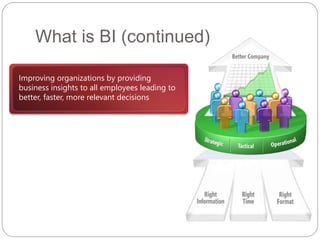
What is BI (continued)
Improving organizations by providing
business insights to all employees leading to
better, faster, more relevant decisions
Business Intelligence
 Rapid access to actionable information
 Includes:
Financial Information
Contacts
Documents
E-Mail
Legal Research & More
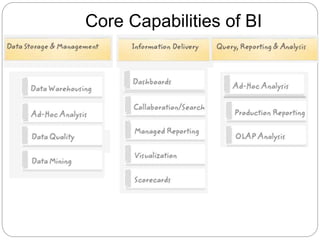
Core Capabilities of BI
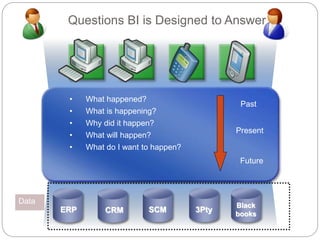
Questions BI is Designed to Answer
• What happened?
• What is happening?
• Why did it happen?
• What will happen?
• What do I want to happen?
ERP CRM 3PtySCM
Black
books
Past
Present
Future
Data
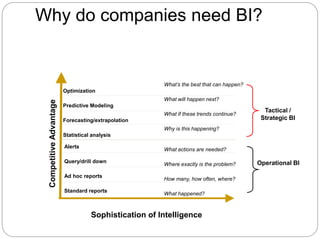
Why do companies need BI?
Tactical /
Strategic BI
What’s the best that can happen?
What will happen next?
What if these trends continue?
Why is this happening?
What actions are needed?
Where exactly is the problem?
How many, how often, where?
What happened?
Sophistication of Intelligence
Operational BI
Optimization
Predictive Modeling
Forecasting/extrapolation
Statistical analysis
Alerts
Query/drill down
Ad hoc reports
Standard reports
CompetitiveAdvantage
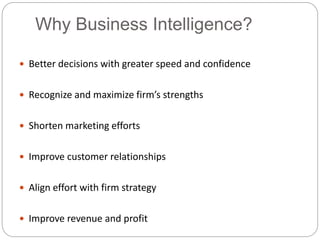
Why Business Intelligence?
 Better decisions with greater speed and confidence
 Recognize and maximize firm’s strengths
 Shorten marketing efforts
 Improve customer relationships
 Align effort with firm strategy
 Improve revenue and profit
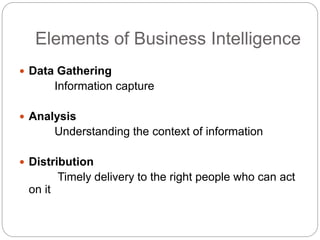
Elements of Business Intelligence
 Data Gathering
Information capture
 Analysis
Understanding the context of information
 Distribution
Timely delivery to the right people who can act
on it
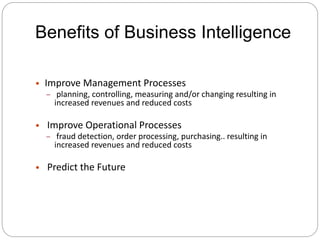
Benefits of Business Intelligence
• Improve Management Processes
– planning, controlling, measuring and/or changing resulting in
increased revenues and reduced costs
• Improve Operational Processes
– fraud detection, order processing, purchasing.. resulting in
increased revenues and reduced costs
• Predict the Future
 Executives : Information is summarized and has been defined for them.
Users have the ability to view static information online and/or print to a local
printer.
 Casual Users
Casual users require the next level of detail from the information that is
provided to viewers. In addition to the privileges of a viewer, casual users
have the ability to refresh report information and the ability to enter desired
information parameters for the purposes of performing high-level research
and analysis.
 Functional Users
Functional users need to perform detailed research and analysis, which
requires access to transactional data. In addition to the privileges of a casual
user, functional users have the ability to develop their own ad hoc queries
and perform OLAP analysis.
 Super Users
Super users have a strong understanding of both the business and
technology to access and analyze transactional data. They have full privileges
to explore and analyze the data with the BI applications available to them.
Business Intelligence Users
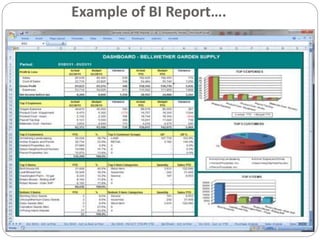
Example of BI Report….
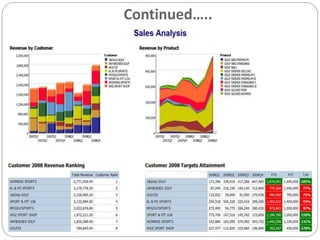
Continued…..
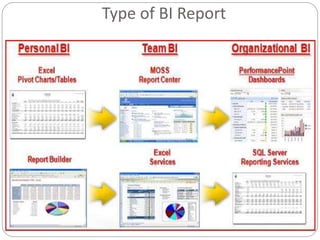
Type of BI Report
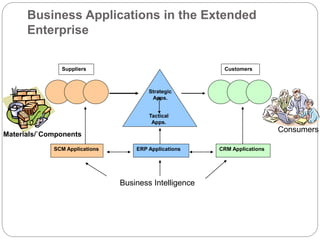
Business Applications in the Extended
Enterprise
Tactical
Apps.
Strategic
Apps.
Suppliers Customers
ERP ApplicationsSCM Applications CRM Applications
Materials/`Components
Consumers
Business Intelligence
BI Golden Rules
• Data Quality & Accuracy
• Data Consistency
• Data Timeliness
• “Get the right information to the right people at the right time”
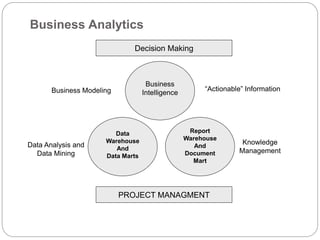
Business Analytics
Data Analysis and
Data Mining
Business Modeling
Knowledge
Management
“Actionable” Information
Report
Warehouse
And
Document
Mart
Data
Warehouse
And
Data Marts
Business
Intelligence
PROJECT MANAGMENT
Decision Making
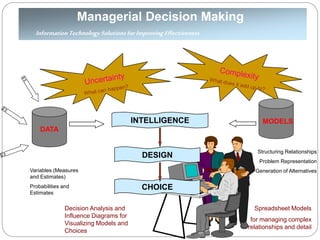
Managerial Decision Making
Information Technology Solutions forImproving Effectiveness
INTELLIGENCE
CHOICE
DESIGN
DATA
MODELS
Variables (Measures
and Estimates)
Probabilities and
Estimates
Structuring Relationships
Problem Representation
Generation of Alternatives
Decision Analysis and
Influence Diagrams for
Visualizing Models and
Choices
Spreadsheet Models
for managing complex
relationships and detail
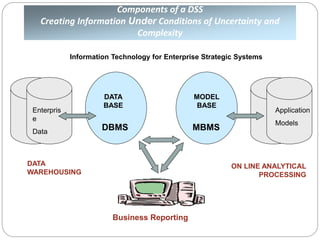
Components of a DSS
Creating Information Under Conditions of Uncertainty and
Complexity
MODEL
BASE
DATA
BASE
MBMSDBMS
DATA
WAREHOUSING
ON LINE ANALYTICAL
PROCESSING
Business Reporting
Application
Models
Enterpris
e
Data
Information Technology for Enterprise Strategic Systems
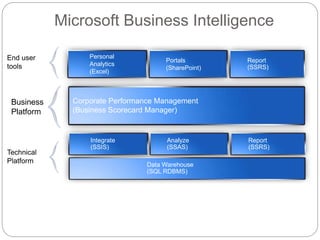
Microsoft Business Intelligence
Data Warehouse
(SQL RDBMS)
Integrate
(SSIS)
Analyze
(SSAS)
Report
(SSRS)
End user
tools
Business
Platform
Personal
Analytics
(Excel)
Portals
(SharePoint)
Report
(SSRS)
Technical
Platform
Corporate Performance Management
(Business Scorecard Manager)
The Five Stages of BI
BI involves five stages of taking raw data and
presenting it as relevant, actionable insight to users.
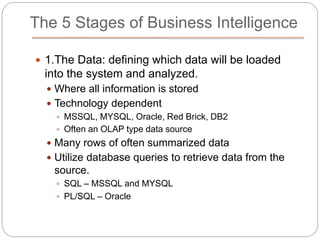
The 5 Stages of Business Intelligence
 1.The Data: defining which data will be loaded
into the system and analyzed.
 Where all information is stored
 Technology dependent
 MSSQL, MYSQL, Oracle, Red Brick, DB2
 Often an OLAP type data source
 Many rows of often summarized data
 Utilize database queries to retrieve data from the
source.
 SQL – MSSQL and MYSQL
 PL/SQL – Oracle
The 5 Stages of Business Intelligence
 OLTP
 Online Transaction processing
 Typically not your reporting database.
 Processes transactions fast for application
 Example
 Retail POS system
 Web Site
 Online Transaction Processing has two key benefits:
 Simplicity
 efficiency
 OLAP
 Online Analytical Processing
 Used for reporting
 May form base of data warehouse or BI tools
 Not used for transaction processing.
 Databases configured for OLAP use a multidimensional data model, allowing for
complex analytical and ad-hoc queries with a rapid execution time
The 5 Stages of Business Intelligence
 2.The ETL (Extract, Transform, and Load) Engine:
moving the source data to the Data Warehouse.
 This can be a complex step involving modifications and
calculations on the data itself.
 If this step doesn’t work properly, the BI solution simply
cannot be effective.
 3.Data Warehousing:
 connects electronic data from different operational
systems so that the data can be queried and analyzed
over time for business decision making.
 A data warehouse is an analytically oriented, integrated,
time-variant, and nonvolatile collection of data that
supports decision making processes
 Large databases that aggregate data collected from
multiple sources
The 5 Stages of Business Intelligence
 4.Analytic Engine:
 analyzes multidimensional data sets found in a data
warehouse to identify trends, outliers, and patterns.
 Data Mining
 is the process of extracting patterns from data. Data mining is
becoming an increasingly important tool to transform this data into
information. It is commonly used in a wide range of profiling practices,
such as marketing, surveillance, fraud detection and scientific
discovery.
 Data mining can be used to uncover patterns in data but is often
carried out only on samples of data. The mining process will be
ineffective if the samples are not a good representation of the larger
body of data.
 Data mining cannot discover patterns that may be present in the larger
body of data if those patterns are not present in the sample being
"mined".
The 5 Stages of Business Intelligence
 5.Presentation Layer:
 The dashboards, reports and alerts that present
findings from the analysis.
 Typically Technology Agnostic
 The presentation layer is for the user.
 It does not care
 How?
 When ?
 Where?
 Why?
 the user accesses the Information just that it is available.
The 5 Stages of Business Intelligence
 5. Presentation Layer:
 Interactive Dashboards:
 A dashboard is a set of high-level reports on key metrics, typically for
managers.
 There may be multiple reports on a single dashboard, much the same
way that a car’s dashboard has multiple gauges and displays on it.
 With a dashboard, users can gain an at-a-glance understanding of key
trends and metrics. Dashboards can be customizable to work for
anyone in an organization, from a sales rep or frontline operations
manager to a middle manager or senior executive.
 An “interactive” dashboard allows users to take those dashboard
reports and filter information to more deeply analyze trends and
results, or to “drill down” into deeper and more detailed analysis of the
data.
 That is, by clicking on the particular reports or results, they can
explore more detailed information to find root causes of results.
Conclusion
 Business Intelligence solutions make it possible
for groups within organizations to gain actionable
insight from business data, and to leverage these
insights to meet critical goals.
 Business intelligence solutions offer business-
focused analysis at a scale, complexity, and
speed that is not achievable with basic
operational systems reporting or spreadsheet
analysis, thereby delivering significant value.
THANK YOU

Business inteligence

  • 1.
    JBIMS MIM 2015-2018 SEMV Business intelligence NAME ROLL NO MUFADDAL NULLWALA 15-I-131
  • 3.
    Topics to becovered  What is Business intelligence  Core Capabilities of Business Intelligence  Elements of Business Intelligence  Why Companies opt for Business Intelligence  Benefits of Business Intelligence  User of Business Intelligence  Reports of Business Intelligence  Business Application in Extended Enterprise  Business Analytics  Golden Rules for Business Intelligence  5 Stages of Business Intelligence
  • 4.
    What is Businessintelligence??? • Business Intelligence (BI) refers to skills, processes, technologies, applications and practices used to support decision making. • Systems that provide directed background data and reporting tools to support and improve the decision-making process. • A popularized, umbrella term used to describe a set of concepts and methods to improve business decision making by using fact-based support systems. The term is sometimes used interchangeably with briefing books and executive information systems. • Business Intelligence is a broad category of applications and technologies for gathering, storing, analyzing, and providing access to data to help clients make better business decisions. • A system that collects, integrates, analyses and presents business information to support better business decision making. • Business Intelligence is an environment in which business users receive information that is reliable, secure, consistent, understandable, easily manipulated and timely...facilitating more informed decision making
  • 5.
    What is BI(continued) Improving organizations by providing business insights to all employees leading to better, faster, more relevant decisions
  • 6.
    Business Intelligence  Rapidaccess to actionable information  Includes: Financial Information Contacts Documents E-Mail Legal Research & More
  • 7.
  • 8.
    Questions BI isDesigned to Answer • What happened? • What is happening? • Why did it happen? • What will happen? • What do I want to happen? ERP CRM 3PtySCM Black books Past Present Future Data
  • 9.
    Why do companiesneed BI? Tactical / Strategic BI What’s the best that can happen? What will happen next? What if these trends continue? Why is this happening? What actions are needed? Where exactly is the problem? How many, how often, where? What happened? Sophistication of Intelligence Operational BI Optimization Predictive Modeling Forecasting/extrapolation Statistical analysis Alerts Query/drill down Ad hoc reports Standard reports CompetitiveAdvantage
  • 10.
    Why Business Intelligence? Better decisions with greater speed and confidence  Recognize and maximize firm’s strengths  Shorten marketing efforts  Improve customer relationships  Align effort with firm strategy  Improve revenue and profit
  • 11.
    Elements of BusinessIntelligence  Data Gathering Information capture  Analysis Understanding the context of information  Distribution Timely delivery to the right people who can act on it
  • 12.
    Benefits of BusinessIntelligence • Improve Management Processes – planning, controlling, measuring and/or changing resulting in increased revenues and reduced costs • Improve Operational Processes – fraud detection, order processing, purchasing.. resulting in increased revenues and reduced costs • Predict the Future
  • 13.
     Executives :Information is summarized and has been defined for them. Users have the ability to view static information online and/or print to a local printer.  Casual Users Casual users require the next level of detail from the information that is provided to viewers. In addition to the privileges of a viewer, casual users have the ability to refresh report information and the ability to enter desired information parameters for the purposes of performing high-level research and analysis.  Functional Users Functional users need to perform detailed research and analysis, which requires access to transactional data. In addition to the privileges of a casual user, functional users have the ability to develop their own ad hoc queries and perform OLAP analysis.  Super Users Super users have a strong understanding of both the business and technology to access and analyze transactional data. They have full privileges to explore and analyze the data with the BI applications available to them. Business Intelligence Users
  • 14.
    Example of BIReport….
  • 15.
  • 16.
    Type of BIReport
  • 17.
    Business Applications inthe Extended Enterprise Tactical Apps. Strategic Apps. Suppliers Customers ERP ApplicationsSCM Applications CRM Applications Materials/`Components Consumers Business Intelligence
  • 18.
    BI Golden Rules •Data Quality & Accuracy • Data Consistency • Data Timeliness • “Get the right information to the right people at the right time”
  • 19.
    Business Analytics Data Analysisand Data Mining Business Modeling Knowledge Management “Actionable” Information Report Warehouse And Document Mart Data Warehouse And Data Marts Business Intelligence PROJECT MANAGMENT Decision Making
  • 20.
    Managerial Decision Making InformationTechnology Solutions forImproving Effectiveness INTELLIGENCE CHOICE DESIGN DATA MODELS Variables (Measures and Estimates) Probabilities and Estimates Structuring Relationships Problem Representation Generation of Alternatives Decision Analysis and Influence Diagrams for Visualizing Models and Choices Spreadsheet Models for managing complex relationships and detail
  • 21.
    Components of aDSS Creating Information Under Conditions of Uncertainty and Complexity MODEL BASE DATA BASE MBMSDBMS DATA WAREHOUSING ON LINE ANALYTICAL PROCESSING Business Reporting Application Models Enterpris e Data Information Technology for Enterprise Strategic Systems
  • 22.
    Microsoft Business Intelligence DataWarehouse (SQL RDBMS) Integrate (SSIS) Analyze (SSAS) Report (SSRS) End user tools Business Platform Personal Analytics (Excel) Portals (SharePoint) Report (SSRS) Technical Platform Corporate Performance Management (Business Scorecard Manager)
  • 23.
    The Five Stagesof BI BI involves five stages of taking raw data and presenting it as relevant, actionable insight to users.
  • 24.
    The 5 Stagesof Business Intelligence  1.The Data: defining which data will be loaded into the system and analyzed.  Where all information is stored  Technology dependent  MSSQL, MYSQL, Oracle, Red Brick, DB2  Often an OLAP type data source  Many rows of often summarized data  Utilize database queries to retrieve data from the source.  SQL – MSSQL and MYSQL  PL/SQL – Oracle
  • 25.
    The 5 Stagesof Business Intelligence  OLTP  Online Transaction processing  Typically not your reporting database.  Processes transactions fast for application  Example  Retail POS system  Web Site  Online Transaction Processing has two key benefits:  Simplicity  efficiency  OLAP  Online Analytical Processing  Used for reporting  May form base of data warehouse or BI tools  Not used for transaction processing.  Databases configured for OLAP use a multidimensional data model, allowing for complex analytical and ad-hoc queries with a rapid execution time
  • 26.
    The 5 Stagesof Business Intelligence  2.The ETL (Extract, Transform, and Load) Engine: moving the source data to the Data Warehouse.  This can be a complex step involving modifications and calculations on the data itself.  If this step doesn’t work properly, the BI solution simply cannot be effective.  3.Data Warehousing:  connects electronic data from different operational systems so that the data can be queried and analyzed over time for business decision making.  A data warehouse is an analytically oriented, integrated, time-variant, and nonvolatile collection of data that supports decision making processes  Large databases that aggregate data collected from multiple sources
  • 27.
    The 5 Stagesof Business Intelligence  4.Analytic Engine:  analyzes multidimensional data sets found in a data warehouse to identify trends, outliers, and patterns.  Data Mining  is the process of extracting patterns from data. Data mining is becoming an increasingly important tool to transform this data into information. It is commonly used in a wide range of profiling practices, such as marketing, surveillance, fraud detection and scientific discovery.  Data mining can be used to uncover patterns in data but is often carried out only on samples of data. The mining process will be ineffective if the samples are not a good representation of the larger body of data.  Data mining cannot discover patterns that may be present in the larger body of data if those patterns are not present in the sample being "mined".
  • 28.
    The 5 Stagesof Business Intelligence  5.Presentation Layer:  The dashboards, reports and alerts that present findings from the analysis.  Typically Technology Agnostic  The presentation layer is for the user.  It does not care  How?  When ?  Where?  Why?  the user accesses the Information just that it is available.
  • 29.
    The 5 Stagesof Business Intelligence  5. Presentation Layer:  Interactive Dashboards:  A dashboard is a set of high-level reports on key metrics, typically for managers.  There may be multiple reports on a single dashboard, much the same way that a car’s dashboard has multiple gauges and displays on it.  With a dashboard, users can gain an at-a-glance understanding of key trends and metrics. Dashboards can be customizable to work for anyone in an organization, from a sales rep or frontline operations manager to a middle manager or senior executive.  An “interactive” dashboard allows users to take those dashboard reports and filter information to more deeply analyze trends and results, or to “drill down” into deeper and more detailed analysis of the data.  That is, by clicking on the particular reports or results, they can explore more detailed information to find root causes of results.
  • 30.
    Conclusion  Business Intelligencesolutions make it possible for groups within organizations to gain actionable insight from business data, and to leverage these insights to meet critical goals.  Business intelligence solutions offer business- focused analysis at a scale, complexity, and speed that is not achievable with basic operational systems reporting or spreadsheet analysis, thereby delivering significant value.
  • 31.