© 2016 DataActiva . All rights reserved. This document contains highly confidential information and is the sole property of DataActiva.
No part of it may be circulated, quoted, copied or otherwise reproduced without the written approval of DataActiva.
Activating Data To Support and Direct A
Sales and Retention Process
DataActiva’s Approach to Data-Driven Business Processes
DataActiva.com
2
Overview
Data activation initiatives are being launched in many companies worldwide, as managers,
administrators, and analysts learn to activate and link various streams of structured
(relational databases spreadsheets and even XML files) and unstructured data (word
processing documents, PDF files, e-mail messages, blogs, Web pages, video, pictures and
social sites) into actionable analytics, reports, and mobile applications for everyone in the
organization.
While the advantages of data activation are well documented, they should be seen as part
of a deliberative process, whose success depends on technology platforms(Business
Intelligence (BI) and Analytics), management buy-in, as well as well-designed robust
analytics.
Our company, DataActiva, activates streams of structured and unstructured data in order
to optimize data-driven decision making. At DataActiva we consider data activation to be
a tremendous opportunity to enhance and even transform how you run your business. In
this presentation we focus on retention and sales.
Improve cost-effectiveness, customer
relationships, and operating environment!
3
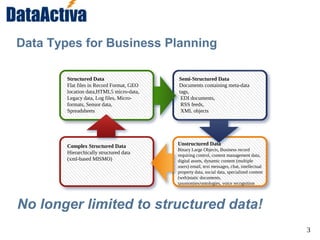
Data Types for Business Planning
Structured Data
Flat files in Record Format, GEO
location data,HTML5 micro-data,
Legacy data, Log files, Micro-
formats, Sensor data,
Spreadsheets
Semi-Structured Data
Documents containing meta-data
tags,
EDI documents,
RSS feeds,
XML objects
Unstructured Data
Binary Large Objects, Business record
requiring control, content management data,
digital assets, dynamic content (multiple
users) email, text messages, chat, intellectual
property data, social data, specialized content
(web)static documents,
taxonomies/ontologies, voice recognition
Complex Structured Data
Hierarchically structured data
(xml-based MISMO)
No longer limited to structured data!
4
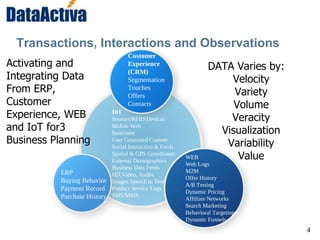
Transactions, Interactions and Observations
ERP
Buying Behavior
Payment Record
Purchase History
Customer
Experience
(CRM)
Segmentation
Touches
Offers
Contacts
WEB
Web Logs
M2M
Offer History
A/B Testing
Dynamic Pricing
Affiliate Networks
Search Marketing
Behavioral Targeting
Dynamic Funnels
DATA Varies by:
Velocity
Variety
Volume
Veracity
Visualization
Variability
Value
IoT
Sensors/RFID/Devices
Mobile Web
Sentiment
User Generated Content
Social Interaction & Feeds
Spatial & GPS Coordinates
External Demographics
Business Data Feeds
HD,Video, Audio,
Images Speech to Text
Product Service Logs
SMS/MMS
Activating and
Integrating Data
From ERP,
Customer
Experience, WEB
and IoT for3
Business Planning
5
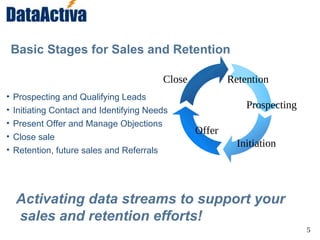
Basic Stages for Sales and Retention
• Prospecting and Qualifying Leads
• Initiating Contact and Identifying Needs
• Present Offer and Manage Objections
• Close sale
• Retention, future sales and Referrals
Activating data streams to support your
sales and retention efforts!
Prospecting
Initiation
Close Retention
Offer
6
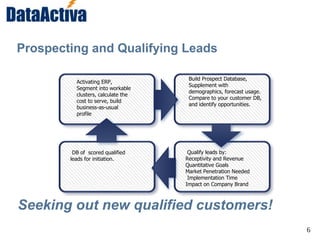
Prospecting and Qualifying Leads
Activating ERP,
Segment into workable
clusters, calculate the
cost to serve, build
business-as-usual
profile
Build Prospect Database,
Supplement with
demographics, forecast usage.
Compare to your customer DB,
and identify opportunities.
Qualify leads by:
Receptivity and Revenue
Quantitative Goals
Market Penetration Needed
Implementation Time
Impact on Company Brand
DB of scored qualified
leads for initiation.
Seeking out new qualified customers!
7
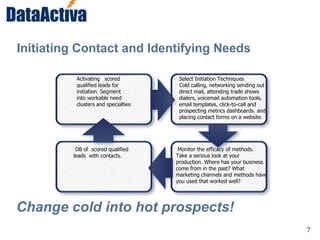
Initiating Contact and Identifying Needs
Activating scored
qualified leads for
initiation. Segment
into workable need
clusters and specialties
Select Initiation Techniques
Cold calling, networking sending out
direct mail, attending trade shows
dialers, voicemail automation tools,
email templates, click-to-call and
prospecting metrics dashboards. and
placing contact forms on a website.
Monitor the efficacy of methods.
Take a serious look at your
production. Where has your business
come from in the past? What
marketing channels and methods have
you used that worked well?
DB of scored qualified
leads with contacts.
Change cold into hot prospects!
8
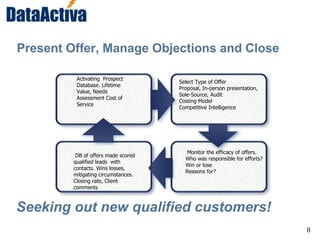
Present Offer, Manage Objections and Close
Activating Prospect
Database. Lifetime
Value, Needs
Assessment Cost of
Service
Select Type of Offer
Proposal, In-person presentation,
Sole-Source, Audit
Costing Model
Competitive Intelligence
Monitor the efficacy of offers.
Who was responsible for efforts?
Win or lose
Reasons for?
DB of offers made scored
qualified leads with
contacts. Wins losses,
mitigating circumstances.
Closing rate, Client
comments
Seeking out new qualified customers!
9
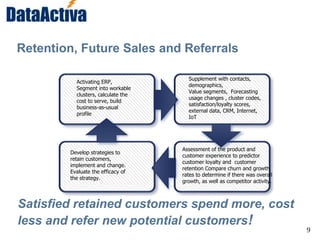
Retention, Future Sales and Referrals
Activating ERP,
Segment into workable
clusters, calculate the
cost to serve, build
business-as-usual
profile
Supplement with contacts,
demographics,
Value segments, Forecasting
usage changes , cluster codes,
satisfaction/loyalty scores,
external data, CRM, Internet,
IoT
Assessment of the product and
customer experience to predictor
customer loyalty and customer
retention Compare churn and growth
rates to determine if there was overall
growth, as well as competitor activity.
Develop strategies to
retain customers,
implement and change.
Evaluate the efficacy of
the strategy.
Satisfied retained customers spend more, cost
less and refer new potential customers!
10
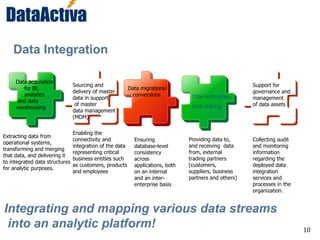
Data Integration
Data acquisition
for BI,
analytics
and data
warehousing
Sourcing and
delivery of master
data in support
of master
data management
(MDM)
Data migrations/
conversions Inter-enterprise
data sharing
Support for
governance and
management
of data assets
Extracting data from
operational systems,
transforming and merging
that data, and delivering it
to integrated data structures
for analytic purposes.
Enabling the
connectivity and
integration of the data
representing critical
business entities such
as customers, products
and employees
Ensuring
database-level
consistency
across
applications, both
on an internal
and an inter-
enterprise basis
Providing data to,
and receiving data
from, external
trading partners
(customers,
suppliers, business
partners and others)
Collecting audit
and monitoring
information
regarding the
deployed data
integration
services and
processes in the
organization.
Integrating and mapping various data streams
into an analytic platform!
11
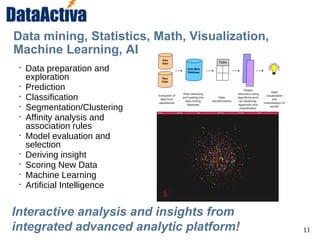
Data mining, Statistics, Math, Visualization,
Machine Learning, AI
§
Data preparation and
exploration
§
Prediction
§
Classification
§
Segmentation/Clustering
§
Affinity analysis and
association rules
§
Model evaluation and
selection
§
Deriving insight
§
Scoring New Data
§
Machine Learning
§
Artificial Intelligence
Interactive analysis and insights from
integrated advanced analytic platform!
12
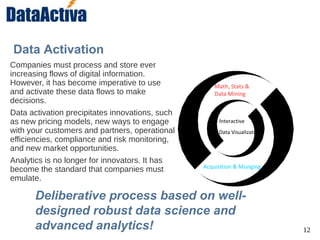
Data Activation
Companies must process and store ever
increasing flows of digital information.
However, it has become imperative to use
and activate these data flows to make
decisions.
Data activation precipitates innovations, such
as new pricing models, new ways to engage
with your customers and partners, operational
efficiencies, compliance and risk monitoring,
and new market opportunities.
Analytics is no longer for innovators. It has
become the standard that companies must
emulate.
Acquisition & Munging
Math, Stats &
Data Mining
Interactive
Data Visualization
Deliberative process based on well-
designed robust data science and
advanced analytics!
13
Thanks!
Dr. Steven Cosgrove
DataActiva UG
Walpodenstraße 4
55116 Mainz
49 (0) 151 5290 9769 (mob)
49 (0) 6131 9719 599 (tel)
dataactiva.com
stevencosgrove@dataactiva.com

Sales process data activation

  • 1.
    © 2016 DataActiva. All rights reserved. This document contains highly confidential information and is the sole property of DataActiva. No part of it may be circulated, quoted, copied or otherwise reproduced without the written approval of DataActiva. Activating Data To Support and Direct A Sales and Retention Process DataActiva’s Approach to Data-Driven Business Processes DataActiva.com
  • 2.
    2 Overview Data activation initiativesare being launched in many companies worldwide, as managers, administrators, and analysts learn to activate and link various streams of structured (relational databases spreadsheets and even XML files) and unstructured data (word processing documents, PDF files, e-mail messages, blogs, Web pages, video, pictures and social sites) into actionable analytics, reports, and mobile applications for everyone in the organization. While the advantages of data activation are well documented, they should be seen as part of a deliberative process, whose success depends on technology platforms(Business Intelligence (BI) and Analytics), management buy-in, as well as well-designed robust analytics. Our company, DataActiva, activates streams of structured and unstructured data in order to optimize data-driven decision making. At DataActiva we consider data activation to be a tremendous opportunity to enhance and even transform how you run your business. In this presentation we focus on retention and sales. Improve cost-effectiveness, customer relationships, and operating environment!
  • 3.
    3 Data Types forBusiness Planning Structured Data Flat files in Record Format, GEO location data,HTML5 micro-data, Legacy data, Log files, Micro- formats, Sensor data, Spreadsheets Semi-Structured Data Documents containing meta-data tags, EDI documents, RSS feeds, XML objects Unstructured Data Binary Large Objects, Business record requiring control, content management data, digital assets, dynamic content (multiple users) email, text messages, chat, intellectual property data, social data, specialized content (web)static documents, taxonomies/ontologies, voice recognition Complex Structured Data Hierarchically structured data (xml-based MISMO) No longer limited to structured data!
  • 4.
    4 Transactions, Interactions andObservations ERP Buying Behavior Payment Record Purchase History Customer Experience (CRM) Segmentation Touches Offers Contacts WEB Web Logs M2M Offer History A/B Testing Dynamic Pricing Affiliate Networks Search Marketing Behavioral Targeting Dynamic Funnels DATA Varies by: Velocity Variety Volume Veracity Visualization Variability Value IoT Sensors/RFID/Devices Mobile Web Sentiment User Generated Content Social Interaction & Feeds Spatial & GPS Coordinates External Demographics Business Data Feeds HD,Video, Audio, Images Speech to Text Product Service Logs SMS/MMS Activating and Integrating Data From ERP, Customer Experience, WEB and IoT for3 Business Planning
  • 5.
    5 Basic Stages forSales and Retention • Prospecting and Qualifying Leads • Initiating Contact and Identifying Needs • Present Offer and Manage Objections • Close sale • Retention, future sales and Referrals Activating data streams to support your sales and retention efforts! Prospecting Initiation Close Retention Offer
  • 6.
    6 Prospecting and QualifyingLeads Activating ERP, Segment into workable clusters, calculate the cost to serve, build business-as-usual profile Build Prospect Database, Supplement with demographics, forecast usage. Compare to your customer DB, and identify opportunities. Qualify leads by: Receptivity and Revenue Quantitative Goals Market Penetration Needed Implementation Time Impact on Company Brand DB of scored qualified leads for initiation. Seeking out new qualified customers!
  • 7.
    7 Initiating Contact andIdentifying Needs Activating scored qualified leads for initiation. Segment into workable need clusters and specialties Select Initiation Techniques Cold calling, networking sending out direct mail, attending trade shows dialers, voicemail automation tools, email templates, click-to-call and prospecting metrics dashboards. and placing contact forms on a website. Monitor the efficacy of methods. Take a serious look at your production. Where has your business come from in the past? What marketing channels and methods have you used that worked well? DB of scored qualified leads with contacts. Change cold into hot prospects!
  • 8.
    8 Present Offer, ManageObjections and Close Activating Prospect Database. Lifetime Value, Needs Assessment Cost of Service Select Type of Offer Proposal, In-person presentation, Sole-Source, Audit Costing Model Competitive Intelligence Monitor the efficacy of offers. Who was responsible for efforts? Win or lose Reasons for? DB of offers made scored qualified leads with contacts. Wins losses, mitigating circumstances. Closing rate, Client comments Seeking out new qualified customers!
  • 9.
    9 Retention, Future Salesand Referrals Activating ERP, Segment into workable clusters, calculate the cost to serve, build business-as-usual profile Supplement with contacts, demographics, Value segments, Forecasting usage changes , cluster codes, satisfaction/loyalty scores, external data, CRM, Internet, IoT Assessment of the product and customer experience to predictor customer loyalty and customer retention Compare churn and growth rates to determine if there was overall growth, as well as competitor activity. Develop strategies to retain customers, implement and change. Evaluate the efficacy of the strategy. Satisfied retained customers spend more, cost less and refer new potential customers!
  • 10.
    10 Data Integration Data acquisition forBI, analytics and data warehousing Sourcing and delivery of master data in support of master data management (MDM) Data migrations/ conversions Inter-enterprise data sharing Support for governance and management of data assets Extracting data from operational systems, transforming and merging that data, and delivering it to integrated data structures for analytic purposes. Enabling the connectivity and integration of the data representing critical business entities such as customers, products and employees Ensuring database-level consistency across applications, both on an internal and an inter- enterprise basis Providing data to, and receiving data from, external trading partners (customers, suppliers, business partners and others) Collecting audit and monitoring information regarding the deployed data integration services and processes in the organization. Integrating and mapping various data streams into an analytic platform!
  • 11.
    11 Data mining, Statistics,Math, Visualization, Machine Learning, AI § Data preparation and exploration § Prediction § Classification § Segmentation/Clustering § Affinity analysis and association rules § Model evaluation and selection § Deriving insight § Scoring New Data § Machine Learning § Artificial Intelligence Interactive analysis and insights from integrated advanced analytic platform!
  • 12.
    12 Data Activation Companies mustprocess and store ever increasing flows of digital information. However, it has become imperative to use and activate these data flows to make decisions. Data activation precipitates innovations, such as new pricing models, new ways to engage with your customers and partners, operational efficiencies, compliance and risk monitoring, and new market opportunities. Analytics is no longer for innovators. It has become the standard that companies must emulate. Acquisition & Munging Math, Stats & Data Mining Interactive Data Visualization Deliberative process based on well- designed robust data science and advanced analytics!
  • 13.
    13 Thanks! Dr. Steven Cosgrove DataActivaUG Walpodenstraße 4 55116 Mainz 49 (0) 151 5290 9769 (mob) 49 (0) 6131 9719 599 (tel) dataactiva.com stevencosgrove@dataactiva.com