Data Warehouses Data Mining Business Intelligence Applications
Outline Why needed? Data Base    Data Warehouse    Data Mining  == Knowledge Discovery in DB Data Warehouses: organization, structuring and presentation  of data, oriented to analyses. Data Cube DM: preprocessing DM: characterization and comparison DM: classification and forecasting Conclusion
Why needed? Necessity is the Mother of Invention Data explosion problem   Automated data collection tools and mature database technology lead to tremendous amounts of data stored in databases and other information repositories  We are drowning in data, but starving for knowledge !   Solution: Data warehousing and data mining Data warehousing and  on-line analytical processing (OLAP) Extraction of  interesting knowledge  (rules, regularities,  patterns, constraints) from data in large databases
Why needed? Evolution of Database Technology 1960s: Data collection, database creation, IMS and network DBMS 1970s:  Relational data model, relational DBMS implementation 1980s:  RDBMS, advanced data models (extended-relational, OO, deductive, etc.) and application-oriented DBMS (spatial, scientific, engineering, etc.) 1990s —2000s :  Data warehousing and data mining, multimedia databases, and Web databases
What Is Data Mining? Data mining (knowledge discovery in databases):  Extraction of interesting  ( non-trivial,   implicit ,  previously unknown  and  potentially useful)   information or patterns from data in  large databases Knowledge discovery(mining) in databases (KDD), knowledge extraction, data/pattern analysis, data archeology, data dredging, information harvesting, business intelligence, etc. What is not data mining? Query processing.  Expert systems or statistical programs
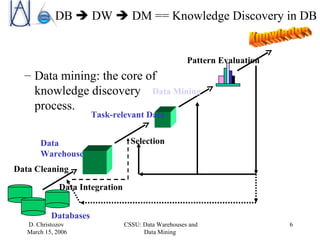
DB    DW    DM == Knowledge Discovery in DB Data mining: the core of knowledge discovery process. Data Cleaning Data Integration Databases Data Warehouse Knowledge Task-relevant Data Selection Data Mining Pattern Evaluation
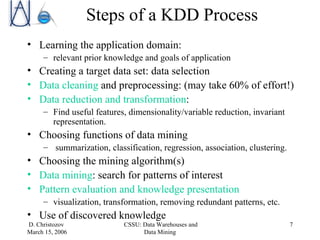
Steps of a KDD Process Learning the application domain: relevant prior knowledge and goals of application Creating a target data set: data selection Data cleaning  and preprocessing: (may take 60% of effort!) Data reduction and transformation : Find useful features, dimensionality/variable reduction, invariant representation. Choosing functions of data mining  summarization, classification, regression, association, clustering. Choosing the mining algorithm(s) Data mining : search for patterns of interest Pattern evaluation and knowledge presentation visualization, transformation, removing redundant patterns, etc. Use of discovered knowledge
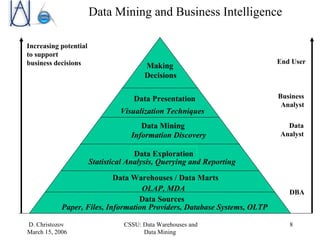
Data Mining and Business Intelligence Increasing potential to support business decisions End User Business Analyst Data Analyst DBA Making Decisions Data Presentation Visualization Techniques Data Mining Information Discovery Data Exploration OLAP, MDA Statistical Analysis, Querying and Reporting Data Warehouses / Data Marts Data Sources Paper, Files, Information Providers, Database Systems, OLTP
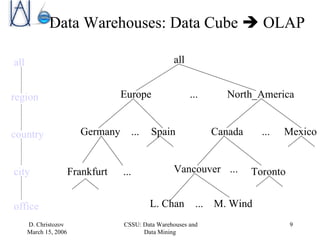
Data Warehouses: Data Cube    OLAP  all Europe North_America Mexico Canada Spain Germany Vancouver M. Wind L. Chan ... ... ... ... ... ... all region office country Toronto Frankfurt city
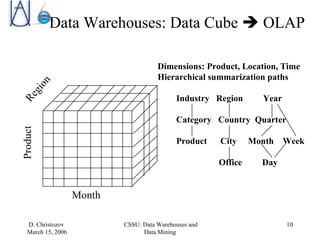
Data Warehouses: Data Cube    OLAP  Product Region Month Dimensions: Product, Location, Time Hierarchical summarization paths Industry  Region  Year Category  Country  Quarter Product  City  Month  Week Office  Day
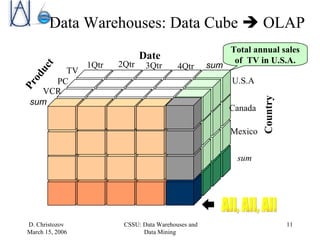
Data Warehouses: Data Cube    OLAP  Total annual sales of  TV in U.S.A. Date Product Country All, All, All sum sum TV VCR PC 1Qtr 2Qtr 3Qtr 4Qtr U.S.A Canada Mexico sum
Concept description: Characterization and discrimination Generalize, summarize, and contrast data characteristics, e.g., dry vs. wet regions Association  ( correlation and causality) Multi-dimensional vs. single-dimensional association  age(X, “20..29”) ^ income(X, “20..29K”)    buys(X, “PC”) [support = 2%, confidence = 60%] contains(T, “computer”)    contains(x, “software”) [1%, 75%] Data Mining Functionalities (1)
Data Mining Functionalities (2) Classification and Prediction   Finding models (functions) that describe and distinguish classes or concepts for future prediction E.g., classify countries based on climate, or classify cars based on gas mileage Presentation: decision-tree, classification rule, neural network Prediction: Predict some unknown or missing numerical values  Cluster analysis Class label is unknown: Group data to form new classes, e.g., cluster houses to find distribution patterns Clustering based on the principle: maximizing the intra-class similarity and minimizing the interclass similarity
Outlier analysis Outlier: a data object that does not comply with the general behavior of the data It can be considered as noise or exception but is quite useful in fraud detection, rare events analysis Trend and evolution analysis Trend and deviation:  regression analysis Sequential pattern mining, periodicity analysis Similarity-based analysis Other pattern-directed or statistical analyses Data Mining Functionalities (3)
Are All the “Discovered” Patterns Interesting? A data mining system/query may generate thousands of patterns, not all of them are interesting. Suggested approach: Human-centered, query-based, focused mining Interestingness measures : A pattern is  interesting  if it is  easily understood  by humans,  valid on new or test data  with some degree of certainty,  potentially useful ,  novel, or validates some hypothesis  that a user seeks to confirm  Objective vs. subjective interestingness measures: Objective:  based on statistics and structures of patterns, e.g., support, confidence, etc. Subjective:  based on user’s belief in the data, e.g., unexpectedness, novelty, actionability, etc.
Can We Find All and Only Interesting Patterns? Find all the interesting patterns: Completeness Can a data mining system find  all  the interesting patterns? Association vs. classification vs. clustering Search for only interesting patterns: Optimization Can a data mining system find  only  the interesting patterns? Approaches First general all the patterns and then filter out the uninteresting ones. Generate only the interesting patterns — mining query optimization
Data Preprocessing Why Data Preprocessing? Data in the real world is dirty incomplete:  lacking attribute values, lacking certain attributes of interest, or containing only aggregate data noisy:  containing errors or outliers inconsistent:  containing discrepancies in codes or names No quality data, no quality mining results! Quality decisions must be based on quality data Data warehouse needs consistent integration of quality data
Major Tasks in Data Preprocessing Data cleaning Fill in missing values, smooth noisy data, identify or remove outliers, and resolve inconsistencies Data integration Integration of multiple databases, data cubes, or files Data transformation Normalization and aggregation Data reduction Obtains reduced representation in volume but produces the same or similar analytical results Data discretization Part of data reduction but with particular importance, especially for numerical data
Data Cleaning Data cleaning tasks Fill in missing values Identify outliers and smooth out noisy data  Correct inconsistent data
How to Handle Missing Data? Ignore the tuple:  usually done when class label is missing (assuming the tasks in classification — not effective when the percentage of missing values per attribute varies considerably. Fill in the missing value manually: tedious + infeasible? Use a global constant to fill in the missing value: e.g., “unknown”, a new class?!  Use the attribute mean to fill in the missing value Use the attribute mean for all samples belonging to the same class to fill in the missing value: smarter Forecast the missing value : use the most probable value Vs. use of the value with less impact on the further analysis
How to Handle Noisy Data? Binning method: first sort data and partition into (equi-depth) bins then one can  smooth by bin means,  smooth by bin median, smooth by bin boundaries , etc. Clustering detect and remove outliers Combined computer and human inspection detect suspicious values and check by human Regression smooth by fitting the data into regression functions
Data Integration Data integration:  combines data from multiple sources into a coherent store Schema integration integrate metadata from different sources Entity identification problem: identify real world entities from multiple data sources, e.g., A.cust-id    B.cust-# Detecting and resolving data value conflicts for the same real world entity, attribute values from different sources are different possible reasons: different representations, different scales, e.g., metric vs. British units
Data Transformation Smoothing: remove noise from data Data reduction - aggregation: summarization, data cube Generalization: concept hierarchy climbing Normalization: scaled to fall within a small, specified range dimensions  Scales: nominal, order and interval scales min-max normalization z-score normalization normalization by decimal scaling Attribute/feature construction New attributes constructed from the given ones
Data Reduction Strategies Warehouse may store terabytes of data: Complex data analysis/mining may take a very long time to run on the complete data set Data reduction  Obtains a reduced representation of the data set that is much smaller in volume but yet produces the same (or almost the same) analytical results Data reduction strategies Data cube aggregation Dimensionality reduction Numerosity reduction Discretization and concept hierarchy generation
Mining Association Rules in Large Databases Association rule mining Mining single-dimensional Boolean association rules from transactional databases Mining multilevel association rules from transactional databases Mining multidimensional association rules from transactional databases and data warehouse From association mining to correlation analysis Constraint-based association mining
What Is Association Mining? Association rule mining: Finding frequent patterns, associations, correlations, or causal structures among sets of items or objects in transaction databases, relational databases, and other information repositories. Applications: Basket data analysis, cross-marketing, catalog design, loss-leader analysis, clustering, classification, etc. Examples.  Rule form:  “ Body      ead [support, confidence]”. buys(x, “diapers”)    buys(x, “beers”) [0.5%, 60%] major(x, “CS”) ^ takes(x, “DB”)   grade(x, “A”) [1%, 75%]
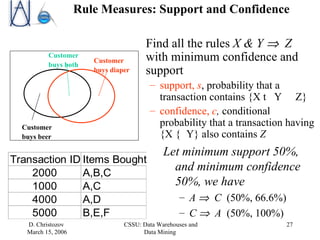
Rule Measures: Support and Confidence Find all the rules  X & Y     Z  with minimum confidence and support support,  s ,  probability  that a transaction contains {X    Y    Z} confidence,  c ,   conditional probability  that a transaction having {X    Y} also contains  Z Let minimum support 50%, and minimum confidence 50%, we have A     C  (50%, 66.6%) C     A  (50%, 100%) Customer buys diaper Customer buys both Customer buys beer
Association Rule Mining Boolean vs. quantitative  associations  buys(x, “SQLServer”) ^ buys(x, “DMBook”)   buys(x, “DBMiner”) [0.2%, 60%] age(x, “30..39”) ^ income(x, “42..48K”)   buys(x, “PC”) [1%, 75%] Single dimension vs. multiple dimensional  associations   Single level vs. multiple-level  analysis What brands of beers are associated with what brands of diapers? Various extensions Correlation, causality analysis Association does not necessarily imply correlation or causality Constraints enforced E.g., small sales (sum < 100) trigger big buys (sum > 1,000)?
Concept Description: Characterization and Comparison Concept description:   Characterization :  provides a concise and succinct summarization of the given collection of data Comparison :  provides descriptions comparing two or more collections of data
Classification and Prediction Classification:  predicts categorical class labels classifies data (constructs a model) based on the training set and the values ( class labels ) in a classifying attribute and uses it in classifying new data Prediction:  models continuous-valued functions, i.e., predicts unknown or missing values
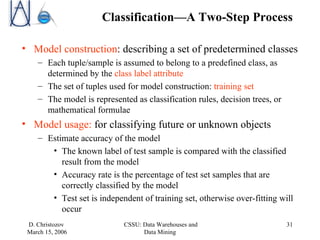
Classification—A Two-Step Process Model construction : describing a set of predetermined classes Each tuple/sample is assumed to belong to a predefined class, as determined by the  class label attribute The set of tuples used for model construction:  training set The model is represented as classification rules, decision trees, or mathematical formulae Model usage:  for classifying future or unknown objects Estimate accuracy of the model The known label of test sample is compared with the classified result from the model Accuracy rate is the percentage of test set samples that are correctly classified by the model Test set is independent of training set, otherwise over-fitting will occur
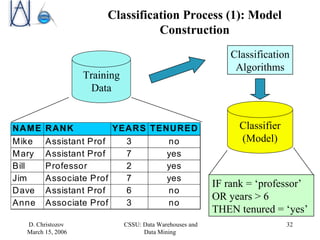
Classification Process (1): Model Construction Training Data Classification Algorithms IF rank = ‘professor’ OR years > 6 THEN tenured = ‘yes’  Classifier (Model)
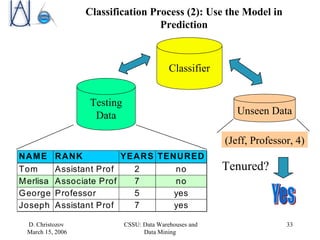
Classification Process (2): Use the Model in Prediction Classifier Testing Data Unseen Data (Jeff, Professor, 4) Tenured?
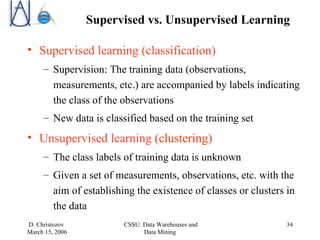
Supervised vs. Unsupervised Learning Supervised learning (classification) Supervision: The training data (observations, measurements, etc.) are accompanied by labels indicating the class of the observations New data is classified based on the training set Unsupervised learning   (clustering) The class labels of training data is unknown Given a set of measurements, observations, etc. with the aim of establishing the existence of classes or clusters in the data
Q and A Thank you !!!

Cssu dw dm

  • 1.
    Data Warehouses DataMining Business Intelligence Applications
  • 2.
    Outline Why needed?Data Base  Data Warehouse  Data Mining == Knowledge Discovery in DB Data Warehouses: organization, structuring and presentation of data, oriented to analyses. Data Cube DM: preprocessing DM: characterization and comparison DM: classification and forecasting Conclusion
  • 3.
    Why needed? Necessityis the Mother of Invention Data explosion problem Automated data collection tools and mature database technology lead to tremendous amounts of data stored in databases and other information repositories We are drowning in data, but starving for knowledge ! Solution: Data warehousing and data mining Data warehousing and on-line analytical processing (OLAP) Extraction of interesting knowledge (rules, regularities, patterns, constraints) from data in large databases
  • 4.
    Why needed? Evolutionof Database Technology 1960s: Data collection, database creation, IMS and network DBMS 1970s: Relational data model, relational DBMS implementation 1980s: RDBMS, advanced data models (extended-relational, OO, deductive, etc.) and application-oriented DBMS (spatial, scientific, engineering, etc.) 1990s —2000s : Data warehousing and data mining, multimedia databases, and Web databases
  • 5.
    What Is DataMining? Data mining (knowledge discovery in databases): Extraction of interesting ( non-trivial, implicit , previously unknown and potentially useful) information or patterns from data in large databases Knowledge discovery(mining) in databases (KDD), knowledge extraction, data/pattern analysis, data archeology, data dredging, information harvesting, business intelligence, etc. What is not data mining? Query processing. Expert systems or statistical programs
  • 6.
    DB  DW  DM == Knowledge Discovery in DB Data mining: the core of knowledge discovery process. Data Cleaning Data Integration Databases Data Warehouse Knowledge Task-relevant Data Selection Data Mining Pattern Evaluation
  • 7.
    Steps of aKDD Process Learning the application domain: relevant prior knowledge and goals of application Creating a target data set: data selection Data cleaning and preprocessing: (may take 60% of effort!) Data reduction and transformation : Find useful features, dimensionality/variable reduction, invariant representation. Choosing functions of data mining summarization, classification, regression, association, clustering. Choosing the mining algorithm(s) Data mining : search for patterns of interest Pattern evaluation and knowledge presentation visualization, transformation, removing redundant patterns, etc. Use of discovered knowledge
  • 8.
    Data Mining andBusiness Intelligence Increasing potential to support business decisions End User Business Analyst Data Analyst DBA Making Decisions Data Presentation Visualization Techniques Data Mining Information Discovery Data Exploration OLAP, MDA Statistical Analysis, Querying and Reporting Data Warehouses / Data Marts Data Sources Paper, Files, Information Providers, Database Systems, OLTP
  • 9.
    Data Warehouses: DataCube  OLAP all Europe North_America Mexico Canada Spain Germany Vancouver M. Wind L. Chan ... ... ... ... ... ... all region office country Toronto Frankfurt city
  • 10.
    Data Warehouses: DataCube  OLAP Product Region Month Dimensions: Product, Location, Time Hierarchical summarization paths Industry Region Year Category Country Quarter Product City Month Week Office Day
  • 11.
    Data Warehouses: DataCube  OLAP Total annual sales of TV in U.S.A. Date Product Country All, All, All sum sum TV VCR PC 1Qtr 2Qtr 3Qtr 4Qtr U.S.A Canada Mexico sum
  • 12.
    Concept description: Characterizationand discrimination Generalize, summarize, and contrast data characteristics, e.g., dry vs. wet regions Association ( correlation and causality) Multi-dimensional vs. single-dimensional association age(X, “20..29”) ^ income(X, “20..29K”)  buys(X, “PC”) [support = 2%, confidence = 60%] contains(T, “computer”)  contains(x, “software”) [1%, 75%] Data Mining Functionalities (1)
  • 13.
    Data Mining Functionalities(2) Classification and Prediction Finding models (functions) that describe and distinguish classes or concepts for future prediction E.g., classify countries based on climate, or classify cars based on gas mileage Presentation: decision-tree, classification rule, neural network Prediction: Predict some unknown or missing numerical values Cluster analysis Class label is unknown: Group data to form new classes, e.g., cluster houses to find distribution patterns Clustering based on the principle: maximizing the intra-class similarity and minimizing the interclass similarity
  • 14.
    Outlier analysis Outlier:a data object that does not comply with the general behavior of the data It can be considered as noise or exception but is quite useful in fraud detection, rare events analysis Trend and evolution analysis Trend and deviation: regression analysis Sequential pattern mining, periodicity analysis Similarity-based analysis Other pattern-directed or statistical analyses Data Mining Functionalities (3)
  • 15.
    Are All the“Discovered” Patterns Interesting? A data mining system/query may generate thousands of patterns, not all of them are interesting. Suggested approach: Human-centered, query-based, focused mining Interestingness measures : A pattern is interesting if it is easily understood by humans, valid on new or test data with some degree of certainty, potentially useful , novel, or validates some hypothesis that a user seeks to confirm Objective vs. subjective interestingness measures: Objective: based on statistics and structures of patterns, e.g., support, confidence, etc. Subjective: based on user’s belief in the data, e.g., unexpectedness, novelty, actionability, etc.
  • 16.
    Can We FindAll and Only Interesting Patterns? Find all the interesting patterns: Completeness Can a data mining system find all the interesting patterns? Association vs. classification vs. clustering Search for only interesting patterns: Optimization Can a data mining system find only the interesting patterns? Approaches First general all the patterns and then filter out the uninteresting ones. Generate only the interesting patterns — mining query optimization
  • 17.
    Data Preprocessing WhyData Preprocessing? Data in the real world is dirty incomplete: lacking attribute values, lacking certain attributes of interest, or containing only aggregate data noisy: containing errors or outliers inconsistent: containing discrepancies in codes or names No quality data, no quality mining results! Quality decisions must be based on quality data Data warehouse needs consistent integration of quality data
  • 18.
    Major Tasks inData Preprocessing Data cleaning Fill in missing values, smooth noisy data, identify or remove outliers, and resolve inconsistencies Data integration Integration of multiple databases, data cubes, or files Data transformation Normalization and aggregation Data reduction Obtains reduced representation in volume but produces the same or similar analytical results Data discretization Part of data reduction but with particular importance, especially for numerical data
  • 19.
    Data Cleaning Datacleaning tasks Fill in missing values Identify outliers and smooth out noisy data Correct inconsistent data
  • 20.
    How to HandleMissing Data? Ignore the tuple: usually done when class label is missing (assuming the tasks in classification — not effective when the percentage of missing values per attribute varies considerably. Fill in the missing value manually: tedious + infeasible? Use a global constant to fill in the missing value: e.g., “unknown”, a new class?! Use the attribute mean to fill in the missing value Use the attribute mean for all samples belonging to the same class to fill in the missing value: smarter Forecast the missing value : use the most probable value Vs. use of the value with less impact on the further analysis
  • 21.
    How to HandleNoisy Data? Binning method: first sort data and partition into (equi-depth) bins then one can smooth by bin means, smooth by bin median, smooth by bin boundaries , etc. Clustering detect and remove outliers Combined computer and human inspection detect suspicious values and check by human Regression smooth by fitting the data into regression functions
  • 22.
    Data Integration Dataintegration: combines data from multiple sources into a coherent store Schema integration integrate metadata from different sources Entity identification problem: identify real world entities from multiple data sources, e.g., A.cust-id  B.cust-# Detecting and resolving data value conflicts for the same real world entity, attribute values from different sources are different possible reasons: different representations, different scales, e.g., metric vs. British units
  • 23.
    Data Transformation Smoothing:remove noise from data Data reduction - aggregation: summarization, data cube Generalization: concept hierarchy climbing Normalization: scaled to fall within a small, specified range dimensions Scales: nominal, order and interval scales min-max normalization z-score normalization normalization by decimal scaling Attribute/feature construction New attributes constructed from the given ones
  • 24.
    Data Reduction StrategiesWarehouse may store terabytes of data: Complex data analysis/mining may take a very long time to run on the complete data set Data reduction Obtains a reduced representation of the data set that is much smaller in volume but yet produces the same (or almost the same) analytical results Data reduction strategies Data cube aggregation Dimensionality reduction Numerosity reduction Discretization and concept hierarchy generation
  • 25.
    Mining Association Rulesin Large Databases Association rule mining Mining single-dimensional Boolean association rules from transactional databases Mining multilevel association rules from transactional databases Mining multidimensional association rules from transactional databases and data warehouse From association mining to correlation analysis Constraint-based association mining
  • 26.
    What Is AssociationMining? Association rule mining: Finding frequent patterns, associations, correlations, or causal structures among sets of items or objects in transaction databases, relational databases, and other information repositories. Applications: Basket data analysis, cross-marketing, catalog design, loss-leader analysis, clustering, classification, etc. Examples. Rule form: “ Body   ead [support, confidence]”. buys(x, “diapers”)  buys(x, “beers”) [0.5%, 60%] major(x, “CS”) ^ takes(x, “DB”)  grade(x, “A”) [1%, 75%]
  • 27.
    Rule Measures: Supportand Confidence Find all the rules X & Y  Z with minimum confidence and support support, s , probability that a transaction contains {X  Y  Z} confidence, c , conditional probability that a transaction having {X  Y} also contains Z Let minimum support 50%, and minimum confidence 50%, we have A  C (50%, 66.6%) C  A (50%, 100%) Customer buys diaper Customer buys both Customer buys beer
  • 28.
    Association Rule MiningBoolean vs. quantitative associations buys(x, “SQLServer”) ^ buys(x, “DMBook”)  buys(x, “DBMiner”) [0.2%, 60%] age(x, “30..39”) ^ income(x, “42..48K”)  buys(x, “PC”) [1%, 75%] Single dimension vs. multiple dimensional associations Single level vs. multiple-level analysis What brands of beers are associated with what brands of diapers? Various extensions Correlation, causality analysis Association does not necessarily imply correlation or causality Constraints enforced E.g., small sales (sum < 100) trigger big buys (sum > 1,000)?
  • 29.
    Concept Description: Characterizationand Comparison Concept description: Characterization : provides a concise and succinct summarization of the given collection of data Comparison : provides descriptions comparing two or more collections of data
  • 30.
    Classification and PredictionClassification: predicts categorical class labels classifies data (constructs a model) based on the training set and the values ( class labels ) in a classifying attribute and uses it in classifying new data Prediction: models continuous-valued functions, i.e., predicts unknown or missing values
  • 31.
    Classification—A Two-Step ProcessModel construction : describing a set of predetermined classes Each tuple/sample is assumed to belong to a predefined class, as determined by the class label attribute The set of tuples used for model construction: training set The model is represented as classification rules, decision trees, or mathematical formulae Model usage: for classifying future or unknown objects Estimate accuracy of the model The known label of test sample is compared with the classified result from the model Accuracy rate is the percentage of test set samples that are correctly classified by the model Test set is independent of training set, otherwise over-fitting will occur
  • 32.
    Classification Process (1):Model Construction Training Data Classification Algorithms IF rank = ‘professor’ OR years > 6 THEN tenured = ‘yes’ Classifier (Model)
  • 33.
    Classification Process (2):Use the Model in Prediction Classifier Testing Data Unseen Data (Jeff, Professor, 4) Tenured?
  • 34.
    Supervised vs. UnsupervisedLearning Supervised learning (classification) Supervision: The training data (observations, measurements, etc.) are accompanied by labels indicating the class of the observations New data is classified based on the training set Unsupervised learning (clustering) The class labels of training data is unknown Given a set of measurements, observations, etc. with the aim of establishing the existence of classes or clusters in the data
  • 35.
    Q and AThank you !!!